
MEC-210 · Lesson 11 of 12 · 25 min
Energy and momentum methods for rigid bodies
Lessons 5 and 6 showed that work-energy and impulse-momentum often solve particle problems faster than Newton's second law, especially when forces depend on position or act briefly. The same is true for rigid bodies. A flywheel's speed after a punch stroke, the speed of a roll at the bottom of a ramp, the motor size needed for a fan, the speed after a clutch engages and the motion of a gate struck by a parcel are all neatest with energy or momentum. This lesson extends both principles to rigid bodies in plane motion. The only genuinely new ingredients are the kinetic energy of rotation and the angular momentum of a rigid body, both governed by the moment of inertia from Lesson 10.
Kinetic energy of a rigid body
Adding up \(\tfrac12 v^2\,dm\) over all the particles of a rigid body in plane motion gives
The first term is the kinetic energy of translation with the centre of mass, the second the kinetic energy of rotation about it. Two special cases follow. For pure translation, \(\omega = 0\) and \(T = \tfrac12 m v^2\). For rotation about a fixed axis through \(O\), \(v_G = \omega r_G\) and the parallel-axis theorem combine into \(T = \tfrac12 I_O\omega^2\). For a body rolling without slipping, the contact point is the instantaneous centre and \(T = \tfrac12 I_{IC}\,\omega^2\) also works, with \(I_{IC}\) taken about the contact point.
Rotational kinetic energy can be large. A steel flywheel of 0.5 m radius and 200 kg, spinning at 1,500 rev/min, stores about \(\tfrac12(\tfrac12 \cdot 200 \cdot 0.5^2)(157)^2 = 308 \text{ kJ}\), about the kinetic energy of a 1,500 kg car travelling at 70 km/h. That is why flywheels can smooth the uneven torque of punch presses and engines, store energy in some uninterruptible power supplies, and why their failure is so dangerous that they are built inside containment.
Work of forces and couples
The work of a force on a rigid body is computed exactly as for a particle, using the displacement of the point where the force acts. A couple of moment \(M\) acting on a body that turns through an angle \(d\theta\) does work \(M\,d\theta\); over a finite rotation, \(U = \int M\,d\theta\), which is \(M\Delta\theta\) for a constant couple. A motor torque, a brake torque and the torque of a torsion spring are all handled this way.
Several forces do no work on a rigid body, and recognizing them saves effort: forces at fixed pivots (the point does not move), the normal force and static friction at the contact of a wheel rolling without slipping (the contact point has zero velocity), and internal forces between the particles of the body (they keep fixed distances). Rolling without slipping is therefore an energy-conserving motion if the surfaces are rigid. Real tyres and rollers deform and lose some energy in rolling resistance, which is handled as a small resisting force or moment.
The principle of work and energy
The principle carries over unchanged: \(T_1 + \sum U_{1 \to 2} = T_2\), or, splitting off conservative forces into potential energy, \(T_1 + V_1 + U^{nc}_{1 \to 2} = T_2 + V_2\). For a system of connected rigid bodies, such as a drum, a belt and a load, write one energy equation for the whole system: internal pin forces and the tension in an inextensible belt that does not slip do no net work and drop out. Kinematic relations then express every body's speed in terms of one variable.
Worked problem
A roll of film at the bottom of a ramp
The 15 kg roll of stretch film of Lesson 10, a solid cylinder, is released from rest and rolls without slipping 2.0 m down the ramp inclined at 10°. How fast is it moving at the bottom?
Show solution
- Drop in height: \(h = 2.0\sin 10^\circ = 0.347 \text{ m}\). The normal force and static friction do no work, so energy is conserved.
- Kinetic energy at the bottom, with \(\omega = v/r\) and \(I_G = \tfrac12 m r^2\): \(T_2 = \tfrac12 m v^2 + \tfrac12(\tfrac12 m r^2)(v/r)^2 = \tfrac34 m v^2\).
- \[mgh = \tfrac34 m v^2 \;\Rightarrow\; v = \sqrt{\tfrac43 g h} = \sqrt{\tfrac43(9.81)(0.347)} = 2.13 \text{ m/s}\]
Answer: The roll reaches 2.13 m/s. Neither its mass nor its radius matters, only the shape factor in \(I_G = c\,m r^2\). The result agrees with Lesson 10's acceleration of 1.14 m/s² over 2.0 m, with far less work.
Writing \(I_G = c\,m r^2\) for any rolling body gives \(v = \sqrt{2gh/(1 + c)}\). The program below races five bodies down the same ramp. They finish in order of how little of their energy goes into spinning: the sliding block first, then the sphere, the solid cylinder, the thick tube and finally the hoop, which puts exactly half its energy into rotation.
# Race down a 10 degree ramp, 2.0 m long, from rest. Rolling bodies share
# their energy between translation and rotation: with I_G = c m r^2,
#   m g h = (1/2) m v^2 + (1/2) c m r^2 (v/r)^2  ->  v = sqrt(2 g h / (1 + c))
# The acceleration is constant, so t = 2 L / v.
import math

g, L, theta = 9.81, 2.0, math.radians(10)
h = L * math.sin(theta)
bodies = [
    ("frictionless sliding block", 0.0),
    ("solid sphere", 2 / 5),
    ("solid cylinder (film roll)", 1 / 2),
    ("thick tube, r_in = r_out/2", (1 + 0.25) / 2),
    ("thin hoop", 1.0),
]
print(f"drop height {h:.4f} m")
for name, c in bodies:
    v = math.sqrt(2 * g * h / (1 + c))
    t = 2 * L / v
    share = c / (1 + c) * 100
print(f"{name:28s} v = {v:5.3f} m/s t = {t:5.3f} s rotation takes {share:4.1f}% of the energy")drop height 0.3473 m frictionless sliding block v = 2.610 m/s t = 1.532 s rotation takes 0.0% of the energy solid sphere v = 2.206 m/s t = 1.813 s rotation takes 28.6% of the energy solid cylinder (film roll) v = 2.131 m/s t = 1.877 s rotation takes 33.3% of the energy thick tube, r_in = r_out/2 v = 2.048 m/s t = 1.953 s rotation takes 38.5% of the energy thin hoop v = 1.846 m/s t = 2.167 s rotation takes 50.0% of the energy
The same reasoning applies to machines that roll their loads: a carton on a roller conveyor must also spin up every roller it touches, and on a gravity roller line the rollers' inertia slows the carton's acceleration. Lightweight plastic rollers are chosen for gravity lines partly for this reason.
Power in rotating machinery
The power delivered by a torque \(M\) to a shaft turning at \(\omega\) is \(P = M\omega\), the rotational counterpart of \(P = Fv\). This one equation sizes nearly every motor and gearbox. A gearbox trades speed for torque: if it reduces speed by a ratio \(n\) with efficiency \(\varepsilon\), the output torque is \(\varepsilon n\) times the input torque, because the power out is \(\varepsilon\) times the power in.
Worked problem
Motor for the conveyor drum
The conveyor of Lesson 10 runs steadily with a drum torque of 80 N·m at a belt speed of 2.0 m/s on a 0.20 m radius drum. The drum is driven by a motor through a gearbox of efficiency 0.94. What power must the motor supply, and what torque must it deliver if it runs at 1,750 rev/min?
Show solution
- Drum speed: \(\omega = v/r = 2.0/0.20 = 10.0 \text{ rad/s}\). Power at the drum: \(P = M\omega = 80(10.0) = 800 \text{ W}\).
- Motor power: \(P_m = 800/0.94 = 851 \text{ W}\).
- Motor speed: \(1750(2\pi/60) = 183.3 \text{ rad/s}\). Motor torque: \(M_m = 851/183.3 = 4.64 \text{ N·m}\).
- The gear ratio is \(183.3/10.0 = 18.3\).
Answer: About 0.85 kW at the motor in steady running. During start-up, the drum torque rose to 149 N·m (Lesson 10), so the motor must deliver about 1.6 kW briefly, which most induction motors can do; the standard choice would be the next frame size above the steady demand, checked against the start-up peak.
Momentum of a rigid body
The linear momentum of a rigid body is \(\mathbf{L} = m\mathbf{v}_G\). Its angular momentum about the centre of mass, in plane motion, is \(H_G = I_G\,\omega\). About a fixed axis of rotation through \(O\), \(H_O = I_O\,\omega\). About any other point, the angular momentum is \(H_G\) plus the moment of \(m\mathbf{v}_G\) about that point, by analogy with the moment equation of Lesson 10.
The principles of linear and angular impulse and momentum become
with the angular equation also valid about a fixed axis using \(I_O\). They are especially useful when a torque acts for a known time, for example a brake stopping a drum, and for collisions and engagements in which the internal impulses are unknown.
Conservation of angular momentum
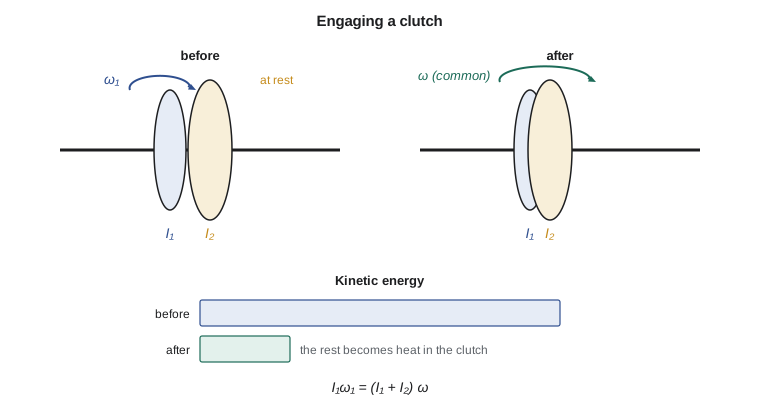
When the external angular impulse about an axis is zero or negligible, the total angular momentum of a system about that axis is conserved. The classic engineering case is a friction clutch or a coupling engaging two shafts. During the brief slip, the clutch faces exert equal and opposite torques on the two sides, which cancel for the system, so the combined angular momentum is the same before and after.
Worked problem
Engaging a clutch
In a test rig, a motor-driven flywheel with \(I_1 = 0.40 \text{ kg·m}^2\) spins at 150 rad/s. A friction clutch then engages it with a stationary shaft assembly of \(I_2 = 1.20 \text{ kg·m}^2\). Neglecting bearing friction and the motor's torque during the brief engagement, find the common speed and the energy dissipated in the clutch.
Show solution
- Angular momentum about the shaft axis is conserved: \(I_1\omega_1 + 0 = (I_1 + I_2)\,\omega\).
- \[\omega = \frac{0.40(150)}{1.60} = 37.5 \text{ rad/s}\]
- Kinetic energy before: \(\tfrac12(0.40)(150)^2 = 4500 \text{ J}\). After: \(\tfrac12(1.60)(37.5)^2 = 1125 \text{ J}\).
- Energy dissipated: \(3375 \text{ J}\), three-quarters of the original.
Answer: The shafts end up at 37.5 rad/s, and the clutch must absorb 3.4 kJ as heat in a fraction of a second. Clutch linings are sized by this energy per engagement and by how often engagements happen.
The fraction lost depends only on the inertia ratio: it equals \(I_2/(I_1 + I_2)\) when the second shaft starts at rest, just as in a perfectly plastic collision between particles. Engaging a light shaft onto a heavy flywheel loses little energy; engaging a heavy load onto a light motor loses most of it. Soft starters and variable-frequency drives exist partly to avoid these losses, by accelerating loads smoothly instead of slamming them onto a running motor.
Eccentric impact
When an impact force does not pass through a body's centre of mass, the body both translates and rotates after the impact. A parcel striking the end of a pivoted diverter gate, a hammer striking a nail, and a bat striking a ball are eccentric impacts. The method combines the coefficient of restitution along the line of impact, applied to the velocities of the two contact points, with conservation of angular momentum about a suitable point, usually the fixed pivot, where the unknown pivot impulse has no moment.
For a pivoted body there is one special point, the centre of percussion, located a distance \(k_O^2/r_G\) from the pivot, where \(k_O\) is the radius of gyration about the pivot and \(r_G\) the distance from the pivot to the centre of mass. A blow struck at this point produces no impulsive reaction at the pivot. For a uniform bar pivoted at one end, it lies two-thirds of the way along. Designers of swinging gates, hammers and impact testers place the striking point there to protect the pivot bearings, and batters feel it as the sweet spot of a bat.
Common mistakes
MistakeLeaving out rotational kinetic energy for rolling or spinning bodies.
InsteadT = ½mv_G² + ½I_Gω² for general plane motion.
MistakeCounting work done by static friction on a wheel that rolls without slipping.
InsteadThe contact point does not move, so that friction does no work.
MistakeAssuming energy is conserved when a clutch engages.
InsteadAngular momentum is conserved; energy is lost as heat in the clutch.
MistakeForgetting gearbox efficiency when relating motor and output torque.
InsteadOutput torque = efficiency x ratio x input torque.
MistakeTaking angular momentum about a point other than G or a fixed axis as Iω.
InsteadAdd the moment of m v_G about that point.
Summary and key terms
- T = ½mv_G² + ½I_Gω²; for fixed-axis rotation T = ½I_Oω².
- Couples do work Mθ; pivots and rolling contacts do no work.
- Rolling bodies reach v = sqrt(2gh/(1 + c)) with I_G = c m r².
- Power in rotation is P = Mω; gearboxes trade speed for torque with some loss.
- H_G = I_G ω; about a fixed axis, H_O = I_O ω.
- Clutch engagement conserves angular momentum and dissipates energy.
- A blow at the centre of percussion gives no impulsive pivot reaction.
- Rotational kinetic energy
- The kinetic energy ½I_Gω² associated with a body's rotation.
- Flywheel
- A rotor with large moment of inertia used to store kinetic energy.
- Work of a couple
- The integral of the couple moment over the angle turned.
- Angular momentum of a rigid body
- I_G ω about the centre of mass in plane motion.
- Friction clutch
- A device that connects two shafts through sliding friction surfaces.
- Eccentric impact
- An impact whose line of action does not pass through the centre of mass.
- Centre of percussion
- The point on a pivoted body where a blow causes no impulsive reaction at the pivot.
- Shape factor
- The constant c in I_G = c m r².
Practice problems
Work each problem on paper first, then reveal the answer to check.
A 50 kg solid disc of radius 0.4 m spins at 300 rev/min. What is its kinetic energy?
Show answer
I = 4.0 kg·m², ω = 31.4 rad/s, T = 1.97 kJ.
How fast would a hoop be going after rolling 2.0 m down the 10° ramp?
Show answer
v = sqrt(gh) = 1.85 m/s.
A motor delivers 5.0 kW at 1,450 rev/min. What torque does it supply?
Show answer
M = 5000/151.8 = 32.9 N·m.
In the clutch example, what common speed results if I₂ = 0.40 kg·m²?
Show answer
75 rad/s; half the energy is lost.
Where is the centre of percussion of a uniform 0.9 m gate arm pivoted at one end?
Show answer
At 0.6 m from the pivot.
In the program, add a body with c = 0.25. Where does it finish?
Show answer
Between the sliding block and the sphere.
Lesson quiz · 5 questions
Score 60% or more to complete this lesson.
Create a free account to save your progress, take quizzes and earn a certificate.