
PMP-110 · Lesson 10 of 12 · 31 min
The project team and leadership basics
Projects are delivered by people, and a third of the 2026 PMP exam sits in the People domain. This lesson introduces the people side of project management at a foundations level: the roles found on predictive and adaptive projects, how responsibilities are clarified, how teams develop over time, the basics of motivation and conflict, and the realities of distributed teams. PMP-120 (leadership and teams) and PMP-121 (stakeholders, conflict and communication) develop each of these topics in depth, so treat this lesson as the map before the territory.
Roles on a project
Role names vary by organization and approach, but certain responsibilities appear on almost every project. A person may hold more than one role, and on small projects one person may hold several.
| Role | Main responsibilities | Common in |
|---|---|---|
| Sponsor | Champions the project, provides funding, removes high-level obstacles, approves major changes, owns or supports the business case | All approaches |
| Project manager | Leads the team to achieve objectives, integrates work, manages stakeholders and governance requirements | Predictive and hybrid; sometimes adaptive |
| Project team members | Do the work of the project; in adaptive teams, self-organize to deliver increments | All approaches |
| Product owner | Represents customers, owns and orders the product backlog by value, accepts work | Adaptive |
| Team facilitator (for example a Scrum Master) | Coaches the team in its process, removes impediments, facilitates events | Adaptive |
| Functional manager | Manages a department and its staff; provides resources and technical oversight | Matrix and functional organizations |
| Subject matter expert | Provides specialist knowledge, often part-time | All approaches |
| PMO | Provides standards, support, oversight or direct management | Many organizations |
In Scrum, a widely used adaptive framework, there is no project manager role; the product owner, the Scrum Master and the developers share accountability. In practice, many organizations using Scrum still have project managers coordinating across teams, managing budgets and handling governance. Exam scenarios may place you in either situation, so read carefully: if you are described as a servant leader on an agile team, choose answers that enable the team to self-organize rather than assigning tasks yourself.
Clarifying responsibilities
Unclear responsibilities cause duplicated work, gaps and conflict. A responsibility assignment matrix (RAM) links work to people. The most common form is the RACI chart: Responsible (does the work), Accountable (owns the outcome and approves it; only one person per activity), Consulted (gives input before) and Informed (kept updated after).
| Activity | Sponsor | Project manager | Business analyst | Developer | Operations lead |
|---|---|---|---|---|---|
| Approve business case | A | C | C | I | C |
| Gather requirements | I | A | R | C | C |
| Build solution | I | A | C | R | I |
| Prepare operations handover | I | A | C | C | R |
| Accept final deliverable | A | R | C | I | C |
Worked problem
Checking a RACI chart
A RACI chart shows two people marked A for "approve test plan" and nobody marked R for "write user guide". What is wrong, and how should it be fixed?
Show solution
- Two As means accountability is split, so nobody truly owns the decision. Choose one accountable person.
- No R means nobody is doing the work. Assign someone responsible.
- Review the chart with the team and stakeholders so everyone agrees.
Answer: Exactly one A per activity and at least one R are basic rules. Fix both and confirm the chart with those involved.
How teams develop
Teams do not perform at their best from day one. The Tuckman ladder, widely cited in PMI material, describes five stages: forming (people meet and learn about the project; polite and uncertain), storming (differences emerge and conflict appears), norming (the team agrees ways of working and builds trust), performing (the team works effectively and solves problems together) and adjourning (the team completes its work and disbands). Teams can move back a stage, for example when new members join or the work changes significantly.
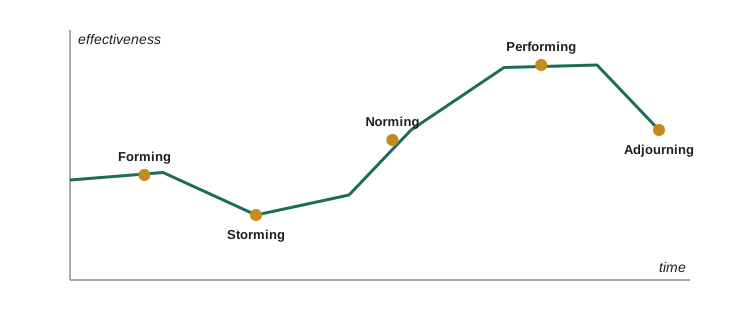
Project managers can help teams through these stages: in forming, by clarifying purpose, roles and norms; in storming, by addressing conflict openly and fairly; in norming, by reinforcing agreements, for example in a team charter; in performing, by stepping back and removing obstacles; and in adjourning, by recognizing contributions and capturing lessons. Co-location, team-building activities, recognition and training all support development.
Motivation in brief
Several classic theories appear in PMI-related study material. Maslow's hierarchy suggests people are motivated by needs from physiological and safety needs up to belonging, esteem and self-actualization. Herzberg distinguishes hygiene factors, such as pay and working conditions, which cause dissatisfaction if missing, from motivators, such as achievement, recognition and the work itself, which create satisfaction. McGregor's Theory X assumes people need close control, while Theory Y assumes people are self-motivated given the right conditions. Daniel Pink's more recent work emphasizes autonomy, mastery and purpose. Modern project guidance, especially for knowledge work, leans toward Theory Y, intrinsic motivators and Pink's three elements.
For the exam, the practical lesson is that recognition, meaningful work, growth opportunities and autonomy usually motivate more effectively than pressure or monetary bonuses alone, and that a project manager should understand what motivates each team member rather than assuming one approach suits all.
Conflict basics
Conflict is inevitable on projects and is not always harmful; disagreement about ideas can improve decisions. Common sources include schedules, priorities, resources, technical opinions, administrative procedures, cost and personalities. PMI describes five general approaches to conflict, drawn from the Thomas-Kilmann model.
| Approach | Also called | Description | When it may fit |
|---|---|---|---|
| Collaborate | Problem solve | Work together to find a solution that meets everyone's needs | Important issues with time to explore; builds commitment |
| Compromise | Reconcile | Each side gives up something | Equal power, need for a quick, acceptable solution |
| Smooth | Accommodate | Emphasize agreement and downplay differences | Preserving relationships when the issue matters less |
| Force | Direct | Impose a solution | Emergencies, safety or legal issues |
| Withdraw | Avoid | Postpone or retreat from the issue | Cooling off; issue may resolve itself or is trivial |
Worked problem
Choosing a conflict approach
Two senior engineers disagree about the system architecture. The decision affects the next two years of work, and the go-live is six months away. Which approach should the project manager encourage?
Show solution
- The issue is important and long-lasting.
- There is time to explore options properly.
- Commitment from both engineers matters for delivery.
Answer: Collaborate: bring them together with the relevant facts and criteria to find a solution both can support. Forcing would risk resentment; withdrawing would leave a critical decision unmade.
Distributed and virtual teams
Many teams work across locations and time zones. Distributed teams give access to wider talent and can reduce costs, but they face challenges: less informal communication, time-zone gaps, cultural differences, technology dependence and difficulty building trust. Good practices include clear communication norms, overlapping core hours, shared digital workspaces, video for important conversations, periodic in-person meetings when possible, and extra attention to inclusion so that remote members are not overlooked.
Worked problem
Finding overlapping hours
A team has members in Vancouver (UTC−8 in winter), Toronto (UTC−5) and Lisbon (UTC+0). Each works 09:00 to 17:00 local time. What is the overlap, in UTC, when all three are working?
Show solution
- Vancouver 09:00–17:00 local = 17:00–01:00 UTC.
- Toronto 09:00–17:00 local = 14:00–22:00 UTC.
- Lisbon 09:00–17:00 local = 09:00–17:00 UTC.
- Common window: from 17:00 (latest start) to 17:00 (earliest end): zero hours.
Answer: There is no overlap in standard hours. The team needs agreed flexible hours, such as Lisbon staying until 18:00 and Vancouver starting at 09:00 one day a week, or asynchronous practices.
Canadian teams often span six time zones, from Newfoundland to British Columbia, and may need to work in both official languages, especially on federal projects or in Quebec. Provincial employment standards set rules on hours of work and overtime that affect flexible scheduling.
Emotional intelligence and team leadership
Emotional intelligence (EI) is the ability to recognize and manage your own emotions and to recognize and influence the emotions of others. Common models describe four parts: self-awareness, self-management, social awareness and relationship management. Project managers with high EI tend to handle conflict better, build trust faster and adapt their style to the situation. Situational leadership models make a related point: the best leadership style depends on the team members' competence and commitment, moving from directing new or inexperienced people toward delegating to experienced, motivated ones. PMP-120 explores these models in depth.
Building a team charter
A team charter, sometimes called working agreements, records how the team will work together. It typically covers team values, communication guidelines (which channels for what, expected response times), decision-making criteria and process, conflict resolution process, meeting guidelines and, for adaptive teams, the definition of done. The team writes it together, which builds ownership, and revisits it when problems arise or membership changes. A project manager facilitates the conversation rather than writing the charter alone.
Worked problem
Drafting working agreements
A newly formed distributed team keeps missing messages and arguing about who decides technical questions. Suggest four working agreements.
Show solution
- Communication: urgent issues by phone or chat mention; non-urgent by the team channel, answered within one working day.
- Decisions: technical design decisions made by the developers involved, with the technical lead deciding if consensus fails within two days.
- Meetings: core overlap hour reserved for the daily stand-up; cameras on for planning and retrospectives.
- Conflict: raise disagreements directly first, then in the retrospective, then with the project manager.
Answer: Agreements like these, written and revisited by the team, address both problems and give a reference point when issues recur.
Recognition and rewards
Recognition is one of the cheapest and most effective motivators. It works best when it is timely, specific and fair, and when it recognizes behaviours the team values, such as helping others or raising a risk early, not just individual heroics. Reward systems that pit team members against each other can damage collaboration. In adaptive teams, celebrating team achievements at reviews and retrospectives reinforces shared ownership. Cultural differences matter: some people appreciate public praise, others prefer private acknowledgement, so a project manager should learn what each person values.
Finally, remember that people are not resources in the same sense as equipment. They have careers, families, cultures and ambitions. Projects that treat team members as interchangeable units tend to lose good people. Projects that invest in their growth, through stretch assignments, mentoring and training, often find that capability and commitment rise together. This is the practical meaning of the empowered culture principle.
PMP-120 returns to all of these topics, from leadership styles and team development to coaching, mentoring and emotional intelligence, with more scenarios and practice.
In summary, the people side of project management is not a soft extra layered on top of the real work. Clear roles, healthy team development, fair handling of conflict and genuine motivation are what allow plans to be carried out. Many projects with sound schedules fail because these foundations were neglected, while teams with strong relationships often recover from technical setbacks that would sink others. This is why the exam gives the People domain a full third of its weight.
Common mistakes
MistakeAssigning tasks directly to members of a self-organizing agile team.
InsteadLet the team decide how to do the work.
MistakePutting more than one A on a RACI activity.
InsteadAccountability must be single.
MistakeAssuming a team will perform well immediately.
InsteadExpect forming and storming.
MistakeDefaulting to forcing in conflict.
InsteadCollaboration is preferred when time and importance allow.
MistakeRelying only on money to motivate.
InsteadRecognition, growth and autonomy often matter more.
Summary and key terms
- Common roles include sponsor, project manager, team members, product owner, team facilitator, functional managers and SMEs.
- RACI charts clarify responsibilities, with exactly one accountable person per activity.
- Teams develop through forming, storming, norming, performing and adjourning.
- Motivation theories emphasize needs, intrinsic motivators and autonomy, mastery and purpose.
- Five conflict approaches range from collaborate to withdraw; collaboration is generally preferred.
- Distributed teams need deliberate communication norms and overlap planning.
- Emotional intelligence and situational leadership help project managers adapt their style.
- Sponsor
- The person who provides resources and support and is accountable for enabling success.
- Product owner
- The role that represents customers and orders the backlog by value.
- Team facilitator
- A servant leader who coaches the team and removes impediments, such as a Scrum Master.
- RACI chart
- A matrix showing who is responsible, accountable, consulted and informed.
- Tuckman ladder
- A model of team development: forming, storming, norming, performing, adjourning.
- Hygiene factor
- A factor that causes dissatisfaction if absent but does not motivate when present.
- Collaborate
- A conflict approach that seeks a solution meeting everyone's needs.
- Emotional intelligence
- The ability to understand and manage one's own and others' emotions.
- Situational leadership
- Adapting leadership style to followers' competence and commitment.
- Distributed team
- A team whose members work in different locations.
Practice problems
Work each problem on paper first, then reveal the answer to check.
What do the letters in RACI stand for?
Show answer
Responsible, accountable, consulted, informed.
How many people should be accountable for an activity?
Show answer
Exactly one.
Name the five Tuckman stages.
Show answer
Forming, storming, norming, performing, adjourning.
Which conflict approach suits a safety emergency?
Show answer
Force or direct.
Which role orders the product backlog?
Show answer
The product owner.
Name Pink's three elements of motivation.
Show answer
Autonomy, mastery and purpose.
Is pay a hygiene factor or motivator in Herzberg's theory?
Show answer
A hygiene factor.
Team in UTC−5 and UTC+1, both 09:00–17:00 local. Overlap?
Show answer
Two hours: 14:00 to 16:00 UTC.
Name the four parts of emotional intelligence.
Show answer
Self-awareness, self-management, social awareness, relationship management.
A new member joins a performing team. What may happen?
Show answer
The team may move back to an earlier stage, such as forming or storming.
Lesson quiz · 5 questions
Score 60% or more to complete this lesson.
Create a free account to save your progress, take quizzes and earn a certificate.