
PMP-110 · Lesson 2 of 12 · 28 min
Value delivery and benefits
Lesson 1 ended with a chain from outputs to outcomes, benefits and value. This lesson turns that chain into a working model. It explains how organizations create value through a system of portfolios, programs, projects and operations, how benefits are identified, owned, measured and sustained, and how a project manager uses simple financial measures such as net present value, payback and benefit-cost ratio to discuss whether a project is worth doing. The PMBOK Guide 8th edition makes "focus on value" one of its six principles, and the 2026 exam content outline includes a Process task on helping ensure value-based delivery, so expect value to appear across many questions, not just finance ones.
The value delivery system
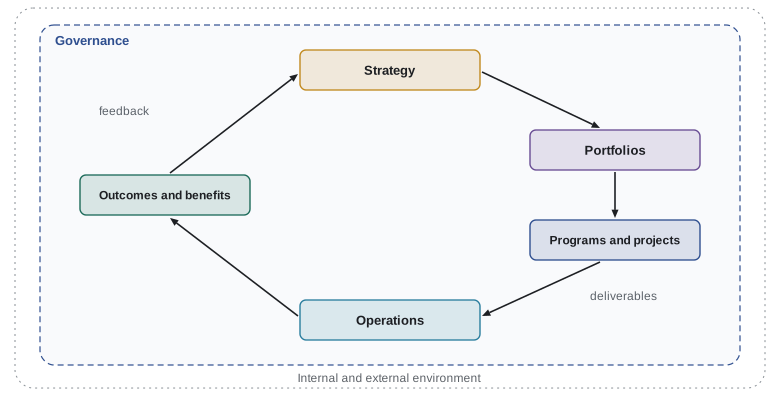
The 7th edition of the PMBOK Guide introduced the idea of a value delivery system: the collection of strategic business activities aimed at building, sustaining and advancing an organization. Portfolios, programs, projects, products and operations are its components, and they work together within a governance framework and an internal and external environment. The 8th edition, published in November 2025, keeps value delivery at the centre of the standard even though it reorganizes much of the guide around six principles, seven performance domains and five focus areas. Whatever label is used, the idea is the same: projects are not ends in themselves but parts of a system that turns strategy into results.
Information flows in both directions in that system. Strategy and governance flow downward, telling projects what is wanted and what constraints apply. Performance information, lessons and realized benefits flow upward, telling leaders whether investments are paying off and what to change. A project manager who reports only percent complete misses the upward flow that leaders most need: evidence about outcomes, risks to benefits and changes in the environment.
Benefits management in brief
Benefits management is the set of activities that make sure the organization actually obtains the benefits it invested in. PMI treats it most fully at program level, but project managers need the basics because they shape the outputs that make benefits possible. A typical cycle has four stages.
- Identify: describe each benefit clearly, link it to strategy and state how it will be measured.
- Plan: set baselines and targets, name a benefit owner, and decide when and how measurement happens.
- Deliver: build outputs and enable the changes in behaviour and process that produce outcomes.
- Sustain: after transition, make sure the benefit continues once the project team has gone, usually through operations.
Two documents carry this thinking in PMI vocabulary. The business case explains why the project is worth doing and is usually owned by the sponsor or a business unit. The benefits management plan describes the target benefits, their timing, the metrics, the owners, the assumptions and the risks to realization. Both are business documents that exist alongside, and often before, the project management plan. Lesson 9 returns to them when it covers initiation.
| Benefit description | Metric | Baseline | Target | Owner | When measured |
|---|---|---|---|---|---|
| Faster claim decisions | Median days to decision | 21 days | 10 days | Director of claims | Monthly from go-live |
| Lower processing cost | Cost per claim | $46 | $34 | Finance manager | Quarterly, year 1 |
| Better customer experience | Satisfaction score (1–5) | 3.2 | 4.0 | Customer service lead | Survey at 6 and 12 months |
Note who owns these benefits: operational leaders, not the project manager. The project ends long before the twelve-month survey, so the person accountable for the benefit must be someone who will still be there. The project manager's job is to make the benefit achievable: delivering the right outputs, supporting the transition and making sure owners and measures are agreed before closure.
Benefits can also be negative. A dis-benefit is an outcome that some stakeholders see as a disadvantage, such as reduced flexibility for a team whose manual workaround disappears. Good benefits management names dis-benefits openly rather than hoping nobody notices, because unmanaged dis-benefits are a common source of resistance.
Financial measures for selecting and justifying projects
Portfolio and program leaders compare candidate projects using financial and non-financial criteria. The PMP exam expects you to interpret, not derive, the common financial measures, and to know which way is better. A higher net present value is better; a shorter payback period is better; a benefit-cost ratio above 1 means benefits exceed costs; a higher internal rate of return is better. You may see simple calculations, so it is worth practising them.
| Measure | What it tells you | Decision rule |
|---|---|---|
| Net present value (NPV) | Present value of benefits minus present value of costs, using a discount rate | Positive is acceptable; higher is better |
| Internal rate of return (IRR) | Discount rate at which NPV equals zero | Higher is better; compare with the hurdle rate |
| Payback period | Time until cumulative benefits recover the investment | Shorter is better; ignores later benefits |
| Benefit-cost ratio (BCR) | Present value of benefits divided by present value of costs | Above 1 is favourable; higher is better |
| Return on investment (ROI) | Net benefit divided by cost, as a percentage | Higher is better; check the time period |
| Opportunity cost | Value of the best alternative not chosen | Consider when choosing between options |
Present value converts a future amount to today's money: \( PV = FV / (1 + r)^t \), where \( r \) is the discount rate per period and \( t \) the number of periods. Net present value sums the present values of all cash flows, with the initial investment as a negative amount at time zero.
Worked problem
Comparing two projects by NPV
Project A costs $200,000 now and returns $90,000 a year for three years. Project B costs $150,000 now and returns $60,000 a year for three years. Using a 10 % discount rate (factors 0.909, 0.826, 0.751), which has the higher NPV?
Show solution
- Sum of factors for three years: 0.909 + 0.826 + 0.751 = 2.486.
- Project A: PV of benefits = 90,000 × 2.486 = 223,740; NPV = 223,740 − 200,000 = 23,740.
- Project B: PV of benefits = 60,000 × 2.486 = 149,160; NPV = 149,160 − 150,000 = −840.
Answer: Project A has the higher NPV ($23,740). Project B is slightly negative at 10 %, so on financial grounds alone it does not meet the hurdle.
Worked problem
Payback and benefit-cost ratio
For the same two projects, find the simple payback period and the BCR using discounted values.
Show solution
- Payback A: 200,000 / 90,000 ≈ 2.2 years. Payback B: 150,000 / 60,000 = 2.5 years.
- BCR A: 223,740 / 200,000 ≈ 1.12.
- BCR B: 149,160 / 150,000 ≈ 0.99.
Answer: Project A pays back sooner and has a BCR above 1; Project B's BCR is just below 1, consistent with its slightly negative NPV.
Internal rate of return is usually found by software or trial and error, so the exam will give it to you. If Project A's IRR is 16 % and the organization's hurdle rate is 10 %, A clears the hurdle. If two projects are mutually exclusive and the measures disagree, NPV is generally preferred because it measures value in money, while IRR and BCR are ratios that can favour small projects.
Watch for sunk cost traps. If a scenario says $2 million has already been spent and asks whether to continue, the money already spent is irrelevant to the decision; what matters is the future cost and future benefit from this point. Continuing a failing project because "we have already invested so much" is the sunk cost fallacy.
Non-financial value
Not all value is financial. Public-sector, health and non-profit projects often aim at safety, access, equity, environmental quality or compliance. Many organizations therefore score projects on several criteria. A weighted scoring model assigns each criterion a weight, rates each option, and multiplies and sums the results.
Worked problem
Weighted scoring for project selection
A school board compares two projects on strategic fit (weight 40 %), financial return (30 %), risk (20 %, higher score means lower risk) and community impact (10 %). Project X scores 8, 6, 5, 9; Project Y scores 6, 9, 7, 4 (out of 10). Which ranks higher?
Show solution
- X: 0.4 × 8 + 0.3 × 6 + 0.2 × 5 + 0.1 × 9 = 3.2 + 1.8 + 1.0 + 0.9 = 6.9.
- Y: 0.4 × 6 + 0.3 × 9 + 0.2 × 7 + 0.1 × 4 = 2.4 + 2.7 + 1.4 + 0.4 = 6.9.
- The scores tie, so the board looks at constraints, capacity and sensitivity: X wins if strategic fit is weighted more heavily; Y wins if financial return is.
Answer: Both score 6.9. A tie is a signal to test the weights and discuss priorities, not to pick at random.
Weighted scoring is only as good as its weights and ratings, so its main value is often the conversation it forces about what the organization actually wants. A project manager is not usually the person choosing between projects, but understanding the scoring helps you explain why your project was chosen, what it is expected to contribute and which criteria leaders will use to judge it later.
The project manager's role in value delivery
In exam scenarios, the best answers usually keep value in view. Before committing to a change request, ask how it affects benefits as well as cost and schedule. When the environment changes, for example a competitor launches first or a regulation is delayed, check with the sponsor whether the business case still holds. When work is late, consider whether delivering a smaller increment earlier would capture some value sooner. When closing, confirm that benefit owners, metrics and transition support are in place. These behaviours line up with the 2026 Process task on helping ensure value-based delivery and with the Business Environment tasks on evaluating external changes.
Canadian federal departments express value through the investment planning and project approval process. Under the Treasury Board framework, larger or riskier projects need a business case, an assessment with the Project Complexity and Risk Assessment tool and, above certain thresholds, Treasury Board approval, with benefits tracked after implementation. Provincial governments and Crown corporations use comparable gating, and many municipal capital programs follow similar business case and benefits practices.
Value thinking also shapes how adaptive teams work. Frequent delivery of usable increments, product owners who order the backlog by value, and reviews with real users all aim to learn early whether outputs are producing outcomes. The same logic applies in predictive projects through milestones that deliver usable capability, pilot sites and early benefits measurement.
Value over the product life
Value is not fixed at approval. Benefits can grow if adoption is faster than expected, or shrink if a competitor, a regulation or a change in strategy alters the picture. For that reason, many organizations review the business case at every phase gate or major release and ask three questions: is the project still desirable, is it still viable, and are the benefits still achievable? A project manager prepares for those reviews by keeping benefit assumptions visible in the assumption log and raising early warnings when they weaken.
Common mistakes
MistakeTreating the project manager as the long-term benefit owner.
InsteadBenefits are usually owned by operational leaders who remain after closure.
MistakeLetting sunk costs drive a decision.
InsteadOnly future costs and benefits matter when deciding whether to continue.
MistakeReading a BCR below 1 as acceptable.
InsteadIt means the present value of costs exceeds benefits.
MistakeChoosing the shortest payback without considering benefits after payback.
InsteadPayback ignores later cash flows.
MistakeIgnoring dis-benefits.
InsteadUnacknowledged negative outcomes fuel resistance and erode value.
Summary and key terms
- Projects are components of a value delivery system that turns strategy into results.
- Benefits are identified, planned, delivered and sustained, with named owners and metrics.
- The business case and benefits management plan justify and track the investment.
- NPV, IRR, payback, BCR and ROI help compare projects; know which direction is better.
- Sunk costs are irrelevant to forward-looking decisions.
- Weighted scoring brings non-financial criteria into selection decisions.
- Project managers protect value by linking changes, risks and closure decisions to benefits.
- Value delivery system
- The components and activities through which an organization turns strategy into value.
- Benefits management plan
- A document describing target benefits, metrics, owners, timing and risks.
- Business case
- A documented justification for a project, usually owned by the sponsor.
- Dis-benefit
- An outcome seen as negative by one or more stakeholders.
- Net present value
- The sum of discounted cash flows, benefits minus costs.
- Internal rate of return
- The discount rate at which NPV equals zero.
- Payback period
- Time for cumulative benefits to recover the initial investment.
- Benefit-cost ratio
- Present value of benefits divided by present value of costs.
- Sunk cost
- Money already spent that cannot be recovered.
- Opportunity cost
- The value of the best alternative forgone.
Practice problems
Work each problem on paper first, then reveal the answer to check.
Who usually owns a benefit after the project closes?
Show answer
An operational or business leader, not the project manager.
PV of $10,000 received in 2 years at 10 %?
Show answer
About $8,264.
Project costs $80,000; discounted benefits $96,000. BCR?
Show answer
1.2.
Cost $120,000, benefits $40,000 a year. Simple payback?
Show answer
3 years.
Two projects: NPV $50,000 and $35,000. Which is better financially?
Show answer
The $50,000 project.
Should $500,000 already spent affect whether to continue?
Show answer
No; it is a sunk cost.
Name the four stages of a simple benefits cycle.
Show answer
Identify, plan, deliver and sustain.
Which principle in the PMBOK Guide 8th edition centres on value?
Show answer
Focus on value.
What does an IRR above the hurdle rate indicate?
Show answer
The project exceeds the minimum required return.
Give one example of a non-financial benefit.
Show answer
Improved safety, access, equity, compliance or environmental quality.
Lesson quiz · 5 questions
Score 60% or more to complete this lesson.
Create a free account to save your progress, take quizzes and earn a certificate.