
PMP-110 · Lesson 4 of 12 · 28 min
The principles of project management
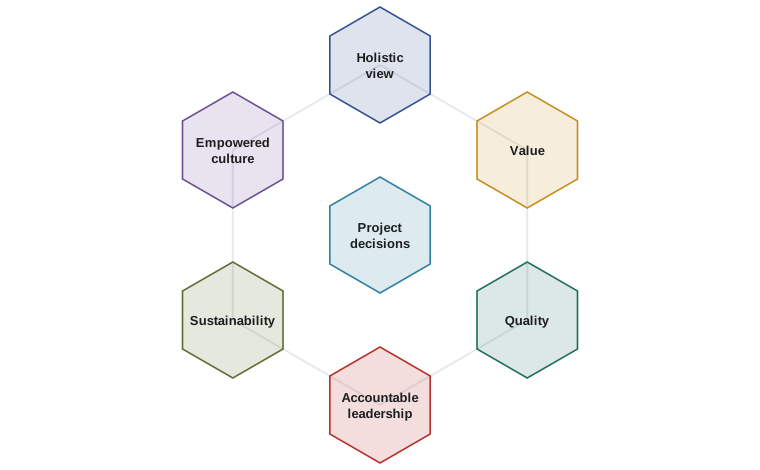
Principles are fundamental norms or values that guide behaviour. Unlike processes, which describe what to do, principles describe how to think and act whatever approach the project uses. The PMBOK Guide 8th edition, published in November 2025, sets out six principles in The Standard for Project Management. They replace the twelve principles of the 7th edition, which many candidates and practitioners still use, so this lesson explains both: the six current principles in detail, and how the older twelve map onto them. Principles matter on the PMP exam because many situational questions have no single "correct process"; instead, the best answer is the one most consistent with these principles.
Why principles rather than rules
Projects vary enormously. A two-week marketing campaign, a ten-year nuclear refurbishment and a software product with continuous releases cannot all follow the same steps. Principles give a common foundation that works across approaches: they tell you what good looks like without prescribing the method. They also help when the method runs out. When a situation arises that no plan anticipated, a project manager guided by principles can still choose a sensible response.
Principles in the PMBOK Guide are not ranked and are not meant to be applied one at a time. They reinforce each other, and real decisions usually draw on several at once. They also overlap with general management ideas, which is deliberate: project management sits inside organizations and should be consistent with good leadership, governance and ethics generally.
The six principles of the 8th edition
| Principle | Core idea | What it looks like in practice |
|---|---|---|
| Adopt a holistic view | See the project as a system within larger systems | Consider how decisions ripple across scope, schedule, cost, people, operations and the organization |
| Focus on value | Judge success by outcomes stakeholders care about | Link work to benefits, check the business case when things change, prioritize by value |
| Embed quality | Build quality into processes and deliverables | Agree acceptance criteria early, prevent defects rather than inspect them out, improve continuously |
| Be an accountable leader | Combine leadership, stewardship and ethical conduct | Take ownership, act with integrity, use resources responsibly, comply with law and policy |
| Integrate sustainability | Weigh environmental, social and economic effects | Consider life-cycle impacts, social effects and long-term costs in decisions |
| Build an empowered culture | Create conditions in which people do their best work | Foster trust, psychological safety, collaboration and shared ownership |
Adopt a holistic view
A holistic view means thinking in systems. A project has many interacting parts, and it sits inside an organization and an environment that also change. Systems thinking helps a project manager anticipate side effects: shortening the schedule may increase cost and risk; adding a feature may increase training needs in operations; a supplier delay may affect a regulatory filing date. It also means recognizing complexity, situations where cause and effect are hard to predict, and responding with experiments, feedback and adaptation rather than pretending the plan can foresee everything. In the 7th edition this idea was spread across the principles of systems thinking, complexity, and adaptability and resiliency.
Focus on value
Lesson 2 covered value in detail. As a principle, it means continually asking whether the project is still worth doing and whether the work being done contributes to the intended outcomes. Value can be financial or non-financial, and different stakeholders may define it differently, so engaging stakeholders to understand value is part of this principle. Focusing on value also means being willing to stop or redirect a project when the case for it weakens.
Embed quality
Quality is the degree to which a set of characteristics fulfils requirements, including stakeholders' stated and implied needs. Embedding quality means designing it into processes and products from the start rather than relying on final inspection. It includes clear acceptance criteria, appropriate standards, prevention over inspection, and continuous improvement. In adaptive teams, practices such as a definition of done, automated testing and frequent reviews embed quality into each increment. The cost of quality concept, covered in later courses, explains why prevention is usually cheaper than fixing defects late.
Be an accountable leader
This principle merges two of the 7th edition's principles: being a diligent, respectful and caring steward, and demonstrating leadership behaviours. Accountability means owning decisions and their consequences. Stewardship means managing the resources entrusted to the project, money, people, materials, data and reputation, responsibly and in compliance with law and policy. Leadership means motivating, influencing, coaching and learning, and it can be exercised by anyone on the team, not only by the person with the title. The PMI Code of Ethics, introduced in lesson 3, gives this principle concrete form.
Integrate sustainability
Sustainability is new as a named principle in the 8th edition. It asks project professionals to consider environmental, social and economic effects across the full life cycle of what the project creates, not just during delivery. Examples include choosing lower-carbon materials, planning for maintenance and disposal, considering effects on local communities and workers, and avoiding solutions that are cheap to build but costly to run. PRINCE2 7 made a similar move by adding sustainability as a performance target, which shows how widely the idea has spread. On the exam, sustainability considerations may appear as one factor in a trade-off decision.
Worked problem
A life-cycle cost comparison
Two lighting designs for a warehouse: Design A costs $60,000 to install and $12,000 a year in energy and maintenance; Design B costs $85,000 and $6,000 a year. Over a 10-year life, ignoring discounting, which has the lower total cost?
Show solution
- Design A: 60,000 + 10 × 12,000 = 180,000.
- Design B: 85,000 + 10 × 6,000 = 145,000.
- Break-even year: the extra 25,000 for B is recovered at 6,000 a year in about 4.2 years.
Answer: Design B costs about $35,000 less over ten years and uses less energy, even though it costs more to install. A holistic, sustainable view favours B unless funding or other constraints rule it out.
Build an empowered culture
People deliver projects. An empowered culture is one in which team members have the authority, information and safety to make decisions, raise problems and suggest improvements. Psychological safety, the belief that you will not be punished for speaking up, is a key ingredient: teams that feel safe report risks and mistakes earlier, which protects the project. This principle draws together the 7th edition's principles about creating a collaborative team environment and effectively engaging with stakeholders, and it connects closely with servant leadership.
Mapping the 7th edition principles
Because study materials, colleagues and older practice questions often use the 7th edition's twelve principles, it helps to see how they relate to the six. The mapping below is an approximate guide, not an official PMI crosswalk.
| 7th edition principle (2021) | Closest 8th edition principle(s) |
|---|---|
| Be a diligent, respectful and caring steward | Be an accountable leader; integrate sustainability |
| Create a collaborative project team environment | Build an empowered culture |
| Effectively engage with stakeholders | Build an empowered culture; focus on value |
| Focus on value | Focus on value |
| Recognize, evaluate and respond to system interactions | Adopt a holistic view |
| Demonstrate leadership behaviours | Be an accountable leader |
| Tailor based on context | Applied throughout; tailoring guidance sits in each domain |
| Build quality into processes and deliverables | Embed quality |
| Navigate complexity | Adopt a holistic view |
| Optimize risk responses | Adopt a holistic view; focus on value (and the Risk domain) |
| Embrace adaptability and resiliency | Adopt a holistic view |
| Enable change to achieve the envisioned future state | Focus on value; build an empowered culture |
Note what moved. Tailoring is no longer a separate principle but is woven into every domain; risk is handled mainly through the Risk performance domain; and sustainability appears for the first time. The underlying ideas are largely continuous, so if you studied the 7th edition you are not starting over.
Applying principles to exam scenarios
Principles help you eliminate wrong answers. Consider an option that hides a problem from stakeholders (violates accountable leadership), one that adds features without checking value (violates focus on value), one that skips testing to meet a date (violates embed quality), one that blames a team member publicly (violates an empowered culture), or one that fixes a local issue while creating a bigger one elsewhere (violates a holistic view). These options are usually distractors.
Worked problem
Using principles to choose a response
A team member tells you in a retrospective that the test environment has been unreliable for weeks and the team has been quietly skipping some tests to keep velocity up. What should you do first?
Show solution
- Embed quality: skipping tests creates hidden defects and technical debt.
- Empowered culture: the team member spoke up; respond in a way that encourages more of this, not blame.
- Holistic view: an unreliable environment is a system problem affecting quality, schedule and morale.
- Response: thank the team, make the problem visible, agree with the team to restore testing, and work to fix or escalate the environment issue as an impediment.
Answer: Treat it as an impediment to remove and a quality risk to address openly, not as a performance problem with individuals.
Worked problem
Scoring options against principles
You rate three responses to a late supplier from 0 to 2 against each of the six principles. Option 1 totals 9, Option 2 totals 6, Option 3 totals 11. What is each option's average per principle, and which best fits the principles?
Show solution
- Option 1: 9 / 6 = 1.5.
- Option 2: 6 / 6 = 1.0.
- Option 3: 11 / 6 ≈ 1.83.
Answer: Option 3 fits the principles best. A simple scoring like this is a study aid; on the exam you weigh principles mentally, not numerically.
Canadian organizations often connect these principles to public commitments: for example, federal greening government commitments and provincial climate policies for sustainability, accessibility legislation such as the Accessible Canada Act for stakeholder engagement and quality, and official languages requirements for communication on federal projects.
Principles when principles conflict
Sometimes principles pull in different directions. Focusing on value might suggest releasing a feature quickly, while embedding quality suggests more testing. Integrating sustainability might favour a more expensive material, while the finance constraint pushes toward the cheaper one. In such cases, the holistic view helps: make the trade-off explicit, involve the stakeholders who own the consequences, and record the decision and its rationale. The worst response is to resolve the conflict silently, so that nobody realizes a principle was set aside.
On the exam, answers that make trade-offs transparent and involve the right decision-makers are usually stronger than answers that maximize a single principle at any cost.
A practical habit is to name the principle in the decision record: "we accepted a two-week delay to complete accessibility testing (embed quality) after confirming with the sponsor that the benefit timing still holds (focus on value)". Recording the reasoning helps later reviewers understand why a choice was made.
Common mistakes
MistakeMemorizing the 7th edition's twelve principles as current.
InsteadThe 8th edition has six.
MistakeTreating principles as steps to follow in order.
InsteadThey guide behaviour together.
MistakeAssuming sustainability is only environmental.
InsteadIt includes social and economic effects.
MistakeBelieving empowerment means no accountability.
InsteadEmpowered teams still own commitments.
MistakeThinking quality means final inspection.
InsteadThe principle is to build quality in from the start.
Summary and key terms
- Principles guide behaviour across all approaches and situations.
- The 8th edition has six principles: holistic view, value, quality, accountable leadership, sustainability and empowered culture.
- A holistic view applies systems thinking and responds to complexity with adaptation.
- Focus on value keeps outcomes and benefits at the centre of decisions.
- Embedding quality favours prevention and clear acceptance criteria.
- Accountable leaders combine stewardship, leadership and ethics; sustainability adds life-cycle effects.
- The 7th edition's twelve principles map largely onto the six; tailoring now sits within each domain.
- Principle
- A fundamental norm or value that guides behaviour.
- Systems thinking
- Viewing a project as interacting parts within larger systems.
- Complexity
- A condition in which outcomes are hard to predict from causes.
- Quality
- The degree to which characteristics fulfil requirements.
- Stewardship
- Responsible management of resources entrusted to the project.
- Sustainability
- Considering environmental, social and economic effects over the life cycle.
- Psychological safety
- The belief that one can speak up without punishment.
- Life-cycle cost
- Total cost to build, operate, maintain and dispose of a product.
- Empowerment
- Giving people authority, information and support to make decisions.
- The Standard for Project Management
- The part of the PMBOK Guide that sets out principles.
Practice problems
Work each problem on paper first, then reveal the answer to check.
How many principles are in the PMBOK Guide 8th edition?
Show answer
Six.
How many were in the 7th edition?
Show answer
Twelve.
Which principle is new in the 8th edition?
Show answer
Integrate sustainability.
Which principle relates most to systems thinking?
Show answer
Adopt a holistic view.
Which two 7th edition principles merge into being an accountable leader?
Show answer
Stewardship and leadership behaviours.
Install $40,000 + $5,000 a year vs $30,000 + $8,000 a year over 5 years: which is cheaper?
Show answer
The first: $65,000 vs $70,000.
What is psychological safety?
Show answer
Confidence that one can speak up without being punished.
Where does tailoring sit in the 8th edition?
Show answer
Within each performance domain rather than as a principle.
A response skips testing to hit a date. Which principle does it violate?
Show answer
Embed quality.
Name the three dimensions of sustainability.
Show answer
Environmental, social and economic.
Lesson quiz · 5 questions
Score 60% or more to complete this lesson.
Create a free account to save your progress, take quizzes and earn a certificate.