
PMP-110 · Lesson 12 of 12 · 34 min
Capstone: tailoring a project approach
This capstone brings the course together in one extended case. You will follow a project from selection through initiation and approach design, applying the ideas from each lesson: value and selection measures, organizational structure and governance, enterprise environmental factors and organizational process assets, the principles, the performance domains, the choice of development approach, tailoring, stakeholders, team roles and tools. Work through each step before reading the suggested answer. The aim is not to memorize this case but to practise the reasoning the PMP exam rewards: reading a situation, identifying what matters and choosing a response consistent with the principles.
The case: a regional health authority
A regional health authority runs 14 clinics and two hospitals. Patients complain about long waits to book appointments by phone, and staff spend hours on manual scheduling. The executive team has asked for proposals. The authority operates as a balanced matrix: clinical and IT staff report to their departments, and project managers sit in a controlling PMO that requires a charter, a risk register, monthly status reports and gate reviews for projects over $500,000. Privacy law strictly governs patient data, the authority's culture is cautious about technology, and a provincial or state funding program will contribute half the cost if the project starts this fiscal year.
Step 1: selecting the project
Three options are proposed: (A) a full online booking platform integrated with the clinical system, (B) an expanded call centre with better phone software, and (C) do nothing. Finance supplies these figures over five years, already discounted at 7 %.
| Option | PV of costs | PV of benefits | NPV | BCR |
|---|---|---|---|---|
| A: online booking | $2,400,000 | $3,500,000 | $1,100,000 | 1.46 |
| B: call centre | $1,300,000 | $1,650,000 | $350,000 | 1.27 |
| C: do nothing | $0 | $0 (waits keep rising) | $0 | n/a |
Worked problem
Step 1 analysis
Which option should be recommended, and what non-financial factors should be considered?
Show solution
- NPV: A ($1.1 million) beats B ($350,000); both beat doing nothing. BCR also favours A.
- Non-financial: A improves access for patients who cannot call during work hours, supports equity goals and reduces staff workload; B is lower risk and faster.
- Risks: A involves integration with the clinical system and patient data privacy; B relies on hiring in a tight labour market.
- Funding EEF: the grant requires a start this fiscal year, which both options can meet.
Answer: Recommend A, with the business case noting its higher risk and the mitigations needed. Doing nothing is not neutral: waits and costs keep rising.
Step 2: initiation
The executive team approves Option A and names the chief operating officer as sponsor. You are assigned as project manager from the PMO.
Worked problem
Step 2 analysis
What should be in place before detailed planning starts?
Show solution
- A charter, issued by the sponsor, stating purpose, measurable objectives (for example, 40 % of appointments booked online within 12 months of launch and average phone wait under 3 minutes), high-level requirements, major risks, summary milestones, pre-approved funding, your authority and approval requirements.
- An assumption log: for example, that the clinical system vendor will provide an integration interface, and that clinic managers will release staff for testing.
- A stakeholder register: patients, clinic staff, physicians, the clinical system vendor, IT security, the privacy office, unions, the funding agency, the board and community groups.
- A benefits management plan with owners: the director of patient access owns the online booking target; the call centre manager owns the wait-time target.
Answer: Charter, assumption log, stakeholder register and benefits plan with named owners. The benefit owners are operational leaders, not the project manager.
Step 3: reading the environment
Before choosing an approach, list the enterprise environmental factors and organizational process assets that shape the project.
| Enterprise environmental factors | Organizational process assets |
|---|---|
| Health privacy law and data residency rules | PMO templates: charter, risk register, status report |
| Cautious culture toward technology | Gate review procedure for projects over $500,000 |
| Balanced matrix: shared authority with department heads | Lessons learned from a failed 2022 portal project |
| Funding deadline tied to the fiscal year | Procurement policy and vendor contracts |
| Union agreements on scheduling staff duties | IT security standards and change management procedure |
The 2022 lessons learned are especially valuable: they record that the earlier portal failed because clinic staff were not involved and the launch happened everywhere at once. That is exactly the kind of organizational knowledge a project manager should consult before planning.
Step 4: choosing a development approach
Worked problem
Step 4 analysis
Rate suitability for an adaptive approach (1 = predictive, 5 = adaptive): patient-facing booking features are uncertain (5); the integration with the clinical system is technically defined by the vendor's interface (2); privacy and security approvals require documented design (2); clinic staff can give feedback every two weeks (4); the organization has some agile experience in IT (3). What approach do you recommend?
Show solution
- Average: (5 + 2 + 2 + 4 + 3) / 5 = 16 / 5 = 3.2, in the middle.
- Look at the parts: patient-facing features favour adaptive; integration and approvals favour predictive.
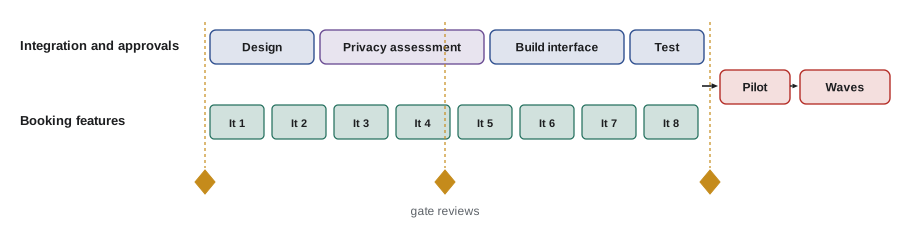
- Recommendation: hybrid. Use two-week iterations with a product owner from patient access for the booking features; use a predictive plan for integration, security assessment and privacy impact assessment; release clinic by clinic.
Answer: A hybrid life cycle, with phased rollout informed by the 2022 lesson about launching everywhere at once.
Step 5: tailoring
Worked problem
Step 5 analysis
Tailor the PMO's required processes and artifacts to the hybrid approach, keeping mandatory items.
Show solution
- Charter and gate reviews: mandatory; keep, and align gates with major releases.
- Risk register: keep, reviewed every two weeks with the team; include privacy, integration and adoption risks.
- Status report: mandatory monthly; generate it from the team's burnup chart and integration milestone tracker to avoid duplicate effort.
- Requirements: a product backlog for features; a formal specification only for the integration interface and security controls.
- Change control: backlog changes managed by the product owner within the approved scope and budget; changes to budget, milestones or interface go to the sponsor or change control board.
- Lessons learned: retrospectives every iteration plus a short review after each clinic wave.
Answer: Keep mandatory governance, lighten and combine reporting, and use adaptive artifacts where the work is uncertain. This is tailoring for the organization and for the project.
Worked problem
Governance thresholds
The governance plan delegates: product owner may reorder the backlog freely; project manager may approve changes up to $30,000 or 10 days; sponsor up to $200,000 or 40 days; the steering committee above that. A vendor change to the interface adds $45,000 and 6 days. Who decides?
Show solution
- Interface changes are outside the product owner's backlog authority.
- Cost $45,000 exceeds the project manager's $30,000 limit; 6 days is within 10.
- The cost threshold crossed is the sponsor's level.
Answer: The sponsor. The project manager analyses the impact on cost, schedule, risk and benefits and brings a recommendation.
Step 6: people and stakeholders
Using the power-interest grid, the privacy office and the funding agency have high power and high interest: manage closely. Physicians have high power but moderate interest: keep satisfied, with short briefings. Clinic schedulers and patients have high interest but less formal power: keep informed and involve actively, because adoption depends on them. Unions need early engagement because scheduling duties will change. The team includes clinic staff seconded part-time, IT developers, a business analyst, a security specialist and the vendor's integration team; a RACI chart clarifies, for example, that the director of patient access is accountable for accepting the booking features and the IT security manager is accountable for the security assessment.
Applying the change models from lesson 11, the team plans communication and training using ADKAR: building awareness of why online booking matters for patients, desire through involving schedulers in design, knowledge and ability through training at each clinic before launch, and reinforcement through dashboards that show the time saved.
Step 7: checking against the principles
| Principle | How the plan reflects it |
|---|---|
| Adopt a holistic view | Considers clinic operations, unions, privacy and the call centre, not just the software |
| Focus on value | Benefits with owners and metrics; phased rollout captures value early |
| Embed quality | Definition of done includes accessibility and security testing; pilot before waves |
| Be an accountable leader | Clear decision rights, transparent reporting, privacy compliance |
| Integrate sustainability | Fewer paper forms and patient trips; system designed for long-term maintenance |
| Build an empowered culture | Schedulers co-design features; retrospectives drive improvements |
In a Canadian province, this project would also need a privacy impact assessment under provincial health information legislation, such as Ontario's Personal Health Information Protection Act or Alberta's Health Information Act, attention to French-language services where required, and accessibility compliance under provincial law such as the Accessibility for Ontarians with Disabilities Act.
Reflecting and moving on
Note what made the answers strong. They used data where it existed, consulted lessons learned, respected mandatory governance while removing waste, matched the approach to the uncertainty of each part, named accountable owners, engaged stakeholders according to their power, interest and importance to adoption, and checked the whole plan against the principles. Those habits apply to any exam scenario. Next in this series, PMP-120 and PMP-121 develop the People domain; PMP-130 and PMP-131 develop planning, quality, risk, procurement and integration; PMP-140 covers agile and hybrid practices; PMP-150 covers the business environment; and PMP-160 brings everything together for exam practice.
Worked problem
A self-check score
You rate your confidence from 1 to 5 on each of the 12 lessons and get: 4, 3, 5, 3, 2, 4, 3, 4, 4, 3, 2, 4. What is your average, and which lessons should you revisit first?
Show solution
- Sum: 4 + 3 + 5 + 3 + 2 + 4 + 3 + 4 + 4 + 3 + 2 + 4 = 41.
- Average: 41 / 12 ≈ 3.4.
- Lowest scores: lesson 5 (domains and focus areas) and lesson 11 (models, methods and artifacts), both at 2.
Answer: About 3.4. Revisit lessons 5 and 11 first, then the lessons scored 3.
What could go wrong
Even a well-designed approach faces risks. In the case, the top threats might include the vendor's integration interface arriving late, low patient adoption, privacy approval taking longer than planned, and clinic staff resisting new workflows. Each needs an owner and a response: for the interface, an early technical spike and contract milestones; for adoption, user testing with patients and clear communication; for approvals, early engagement with the privacy office; for resistance, involving schedulers in design and providing training before launch. Opportunities exist too: if the pilot clinic adopts quickly, waves could be accelerated, capturing benefits sooner.
Recording these risks in the register, with owners and triggers, turns the approach design into an actionable plan.
Revisit them at every gate.
Common mistakes
MistakeChoosing an approach for the whole project when parts differ.
InsteadHybrids exist for this reason.
MistakeDropping mandatory governance in the name of agility.
InsteadTailor within organizational requirements.
MistakeIgnoring lessons learned from earlier projects.
InsteadThey are among the most valuable OPAs.
MistakeMaking the project manager the benefit owner.
InsteadOperational leaders own benefits.
MistakeEngaging only powerful stakeholders.
InsteadUsers and front-line staff determine adoption.
Summary and key terms
- Selection combines financial measures such as NPV and BCR with non-financial factors and risk.
- Initiation produces a charter, assumption log, stakeholder register and benefits plan with owners.
- EEFs and OPAs, including lessons learned, shape the approach and plan.
- Hybrid life cycles suit projects whose parts differ in uncertainty and constraints.
- Tailoring keeps mandatory governance while removing duplication and waste.
- Clear decision rights and escalation thresholds route changes to the right level.
- Checking the plan against the six principles reveals gaps.
- Capstone
- An integrating exercise that applies the whole course.
- Phased rollout
- Releasing a solution to groups or sites in waves.
- Pilot
- An initial limited release to test a solution in real conditions.
- Benefit owner
- The person accountable for realizing a benefit.
- Privacy impact assessment
- An analysis of how a project affects personal information and how risks will be managed.
- Burnup chart
- A chart showing work completed against total scope over time.
- Definition of done
- The criteria a work item must meet to be considered complete.
- Gate review
- A governance checkpoint to decide whether to continue.
- Self-assessment
- Rating your own understanding to guide further study.
- Hybrid life cycle
- A life cycle combining predictive and adaptive elements.
Practice problems
Work each problem on paper first, then reveal the answer to check.
Option NPVs: $800,000 and $500,000. Which is better financially?
Show answer
The $800,000 option.
Who should own the online booking benefit in the case?
Show answer
The director of patient access.
Which lesson learned shaped the rollout plan?
Show answer
The 2022 portal failed because staff were not involved and it launched everywhere at once.
Why a hybrid approach in the case?
Show answer
Features were uncertain but integration and approvals needed documented design.
Change adds $25,000 and 12 days; PM limit $30,000 or 10 days. Who decides?
Show answer
The sponsor, because 12 days exceeds the PM's limit.
Physicians have high power, moderate interest. Strategy?
Show answer
Keep satisfied.
Name two mandatory PMO items kept in the tailored plan.
Show answer
Charter, gate reviews, monthly status report, risk register.
Which change model structured the training plan?
Show answer
ADKAR.
Confidence scores 3, 4, 5, 2: average?
Show answer
3.5.
Which course covers agile and hybrid practices next?
Show answer
PMP-140.
Lesson quiz · 5 questions
Score 60% or more to complete this lesson.
Create a free account to save your progress, take quizzes and earn a certificate.