
PMP-131 · Lesson 3 of 12 · 28 min
Risk management planning and identification
Every plan in PMP-130 rested on estimates and assumptions: that the permit would arrive in six weeks, that the ceiling held no surprises, that tag prices would hold. Risk management is the discipline of dealing with that uncertainty deliberately. This lesson defines risk, explains how organizations express how much risk they will accept, describes the risk management plan and walks through the techniques for identifying risks and writing them so they can be managed. Lessons 4 to 6 cover analysis, responses and monitoring. PRINCE2 users will recognize many of the ideas from PRIN-131's risk practice; the vocabulary differs in places, and this course uses the terms common in PMI-based materials.
What a risk is
A risk is an uncertain event or condition that, if it occurs, has a positive or negative effect on one or more project objectives. Three parts of that definition matter. It is uncertain: something that has already happened, or is certain to happen, is not a risk but an issue or a fact to plan for. It has an effect on objectives such as scope, schedule, cost, quality or benefits. And the effect can be negative (a threat) or positive (an opportunity). Exam questions regularly test whether candidates remember opportunities, which many real risk registers neglect.
It helps to distinguish individual project risks, the specific events in the risk register, from overall project risk, the effect of uncertainty on the project as a whole. Overall risk includes the combined effect of individual risks and other sources of uncertainty, such as the spread of every cost estimate. Lesson 4 shows how a Monte Carlo simulation estimates overall cost risk for Project Compass and why it can differ sharply from the sum of a few listed risks.
| Term | Meaning | Project Compass example |
|---|---|---|
| Threat | A risk with a negative effect on objectives | Permit may be delayed by a backlog at the city |
| Opportunity | A risk with a positive effect on objectives | Tag supplier may offer a volume discount for a joint order |
| Issue | A current condition or situation that may affect objectives | The permit is now three weeks late |
| Known-unknown | An identified risk whose occurrence is uncertain | Asbestos may be found above the ceiling |
| Unknown-unknown | A risk that has not been identified | An event nobody foresaw, such as a flood from a mall water main |
| Emergent risk | A risk that becomes visible only as the project unfolds | New app store privacy rules announced mid-project |
PMP-130 linked these categories to reserves: contingency reserve covers identified risks (known-unknowns) and sits inside the cost baseline; management reserve covers unidentified risks (unknown-unknowns) and is held outside it by management. Because some risks cannot be identified in advance, risk management also builds resilience: buffers, flexible contracts, cross-trained people and a habit of scanning for emerging risks throughout the project.
Risk attitude: appetite, tolerance and thresholds
Organizations and individuals differ in how much uncertainty they will accept. Risk appetite is the degree of uncertainty an organization is willing to take on in anticipation of a reward. Risk thresholds turn appetite into measurable limits: the level of exposure above which a risk must be escalated or acted on. Some materials also speak of risk tolerance, the amount of variation from objectives that is acceptable. Appetite is a general stance; thresholds are concrete numbers.
The library board is risk-averse about the opening date and patron safety, because the branch opening is a public commitment and the library is accountable for public money. It is more relaxed about the mobile app's feature set, where it is willing to experiment. The risk management plan records thresholds that reflect this: any risk that could delay the opening by more than ten working days, add more than $50,000, or affect patron or worker safety must be reported to the sponsor within two working days. Risks to app features within the release budget are managed by the product owner.
Risk attitude also has a human side. Individuals' perceptions of risk are influenced by biases such as optimism, anchoring on early estimates and groupthink. A project manager who knows this asks for evidence, invites dissenting views and uses techniques such as anonymous input to counter the loudest or most senior voice.
The risk management plan
The risk management plan describes how risk management activities will be structured and performed on this project. It is created early, during planning, and is a component of the project management plan. It is proportionate: a short project with familiar work needs a light plan; a large, novel or politically exposed project needs a fuller one.
| Component | What it specifies | Project Compass choice |
|---|---|---|
| Strategy and methodology | Overall approach, tools and data sources | Qualitative analysis for all risks; quantitative cost and schedule analysis at baseline and each phase gate |
| Roles and responsibilities | Who leads, supports and owns risks | Project manager leads; every risk has a named owner; sponsor decides on escalated risks |
| Funding | Money for risk activities and reserves | Contingency from expected monetary value; management reserve of 5 % held by the sponsor |
| Timing | When risk activities happen | Risk review in every biweekly project meeting; full reassessment at each phase gate |
| Risk categories | Structure for grouping risks, often a risk breakdown structure | Technical, external, organizational, project management, commercial |
| Stakeholder risk appetite | Appetite and thresholds for key objectives | Low appetite for opening delay and safety; higher for app features |
| Definitions of probability and impact | Scales for scoring risks | Five-point scales with defined ranges for each objective (lesson 4) |
| Probability and impact matrix | How scores combine into priority | Score = probability × impact; 12 or above is high |
| Reporting formats and tracking | What is reported, to whom and how risk is documented | Risk register in the project workspace; top five risks in the monthly board report |
A risk breakdown structure (RBS) is a hierarchical list of risk categories, for example technical (requirements, technology, quality), external (suppliers, regulatory, market, weather), organizational (resources, funding, priorities) and project management (estimating, planning, communication). It works as a prompt list during identification and as a way to see where risks cluster.
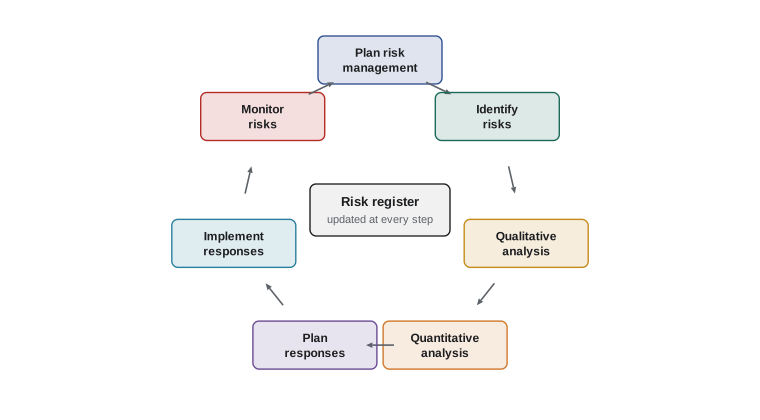
Identifying risks
Identification is an iterative activity that involves the team and stakeholders, not a one-off workshop at the start. Different techniques surface different risks, so most projects combine several.
| Technique | How it works | Strengths and cautions |
|---|---|---|
| Brainstorming | A facilitated group generates risks freely, often prompted by the RBS | Fast and inclusive; can be dominated by loud voices |
| Interviews | One-to-one discussions with experienced people and stakeholders | Draws out concerns people will not raise in groups; time-consuming |
| Delphi technique | Anonymous experts answer questionnaires in rounds, with summarized feedback, until views converge | Reduces bias and the influence of seniority; slower |
| Checklists | Lists of risks from previous similar projects | Quick and builds on experience; may miss what is new |
| Document analysis | Reviewing plans, contracts, assumptions and requirements for gaps and inconsistencies | Finds risks hidden in the paperwork |
| Assumption and constraint analysis | Testing each assumption and constraint: what if it is false or binding? | Directly converts planning assumptions into risks |
| SWOT analysis | Strengths, weaknesses, opportunities and threats of the project or organization | Good for opportunities and organizational risks |
| Root cause analysis | Working back from potential problems to underlying causes | Helps write sharper risks and find shared causes |
| Prompt lists | Frameworks such as PESTLE (political, economic, social, technological, legal, environmental) or TECOP (technical, environmental, commercial, operational, political) | Broadens thinking to external and overall risk |
Assumption and constraint analysis is particularly productive. PMP-130's plan for Project Compass assumed a six-week permit review, a tagging rate of 110 items per person-hour from the pilot, stable tag prices and availability of one electrician crew. Each assumption becomes a candidate risk: the permit could take longer; the rate could be lower with a new tag batch; prices could rise; the crew could be needed elsewhere. Lessons learned from earlier projects add more: the library's register records that a mall landlord restricted noisy work at another branch, and that tag lead times doubled before the holidays.
Writing risks so they can be managed
A vague risk such as "budget" or "the permit" cannot be analysed or owned. A structured risk statement, sometimes called risk metalanguage, separates cause, risk and effect: because of a cause (a fact or condition), an uncertain event may occur, which would lead to an effect on objectives. For example: because the city's permit office has a backlog (cause), the building permit may be issued later than planned (risk), which would delay demolition and the critical path and add costs for extended site overheads (effect). Writing risks this way exposes shared causes, suggests responses that act on the cause or the effect, and prevents confusing a risk with its cause or its consequence.
Triggers, also called risk symptoms or warning signs, are indications that a risk is about to occur or has occurred. For the permit risk, a trigger might be the city not acknowledging the application within ten days. Recording triggers helps owners act early, and monitoring them is part of lesson 6.
The risk register and risk report
The risk register records the details of individual risks. Early in the project it may hold just the risk statement, a potential owner and possible responses. As analysis and planning proceed, it gains probability and impact scores, priority, categories, triggers, agreed responses, response owners, residual and secondary risks, and status. The risk report, by contrast, summarizes overall project risk and the most important individual risks for stakeholders.
# The first Project Compass risk register, sorted by probability x impact score
# Scales: probability and impact each scored 1 (very low) to 5 (very high)
risks = [  # id, risk statement (cause -> event -> effect), P, I, owner
 ("R01", "Old ceiling may contain asbestos, so removal halts work and adds abatement cost", 2, 4, "Fit-out lead"),
 ("R02", "City permit review is backlogged, so permit may be late and delay demolition", 3, 3, "Project manager"),
 ("R03", "Tag supplier faces tariff costs, so tag price may rise before the order", 2, 3, "Procurement"),
 ("R04", "App store review rules change, so the app may need rework before release", 2, 2, "Product owner"),
 ("R05", "Only one electrician crew is available, so rough-in could slip", 3, 4, "Fit-out lead"),
 ("R06", "Mall landlord controls after-hours access, so noisy work may be restricted", 3, 2, "Project manager"),
 ("R07", "Kiosk firmware is new, so early failures may hit opening week", 3, 3, "Technology lead"),
 ("R08", "Volunteer turnout for the collection move may be low, so opening could slip", 2, 3, "Branch manager"),
 ("R09", "Vendor offers volume discount if tags are ordered with another branch (opportunity)", 3, 2, "Procurement"),
 ("R10", "Key staff may leave during the project, so knowledge is lost", 2, 3, "Sponsor"),
]
print(f"{'ID':4s}{'P':>3s}{'I':>3s}{'Score':>7s}  Zone   Owner")
for rid, text, p, i, owner in sorted(risks, key=lambda r: -r[2] * r[3]):
    s = p * i
    zone = "high" if s >= 12 else "medium" if s >= 6 else "low"
print(f"{rid:4s}{p:3d}{i:3d}{s:7d} {zone:6s} {owner}")ID P I Score Zone Owner R05 3 4 12 high Fit-out lead R02 3 3 9 medium Project manager R07 3 3 9 medium Technology lead R01 2 4 8 medium Fit-out lead R03 2 3 6 medium Procurement R06 3 2 6 medium Project manager R08 2 3 6 medium Branch manager R09 3 2 6 medium Procurement R10 2 3 6 medium Sponsor R04 2 2 4 low Product owner
The first register contains ten risks, nine threats and one opportunity. The only high-priority risk is R05: the project depends on a single electrician crew during rough-in, which sits on the critical path. Several medium risks share a theme of external dependencies: the city, the landlord, the tag supplier and the kiosk vendor. That pattern suggests a response at the cause level, such as earlier engagement with external parties, which lesson 5 develops. Note that the opportunity R09 is scored on the same scales but for benefit, not harm; many organizations keep a separate opportunity matrix so the two are not mixed.
Each risk has an owner: the person best placed to monitor it and ensure that the agreed response is carried out. The owner need not be the person who performs the response work. The project manager facilitates the process but should not own every risk; spreading ownership spreads attention and keeps risks close to the people who can see their triggers.
Risk in adaptive and hybrid projects
Adaptive approaches manage much uncertainty through their structure: short iterations, frequent delivery and feedback reduce the chance of building the wrong thing for long. Risks still need explicit attention. Teams can add risk-reduction work to the backlog, such as a spike to test the app's connection to the library system before building features on it, and prioritize it high, producing a risk-adjusted backlog. Daily stand-ups and retrospectives surface impediments and emerging risks quickly. A burn-up chart showing growing scope is itself an early warning of schedule risk.
On Project Compass, the app team held a two-day spike in its first sprint to confirm that the library system's interface could return real-time availability. It could, but only every five minutes, which changed the design of the holds feature and removed a risk that would otherwise have surfaced weeks later. In the predictive fit-out, the same purpose is served by investigations such as the ceiling survey analysed in lesson 4.
Worked problem
Risk, issue or neither?
Classify each of the following for Project Compass: (1) the permit has just been issued three weeks late; (2) the tag supplier has announced that prices may rise next quarter if new tariffs take effect; (3) the branch will be closed on statutory holidays; (4) a board member says a nearby school might want to share the community room, which could bring grant money.
Show solution
- (1) The delay has happened. It is an issue to resolve, though it was previously a risk in the register.
- (2) A possible price rise is uncertain and negative: a threat.
- (3) Holiday closures are known and certain. They are a planning fact for the calendar, not a risk.
- (4) Possible shared use bringing grant money is uncertain and positive: an opportunity.
Answer: Issue, threat, planning fact and opportunity. Only uncertain events with effects on objectives belong in the risk register.
Common mistakes
MistakeListing only threats in the risk register.
InsteadIdentify and manage opportunities too.
MistakeRecording events that have already happened as risks.
InsteadTreat them as issues and manage them in the issue log.
MistakeWriting risks as single words such as "budget".
InsteadUse cause, risk and effect statements.
MistakeMaking the project manager the owner of every risk.
InsteadAssign each risk to the person best placed to monitor it and drive the response.
MistakeIdentifying risks once at the start.
InsteadIdentify risks throughout the project, especially at phase gates and after changes.
Summary and key terms
- A risk is an uncertain event or condition with a positive or negative effect on objectives.
- Individual risks are listed in the register; overall project risk is the effect of all uncertainty on the project.
- Risk appetite is the general willingness to accept uncertainty; thresholds are measurable limits that trigger action.
- The risk management plan sets method, roles, funding, timing, categories, scales, matrix and reporting.
- Identification combines techniques: brainstorming, interviews, Delphi, checklists, assumption analysis, SWOT and prompt lists.
- Write risks as cause, risk and effect, with triggers and an owner.
- Adaptive teams use spikes and a risk-adjusted backlog to reduce uncertainty early.
- Risk
- An uncertain event or condition that, if it occurs, has a positive or negative effect on objectives.
- Overall project risk
- The effect of uncertainty on the project as a whole.
- Risk appetite
- The degree of uncertainty an organization is willing to accept in anticipation of a reward.
- Risk threshold
- The level of exposure above which a risk must be addressed or escalated.
- Risk breakdown structure
- A hierarchical representation of potential sources of risk.
- Delphi technique
- Anonymous, iterative expert consultation used to reach consensus.
- Trigger
- An event or condition indicating that a risk is about to occur or has occurred.
- Risk register
- A repository in which the details of identified individual risks are recorded.
- Risk owner
- The person responsible for monitoring a risk and ensuring the response is implemented.
Practice problems
Work each problem on paper first, then reveal the answer to check.
Is a certain event a risk?
Show answer
No. Risks are uncertain; certain events are planning facts or issues.
What is the positive form of risk called?
Show answer
An opportunity.
Which technique uses anonymous rounds of expert input?
Show answer
The Delphi technique.
What three parts does a structured risk statement have?
Show answer
Cause, risk (uncertain event) and effect.
Where are risk probability and impact scales defined?
Show answer
In the risk management plan.
What is a trigger?
Show answer
A warning sign that a risk is about to occur or has occurred.
Name two prompt lists for identifying risks.
Show answer
PESTLE and TECOP (also VUCA).
Which type of reserve covers unknown-unknowns?
Show answer
Management reserve.
What is a risk-adjusted backlog?
Show answer
A product backlog that includes and prioritizes risk-reduction work.
Must the risk owner perform the response work personally?
Show answer
No; the owner ensures it is done and monitors the risk.
Lesson quiz · 5 questions
Score 60% or more to complete this lesson.
Create a free account to save your progress, take quizzes and earn a certificate.