
PMP-131 · Lesson 6 of 12 · 25 min
Monitoring risks, issues and reserves
A risk register is a snapshot that starts ageing the moment it is approved. Some risks pass without occurring, some occur, new ones appear, and responses work better or worse than expected. Monitoring risks keeps the register and the reserves honest. This lesson covers risk reviews and audits, triggers, workarounds, reserve analysis, and the relationship between the risk register and the issue log, where risks that have materialized are managed. It follows Project Compass through its first six months, the same period as PMP-130's earned value analysis.
What monitoring risks involves
Monitoring risks means tracking identified risks, watching triggers, implementing and evaluating responses, identifying new risks, and checking whether the project's assumptions and risk exposure have changed. It answers questions such as: have any triggers fired? Are the agreed responses being carried out, and are they working? Has the probability or impact of any risk changed? Have new risks emerged? Is the remaining reserve adequate? Are risk management processes being followed?
| Technique | What it does | Project Compass practice |
|---|---|---|
| Risk reassessment (risk review) | Re-scores existing risks, identifies new ones and closes those that have passed | Ten minutes on the top risks in each biweekly project meeting; full review at phase gates |
| Risk audit | Examines whether risk processes are followed and whether responses are effective | Quarterly audit by the library's project office |
| Trigger monitoring | Watches defined warning signs so contingency responses start on time | Owners report trigger status in the project meeting |
| Variance and trend analysis | Uses performance data, such as earned value, to detect emerging risk | CPI and SPI trends from PMP-130 reviewed monthly |
| Technical performance analysis | Compares technical achievements with planned values | Tag read rate and kiosk success rate against quality metrics |
| Reserve analysis | Compares remaining contingency and management reserve with remaining risk | Reserve log updated whenever contingency is drawn or released |
A risk audit is different from a risk review. The review looks at the risks themselves; the audit looks at the process. An audit might find that half the risks have no trigger defined, that owners never update status, or that opportunities are never discussed. Those findings lead to improvements in how risk management is done, on this project and on future ones.
The first six months of Project Compass
The project reached its month 6 status date with several risks resolved one way or the other. R02, the permit delay, occurred: the permit arrived three weeks late. Part of the cause was that the submission checklist had not been completed (lesson 5), so the city asked for two rounds of additional drawings. The contingency response, re-sequencing interior design work to proceed in parallel, limited the critical path delay, and $22,000 of contingency paid for extended site overheads. R01, asbestos, was closed when the intrusive survey found none. R03 occurred in a form the team had recorded as a residual risk: a tariff surcharge on imported tags, passed through under the supplier's terms, cost $19,000, more than the $15,000 allowed for that risk.
# Month 6 reserve analysis for Project Compass ($000)
contingency = {"R01 asbestos": 30, "R02 permit delay": 24, "R03 tag price": 15, "R04 app rework": 11}
events = [  # (month, risk, outcome, amount drawn from the contingency pool)
    (2, "R02 permit delay", "occurred: permit 3 weeks late", 22),
    (3, "R01 asbestos", "closed: intrusive survey found none", 0),
    (4, "R03 tag price", "occurred: tariff surcharge on tags", 19),
]
pool = sum(contingency.values())
print(f"Contingency pool at baseline: {pool}")
print("Month  Risk               Outcome                              Draw  Pool left")
for m, r, what, draw in events:
    pool -= draw
    print(f"{m:5d}  {r:18s} {what:36s}{draw:5d}{pool:10d}")
earmarked = contingency["R04 app rework"]
print(f"\nStill earmarked for open risks: {earmarked}; unallocated after closures: {pool - earmarked}")
bac, eac, mr = 2400, 2605, 120
print(f"EAC {eac:,} vs BAC {bac:,}: forecast overrun {eac - bac}")
print(f"EAC vs BAC plus management reserve ({bac + mr:,}): shortfall {eac - bac - mr}")Contingency pool at baseline: 80
Month Risk Outcome Draw Pool left
2 R02 permit delay occurred: permit 3 weeks late 22 58
3 R01 asbestos closed: intrusive survey found none 0 58
4 R03 tag price occurred: tariff surcharge on tags 19 39
Still earmarked for open risks: 11; unallocated after closures: 28
EAC 2,605 vs BAC 2,400: forecast overrun 205
EAC vs BAC plus management reserve (2,520): shortfall 85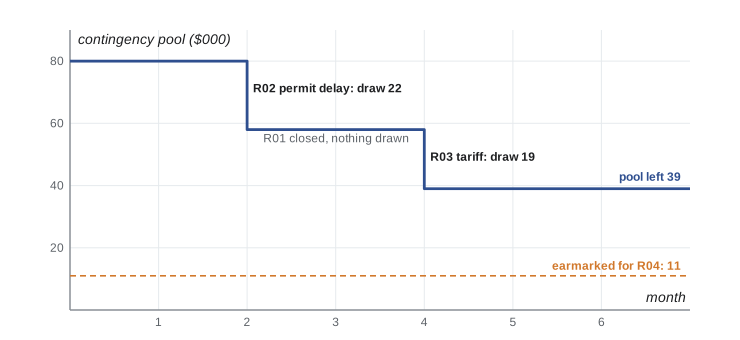
Of the $80,000 contingency, $41,000 has been drawn and $39,000 remains. Eleven thousand is earmarked for R04, the app store rework risk, which is still open; the remaining $28,000 is unallocated because the risks it was set aside for have closed. The library's risk management plan keeps released contingency in the project pool for new or changed risks, recorded in the reserve log, rather than returning it immediately; other organizations return it to the sponsor. Either approach works if it is stated in the plan and the log shows where every dollar is.
The bigger picture is less comfortable. PMP-130's earned value analysis forecast an estimate at completion of about $2.6 million, $205,000 over the BAC of $2.4 million and $85,000 more than the BAC plus the entire management reserve. The overrun comes mainly from construction unit costs and slower tagging, not from the listed risk events. That matches the quantitative risk analysis in lesson 4, which showed only a 22 % chance of finishing within the baseline. The contingency pool cannot absorb this, because contingency is for identified risks, and the overrun is a performance problem across the estimates.
Reserve analysis and when to escalate
Reserve analysis compares the reserve remaining with the risk remaining. If identified risks still open have a combined EMV greater than the contingency left, or the forecast exceeds the budget including reserves, the project manager must act: by strengthening responses, finding corrective actions, or asking the sponsor for a decision. Waiting until reserves are exhausted removes options.
At month 6, the Project Compass threshold is clearly crossed: a forecast more than $50,000 over the baseline must be reported to the sponsor within two working days. The project manager reports the position, the causes and the options: corrective actions on tagging (a third encoding station, which became change request CR-02), value engineering of remaining finishes, release of management reserve, and additional board funding if needed. Management reserve is not the project manager's to spend; the sponsor decides whether to release it, and once released it is added to the cost baseline through change control. Lesson 11 follows the change requests and lesson 12 the outcome.
Reserves also apply to schedule. A project may hold contingency time, sometimes visible as a buffer before a milestone, and the same logic applies: track consumption against remaining schedule risk, and escalate before the buffer is gone. Project Compass's schedule contingency before soft opening was five working days; the permit delay used three of them.
Workarounds
A workaround is an unplanned response to a risk that has occurred, either because it was not identified or because it was passively accepted. It differs from a contingency response, which was planned in advance. When the mall's water main burst in month 5, a risk nobody had identified, the team improvised: it moved furniture deliveries to a storage unit for two weeks and dried out the unit with rented equipment. That was a workaround. Because the lease made the landlord responsible for building services, the landlord's insurer reimbursed the costs, so no reserve was needed: risk had been transferred by a lease clause nobody had thought of as a risk response. The event also added a new lesson to the register, and a new risk: that the mall's ageing services could fail again before opening. Frequent workarounds suggest that risk identification has gaps.
Issues and the issue log
An issue is a current condition or situation that may affect project objectives. A risk that occurs becomes an issue; so do problems that were never risks, such as a disagreement between two departments or a team member's long absence. Issues are recorded in an issue log, which tracks a description, the date raised, who raised it, a priority, an owner, a target date for resolution, status and the final resolution. Issues need resolution, not monitoring: an owner works to remove the obstacle, escalating if necessary.
| Aspect | Risk register | Issue log |
|---|---|---|
| Content | Uncertain future events or conditions | Current problems, decisions needed, conflicts |
| Main question | What might happen, and what will we do about it? | What is happening now, and how will we resolve it? |
| Typical actions | Responses planned in advance, triggers watched | Investigation, decisions, escalation, workarounds |
| Link | A risk that occurs moves to the issue log | An issue may create new risks or change requests |
| Compass example | R04 app store rework | Permit issued late; furniture storage after the water main break |
The 2026 exam outline includes the task of removing impediments and managing issues, and PMP-120 covered the people side: removing obstacles so the team can work. In adaptive teams, issues often surface as impediments in daily stand-ups, and the team lead, scrum master or project manager is expected to clear them quickly. An impediment board, a column on the team board or a short list in the stand-up notes plays the role of the issue log. Whatever the form, issues should have owners and target dates; an issue that sits unresolved for weeks is a schedule risk in its own right.
Issues often lead to change requests. The late permit did not require one, because contingency covered the cost and the delay stayed within schedule contingency. The cost overrun, by contrast, will require changes to the cost baseline. Lesson 11 explains how such changes are controlled.
Reporting risk
Stakeholders need a concise view of risk, not the whole register. The project's monthly board report includes the top five risks with trends, any risks that crossed thresholds, the remaining contingency and management reserve, and the overall confidence of meeting the budget and opening date. Adaptive teams sometimes use a risk burndown chart, plotting the total risk exposure (sum of EMVs or of scores) over time: a falling line shows that risk is being retired as the product takes shape. Good risk reporting is honest about bad news early; the board that heard about a 22 % confidence level at baseline was not surprised by the month 6 forecast.
Worked problem
Contingency, workaround or management reserve?
Three events occur on a project. (1) A risk in the register with a contingency plan occurs: the trigger fires and the planned response is executed, costing $15,000. (2) An unidentified problem occurs within scope, and the team improvises a fix that costs $8,000. (3) The forecast at completion now exceeds the baseline by $60,000 because productivity is lower than estimated across many activities. How should each be handled?
Show solution
- (1) A planned contingency response for an identified risk: fund it from contingency reserve and update the reserve log.
- (2) An improvised response to an unidentified risk is a workaround. Funding normally comes from management reserve with sponsor approval, and the baseline is updated through change control; the event is recorded as a lesson.
- (3) A general performance problem is not a risk event. Analyse causes, propose corrective actions, report against thresholds and, if necessary, request management reserve or additional funding through change control.
Answer: Contingency for the planned response, management reserve via the sponsor for the workaround, and corrective action plus escalation for the performance overrun.
Common mistakes
MistakeReviewing the risk register only at the start of the project.
InsteadReassess risks regularly and at phase gates; close passed risks and add new ones.
MistakeUsing contingency to cover general cost overruns.
InsteadContingency is for identified risks; performance overruns need corrective action and escalation.
MistakeKeeping a risk in the register after it has occurred.
InsteadMove it to the issue log and manage it to resolution.
MistakeCalling a planned contingency response a workaround.
InsteadWorkarounds are unplanned responses to risks that occurred.
MistakeWaiting until reserves are exhausted before telling the sponsor.
InsteadReport when thresholds are crossed, while options remain.
Summary and key terms
- Monitoring risks: track risks and triggers, implement and evaluate responses, identify new risks, review reserves.
- Risk reviews look at the risks; risk audits look at the process.
- Reserve analysis compares remaining reserves with remaining risk and forecasts.
- Management reserve is released by the sponsor and added to the baseline through change control.
- Workarounds are unplanned responses to risks that occurred; frequent workarounds signal identification gaps.
- Issues are current problems tracked in the issue log with owners and target dates; occurred risks become issues.
- Report risk concisely and early, including overall confidence.
- Risk reassessment
- Periodic review of existing risks and identification of new ones.
- Risk audit
- An examination of the effectiveness of risk responses and risk management processes.
- Reserve analysis
- Comparison of remaining contingency and management reserves with remaining risk.
- Workaround
- An unplanned response to a risk that has occurred.
- Issue
- A current condition or situation that may affect project objectives.
- Issue log
- A document recording issues, owners, priorities, target dates and resolutions.
- Risk report
- A summary of overall project risk and the most significant individual risks.
- Risk burndown chart
- A chart of total risk exposure over time, used mainly in adaptive projects.
Practice problems
Work each problem on paper first, then reveal the answer to check.
What is the difference between a risk review and a risk audit?
Show answer
A review examines the risks; an audit examines the process and the effectiveness of responses.
A risk in the register occurs. Where is it managed now?
Show answer
In the issue log.
What is a workaround?
Show answer
An unplanned response to a risk that has occurred.
Who releases management reserve?
Show answer
The sponsor or management, per the governance rules.
Contingency at month 6 is $39,000; open risks have an EMV of $11,000. Is contingency adequate for open risks?
Show answer
Yes, for identified open risks, though it cannot cover general overruns.
Why should a cost overrun from low productivity not be paid from contingency?
Show answer
Contingency is for identified risks, not general performance problems.
What does a falling risk burndown chart show?
Show answer
Risk exposure is being retired over time.
Name three fields of an issue log.
Show answer
Description, owner, priority, target date, status, resolution.
What should frequent workarounds prompt?
Show answer
A review of risk identification.
What happens to the cost baseline when management reserve is used?
Show answer
It increases by the approved amount, through change control.
Lesson quiz · 5 questions
Score 60% or more to complete this lesson.
Create a free account to save your progress, take quizzes and earn a certificate.