
PRIN-101 · Lesson 10 of 12 · 26 min
PRINCE2 compared with the PMP, agile and other approaches
PRINCE2 is one of several ways to think about and certify project management. Candidates, especially in North America, often ask whether they should take PRINCE2, the PMP or an agile certification, or whether they need more than one. This lesson compares PRINCE2 with PMI's PMBOK Guide and PMP certification, with agile approaches such as Scrum, with PRINCE2 Agile and with other frameworks and standards, so that you can explain the differences clearly and make a sensible choice for your own career.
A method versus a body of knowledge
The most important distinction is between a method and a body of knowledge or standard. PRINCE2 is a method: it prescribes a set of principles, practices, processes and roles and tells you how they fit together, although you must tailor them. PMI's PMBOK Guide, now in its eighth edition (2025), describes principles, performance domains and focus areas of project management and points to a wide range of tools and techniques, but it does not prescribe a single way of running a project. In practice, the two complement each other: PRINCE2 provides the governance structure, roles and decision points, while the PMBOK Guide and other sources provide detailed techniques such as scheduling, earned value management and estimating that PRINCE2 deliberately leaves out.
| Feature | PRINCE2 | PMI PMBOK Guide and PMP |
|---|---|---|
| Nature | A prescriptive but tailorable method | A guide to principles, domains and practices |
| Owner | PeopleCert (commercial company) | PMI (member-based professional association) |
| Focus | Governance, roles, business justification, staged control | Broad knowledge of project management, including techniques and leadership |
| Roles | Defined roles: project board, project manager, team manager and others | Describes roles generally; organizations define their own |
| Techniques | Mostly left to other sources, except product-based planning | Wide range described or referenced |
| Entry certificate | Foundation, no experience required | CAPM, no experience required |
| Senior certificate | Practitioner, prerequisite certification required | PMP, 36 to 60 months of experience plus 35 hours of education |
| Renewal | Every three years: CPD, new exam in suite or re-sit | Every three years: 60 professional development units |
PRINCE2 Practitioner and the PMP
The certifications themselves differ as much as the frameworks. The PMP requires documented experience leading projects (36 months with a four-year degree or 60 months without, within a recent window), 35 hours of project management education and a long, scenario-based exam covering predictive, agile and hybrid approaches. PRINCE2 Practitioner requires no documented experience, only a prerequisite certificate, and tests your ability to apply one specific method to a scenario with the manual open. The PMP is therefore usually seen as a signal of experience and broad competence, while PRINCE2 Practitioner signals that you can work within a particular governance framework.
In Canada, both credentials are recognized. The PMP is more frequently requested in private-sector job postings in technology, engineering, construction and consulting, and PMI has active chapters across the country. PRINCE2 is more often seen in federal government, defence and organizations with UK or European links, and some federal professional services contracts list either the PMP or PRINCE2 Practitioner as acceptable evidence for project manager resource categories. Many senior Canadian project managers hold both, using the PMP to show breadth and experience and PRINCE2 to show fluency in a governance method used by public-sector clients.
Worked problem
Choosing a first credential
Two candidates ask for advice. Ahmed has 18 months of experience as a project coordinator and a four-year degree, and wants to work on government projects with UK partners next year. Beth has six years of experience leading software projects in a US company and wants a credential that most local employers recognize. What would you suggest?
Show solution
- Ahmed does not yet meet the PMP experience requirement of 36 months with a degree.
- PRINCE2 Foundation has no experience requirement and is valued in his target environment; Practitioner could follow.
- Beth meets the PMP requirements, and the PMP is the most widely recognized credential with US employers.
- Later, Beth could use her PMP as the prerequisite for PRINCE2 Practitioner if she works with organizations that use it.
Answer: Ahmed: PRINCE2 Foundation now, Practitioner next, the PMP when eligible. Beth: the PMP first, PRINCE2 later if useful.
PRINCE2 and agile approaches
Agile approaches such as Scrum and Kanban focus on delivering value in small increments, responding to change and empowering self-organizing teams. Scrum, for example, defines roles (product owner, scrum master, developers), events (sprints, sprint planning, daily scrum, review, retrospective) and artefacts (product backlog, sprint backlog, increment). Scrum is a framework for delivering products, and it says little about project governance, business justification or how a project fits within an organization's investment decisions.
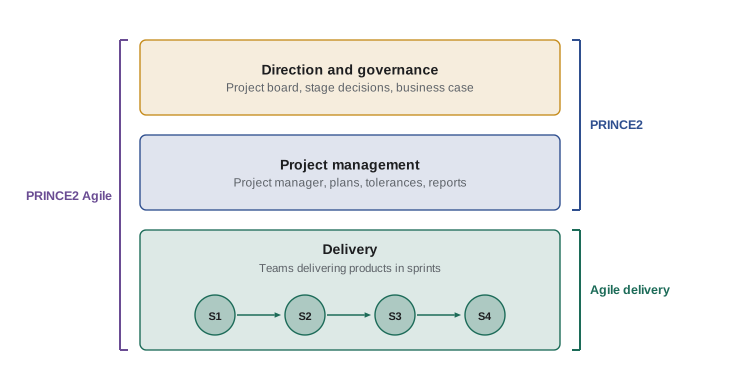
PRINCE2 and agile are therefore not opposites. PRINCE2 governs the project: it asks whether the project is justified, who directs it, what tolerances apply and when the board should decide. Agile approaches can be used to deliver the products within that governance, typically in managing product delivery. PRINCE2 7 explains how to combine them, and PRINCE2 Agile goes further, describing how to fix time and cost while flexing scope, how to set tolerances on features rather than dates and how to blend agile reporting such as burn charts with PRINCE2's highlight reports.
| Aspect | Typical PRINCE2 emphasis | Typical agile emphasis |
|---|---|---|
| Planning | Product-based plans at project, stage and team levels | Backlogs and short iteration plans |
| Control | Tolerances and stage boundaries | Time-boxes, reviews and retrospectives |
| Change | Controlled through issues and change authority | Welcomed and absorbed through backlog prioritization |
| Roles | Board, project manager, team manager | Product owner, scrum master, developers |
| Justification | Business case reviewed at each stage | Value judged by the product owner sprint by sprint |
Other frameworks and standards
Several other bodies of guidance appear alongside PRINCE2 in job postings and procurement documents:
- ISO 21502:2020, Project, programme and portfolio management, guidance on project management: an international standard describing good practice, against which PRINCE2 and PMI approaches can be compared.
- The Association for Project Management (APM) Body of Knowledge, influential in the UK, with qualifications such as the PMQ and the Chartered Project Professional standard.
- IPMA's Individual Competence Baseline, which underpins a four-level certification system (Levels A to D) used in many countries.
- Programme and portfolio guidance, including the former MSP and MoP products in the PRINCE2 family and PMI's program and portfolio standards.
Organizations rarely use just one source. A typical large organization might use PRINCE2 for project governance, Scrum for software delivery, PMBOK-style techniques for scheduling and cost control, and an internal stage-gate policy that aligns with ISO 21502.
Making a sensible choice
When choosing between or combining credentials, consider what your employer and clients ask for, where you want to work, whether you meet experience requirements, what you will learn that is useful in practice and the total cost, including renewal. A simple weighted scoring approach can help make the trade-offs visible.
Worked problem
A weighted comparison
Chloe scores PRINCE2 Practitioner and the PMP from 1 (poor) to 5 (excellent) on three criteria weighted by importance: local employer demand (weight 0.5): PRINCE2 3, PMP 5; fit with her current employer's method (weight 0.3): PRINCE2 5, PMP 3; cost and effort (weight 0.2): PRINCE2 4, PMP 2. Which scores higher?
Show solution
- PRINCE2: 0.5 × 3 + 0.3 × 5 + 0.2 × 4 = 1.5 + 1.5 + 0.8 = 3.8.
- PMP: 0.5 × 5 + 0.3 × 3 + 0.2 × 2 = 2.5 + 0.9 + 0.4 = 3.8.
- The scores tie, so the decision depends on timing and which weight matters most to her in the next year.
Answer: Both score 3.8. A tie is a useful signal that either is reasonable, and that holding both in time may be best.
Where PRINCE2 fits with PMBOK-style techniques
Because PRINCE2 deliberately leaves out many specialist techniques, practitioners routinely borrow them from other sources. A PRINCE2 stage plan, for example, might be scheduled using critical path analysis, resource levelling and a Gantt chart, none of which the manual prescribes. Progress against cost and schedule might be measured with earned value management, then summarized in the highlight report. Risks might be analysed with probability and impact grids, expected monetary value or Monte Carlo simulation. Estimating might use analogous, parametric or three-point techniques. PRINCE2 provides the framework that says when these techniques are needed and who uses the results; PMBOK-style guidance explains how to apply them.
This is one reason why many experienced project managers hold both PMP and PRINCE2 certifications. The combination signals both broad technical knowledge and fluency in a governance method. For employers that use PRINCE2, a PMP holder who also understands PRINCE2 roles and decision points can contribute immediately; for employers that do not, PRINCE2 knowledge still brings useful ideas, such as tolerances, product descriptions and staged business case reviews, that can be applied within any approach.
Vocabulary differences to watch
Candidates moving between PMI and PRINCE2 should watch for terms that differ or overlap. PMI's project sponsor is broadly similar to PRINCE2's executive, but the executive sits on a board with user and supplier representatives. PMI's project charter has a role similar to PRINCE2's project brief and authorization to initiate, while the project management plan corresponds loosely to the project initiation documentation. PMI uses phase for what PRINCE2 often calls a management stage, though PRINCE2 also distinguishes technical stages. A PMI change control board resembles a PRINCE2 change authority. In the exam, always use PRINCE2 terms, and in practice, agree a glossary with your team when people come from different backgrounds.
| PMI term | Nearest PRINCE2 term | Key difference |
|---|---|---|
| Project sponsor | Executive | The executive chairs a board with user and supplier roles |
| Project charter | Project brief and authorization | PRINCE2 separates starting up and initiating |
| Project management plan | Project initiation documentation | The PID also records tailoring decisions |
| Phase gate | End stage assessment | Board decides on the next stage using the business case |
| Change control board | Change authority | Authority can be delegated within a change budget |
Whichever frameworks you use, the underlying goals are the same: deliver something valuable, make good decisions with the right people at the right time, and learn as you go. Being able to explain how PRINCE2 achieves those goals, and how it differs from and complements other approaches, is valuable in job interviews and in conversations with sponsors and colleagues who were trained differently. It also helps you avoid unproductive arguments about which approach is best, focusing instead on what this particular project needs.
In the exam itself, however, you should stay strictly within PRINCE2's vocabulary and logic, even where you know another framework handles a situation differently or in more detail.
Common mistakes
MistakeDescribing PRINCE2 and the PMBOK Guide as the same kind of thing.
InsteadExplain that PRINCE2 is a method and the PMBOK Guide is a guide to a body of knowledge.
MistakeAssuming PRINCE2 and agile cannot be combined.
InsteadUse PRINCE2 for governance and agile for delivery, or study PRINCE2 Agile.
MistakeExpecting PRINCE2 to teach detailed scheduling techniques.
InsteadUse other sources for scheduling, estimating and earned value.
MistakeChoosing a credential without checking local demand.
InsteadLook at job postings and contract requirements where you want to work.
MistakeAssuming the PMP and PRINCE2 Practitioner prove the same thing.
InsteadThe PMP signals experience and breadth; Practitioner signals method application.
Summary and key terms
- PRINCE2 is a tailorable method; the PMBOK Guide describes principles, domains and practices.
- PRINCE2 focuses on governance, roles and staged control and leaves most techniques to other sources.
- The PMP requires documented experience and education; PRINCE2 Practitioner requires a prerequisite certificate.
- The PMP is more common in North America; PRINCE2 is strong in the UK, Europe, Australia and some public sectors.
- Agile approaches deliver products and can work within PRINCE2 governance; PRINCE2 Agile explains how.
- ISO 21502, the APM Body of Knowledge and IPMA's competence baseline are other important references.
- Choose credentials by demand, eligibility, usefulness and total cost; many professionals hold several.
- PMBOK Guide
- PMI's guide to the project management body of knowledge.
- PMP
- Project Management Professional, PMI's experience-based certification.
- CAPM
- Certified Associate in Project Management, PMI's entry-level certification.
- Scrum
- An agile framework with defined roles, events and artefacts.
- Kanban
- An agile method that visualizes and limits work in progress.
- Product owner
- The Scrum role accountable for maximizing product value.
- ISO 21502
- An international standard giving guidance on project management.
- APM
- The UK Association for Project Management.
- IPMA
- The International Project Management Association.
- Weighted scoring
- Comparing options by scores multiplied by importance weights.
Practice problems
Work each problem on paper first, then reveal the answer to check.
Is PRINCE2 a method or a body of knowledge?
Show answer
A method.
Which organization publishes the PMBOK Guide?
Show answer
PMI.
Name one technique PRINCE2 leaves to other sources.
Show answer
For example earned value management or critical path scheduling.
How many months of experience does the PMP require with a four-year degree?
Show answer
36.
What does PRINCE2 Practitioner require instead of experience?
Show answer
An accepted prerequisite certification.
Where in the PRINCE2 process model would agile delivery usually sit?
Show answer
Managing product delivery.
Name the three Scrum roles.
Show answer
Product owner, scrum master and developers.
Which ISO standard gives guidance on project management?
Show answer
ISO 21502.
Weighted score with weights 0.6 and 0.4 and scores 4 and 2?
Show answer
2.4 + 0.8 = 3.2.
Which credential is more common in US job postings?
Show answer
The PMP.
Lesson quiz · 5 questions
Score 60% or more to complete this lesson.
Create a free account to save your progress, take quizzes and earn a certificate.