
PRIN-101 · Lesson 7 of 12 · 26 min
The seven practices: an overview
If the principles say what must be true, the practices describe the aspects of project management that must be addressed continually, from the first idea to closure. PRINCE2 7 has seven practices: business case, organizing, plans, quality, risk, issues and progress. Earlier editions called them themes. Each practice has a purpose, key concepts, roles and management products, and each explains how PRINCE2 requirements can be met using a range of techniques. This lesson gives an overview of all seven, introduces the seven performance targets and shows how tolerances link the practices together. PRIN-130 and PRIN-131 cover the practices in depth.
The seven practices at a glance
| Practice | Question it answers | Key management products |
|---|---|---|
| Business case | Why are we doing this, and is it still worth it? | Business case, benefits management approach |
| Organizing | Who is doing what, and how do they work together? | Project brief roles, communication management approach |
| Plans | How, how much and when? | Project plan, stage plans, team plans, product descriptions |
| Quality | What does fit for purpose mean, and how will we check it? | Project product description, quality management approach, quality register |
| Risk | What could happen, and what will we do about it? | Risk management approach, risk register |
| Issues | What is happening that we did not plan for, including changes? | Issue management approach, issue register, issue reports |
| Progress | Where are we now, where are we going and should we carry on? | Highlight reports, end stage reports, exception reports |
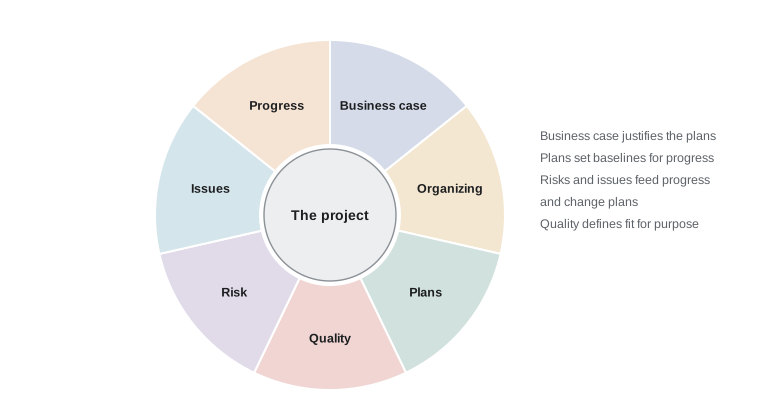
Business case
The business case practice establishes mechanisms to judge whether the project is, and remains, desirable, viable and achievable. Desirable means the balance of costs, benefits and risks is favourable; viable means the project can deliver its products; achievable means the products can provide the expected benefits. The practice distinguishes outputs (the products delivered), outcomes (the changes that result from using them) and benefits (measurable improvements that matter to stakeholders), and it recognizes dis-benefits: negative outcomes that someone sees as a drawback. Benefits are often realized after the project closes, so the benefits management approach says how and when they will be measured.
Worked problem
A gentle net present value
A project costs 100,000 now and is expected to produce benefits of 40,000 a year for three years. Using a discount rate of 8 %, is the net present value positive? (Discount factors: year 1 = 0.926, year 2 = 0.857, year 3 = 0.794.)
Show solution
- Present value of year 1 benefit: 40,000 × 0.926 = 37,040.
- Year 2: 40,000 × 0.857 = 34,280.
- Year 3: 40,000 × 0.794 = 31,760.
- Total present value of benefits: 37,040 + 34,280 + 31,760 = 103,080.
- Net present value: 103,080 − 100,000 = 3,080.
Answer: The NPV is about 3,080, slightly positive, so on these figures the project is worth doing, though with little margin for cost overruns.
Simple payback is another common measure: the time until cumulative benefits equal the cost. Here, 40,000 a year repays 100,000 in 2.5 years. PRINCE2 does not prescribe which measures to use; it requires that the business case be developed, maintained and verified.
Organizing
The organizing practice defines and establishes the project's structure of accountability and responsibilities: who is directing, who is managing and who is delivering. It covers the project board (executive, senior user, senior supplier), project assurance, the change authority, the project manager, team managers and project support. In PRINCE2 7, organizing also covers the wider set of relationships the project depends on, including stakeholders, users affected by change, and the communication needed to engage them. One person can hold more than one role, and one role can be shared, but some combinations should be avoided; for example, project assurance should be independent of the project manager.
Plans
The plans practice facilitates communication and control by defining the means of delivering the products: where and how, by whom, and estimating when and how much. PRINCE2 recognizes three levels of plan: the project plan for the board, stage plans for the project manager and optional team plans for team managers, plus exception plans when needed. Its distinctive technique is product-based planning: describe the final product, break it down into the products needed to create it, write product descriptions, and create a product flow diagram showing the sequence in which products are developed, before identifying activities, estimating and scheduling.
Quality
The quality practice defines and implements the means by which the project creates and verifies products that are fit for purpose. It begins with the customer's quality expectations and acceptance criteria, captured in the project product description, and continues through quality planning (deciding how each product will be checked and by whom) and quality control (carrying out the checks and recording results in the quality register). PRINCE2 also distinguishes quality assurance, which is independent of the project team and checks that the project is being run in a way likely to meet quality requirements.
Risk
The risk practice identifies, assesses and controls uncertainty so that the project is more likely to succeed. A risk is an uncertain event or set of events that, if it occurs, will affect the achievement of objectives. PRINCE2 treats both threats (negative risks) and opportunities (positive risks). The practice describes a risk management procedure: identify, assess, plan, implement and communicate. Responses to threats include avoiding, reducing, transferring, sharing, accepting or preparing contingency plans; responses to opportunities include exploiting, enhancing, sharing or rejecting.
Issues
The issues practice collects and assesses issues and controls changes to the project's baselined products. An issue is any event that has happened, was not planned and requires management action. PRINCE2 recognizes three types: requests for change, off-specifications (something that should be, or is forecast to be, provided but is not), and problems or concerns. Requests for change and off-specifications are decided by the change authority, which might be the project board or a delegated group, within an agreed change budget.
Progress
The progress practice establishes mechanisms to monitor and compare actual achievements against those planned, provide a forecast for the project objectives and the project's continued viability, and control any unacceptable deviations. It is where manage by exception becomes concrete. The board sets stage tolerances and receives highlight reports at agreed intervals; the project manager sets work package tolerances and receives checkpoint reports from team managers; and when a tolerance is forecast to be exceeded, an exception report goes up a level.
The seven performance targets and tolerances
PRINCE2 7 identifies seven aspects of performance that are planned, monitored and controlled: time, cost, quality, scope, benefits, risk and sustainability. Sustainability is new in the seventh edition and covers environmental and social performance targets, such as carbon emissions or waste, that the project must meet. Tolerances can be set for each of these.
| Performance target | Example of a tolerance |
|---|---|
| Time | +2 weeks on the stage end date |
| Cost | ±5 % of the stage budget |
| Quality | Response time between 1.5 and 2.5 seconds on a product attribute |
| Scope | Must-have features delivered; up to two should-have features may be deferred |
| Benefits | Annual savings no lower than 90 % of forecast |
| Risk | No single threat with an expected value above 50,000 without board approval |
| Sustainability | Project carbon footprint no more than 5 % above target |
Worked problem
Checking tolerances across several targets
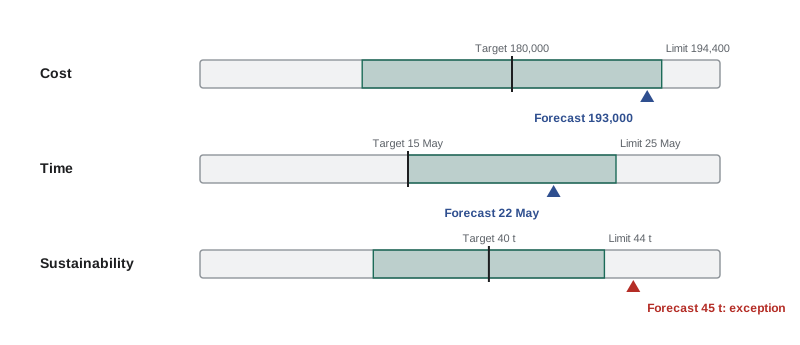
A stage has a budget of 180,000 with a tolerance of ±8 %, an end date of 15 May with a tolerance of +10 days, and a sustainability target of 40 tonnes of CO2e with a tolerance of +10 %. The project manager forecasts a cost of 193,000, an end date of 22 May and 45 tonnes. Which tolerances are threatened?
Show solution
- Cost limit: 180,000 × 1.08 = 194,400. Forecast 193,000 is within tolerance.
- Time limit: 15 May + 10 days = 25 May. Forecast 22 May is within tolerance.
- Sustainability limit: 40 × 1.10 = 44 tonnes. Forecast 45 tonnes exceeds tolerance.
- Because one tolerance is forecast to be exceeded, the project manager raises an exception report to the project board.
Answer: Only the sustainability tolerance is threatened, but that alone triggers an exception to the board.
How the practices work together
The practices are not separate procedures to be run one after another. The business case justifies the plans; the plans set baselines against which progress is measured; risks and issues affect plans and the business case; quality criteria define what the products must achieve; and organizing defines who makes each decision. A single event, such as a key supplier going out of business, touches almost every practice: it is an issue, it changes the risk profile, it may need a new plan, it may affect quality and the business case, and it may require an exception report. Practitioner questions often test exactly these connections.
Canadian public-sector projects may need to address requirements that fit naturally into the practices: official languages and accessibility requirements as quality criteria, the federal Greening Government Strategy or provincial climate commitments as sustainability targets, and privacy impact assessments as products managed under the plans and quality practices.
Management products in the practices
Each practice is supported by management products, documents or information sets that record decisions and status. PRINCE2 7 groups them broadly into baselines (such as the business case, plans and product descriptions), records (such as the risk register, issue register, quality register and lessons log) and reports (such as highlight, checkpoint, end stage and exception reports). The manual provides outlines for each, describing its purpose and typical composition. These outlines are not forms to be filled in blindly; they are checklists of what information is usually needed, to be tailored to the project. On a small project, several products might be combined in a single document or tool, while a large project might keep each in a dedicated system.
In the Foundation exam you should recognize the purpose of the main products, and in Practitioner you may need to choose which product should record a given piece of information. For example, an identified threat with its probability, impact and response belongs in the risk register, while a stakeholder's formal request to add a feature is an issue recorded in the issue register and possibly described in an issue report.
As you study each practice in the later courses, keep asking the same three questions: what is its purpose, who is responsible for what within it, and which management products support it? Those three questions organize the manual's material in a way that matches how exam questions are written.
Taken together, the practices give a project manager a complete checklist of what must be kept under control, while the processes, covered next, say when each is used and by whom.
Common mistakes
MistakeCalling the practices themes in the exam.
InsteadUse the PRINCE2 7 term, practices.
MistakeForgetting sustainability as a performance target.
InsteadLearn all seven: time, cost, quality, scope, benefits, risk and sustainability.
MistakeTreating an issue and a risk as the same thing.
InsteadA risk is uncertain; an issue has already happened.
MistakeTreating outputs as benefits.
InsteadDistinguish outputs, outcomes and measurable benefits.
MistakeRaising exceptions only for cost and time.
InsteadA forecast breach of any tolerance is an exception.
Summary and key terms
- PRINCE2 7 has seven practices: business case, organizing, plans, quality, risk, issues and progress.
- Business case checks that the project is desirable, viable and achievable, distinguishing outputs, outcomes and benefits.
- Organizing defines who directs, manages and delivers, and the relationships involved.
- Plans uses product-based planning across project, stage and team levels.
- Quality, risk and issues define fitness for purpose, manage uncertainty and control change.
- Progress compares actual with planned performance and escalates exceptions.
- The seven performance targets are time, cost, quality, scope, benefits, risk and sustainability.
- Desirable, viable, achievable
- The three tests of a sound business case.
- Output
- A specialist product handed over to a user.
- Outcome
- The result of change from using outputs.
- Benefit
- A measurable improvement seen as an advantage by a stakeholder.
- Dis-benefit
- A measurable decline seen as negative by a stakeholder.
- Product-based planning
- Planning that starts by defining products before activities.
- Quality register
- A record of planned and completed quality activities.
- Off-specification
- Something that should be provided but is not, or is forecast not to be.
- Change authority
- The person or group authorized to approve changes.
- Net present value
- The total present value of benefits minus costs, using a discount rate.
Practice problems
Work each problem on paper first, then reveal the answer to check.
List the seven practices.
Show answer
Business case, organizing, plans, quality, risk, issues and progress.
What are the three tests of a business case?
Show answer
Desirable, viable and achievable.
Distinguish an output from a benefit.
Show answer
An output is a delivered product; a benefit is a measurable improvement from using it.
Simple payback for a cost of 90,000 and benefits of 30,000 a year?
Show answer
3 years.
Present value of 50,000 received in year 2 with a factor of 0.857?
Show answer
42,850.
Name the three types of issue.
Show answer
Request for change, off-specification, and problem or concern.
What is the difference between a risk and an issue?
Show answer
A risk is uncertain and may happen; an issue has happened.
Name the seven performance targets.
Show answer
Time, cost, quality, scope, benefits, risk and sustainability.
Budget 250,000, tolerance ±6 %. Upper limit?
Show answer
265,000.
Who receives checkpoint reports?
Show answer
The project manager, from team managers.
Lesson quiz · 5 questions
Score 60% or more to complete this lesson.
Create a free account to save your progress, take quizzes and earn a certificate.