
PRIN-101 · Lesson 2 of 12 · 26 min
A short history of PRINCE2 and its editions
Knowing where PRINCE2 came from is more than trivia. The method has been revised several times, and study guides, practice questions, videos and forum posts from earlier editions are still everywhere online. A candidate who learns from 2017 material may memorize "themes" that are now called practices, six performance targets instead of seven, and roles or management products that have since been reorganized. This lesson traces the history of PRINCE2 from its roots in the 1970s to the seventh edition and the 2026 renaming, explains who has owned the method over time and shows you how to tell which edition a piece of material is based on.
From PROMPT to PRINCE
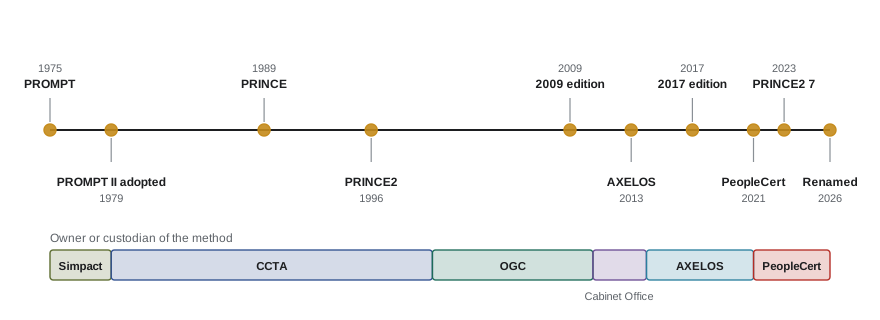
The story begins in 1975, when a British consultancy called Simpact Systems developed a project management method named PROMPT, later PROMPT II, to bring more discipline to computer projects that were running late and over budget. In 1979 the UK government's Central Computer and Telecommunications Agency (CCTA) adopted PROMPT II for government information systems projects.
In 1989 the CCTA published PRINCE, short for PRojects IN Controlled Environments, as a replacement. PRINCE built on PROMPT II but was firmly aimed at government IT work. It introduced ideas that survive today: a project board that directs the project, a project manager who manages it day to day, stages as points of control and a focus on the products the project delivers. Because it was designed for large IT projects, early PRINCE could feel heavy and bureaucratic when applied to anything smaller or outside information technology.
PRINCE2 becomes a generic method
In 1996 the CCTA published PRINCE2. The key change was that the method became generic: it was rewritten so that it could be applied to any kind of project, not just IT. It was organized around processes describing the journey through a project, supported by components such as the business case, organization, plans, controls, management of risk, quality, configuration management and change control. Revisions followed in the late 1990s and the early 2000s as the method was refined in use.
Responsibility for the method moved several times as the UK government reorganized itself. The CCTA was merged into the Office of Government Commerce (OGC) around 2000 and 2001. The OGC published the major 2009 refresh, which introduced the structure most current practitioners know: seven principles, seven themes and seven processes. In 2010 and 2011, OGC functions moved into the Cabinet Office.
AXELOS, the 2017 update and renumbering
In 2013 the Cabinet Office created AXELOS, a joint venture with the outsourcing company Capita, to own and develop PRINCE2, ITIL and related best-practice products; AXELOS began operating in 2014. AXELOS published the 2017 update, which kept the seven-seven-seven structure but placed much more emphasis on tailoring the method to the project and its environment. In 2020 the editions were renumbered: the 2009 update became the fifth edition and the 2017 update the sixth edition, which is why you will see older material described as "PRINCE2 2017" or "PRINCE2 6th edition".
In 2021 PeopleCert, an examination and certification body that had long delivered AXELOS exams, acquired AXELOS. PeopleCert now owns PRINCE2, ITIL and the related products, writes and runs the exams, accredits training organizations and operates the PeopleCert Plus membership. Lesson 3 explains these roles.
PRINCE2 7
The seventh edition, Managing Successful Projects with PRINCE2, was released in 2023, with the new Foundation and Practitioner exams following in the same period. It is the edition that current exams test. Its main changes include:
- People as an integrated element. The method now gives explicit attention to leadership, culture, teams, communication, relationships and the management of change for the people affected by a project.
- Project context as an integrated element, recognizing that tailoring depends on the environment: whether the project is commercial, part of a programme, run across several organizations, large or small, predictive or agile.
- Themes renamed practices, reflecting the idea that these are things project managers practise throughout the life of a project.
- Sustainability as a seventh performance target, alongside time, cost, quality, scope, benefits and risk.
- Guidance on digital and data management, and updated management products.
- A clearer explanation of how PRINCE2 works with agile and other delivery methods.
| Year | Event |
|---|---|
| 1975 | Simpact Systems develops PROMPT |
| 1979 | CCTA adopts PROMPT II for government IT projects |
| 1989 | CCTA publishes PRINCE |
| 1996 | PRINCE2 published as a generic method |
| 2009 | Major refresh: seven principles, themes and processes (later called the 5th edition) |
| 2013–2014 | AXELOS created as a Cabinet Office and Capita joint venture |
| 2017 | Update emphasizing tailoring (later called the 6th edition) |
| 2021 | PeopleCert acquires AXELOS |
| 2023 | PRINCE2 7 released |
| 2026 | PRINCE2 7 certificates renamed PRINCE2 Project Management |
The 2026 renaming
In late 2025 PeopleCert announced new names for the PRINCE2 family. PRINCE2 7 became PRINCE2 Project Management, and PRINCE2 Agile became simply PRINCE2 Agile. The related programme, portfolio, risk and project office products, previously known as MSP, MoP, M_o_R and P3O, were also brought under the PRINCE2 brand. According to PeopleCert, holders of PRINCE2 7 certificates would see the new name on their e-certificates and digital badges from the week of 12 January 2026. The method itself did not change with the name: the 2023 manual, the five integrated elements and the exams remain the same. You will therefore see "PRINCE2 7", "PRINCE2 7th edition" and "PRINCE2 Project Management (Version 7)" used for the same thing.
Comparing the sixth and seventh editions
If you are returning to PRINCE2 after certifying on the sixth edition, or using a colleague's older notes, the differences below matter most. They are differences of emphasis and structure rather than a complete rewrite: the seven principles, the project board and the seven processes would all be familiar to a 2017 candidate.
| Topic | 6th edition (2017) | PRINCE2 7 (2023) |
|---|---|---|
| Structure | Principles, themes, processes, tailoring to the environment | Five integrated elements: principles, people, practices, processes, project context |
| Aspects of project management | Seven themes | Seven practices (same broad areas, renamed and updated) |
| Performance targets | Six: time, cost, quality, scope, benefits, risk | Seven: adds sustainability |
| People and change | Covered implicitly | A full integrated element |
| Data and digital | Little guidance | Guidance on digital and data management |
| Exam | 2017 Foundation and Practitioner exams | New Foundation and Practitioner exams based on the 2023 manual |
Worked problem
Dating a study guide
You find a free online flashcard set. It refers to "the seven themes", lists the tolerances as time, cost, quality, scope, benefits and risk, and says nothing about people or sustainability. Which edition is it based on, and should you use it?
Show solution
- The word themes rather than practices points to the 2009 or 2017 editions.
- Six tolerance areas without sustainability also points to an edition before 2023.
- No people element confirms it is pre-2023 material.
- The principles and processes will largely still apply, but terminology, the performance targets and the people and context content will not match the current exam.
Answer: It is based on the sixth (or fifth) edition. Use it only with care for the principles and processes, and prefer material written for PRINCE2 7.
What happens to older certificates
Certificates do not disappear when a new edition is published. Candidates who passed earlier exams remain on PeopleCert's register, and their certificates still show that they passed that exam on that date. PeopleCert's current renewal policy, explained in Lesson 11, works on a three-year cycle from the certification date, and certificates that have not been renewed are flagged on the register as needing renewal. Older Foundation and Practitioner certificates are also recognized as prerequisites for some newer exams; for example, a PRINCE2 sixth-edition Foundation or Practitioner certificate is accepted as a prerequisite for the PRINCE2 7 Practitioner exam, as Lesson 5 explains.
For Canadian candidates, the edition question often comes up when an employer or a federal contract asks for "PRINCE2 Practitioner" without saying which edition. Most procurement documents simply require a valid certificate, but some evaluation grids give points only for current credentials, so it is worth checking the wording and keeping certificates renewed if they matter for your work.
Worked problem
Tracking a three-year cycle
Marc passed PRINCE2 6th edition Practitioner on 15 March 2022 and did nothing further. On 1 October 2026, how long ago did his certificate reach its renewal date, and what does the register show?
Show solution
- Three years from 15 March 2022 is 15 March 2025.
- From 15 March 2025 to 1 October 2026 is about 1 year and 6.5 months.
- Under PeopleCert's policy the certificate stays on the register but is marked as needing renewal.
Answer: His renewal date passed about 18 months earlier; the register still lists him but flags the certificate as needing renewal.
Lesson 11 explains the three ways to renew: passing another exam in the same product suite, re-sitting the same exam, or logging continuing professional development points through PeopleCert Plus.
Why the history matters for the exam
Exam questions are written from the current manual, and the manual uses current vocabulary. A Foundation question that asks you to identify a practice will offer distractors that sound plausible to someone who learned the old themes, and a question about tolerances may include sustainability as the correct answer. History also helps you understand the method's character. PRINCE2 grew up in government, where accountability, documented decisions and the ability to stop failing investments matter enormously, and those values still shape the principles. At the same time, each edition has pushed further toward flexibility and tailoring, partly in response to criticism that earlier versions encouraged paperwork for its own sake.
That tension between control and flexibility runs through the rest of this course. The best PRINCE2 practitioners apply the principles faithfully but tailor everything else ruthlessly, producing only the documents and controls that add value for the project in front of them.
Criticisms that shaped the editions
Each revision of PRINCE2 has responded partly to criticism. Practitioners complained that early versions encouraged "PRINCE2 by template", in which teams filled in every document whether or not it helped. Others pointed out that the method said little about leadership, motivation or the politics of change, and that it fitted awkwardly with agile delivery. The 2009 refresh answered the first complaint by introducing principles, so that the method was anchored in ideas rather than paperwork; the 2017 update stressed tailoring; and the seventh edition added people and context and explained how to combine PRINCE2 with agile ways of working. Understanding these debates helps you answer exam questions about why the method is designed the way it is, and it helps you argue for sensible tailoring at work.
Finally, the history explains why you will meet PRINCE2 language in places that have never formally adopted the method. Generations of UK, Australian and Commonwealth public servants and consultants learned it, and terms such as project board, stage boundary, exception report and product description have spread into organizations far beyond the method's original home.
Common mistakes
MistakeStudying from 2017 notes and memorizing six tolerance areas.
InsteadLearn the seven performance targets, including sustainability.
MistakeCalling the practices themes in an exam.
InsteadUse the PRINCE2 7 term, practices.
MistakeThinking the 2026 renaming changed the method or the exam.
InsteadRecognize that PRINCE2 Project Management is the same PRINCE2 7 content under a new name.
MistakeAssuming an old certificate has been cancelled.
InsteadCheck the register; it remains listed but may need renewal.
MistakeBelieving PRINCE2 is only for IT projects.
InsteadRemember it has been generic since 1996.
Summary and key terms
- PRINCE2 descends from PROMPT II (1975), adopted by the UK government's CCTA in 1979.
- PRINCE was published in 1989 for government IT projects; PRINCE2 became generic in 1996.
- The 2009 refresh introduced seven principles, seven themes and seven processes.
- AXELOS owned PRINCE2 from 2013–2014; PeopleCert acquired AXELOS in 2021.
- PRINCE2 7 (2023) added people and project context, renamed themes as practices and added sustainability.
- In 2026 PRINCE2 7 certificates were renamed PRINCE2 Project Management without changing the method.
- Older certificates remain on the register but follow a three-year renewal cycle.
- PROMPT II
- A 1970s project method adopted by the UK government, the ancestor of PRINCE.
- CCTA
- Central Computer and Telecommunications Agency, which created PRINCE and PRINCE2.
- OGC
- Office of Government Commerce, which published the 2009 edition.
- AXELOS
- The joint venture that owned PRINCE2 and ITIL from 2013 until PeopleCert acquired it.
- PeopleCert
- The company that owns PRINCE2 and runs its exams.
- Edition
- A published version of the PRINCE2 manual.
- Theme
- The pre-2023 name for what PRINCE2 7 calls a practice.
- Performance target
- An aspect of performance, such as time or sustainability, that is planned and controlled.
- Generic method
- A method designed to apply to any kind of project.
- Register
- PeopleCert's record of successful candidates and their certificates.
Practice problems
Work each problem on paper first, then reveal the answer to check.
What method preceded PRINCE?
Show answer
PROMPT II.
When was PRINCE2 published, and what was the key change?
Show answer
1996; it became a generic method for any project.
Which edition introduced seven principles, themes and processes?
Show answer
The 2009 refresh, later called the fifth edition.
What was the 2017 update renamed in 2020?
Show answer
The sixth edition.
Who acquired AXELOS in 2021?
Show answer
PeopleCert.
Name two integrated elements new in PRINCE2 7.
Show answer
People and project context.
Which performance target did PRINCE2 7 add?
Show answer
Sustainability.
What is PRINCE2 7 called after the 2026 renaming?
Show answer
PRINCE2 Project Management.
A guide refers to themes. What does that suggest?
Show answer
It is based on an edition before PRINCE2 7.
A certificate dated 10 June 2023 reaches its three-year renewal date when?
Show answer
10 June 2026.
Lesson quiz · 5 questions
Score 60% or more to complete this lesson.
Create a free account to save your progress, take quizzes and earn a certificate.