
PRIN-101 · Lesson 12 of 12 · 28 min
Study strategy and your personal PRINCE2 plan
This final lesson turns everything in the course into a plan you can act on. It explains how people learn a method like PRINCE2 most effectively, how to structure study for Foundation and Practitioner, how to know when you are ready, how to prepare for exam day and how to put together a personal certification plan as the capstone for this course. You will leave with a dated plan covering which certification to take, when, how you will study, what it will cost and how you will keep it current.
How people learn a method
PRINCE2 is a connected system of ideas, vocabulary and relationships. Rereading the manual and highlighting it feels productive but is one of the least effective ways to learn. Research on learning points to a handful of techniques that work much better:
- Retrieval practice: testing yourself by recalling information from memory, with flashcards, practice questions or by explaining a concept without notes. Each successful recall strengthens memory.
- Spaced repetition: revisiting material at increasing intervals, such as one day, three days, a week and two weeks after first learning it, rather than cramming.
- Interleaving: mixing topics in a study session, such as alternating questions on practices and processes, which helps you tell similar concepts apart.
- Elaboration: asking why and how, and connecting new ideas to examples from your own work. Why does the senior user specify benefits? How would manage by exception work on my last project?
- An error log: recording every practice question you get wrong, why the right answer is right and why your answer was wrong, then reviewing the log regularly.
| Technique | Example for PRINCE2 | Why it works |
|---|---|---|
| Retrieval practice | Write the seven processes and their purposes from memory | Recalling strengthens memory more than rereading |
| Spaced repetition | Review flashcards on days 1, 3, 7 and 14 | Spacing counteracts forgetting |
| Interleaving | Mix practice questions on roles, practices and processes | Builds the ability to discriminate between similar ideas |
| Elaboration | Explain how a principle applied on a project you know | Connections make knowledge usable |
| Error log | Record and review every wrong practice answer | Targets weaknesses and prevents repeated mistakes |
Structuring Foundation study
Foundation rewards broad, accurate knowledge across the whole manual. A typical plan works through the integrated elements in order, then shifts to mixed practice:
- Weeks 1 and 2: principles, people and project context; the roles and the project board; begin flashcards.
- Weeks 3 and 4: the seven practices, with the key concepts, roles and management products of each.
- Week 5: the seven processes and how they connect; draw the process model from memory.
- Week 6: full practice papers under timed conditions, error log review and targeted revision.
Worked problem
A weighted Foundation plan
Jordan has 30 study hours available over six weeks. He decides to split time in proportion to how much content each area has and how weak he is in it: principles 10 %, people and context 10 %, practices 35 %, processes 25 %, practice exams and review 20 %. How many hours go to each area, and how many hours a week is that?
Show solution
- Principles: 0.10 × 30 = 3 hours.
- People and context: 0.10 × 30 = 3 hours.
- Practices: 0.35 × 30 = 10.5 hours.
- Processes: 0.25 × 30 = 7.5 hours.
- Practice exams and review: 0.20 × 30 = 6 hours.
- Weekly load: 30 / 6 = 5 hours.
Answer: 3, 3, 10.5, 7.5 and 6 hours respectively, at 5 hours a week.
Structuring Practitioner study
Practitioner study is different. You already know the method; now you must apply it quickly, with the manual, to scenarios. Effective preparation includes:
- Preparing the manual: tabs, highlighting and margin notes, as described in Lesson 5.
- Working through sample scenarios and papers under timed conditions, and reviewing every answer, right or wrong, against the manual.
- Practising the most common application questions: which action fits a situation, which management product records something, whether a tolerance is breached and what happens next, and whether a tailoring decision is appropriate.
- Applying the method to a real or imagined project of your own, writing a short tailored outline: roles, stages, tolerances and key products.
Many candidates allow 15 to 25 hours of Practitioner preparation beyond Foundation, more if there is a long gap between the two exams or if they come from a PMP background and need to learn PRINCE2's vocabulary.
Knowing when you are ready
Practice exams are the best readiness check, provided they are written for the current edition and you take them under real conditions. A useful rule is to book the real exam when you consistently score well above the pass mark on fresh papers: for example, at least 75 % on two consecutive Foundation practice papers you have not seen before, or a comfortable margin above 60 % on Practitioner samples within the time limit. If your scores are close to the pass mark, use your error log to identify weak areas and study those before booking.
Worked problem
Reading practice scores
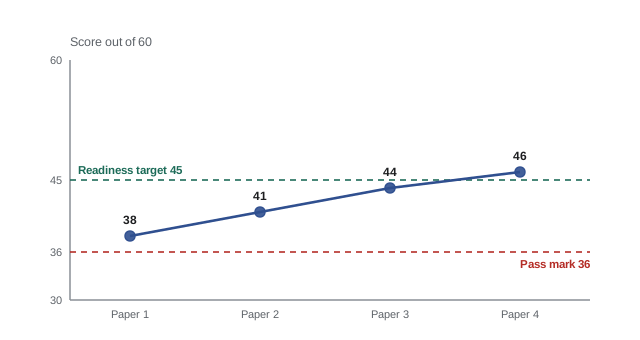
Mei's scores on four fresh Foundation practice papers were 38, 41, 44 and 46 out of 60. Is she ready, using the rule of at least 75 % on two consecutive papers?
Show solution
- 75 % of 60 is 45.
- Her last two scores are 44 and 46: 73 % and 77 %.
- Only one of the last two meets 75 %, so she has not yet met the rule, but her trend is rising.
- One more fresh paper at 45 or above would meet it.
Answer: Nearly: she should take one more fresh paper and book the exam if she scores 45 or more.
Exam day
Whatever exam you take, a calm, prepared start makes a difference. The day before, confirm your booking, time zone and identification, run the proctoring system check again if you are online, prepare your room and, for Practitioner, put your manual on the desk. Sleep matters more than last-minute cramming. On the day, log in or arrive early, read each question carefully, follow your pacing plan, answer every question and use any remaining time to review flagged questions rather than rechecking everything.
Capstone: your personal PRINCE2 plan
Use the template below to build your own plan. Write it down, date it and share it with your manager or a study partner; people who make specific, public plans are more likely to follow through.
| Plan element | Questions to answer | Your entry (example) |
|---|---|---|
| Goal | Which certification, and why? | PRINCE2 Foundation, then Practitioner, to work on government transformation projects |
| Eligibility | Do I need a prerequisite? | None for Foundation; Foundation is the prerequisite for Practitioner |
| Route | Self-study, e-learning, virtual or classroom? | Self-study Foundation; live virtual Practitioner |
| Budget | Fees, manual, insurance, membership, time | About 2,600 in fees; employer to fund Practitioner |
| Schedule | Study hours, weekly load, exam dates | 30 hours over 6 weeks; Foundation in week 7; Practitioner 3 months later |
| Readiness checks | What scores will trigger booking? | 75 % on two fresh Foundation papers; 70 % on Practitioner samples |
| Risks | What could derail the plan? | Busy season at work; mitigate by front-loading study |
| Renewal | When and how will I renew? | Renewal date three years after passing; plan a further suite exam or CPD |
Worked problem
Building a capstone timeline
Omar starts studying on 5 January. He plans 30 hours for Foundation at 5 hours a week with a one-week buffer, then a four-week gap applying the method at work, then 20 hours of Practitioner preparation at 5 hours a week. On what dates should he plan his two exams, approximately?
Show solution
- Foundation: 30 / 5 = 6 weeks, plus 1 week of buffer = 7 weeks, so around 23 February.
- Gap: four weeks, to around 23 March.
- Practitioner preparation: 20 / 5 = 4 weeks, so around 20 April.
- He should book the exams for the weeks of 23 February and 20 April, subject to readiness checks.
Answer: Foundation around 23 February and Practitioner around 20 April.
Notice that the plan is itself a small project. It has a business case (your goal), stages (Foundation and Practitioner), tolerances (a buffer week), risks and a clear end. Applying PRINCE2 thinking to your own certification is good practice for the exams.
Canadian candidates may want to align their plan with performance review and training budget cycles, which in the federal public service and many provincial organizations follow an April-to-March fiscal year. Asking for funding in the first quarter of the fiscal year often works better than asking near year-end, when budgets are committed or must be spent quickly.
Where to go next
The rest of this program takes the method apart in depth. PRIN-110 studies the principles, PRIN-120 people and the project context, PRIN-130 and PRIN-131 the practices, PRIN-140 and PRIN-141 the processes, PRIN-150 tailoring and PRINCE2 in different environments, and PRIN-160 exam strategy and practice. Taken together with this course, they are designed to prepare you for both Foundation and Practitioner, alongside the official manual and accredited practice papers.
Studying with others
Study partners and groups can make preparation more effective and more enjoyable, provided they are used well. Quizzing each other is an efficient form of retrieval practice, and explaining a concept to someone else quickly reveals gaps in your own understanding. A group of three or four colleagues preparing for the same exam might meet weekly for an hour, each person preparing questions on an assigned practice or process, then working through a timed set of practice questions together and discussing the answers. Online communities can also help, but be careful with shared exam "dumps" that claim to contain real questions: using them breaches exam rules, can lead to certificates being revoked and teaches you less than genuine practice.
If you are studying alone, you can still get some of the benefits by explaining concepts aloud as if teaching, recording short summaries for yourself, or writing a one-page explanation of each process from memory and then checking it against the manual.
Finally, be kind to yourself. Most candidates pass at the first attempt when they prepare steadily, but a failed attempt is not a verdict on your ability as a project professional. Treat it as feedback, adjust your plan using your score report and error log, and try again. The habits you build while preparing, such as planning in stages, setting tolerances, tracking progress and learning from experience, are exactly the habits PRINCE2 asks of you on real projects, and they will serve you long after the exam.
Good luck with your preparation, and remember to confirm every exam detail with PeopleCert and your provider before booking.
Common mistakes
MistakeRereading and highlighting as the main study method.
InsteadUse retrieval practice, spaced repetition and an error log.
MistakeBooking the exam before practice scores are consistently strong.
InsteadSet a readiness target well above the pass mark.
MistakeUsing practice papers from an old edition.
InsteadUse papers written for PRINCE2 7.
MistakeLeaving manual preparation until the night before Practitioner.
InsteadTab and annotate the manual during study.
MistakeKeeping the plan in your head.
InsteadWrite a dated plan and share it.
Summary and key terms
- Retrieval practice, spaced repetition, interleaving, elaboration and an error log beat rereading.
- Foundation study covers all integrated elements, then shifts to timed mixed practice.
- Practitioner study focuses on applying the method to scenarios with a well-prepared manual.
- Book when practice scores are consistently above a readiness target such as 75 %.
- Prepare the day before: booking, ID, system check, room and, for Practitioner, the manual.
- A personal plan covers goal, eligibility, route, budget, schedule, readiness checks, risks and renewal.
- The later PRIN courses study each part of the method in depth.
- Retrieval practice
- Strengthening memory by recalling information without notes.
- Spaced repetition
- Reviewing material at increasing intervals.
- Interleaving
- Mixing different topics within a study session.
- Elaboration
- Explaining why and how and linking ideas to examples.
- Error log
- A record of mistakes and the reasons for them.
- Readiness target
- A practice score that signals you are ready to book.
- Fresh paper
- A practice exam you have not seen before.
- Weighted study plan
- A plan that allocates hours by content size and weakness.
- Buffer
- Spare time added to a plan to absorb delays.
- Capstone
- A final task that brings together the learning in a course.
Practice problems
Work each problem on paper first, then reveal the answer to check.
Name three evidence-based study techniques.
Show answer
For example retrieval practice, spaced repetition and interleaving.
Why is rereading less effective than retrieval?
Show answer
Recalling information strengthens memory more than recognizing it.
Hours for practices at 35 % of 40 hours?
Show answer
14 hours.
Weeks for 24 hours at 4 hours a week plus one buffer week?
Show answer
7 weeks.
What score is 75 % of 60?
Show answer
45.
Scores of 46 and 47 on two fresh papers: ready by the 75 % rule?
Show answer
Yes.
Name two things to do the day before an online exam.
Show answer
For example confirm the booking and rerun the system check.
Name four elements of a personal certification plan.
Show answer
For example goal, route, budget and renewal.
Which course in the program covers the processes in depth?
Show answer
PRIN-140 and PRIN-141.
How is a personal certification plan like a PRINCE2 project?
Show answer
It has a justification, stages, tolerances, risks and an end.
Lesson quiz · 5 questions
Score 60% or more to complete this lesson.
Create a free account to save your progress, take quizzes and earn a certificate.