
PRIN-101 · Lesson 4 of 12 · 28 min
The Foundation exam: format, rules and scoring
The Foundation exam is the entry point to PRINCE2 certification and the exam most candidates take first. It checks that you know and understand the method well enough to work as an informed member of a project team that uses PRINCE2. This lesson explains the format, the rules, the types of question you will see, how scoring works and how to manage your time, with worked examples of the arithmetic that helps you plan. All details are stated as they stood at the time of writing; confirm them with PeopleCert or your training provider before you book.
The format at a glance
At the time of writing, the PRINCE2 Project Management (version 7) Foundation exam had the following format, as published by PeopleCert and accredited training providers:
| Feature | Foundation exam |
|---|---|
| Questions | 60 multiple-choice questions |
| Time | 60 minutes |
| Pass mark | 36 correct (60 %) |
| Materials | Closed book: no manual or notes |
| Prerequisites | None |
| Delivery | Online with remote proctoring, or at an accredited provider |
| Negative marking | None: a wrong answer scores the same as a blank |
| Validity | Renewal required every three years under the current policy |
Candidates taking the exam in a language that is not their first language have often been allowed extra time, commonly 25 %, under PeopleCert's policies; if this applies to you, check the current rule and how to request it when you book. Candidates with disabilities can request accommodations through the same process.
What the exam tests
Foundation tests knowledge and comprehension rather than application. Questions ask you to recognize the purpose of a principle, practice or process, identify which role is responsible for a decision, recall what a management product is for, or understand how the integrated elements relate to one another. You will not be asked to analyse a long scenario; that is what Practitioner does. The syllabus covers all five integrated elements, so every part of the manual can appear, but questions on the practices and processes make up a large share because there is more to know about them.
| Area | What you should be able to do |
|---|---|
| Principles | State each of the seven principles and explain why each matters |
| People | Describe how leadership, culture, teams, communication and change affect projects |
| Practices | Explain the purpose of each practice and its key concepts, roles and management products |
| Processes | State the purpose and objectives of each process and the main activities and decisions in it |
| Project context | Explain how context affects tailoring |
| Roles and products | Identify who does what and what each key management product is for |
Question styles
All Foundation questions are multiple choice with four options and one correct answer, but they come in several styles. The examples below are written for this course to illustrate the styles; they are not real exam questions.
- Standard: a direct question with four answers. For example, "Which role is responsible for the business case?"
- Negative: the question asks which option is NOT true or is NOT a purpose of something. The capitals are a warning; read the stem twice.
- Missing word: a sentence with a gap, such as "The ____ practice establishes mechanisms to judge whether the project is desirable, viable and achievable."
- List: the question gives several numbered statements and asks which combination is correct, for example "Which statements about stages are true? 1, 2, 3 or 4", with options such as "1 and 2", "2 and 3" and so on.
List questions take longer than they look. A good technique is to judge each numbered statement as true or false first, then find the option that matches your judgements. If you are sure statement 1 is false, you can eliminate every option that includes it.
Worked problem
Working a list question
A practice question (written for this course) gives four statements about the project board and asks which two are true: (1) the executive is ultimately accountable for the project; (2) the senior supplier represents the people who will use the products; (3) the senior user specifies the benefits; (4) the project manager is a member of the board. Options: A) 1 and 2; B) 1 and 3; C) 2 and 4; D) 3 and 4.
Show solution
- Statement 1: true; the executive is ultimately accountable.
- Statement 2: false; the senior user represents users, the senior supplier represents those designing and building the products.
- Statement 3: true; the senior user specifies the benefits and is held to account for realizing them.
- Statement 4: false; the project manager reports to the board but is not a member of it.
- True statements are 1 and 3.
Answer: Option B (1 and 3). Eliminating options containing a statement you know is false often gets you there quickly.
Scoring and the pass mark
Each question is worth one mark, and you need 36 out of 60 to pass, which is 60 %. There is no negative marking, so you should never leave a question blank: a guess has a one-in-four chance of being right, and a wrong answer costs nothing. There is no published scaling or weighting for Foundation; the raw score decides the result.
Worked problem
How much guessing helps
Sam finishes the exam confident of 33 answers being correct. Of the remaining 27, he can eliminate two options on 12 questions and has no idea on 15. What is his expected score if he answers everything, and is he likely to pass?
Show solution
- On the 12 questions with two options left, each guess has a 1/2 chance: 12 × 0.5 = 6 expected marks.
- On the 15 pure guesses, each has a 1/4 chance: 15 × 0.25 = 3.75 expected marks.
- Expected total: 33 + 6 + 3.75 ≈ 42.8.
- That is comfortably above 36, although real results vary around the expected value.
Answer: About 43 marks expected, so he is likely to pass. Answering every question and eliminating options is worth several marks.
The lesson is not that you can guess your way through. It is that partial knowledge, used well, is valuable. Eliminating two options doubles your chance on a question compared with a pure guess.
Managing your time
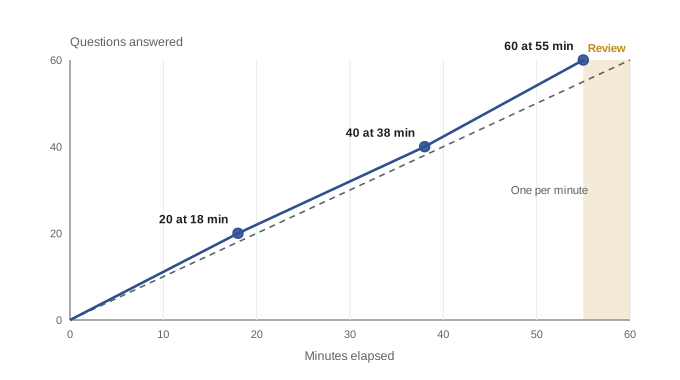
Sixty minutes for sixty questions gives an average of one minute per question. Many standard questions take 20 to 40 seconds, while list and negative questions take longer. A simple pacing plan is to check the clock at three points:
| Checkpoint | Questions answered | Time used |
|---|---|---|
| First check | 20 | No more than 18 minutes |
| Second check | 40 | No more than 38 minutes |
| Third check | 60 | No more than 55 minutes, leaving 5 for review |
If a question stumps you, choose your best answer, flag it if the exam software allows, and move on. Returning with fresh eyes often helps, and other questions sometimes jog your memory. Do not change answers at the end without a clear reason; first instincts based on study are often right, and second-guessing tends to turn right answers into wrong ones.
Worked problem
Pacing with extra time
Ana is taking Foundation in her second language and has been granted 25 % extra time. How long does she have, and what is her average time per question?
Show solution
- Extra time: 60 × 0.25 = 15 minutes.
- Total: 60 + 15 = 75 minutes.
- Average per question: 75 / 60 = 1.25 minutes, or 75 seconds.
Answer: 75 minutes in total, about 75 seconds per question.
Exam day: online proctoring
Most candidates now take Foundation online. Before exam day, check your computer against the proctoring provider's requirements, install any secure browser software and run its system test. On the day you will typically need:
- A quiet, private, well-lit room with a clear desk and no other people present.
- A computer with a working webcam, microphone and stable internet connection, and a single monitor.
- Government-issued photo identification whose name matches your booking.
- Time for check-in, which may include photographing your ID and showing the proctor your room and desk with the webcam.
During the exam, you may not use notes, books, phones, other devices, headphones or other applications, and you should not read questions aloud or leave the camera view. Breaking the rules can lead to the exam being stopped and the result voided. For online exams, a provisional result is usually shown soon after you finish, with the certificate issued afterwards; check the current process with PeopleCert.
Canadian candidates should check that the name on their booking matches their identification exactly, including accents in French names, and that their chosen exam language (English or French, for example) is available at the time they want. Online exams can be booked across time zones, but proctor availability can be thinner overnight in Pacific or Atlantic time.
If you do not pass
Failing Foundation is disappointing but common enough that training providers sell retake insurance, sometimes called Take2, which lets you resit at a reduced cost or no extra cost within a set period. Without insurance you buy a new exam. Use your score report to see which areas were weak, return to the manual for those areas, do fresh practice questions and book again when you are consistently scoring well above the pass mark on practice papers.
Building Foundation knowledge that lasts
Because Foundation is closed book, you must hold a surprising amount of detail in memory: the seven principles, the seven practices and their purposes, the seven processes and their objectives, the roles and their responsibilities, the main management products and their purposes, the seven performance targets and the types of issue. Flashcards are well suited to this. Put a term or question on one side and a short, accurate answer on the other, written in your own words but checked against the manual. Review cards little and often, and retire cards only after you have answered them correctly several days apart. Candidates who can recite the purpose of every process without hesitation find that many exam questions become straightforward recognition tasks, leaving more time for the trickier list and negative questions.
It also helps to learn the relationships between items rather than isolated facts. For example, learn that the executive owns the business case, the senior user specifies benefits, the senior supplier is accountable for the quality of products delivered by suppliers, and the project manager prepares most management products. Questions often hinge on exactly these distinctions.
Finally, remember that the exam tests the manual's version of PRINCE2, not your organization's. If your workplace uses PRINCE2 terms loosely, for example calling every status update a highlight report, set those habits aside while studying and answer according to the manual.
Common mistakes
MistakeLeaving questions blank.
InsteadAnswer every question; there is no negative marking.
MistakeMissing the word NOT in a negative question.
InsteadRead every stem twice and underline negatives mentally.
MistakeSpending three minutes on one list question.
InsteadJudge each statement, choose, flag and move on.
MistakeTesting your computer only on exam morning.
InsteadRun the system check days before, then again on the day.
MistakeChanging many answers in the final minutes.
InsteadChange an answer only when you find a clear reason.
Summary and key terms
- Foundation has 60 multiple-choice questions in 60 minutes, closed book.
- The pass mark is 36 out of 60 (60 %), with no negative marking.
- It tests knowledge and comprehension across all five integrated elements.
- Question styles include standard, negative, missing word and list questions.
- Aim to run slightly ahead of one question per minute and keep five minutes for review.
- Online proctoring needs a private room, a webcam, matching ID and a tested computer.
- Retake insurance can reduce the cost of a resit; confirm current options with your provider.
- Foundation
- The first PRINCE2 certification level, testing knowledge and comprehension.
- Closed book
- An exam in which no manual or notes may be used.
- Pass mark
- The minimum score needed to pass, 36 out of 60 for Foundation.
- Negative marking
- Deducting marks for wrong answers; not used in Foundation.
- Negative question
- A question asking which option is NOT true.
- List question
- A question asking which combination of numbered statements is correct.
- Remote proctoring
- Supervision of an online exam through webcam and software.
- Retake insurance
- An option that reduces the cost of a resit.
- Syllabus
- The official list of learning outcomes an exam covers.
- Provisional result
- A result shown at the end of an online exam before certification is confirmed.
Practice problems
Work each problem on paper first, then reveal the answer to check.
How many questions does Foundation have, and how long do you have?
Show answer
60 questions in 60 minutes.
What is the pass mark?
Show answer
36 out of 60, or 60 %.
Can you use the manual in Foundation?
Show answer
No; it is closed book.
Why should you never leave a question blank?
Show answer
There is no negative marking, so a guess can only help.
Expected marks from 8 pure guesses?
Show answer
8 × 0.25 = 2.
Expected marks from 10 questions where two options are eliminated?
Show answer
10 × 0.5 = 5.
How many questions should you have answered at 38 minutes in the pacing plan?
Show answer
40.
Total time with 25 % extra time?
Show answer
75 minutes.
Name the four question styles described.
Show answer
Standard, negative, missing word and list.
Name two things you need for an online exam.
Show answer
For example a webcam and matching government photo ID.
Lesson quiz · 5 questions
Score 60% or more to complete this lesson.
Create a free account to save your progress, take quizzes and earn a certificate.