
PRIN-120 · Lesson 1 of 12 · 28 min
Why people are central to PRINCE2 7
This is an independent course. PRINCE2 is a registered trade mark of the PeopleCert group. The scenarios, questions and examples in this course are original and are not taken from any PeopleCert exam or from the official manual. Amounts in the examples are in Canadian dollars unless stated otherwise.
Projects are delivered by people, for people, and they change what people do every day. That sounds obvious, yet earlier editions of PRINCE2 said comparatively little about it. The method described roles, processes and controls in detail but left leadership, culture, communication and the human side of change largely to other bodies of knowledge. The seventh edition, published in 2023, changed that. It made people one of five integrated elements of the method, alongside the principles, the practices, the processes and the project context. This course is about that people element and about the context in which every project sits.
In this first lesson we look at why the change was made, what the people element covers, how it connects to the rest of PRINCE2, and how this course fits with the others in the PRINCE2 track. We also introduce a simple idea that runs through the whole course: a project can deliver every product on time and on budget and still fail, because the people who were meant to use those products never changed how they work.
The five integrated elements
PRINCE2 7 describes the method as five elements that work together. The principles are the foundation: seven universal obligations that every PRINCE2 project must honour, covered in depth in PRIN-110. The practices are the aspects of project management that must be addressed continually, such as the business case, organizing, plans, quality, risk, issues and progress. The processes describe the journey from starting up to closing. The project context recognizes that every project is different and must be tailored. And people sit across all of them, because every principle, practice and process is carried out by people and affects people.
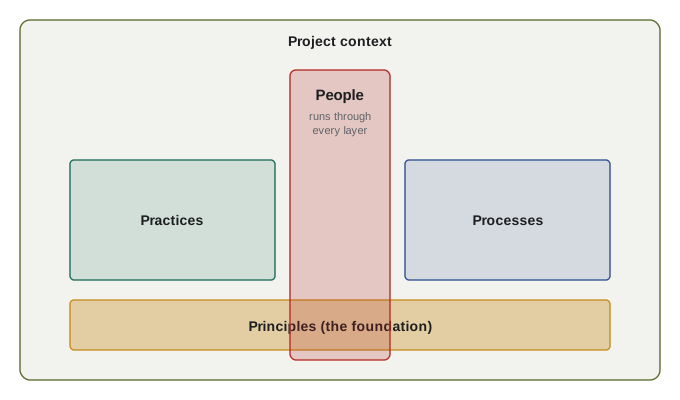
The diagram is a reminder that the people element is not a new process step or a new management product. You will not find a single document called the people plan. Instead, people considerations appear in how the project board is formed, how plans are made with the people who will do the work, how risks are discussed openly, how progress is reported honestly and how products are handed over to the people who will use them.
What changed from the sixth edition
The sixth edition, published in 2017, organized PRINCE2 around seven principles, seven themes and seven processes, with tailoring as a separate topic. The seventh edition kept the sevens but renamed the themes as practices, made the people element explicit, gave the project context a more prominent role and added sustainability as a performance target. It also put more emphasis on digital and data management and on agile ways of working. For exam candidates, the practical consequence is that questions now ask about change management, team leadership, communication and organizational context as part of PRINCE2 itself, not as general knowledge.
| Aspect | Sixth edition (2017) | Seventh edition (2023) |
|---|---|---|
| Structure | Principles, themes, processes, tailoring | Five integrated elements: principles, people, practices, processes, project context |
| People | Mostly implied through roles | An explicit integrated element covering context, change, teams and communication |
| Themes or practices | Seven themes | Seven practices, with organizing and plans reworked |
| Performance targets | Six aspects, called tolerances in earlier editions | Seven performance targets including sustainability |
| Tailoring | A chapter on tailoring and adopting | Part of the project context element and the tailor principle |
| Data and digital | Little explicit guidance | Explicit attention to digital and data management |
Why projects fail on people
Studies of failed projects, from public inquiries to industry surveys, return to the same causes again and again: unclear ownership, weak sponsorship, resistance from the people affected, poor communication, unrealistic expectations and teams that did not trust each other enough to raise bad news. Very few failures are caused only by a missing template. A project with excellent documents and a disengaged executive will struggle; a project with modest documents and an engaged, honest leadership team will usually find its way.
PRINCE2 has always had controls that depend on people behaving well. Management by exception only works if team managers and project managers report forecast breaches early. Continued business justification only works if the executive is willing to stop a project. Learning from experience only works if people feel safe admitting what went wrong. The people element makes this dependency explicit and gives project managers language and techniques for creating the conditions in which the controls actually work.
| PRINCE2 control | What it depends on | How it fails when people are neglected |
|---|---|---|
| Manage by exception | Early, honest reporting of forecast breaches | Problems are hidden until tolerance is long gone |
| Continued business justification | An executive willing to stop or redirect | Projects continue because nobody wants to deliver bad news |
| Learn from experience | Psychological safety to admit mistakes | Lessons logs are empty or full of bland statements |
| Focus on products | Users involved in defining quality criteria | Products meet the specification but not the need |
| Defined roles | People who accept and understand their roles | Board members who never attend or delegate silently |
Outputs, outcomes and benefits
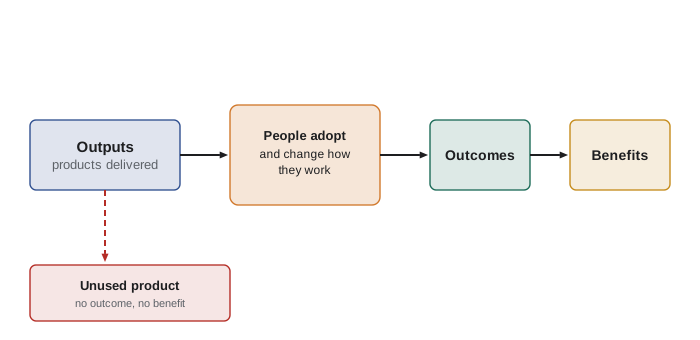
PRINCE2 distinguishes three things a project produces. Outputs are the specialist products the project delivers, such as a new system, building or procedure. Outcomes are the results of change that occur when people use those outputs, such as staff processing applications faster. Benefits are the measurable improvements that result from outcomes and that someone values, such as lower cost per application. The chain from output to benefit passes through people. If nobody uses the new system, or if they use it while keeping their old spreadsheets on the side, the outcomes do not occur and the benefits do not arrive.
Worked problem
How adoption limits benefits
A provincial agency expects a new case management system to save 12 minutes per case across 40,000 cases a year, at a loaded staff cost of 54 dollars an hour. Six months after go-live, only 65 % of cases are handled in the new system; the rest are still handled the old way. What annual benefit is being realized compared with the forecast?
Show solution
- Forecast hours saved: 40,000 × 12 ÷ 60 = 8,000 hours.
- Forecast benefit: 8,000 × 54 = 432,000 dollars a year.
- Cases actually handled in the new system: 40,000 × 0.65 = 26,000.
- Hours saved: 26,000 × 12 ÷ 60 = 5,200 hours; benefit 5,200 × 54 = 280,800 dollars.
- Shortfall: 432,000 − 280,800 = 151,200 dollars a year, or 35 % of the forecast.
Answer: The project delivered the output, but only about 281,000 of the forecast 432,000 dollars a year is being realized. The shortfall is a people problem: adoption. Addressing it needs change management, not more system features.
The example also shows why the people element belongs inside the method rather than after it. If the project had planned adoption from the start, it would have included training, support, process redesign and leadership communication as products in its plans, with quality criteria and owners, instead of treating them as an afterthought once the system went live.
The four topics of the people element
In this course we organize the people element under four headings that reflect how PRINCE2 7 treats the subject. The first is context: the organizations involved, the layers of management and the relationships between them. The second is leading successful change: helping the people affected move from how they work today to how they will work in future. The third is leading successful teams: forming and sustaining the temporary team that delivers the project. The fourth is communication: the planned, two-way flow of information between the project and everyone with an interest in it.
| Topic | Central question | Lessons in this course |
|---|---|---|
| Context | Which organizations and people are involved, and how do they relate? | Lessons 2, 3 and 4 |
| Leading successful change | How will people move from the current state to the target state? | Lesson 5 |
| Leading successful teams | How do we build a temporary team that performs? | Lesson 6 |
| Communication | How will information flow to and from everyone involved? | Lesson 7 |
| Performance and sustainability | What are we managing to, and how do we escalate? | Lessons 8 and 9 |
| Tailoring and exams | How do we scale all of this, and how is it examined? | Lessons 10 and 11 |
Two ecosystems
A useful way to picture the context of a project is as two overlapping ecosystems. The organizational ecosystem is the permanent world: the commissioning organization, its business units, its customers, its suppliers, its regulators and the communities around it. The project ecosystem is the temporary world created for the project: the board, the project manager, the team managers, the teams and the people who support and assure them. The project ecosystem sits inside the organizational one and borrows people from it. Most people on a project still have line managers, performance reviews and loyalties back in the permanent organization.
This overlap explains many of the tensions project managers feel. A specialist may be committed to the project on paper but pulled back to operational work whenever there is a crisis. A senior user may support the project in board meetings but face resistance from their own staff. A supplier's team manager may want to help but be bound by a contract that rewards different behaviour. Understanding both ecosystems, and where they meet, is the starting point for everything else in this course.
Delegation, trust and management by exception
Management by exception allows each level of management to delegate authority to the level below within agreed tolerances. How much a board can delegate depends on how much it trusts the project manager, and how much a project manager can delegate depends on trust in team managers and teams. Trust is built through competence, honesty and reliability over time. A new project manager with an unfamiliar board may start with tight tolerances and frequent reports; as trust grows, tolerances can widen and reporting can lighten. PRINCE2 7 explicitly links the extent of delegation to the quality of relationships.
This is an important exam point. When a scenario asks why a board has set very tight tolerances, or why highlight reports are weekly rather than monthly, one valid explanation is that trust has not yet been established. The remedy is not simply to argue for wider tolerances but to build the relationship: deliver what was promised, report honestly and involve the board early when risks emerge.
How this course relates to others
This course assumes you have met the PRINCE2 basics in PRIN-101 and the principles in PRIN-110. It does not repeat the general theory of leadership styles, motivation, conflict and emotional intelligence; those are covered from a PMI perspective in PMP-120 and from an organizational behaviour perspective in BUS-130. Here we keep a PRINCE2 lens. We ask how the people element shows up in PRINCE2 roles, management layers, management products, tolerances and tailoring, and how it is likely to be tested in Foundation and Practitioner exams. Where general theory helps, we summarize it briefly and point you to the deeper course.
Worked problem
Spotting the people issue in a scenario
A project to merge two customer service centres is on schedule. The team has delivered the new phone system and the combined office. Highlight reports show green status. However, the senior user mentions that staff turnover in both centres has doubled since the merger was announced. Which PRINCE2 elements are most relevant, and what should the project manager do?
Show solution
- Recognize that the outputs are on track but the outcomes are at risk, because experienced staff are leaving.
- Identify the people element topics involved: leading successful change, because staff are reacting to the change, and communication, because the announcement may have created fear.
- Record the turnover as a risk to benefits in the risk register, with the senior user as risk owner.
- Propose change management actions as work in the plan: engagement sessions, clear role information and support from line managers.
- Raise the threat to the business case with the executive, since benefits depend on retaining skilled staff.
Answer: Green status on outputs does not mean the project is healthy. The project manager should treat the turnover as a threat to outcomes and benefits, plan change management work and make sure the board sees the risk.
Common mistakes
MistakeTreating the people element as a separate document or process step.
InsteadApply people considerations within every principle, practice and process.
MistakeMeasuring success only by outputs delivered on time and budget.
InsteadTrack adoption, outcomes and benefits, which depend on people.
MistakeAssuming management by exception works regardless of relationships.
InsteadRecognize that delegation depends on trust and honest reporting.
MistakeIgnoring the permanent organization that team members come from.
InsteadMap both the organizational and the project ecosystem.
MistakeLeaving change management until after the products are delivered.
InsteadPlan adoption and change activities as products from the start.
Summary and key terms
- PRINCE2 7 has five integrated elements: principles, people, practices, processes and the project context.
- People run through every other element rather than forming a separate step.
- Benefits depend on people adopting outputs so that outcomes occur.
- The people element covers context, leading change, leading teams and communication.
- Every PRINCE2 control depends on behaviour, such as honest reporting and willingness to stop.
- Projects sit in a temporary project ecosystem inside a permanent organizational ecosystem.
- The extent of delegation depends on trust built through relationships.
- Integrated element
- One of the five parts of PRINCE2 7 that work together: principles, people, practices, processes and project context.
- Output
- A specialist product delivered by the project.
- Outcome
- The result of change that occurs when people use outputs.
- Benefit
- A measurable improvement resulting from an outcome and valued by a stakeholder.
- Adoption
- The extent to which people actually use a new product or way of working.
- Organizational ecosystem
- The permanent organizations, units and relationships around a project.
- Project ecosystem
- The temporary structure and team created to deliver a project.
- Delegation
- Passing authority to a lower level of management within agreed tolerances.
- Practice
- An aspect of project management applied continually, called a theme in the sixth edition.
- Sustainability
- A performance target in PRINCE2 7 covering environmental, social and economic effects.
Practice problems
Work each problem on paper first, then reveal the answer to check.
Name the five integrated elements of PRINCE2 7.
Show answer
Principles, people, practices, processes and project context.
What were the practices called in the sixth edition?
Show answer
Themes.
Forecast benefit is 500,000 a year and adoption reaches 70 %. If benefit scales with adoption, what is realized?
Show answer
350,000 a year.
Which comes first in the chain: outcome or benefit?
Show answer
Outcome; benefits result from outcomes.
Give one PRINCE2 control that depends on honest reporting.
Show answer
Manage by exception.
What are the four topics of the people element used in this course?
Show answer
Context, leading successful change, leading successful teams and communication.
Which ecosystem is temporary?
Show answer
The project ecosystem.
Why might a board set tight tolerances for a new project manager?
Show answer
Trust has not yet been established.
Which course covers motivation and conflict theory from a PMI perspective?
Show answer
PMP-120.
Is there a single management product called the people plan?
Show answer
No; people considerations appear throughout existing products and processes.
Lesson quiz · 5 questions
Score 60% or more to complete this lesson.
Create a free account to save your progress, take quizzes and earn a certificate.