
PRIN-120 · Lesson 11 of 12 · 34 min
People and context in exam scenarios
PRINCE2 7 examinations test the people element and the project context alongside the principles, practices and processes. Foundation questions check that you know the concepts and terms. Practitioner questions place you in a scenario and ask you to apply the method. This lesson explains how people and context typically appear in exam questions, gives a reasoning method for scenario questions and works through original examples. Detailed exam technique, timing and practice papers are covered in PRIN-160; the exam formats themselves were introduced in PRIN-101. Everything here is original: no question in this course is taken from a PeopleCert exam.
The two exams at a glance
As of October 2026, PeopleCert describes the PRINCE2 7 Foundation exam as 60 multiple-choice questions in 60 minutes, closed book, with a pass mark of 36 out of 60. The Practitioner exam is described as 70 questions in 150 minutes, open book with the official manual only, with a pass mark of 60 %, and it requires an eligible prerequisite such as PRINCE2 Foundation or certain other project management certifications. Formats and rules can change, so always check the current candidate guidance before booking.
| Feature | Foundation | Practitioner |
|---|---|---|
| Questions | 60 multiple choice | 70 objective questions based on a scenario |
| Time | 60 minutes | 150 minutes |
| Pass mark | 36 of 60 (60 %) | 60 % |
| Materials | Closed book | Official manual only |
| Focus | Recall and understanding of concepts | Application and analysis in context |
| Prerequisite | None | An eligible certification such as PRINCE2 Foundation |
Worked problem
Budgeting time per question
In the Practitioner exam, a candidate plans to spend 15 minutes reading the scenario at the start and keep 10 minutes for review at the end. How much time is left per question? In Foundation, with 5 minutes kept for review, how much time is there per question?
Show solution
- Practitioner: 150 − 15 − 10 = 125 minutes for 70 questions.
- 125 ÷ 70 ≈ 1.8 minutes, or about 1 minute 47 seconds per question.
- Foundation: 60 − 5 = 55 minutes for 60 questions.
- 55 ÷ 60 ≈ 0.92 minutes, or about 55 seconds per question.
Answer: About 1 minute 47 seconds per Practitioner question and 55 seconds per Foundation question. Time spent searching the manual in Practitioner comes out of that budget, so the manual should be used to confirm, not to learn.
How people and context appear in questions
People and context questions tend to cluster around a few themes. Knowing them helps you recognize what a question is really testing.
| Theme | What the question is often testing | Typical trap |
|---|---|---|
| Layers and escalation | Which level holds a tolerance and who escalates to whom | Escalating past the level that set the tolerance |
| Roles and interests | Which role is accountable for a concern | Giving the project manager a board responsibility |
| Leading change | Who owns outcomes; how resistance is handled | Treating resistance as something to suppress |
| Leading teams | Negotiated work packages; trust and delegation | Imposing unrealistic work packages |
| Communication | When the approach is created and reviewed; two-way flow | Assuming communication is only outward reporting |
| Commercial context | Customer and supplier interests; contracts | Managing an external supplier's staff directly |
| Performance targets | The seven targets and forecast breaches | Waiting for an actual breach before acting |
| Tailoring | Scaling arrangements while keeping principles | Dropping a principle in the name of tailoring |
A reasoning method for scenario questions
Scenario questions reward a systematic approach. The following five steps work well for people and context questions and fit within the time budget once practised.
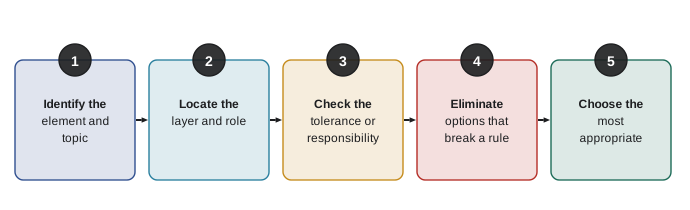
- Step 1, identify the element and topic: is this about context, change, teams, communication, targets or tailoring?
- Step 2, locate the layer and role: who in the scenario is acting, and at which management level?
- Step 3, check the relevant tolerance or responsibility: what authority does that role hold, and has a tolerance been forecast to be exceeded?
- Step 4, eliminate options that break a principle or overstep a role, such as a project manager approving a change in project tolerance.
- Step 5, choose the most appropriate remaining option. Several options may be possible; the best one usually follows PRINCE2 guidance most closely and solves the actual problem.
Worked scenario 1: an escalation question
Worked problem
Who should act?
Scenario: a team manager in a supplier organization forecasts that a work package will finish nine days late. The work package time tolerance is five days. The stage is still forecast to finish within its time tolerance. Question: what should happen next? Options: A, the team manager raises an issue with the project manager; B, the team manager sends an exception report to the project board; C, the project manager asks the business layer to extend the project; D, the senior supplier instructs the team to work overtime.
Show solution
- Element and topic: performance targets and escalation through the layers.
- Layer and role: the team manager in the delivering layer holds a work package tolerance.
- Tolerance: the work package time tolerance is forecast to be exceeded; stage tolerance is not.
- Eliminate B, because exception reports go from the project manager to the board; C, because no project tolerance is threatened; D, because the senior supplier does not manage work packages day to day.
- Most appropriate: A.
Answer: A. The team manager escalates to the person who set the work package tolerance, the project manager, by raising an issue.
Worked scenario 2: a change question
Worked problem
Handling resistance
Scenario: a hospital is introducing electronic prescribing. Nurses on two wards say the new screens slow down medication rounds and they have reverted to paper during night shifts. The project is in its final delivery stage. Question: which action is most appropriate? Options: A, the project manager instructs ward managers to discipline nurses who use paper; B, the senior user arranges for user representatives to investigate the concern with the nurses and the issue is recorded for assessment; C, the project manager closes the project because the products are delivered; D, the executive removes the two wards from scope.
Show solution
- Element and topic: leading successful change; resistance as information.
- Layer and role: the senior user is accountable for user needs and benefits.
- Responsibility: the concern could be a genuine product issue affecting outcomes and safety.
- Eliminate A, which treats resistance as obstruction and oversteps the project manager's role; C, which ignores unrealized outcomes; D, which is premature and not based on analysis.
- Most appropriate: B.
Answer: B. The concern is investigated through the user interest and handled as an issue, which may reveal a design problem or a training need.
Worked scenario 3: a communication question
Worked problem
When to review the approach
Scenario: midway through stage 2, a regional newspaper publishes a story criticizing the project's impact on local traffic. The communication management approach does not mention media or local residents. Question: what is the most appropriate response? Options: A, wait until the end of the project to update the approach; B, the project manager reviews and updates the communication management approach, seeking board approval for significant changes; C, the senior supplier issues a press release; D, record the article in the lessons log only.
Show solution
- Element and topic: communication; the approach must remain fit for purpose.
- Layer and role: the project manager maintains the approach; the board approves significant changes.
- Responsibility: a new stakeholder group has emerged and is not covered.
- Eliminate A, which ignores a current gap; C, which bypasses agreed communication roles; D, which records but does not act.
- Most appropriate: B.
Answer: B. The approach is reviewed at stage boundaries and whenever needed, and significant changes are approved by the board.
Worked scenario 4: a context and tailoring question
Worked problem
Combining roles
Scenario: a small charity runs a three-month project to launch a volunteer booking app. The chief executive will fund it and is also the main user of the volunteer data. A volunteer developer will build it. Question: which arrangement is most appropriate? Options: A, the chief executive acts as executive and senior user, the developer as senior supplier, with a trustee providing assurance; B, the developer acts as executive and project manager; C, no board is needed because the project is small; D, the chief executive acts as project manager and provides project assurance.
Show solution
- Element and topic: tailoring the organization and roles to context.
- Layer and role: a small board is still needed to direct the project.
- Responsibility: the executive and senior user roles may be combined; assurance should be independent.
- Eliminate B, because the supplier should not own the business case; C, because tailoring cannot remove the board's function; D, because a project manager cannot provide their own assurance.
- Most appropriate: A.
Answer: A. Combining executive and senior user is legitimate tailoring, the supplier interest is represented and assurance remains independent.
Common reasoning errors
Candidates often lose marks in predictable ways. Choosing an answer that sounds proactive but oversteps a role is the most common error: a project manager who changes project tolerances, approves benefits or instructs a supplier's staff is not following PRINCE2 even if the action seems decisive. A second error is applying general management knowledge instead of PRINCE2 guidance, for example assuming the project manager owns benefits because they did in a previous job. A third is ignoring qualifiers such as first, most appropriate or according to PRINCE2, which change what the question asks.
| Reasoning error | How to avoid it |
|---|---|
| Choosing an option that oversteps a role | Check which role holds the authority before choosing |
| Using workplace habits instead of PRINCE2 guidance | Ask what PRINCE2 says, not what your organization does |
| Ignoring qualifiers such as first or most appropriate | Underline qualifiers and answer that exact question |
| Escalating too far or not far enough | Find the level that set the tolerance in question |
| Picking an option that drops a principle | Remember that tailoring never removes principles |
Using the manual in the Practitioner exam
In the Practitioner exam you may use the official manual. It is most useful for confirming a definition, a role responsibility or the purpose of a management product when you are unsure between two options. It is far less useful for learning concepts during the exam, because searching takes time you do not have. Candidates who do well usually know the material well enough to answer most questions without the manual, and use it for a handful of checks. Tabbing the chapters on people, practices and processes before the exam, where permitted by the exam rules, can speed up those checks. This course does not reproduce the manual; your study should combine it with practice on original scenarios.
Worked problem
Estimating manual use
In a practice Practitioner paper, a candidate looks up 20 questions and each lookup takes 3 minutes. Using the time budget from earlier, how much time do the lookups consume, and what does that leave for the other 50 questions?
Show solution
- Lookup time: 20 × 3 = 60 minutes.
- Time available for questions: 125 minutes.
- Remaining for the 50 other questions: 125 − 60 = 65 minutes, or 1.3 minutes each.
Answer: Twenty lookups consume nearly half the question time. Reducing lookups to around 8, by studying the material more thoroughly, would free about 36 minutes.
Common mistakes
MistakeChoosing the most decisive-sounding option.
InsteadChoose the option that follows PRINCE2 roles and authority.
MistakeRelying on habits from your own workplace.
InsteadAnswer according to PRINCE2 guidance.
MistakeSearching the manual for every Practitioner question.
InsteadUse the manual for a few checks and rely on preparation.
MistakeIgnoring qualifiers in the question stem.
InsteadNote qualifiers such as first and most appropriate.
MistakeStudying people topics as general theory only.
InsteadPractise applying them through PRINCE2 roles, layers and products.
Summary and key terms
- Foundation is described as 60 questions in 60 minutes, closed book, with a pass mark of 36.
- Practitioner is described as 70 questions in 150 minutes, open book, with a 60 % pass mark.
- People and context questions cluster around layers, roles, change, teams, communication, targets and tailoring.
- A five-step method identifies the topic, layer, authority, eliminations and best answer.
- Many wrong options overstep a role or drop a principle.
- Answer according to PRINCE2, not workplace habit, and respect qualifiers.
- Use the manual in Practitioner for confirmation, not for learning.
- Foundation exam
- The entry-level PRINCE2 exam testing knowledge and understanding.
- Practitioner exam
- The scenario-based PRINCE2 exam testing application.
- Scenario
- A description of a project situation on which questions are based.
- Qualifier
- A word in a question, such as first or most appropriate, that narrows what is asked.
- Distractor
- A plausible but incorrect answer option.
- Open book
- An exam in which a specified reference may be consulted.
- Candidate guidance
- Official information on exam format, rules and requirements.
- Elimination
- Removing options that are clearly wrong before choosing.
- Time budget
- The planned time per question in an exam.
- Authority
- The power a role holds to make particular decisions.
Practice problems
Work each problem on paper first, then reveal the answer to check.
How many questions and minutes in the Foundation exam?
Show answer
60 questions in 60 minutes.
What is the Foundation pass mark?
Show answer
36 of 60.
Is the Practitioner exam open or closed book?
Show answer
Open book with the official manual.
120 minutes for 70 questions. Time per question?
Show answer
About 1.7 minutes.
A team manager forecasts a work package breach but the stage is fine. Who is told?
Show answer
The project manager, through an issue.
Who is accountable for user needs and benefits?
Show answer
The senior user.
When is the communication management approach reviewed?
Show answer
At stage boundaries and whenever needed.
Can a project manager provide their own assurance?
Show answer
No.
Name a common reasoning error.
Show answer
Choosing an option that oversteps a role.
What is the manual best used for during Practitioner?
Show answer
Confirming definitions or responsibilities when unsure.
Lesson quiz · 5 questions
Score 60% or more to complete this lesson.
Create a free account to save your progress, take quizzes and earn a certificate.