
PRIN-120 · Lesson 9 of 12 · 26 min
Sustainability as a performance target
The seventh edition of PRINCE2 added sustainability as a performance target alongside benefits, cost, time, quality, scope and risk. That means sustainability is no longer something a project considers if it has time; it is something the project plans for, measures, reports and manages within tolerances like any other target. This lesson explains what sustainability means in a PRINCE2 project, how sustainability targets and tolerances are set, how they are measured, how they interact with other targets and how the wider policy context differs between organizations and countries. It also explains why sustainability is fundamentally a people topic: it concerns the effects of the project on communities, workers and future generations, and it depends on the choices people make throughout the project.
What sustainability means in a project
Sustainability is usually described in three dimensions. Environmental sustainability covers effects on climate, resources, ecosystems and pollution. Social sustainability covers effects on people: workers, communities, accessibility, equity, health and safety. Economic sustainability covers long-term financial viability, including whole-life costs rather than only the project budget. A project can affect all three in two ways: through how it is run, such as travel, materials, waste and working conditions, and through what it delivers, such as the energy use of a new building over 40 years or the accessibility of a new public service.
| Dimension | Effects of how the project runs | Effects of what the project delivers |
|---|---|---|
| Environmental | Travel, site energy, materials, waste, data centre use during development | Operational energy and emissions, resource use, end-of-life disposal |
| Social | Working conditions, supplier labour practices, local disruption, safety | Accessibility, community impact, equity of access, health |
| Economic | Project cost, local procurement, supplier viability | Whole-life cost, maintenance, resilience, long-term value |
Distinguishing the two is important when setting targets. A project manager can directly control how the project runs, but the long-term effects of products are shaped mainly by design decisions and by the people who will operate them. Product-related sustainability often appears in quality criteria and acceptance criteria, while project-related sustainability appears in plans, budgets and tolerances.
Setting sustainability targets and tolerances
Sustainability targets should come from the organization's own commitments, the project's business case and relevant legal requirements. The business layer may set a project-level sustainability tolerance, for example a maximum carbon budget or a minimum share of spending with local or social enterprises. The board then sets stage tolerances, and product descriptions carry product-level criteria such as an energy performance rating. As with other targets, sustainability tolerances should be measurable, agreed and monitored.
| Level | Example target | Example tolerance |
|---|---|---|
| Project (set by business layer) | Total construction emissions 1,200 tonnes CO2e | +5 % |
| Stage (set by board) | Stage 3 site emissions 450 tonnes CO2e | +8 % |
| Work package (set by project manager) | Waste diverted from landfill at least 75 % | −5 percentage points |
| Product (quality criteria) | Building operational energy intensity | No more than the design value plus 10 % |
| Social | Local hiring at least 25 % of site labour hours | −3 percentage points |
Measuring carbon
Carbon is the most commonly quantified sustainability target. Greenhouse gas emissions are usually expressed in tonnes of carbon dioxide equivalent, written tCO2e, which converts other gases into the amount of carbon dioxide with the same warming effect. A simple estimate multiplies activity data, such as litres of diesel or kilowatt-hours of electricity, by an emission factor for that activity. Organizations publish their own factors or use national inventories; the numbers in this lesson are illustrative.
Worked problem
Estimating a stage's carbon footprint
A stage uses 42,000 litres of diesel in site equipment, 180,000 kWh of grid electricity, 60 return flights for specialists and 3,500 tonnes of concrete. Illustrative emission factors: diesel 2.7 kg CO2e per litre; electricity 0.10 kg per kWh; one return flight 0.8 tonnes; concrete 0.12 tonnes per tonne. The stage tolerance is 450 tCO2e +8 %. Estimate emissions and check tolerance.
Show solution
- Diesel: 42,000 × 2.7 = 113,400 kg = 113.4 tCO2e.
- Electricity: 180,000 × 0.10 = 18,000 kg = 18.0 tCO2e.
- Flights: 60 × 0.8 = 48.0 tCO2e.
- Concrete: 3,500 × 0.12 = 420.0 tCO2e.
- Total: 113.4 + 18.0 + 48.0 + 420.0 = 599.4 tCO2e.
- Tolerance limit: 450 × 1.08 = 486 tCO2e. The forecast exceeds it by about 113 tCO2e.
Answer: The stage is forecast at about 599 tCO2e against a limit of 486, so an exception should be raised. Concrete dominates, so the most effective options are lower-carbon mixes or design changes, not cutting flights.
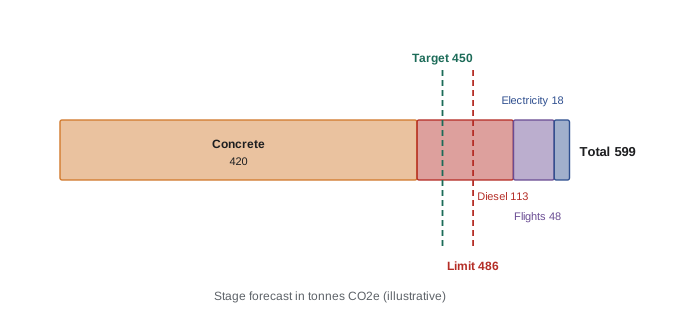
The example shows why measurement matters before action. Without the breakdown, a project might focus on visible measures such as reducing flights, which contribute only 8 % of the footprint here, and miss the material choice that dominates.
Scopes and boundaries
Organizations commonly report emissions in three scopes. Scope 1 covers direct emissions from sources the organization owns or controls, such as its own vehicles and equipment. Scope 2 covers emissions from purchased electricity and heat. Scope 3 covers all other indirect emissions in the value chain, such as purchased materials, supplier activities, business travel and the use of sold products. For a project, many significant emissions fall in scope 3 because they arise in suppliers' operations. Agreeing the boundary of what the project will measure, and how suppliers will report, is part of setting a sustainability target.
Boundaries are a people issue as much as a technical one. Suppliers may need to collect data they have never collected before, and they will be more willing if the customer explains why it matters, keeps requests proportionate and recognizes the effort involved. Building sustainability reporting into contracts and work packages from the start is far easier than adding it later.
Trade-offs with other targets
Sustainability interacts with every other target. A lower-carbon concrete may cost more or cure more slowly, affecting cost and time. A more accessible design may increase scope. Buying from local social enterprises may raise prices but deliver community benefits. PRINCE2's approach is to make these trade-offs visible and decide them consciously, using the business case and agreed tolerances. A useful technique is to put a value on sustainability effects, such as an internal carbon price, so that options can be compared on a common basis while recognizing that not everything reduces neatly to money.
Worked problem
Using an internal carbon price
The project can switch to a lower-carbon concrete mix that cuts concrete emissions by 30 % but costs 14 dollars more per tonne. The organization uses an internal carbon price of 120 dollars per tCO2e for decisions. Using the stage figures above, is the switch justified on this basis? Does it bring the stage within tolerance?
Show solution
- Emissions saved: 420 × 0.30 = 126 tCO2e.
- Value of saving at internal price: 126 × 120 = 15,120 dollars.
- Extra cost: 3,500 × 14 = 49,000 dollars.
- On the internal carbon price alone, the switch costs more than the value of emissions saved.
- New stage total: 599.4 − 126 = 473.4 tCO2e, within the 486 limit.
Answer: The switch brings the stage within sustainability tolerance but costs about 34,000 dollars more than the carbon value at the internal price. The board must decide whether staying within the sustainability tolerance, which reflects the organization's commitment, justifies the extra cost, perhaps by accepting a cost tolerance change. That is exactly the kind of trade-off PRINCE2 expects to be made openly.
Social sustainability and people
Social sustainability covers the project's effects on people inside and outside it. Inside the project, it includes fair working conditions, reasonable workloads, health and safety, and respect for workers in the supply chain. Outside, it includes disruption to neighbours, accessibility of products, effects on vulnerable groups and opportunities such as local jobs and training. Many public bodies now evaluate social value in procurement and expect projects to report on it.
Supply chain labour practices deserve particular attention. Projects that buy materials or services internationally may be exposed to forced labour or unsafe working conditions in their supply chains. Organizations in several jurisdictions now have reporting duties on these risks, and boards increasingly expect assurance that suppliers have been checked. In PRINCE2 terms, this belongs in the risk register, the quality criteria for procurement and the senior supplier's assurance responsibilities.
The policy context
In Canada, the federal Greening Government Strategy commits federal operations to net-zero emissions by 2050; the Treasury Board Secretariat reported in February 2026 that emissions from federal real property and conventional fleets had fallen 42.5 % from the 2005 to 2006 baseline by March 2025, exceeding the 40 % target for 2025. The Canadian Sustainability Standards Board published its first disclosure standards in December 2024 for voluntary use unless regulators require them, and securities regulators paused work on a mandatory climate disclosure rule in 2025. The Fighting Against Forced Labour and Child Labour in Supply Chains Act requires many entities to report annually on supply chain labour risks. Provinces and municipalities add their own requirements. A project manager should check which commitments apply to the commissioning organization. All of this is current as of October 2026 and changes frequently.
For PRINCE2 purposes the key point is that sustainability targets come from the commissioning organization's commitments and obligations, which sit in the business layer. The method does not tell an organization what its sustainability ambitions should be; it makes sure that whatever ambitions exist are translated into measurable targets and managed with the same discipline as cost and time.
Reporting sustainability
Sustainability performance should appear in the same reports as other targets: checkpoint reports, highlight reports, end stage reports and exception reports. Showing it alongside cost and time reinforces that it is a genuine target. At closure, the end project report should record performance against sustainability tolerances, and the lessons report should capture what worked, such as materials, supplier practices or design choices, so that future projects can learn.
Engaging people in sustainability
Sustainability targets are met or missed through the daily choices of many people: designers choosing materials, buyers choosing suppliers, site managers deciding on generator use, team members deciding whether to travel or meet online. Targets imposed without explanation tend to be treated as compliance exercises. Targets that people understand, can influence and see progress against tend to be met. Project managers can help by explaining the reasons for each target, showing the breakdown of the footprint so people see where their choices matter, recognizing teams that find reductions and including sustainability in checkpoint discussions rather than only in formal reports.
Suppliers are a key audience. Many have their own sustainability commitments and expertise, and may propose better solutions if asked. Inviting suppliers to suggest lower-impact alternatives during planning, and sharing any savings or recognition fairly, turns sustainability from a contract requirement into a joint objective. Where suppliers lack the capacity to measure emissions, the customer may need to provide simple tools or accept estimates for a first project, improving data quality over time.
Common mistakes
MistakeTreating sustainability as optional if time and budget allow.
InsteadManage sustainability as a performance target with tolerances.
MistakeFocusing on visible actions without measuring.
InsteadMeasure the footprint first and target the largest sources.
MistakeIgnoring scope 3 emissions from suppliers.
InsteadAgree measurement boundaries and supplier reporting in contracts and work packages.
MistakeHiding trade-offs between sustainability and cost or time.
InsteadMake trade-offs visible and decide them using the business case and tolerances.
MistakeForgetting the social dimension.
InsteadConsider workers, communities, accessibility and supply chain labour practices.
Summary and key terms
- Sustainability is a PRINCE2 7 performance target with environmental, social and economic dimensions.
- Effects arise both from how the project runs and from what it delivers.
- Targets and tolerances can be set at project, stage, work package and product level.
- Carbon is estimated as activity multiplied by emission factor, in tonnes CO2e.
- Scope 3 emissions in the supply chain are often significant for projects.
- Trade-offs with cost, time and scope should be made openly, sometimes using an internal carbon price.
- Sustainability commitments come from the business layer and the policy context, which differs by country.
- Sustainability
- Meeting present needs without compromising the ability of future generations to meet theirs, across environmental, social and economic dimensions.
- tCO2e
- Tonnes of carbon dioxide equivalent, a common unit for greenhouse gas emissions.
- Emission factor
- The emissions produced per unit of an activity, such as per litre of fuel.
- Scope 1
- Direct emissions from sources an organization owns or controls.
- Scope 2
- Emissions from purchased electricity, heat or steam.
- Scope 3
- Other indirect emissions across the value chain.
- Internal carbon price
- A value per tonne of emissions used to compare options.
- Social value
- The wider benefits a project creates for communities and society.
- Whole-life cost
- The total cost of a product over its life, including operation and disposal.
- Embodied carbon
- Emissions from producing, transporting and installing materials.
Practice problems
Work each problem on paper first, then reveal the answer to check.
Name the three dimensions of sustainability.
Show answer
Environmental, social and economic.
10,000 litres of diesel at 2.7 kg CO2e per litre. Emissions?
Show answer
27 tCO2e.
Stage target 300 tCO2e with +10 % tolerance. Limit?
Show answer
330 tCO2e.
Which scope covers purchased electricity?
Show answer
Scope 2.
Which scope usually covers supplier materials?
Show answer
Scope 3.
Saving 50 tCO2e at an internal price of 100 per tonne is worth?
Show answer
5,000.
Where do product-related sustainability requirements usually appear?
Show answer
In quality and acceptance criteria.
Who sets the project-level sustainability tolerance?
Show answer
The business layer.
Give one social sustainability consideration.
Show answer
Supply chain labour practices or accessibility of products.
Why measure before acting on carbon?
Show answer
To target the largest sources rather than the most visible.
Lesson quiz · 5 questions
Score 60% or more to complete this lesson.
Create a free account to save your progress, take quizzes and earn a certificate.