
PRIN-120 · Lesson 8 of 12 · 31 min
Performance targets, tolerances and exceptions
PRINCE2 7 describes seven performance targets that every project must manage: benefits, cost, time, quality, scope, risk and sustainability. Targets are set for each level of management, tolerances define how far performance may deviate before the next level up must be told, and exceptions are raised when a tolerance is forecast to be exceeded. PRIN-110 covered the principle of managing by exception and the basic arithmetic of tolerances. This lesson looks at the same machinery from the people side: who sets and agrees targets, how targets shape behaviour, how to forecast honestly and how exceptions are handled as decisions between people rather than as paperwork.
The seven performance targets
The table below summarizes the seven targets, with typical ways of expressing a target and its tolerance. Sustainability is new in the seventh edition and gets a lesson of its own next.
| Target | Typical target | Typical tolerance | Who cares most |
|---|---|---|---|
| Benefits | Annual saving of 400,000 from year 2 | Not less than 340,000 (−15 %) | Executive, senior user, business layer |
| Cost | Stage budget of 600,000 | +8 % / −5 % | Executive, finance |
| Time | Stage ends 30 June | +2 weeks / −1 week | Senior user, operations |
| Quality | Defect rate in acceptance testing | No more than 2 % of test cases fail | Senior user, senior supplier |
| Scope | All must-have features delivered | Should-have features may be deferred up to 20 % by count | Senior user |
| Risk | Aggregated threat exposure | Expected loss not above 150,000 | Executive, business layer |
| Sustainability | Construction emissions | Not above 1,200 tonnes CO2e (+5 %) | Executive, sustainability lead, communities |
Not every target needs a numeric tolerance at every level. A work package may have only time and cost tolerances, with quality defined through product descriptions. A project-level benefits tolerance may be expressed as a range. What matters is that each level knows which targets it is managing to and what would trigger escalation.
Who sets and agrees targets
Targets flow down through the management layers: the business layer sets project tolerances, the board sets stage tolerances and the project manager sets work package tolerances. In people terms, though, good targets are not simply imposed. They are discussed. A project manager who accepts an unrealistic stage target without saying so is storing up an exception. A board that sets tolerances without understanding the plan may set them too tight, causing needless escalations, or too loose, losing control. The best practice is a conversation at each stage boundary in which the project manager presents the stage plan, forecasts and risks, and the board sets tolerances it can live with.
| Tolerance setting | Likely result | People effect |
|---|---|---|
| Too tight | Frequent exceptions for minor variation | Board fatigue; project manager feels distrusted; senior time wasted |
| Too loose | Problems absorbed until they are large | Board loses control; surprises at stage end |
| Unbalanced | Tight time but loose quality, for example | Teams cut corners on the loosest target |
| Agreed and explained | Exceptions only for real issues | Mutual trust; delegation works |
How targets shape behaviour
People respond to the targets they are measured against, sometimes in ways nobody intended. If a team is judged only on time, it may meet dates by quietly reducing quality. If a project manager is judged only on cost, they may avoid spending on risk responses that would save money later. An old observation, often called Goodhart's law, warns that when a measure becomes a target it can cease to be a good measure. PRINCE2's use of seven targets is partly a defence against this: by watching several targets together, the board can see when one is being met at the expense of another.
Worked problem
Spotting a hidden trade-off
A team's highlight data for three months show work packages delivered on time in every month, but the first-time pass rate in quality reviews has fallen from 90 % to 72 % to 61 %, and rework items in the issue register have risen from 4 to 11 to 19. Time tolerance has not been breached. What is likely happening, and what should the project manager do?
Show solution
- On-time delivery looks good in isolation.
- Falling first-time pass rates and rising rework suggest quality is being traded for time.
- Rework will consume future effort, threatening later time and cost targets.
- The project manager should discuss the trend with the team manager, check whether estimates are realistic and consider whether a quality tolerance is being approached.
Answer: Meeting dates while quality declines is a classic hidden trade-off. Looking across targets reveals it early; looking only at time would hide it until rework overwhelmed the plan.
Forecasting honestly
Management by exception depends on forecasts, not just actuals. An exception should be raised when a tolerance is forecast to be exceeded, not when it has already been exceeded. Forecasting therefore needs both a method and honesty. Earned value is one widely used method: comparing the value of work completed with the cost spent and the schedule planned gives indices that can be used to project the final outcome. The method is only as good as the inputs, and inputs are only as good as people's willingness to report real progress.
Worked problem
Forecasting a stage cost with earned value
A stage has a budget at completion of 600,000 and a cost tolerance of +8 %. At the halfway point by time, planned value is 300,000, earned value is 270,000 and actual cost is 315,000. Using the cost performance index, forecast the stage cost at completion. Is an exception needed?
Show solution
- Cost performance index: CPI = EV ÷ AC = 270,000 ÷ 315,000 = 0.857.
- Estimate at completion: EAC = BAC ÷ CPI = 600,000 ÷ 0.857 ≈ 700,000.
- Tolerance limit: 600,000 × 1.08 = 648,000.
- The forecast of about 700,000 exceeds 648,000.
Answer: The stage is forecast to exceed its cost tolerance by about 52,000. The project manager should raise an issue, assess options and send an exception report to the board now, rather than waiting until the money is spent.
The same logic applies to time. The schedule performance index, earned value divided by planned value, gives a rough indication of whether the stage will finish late. Here SPI is 270,000 ÷ 300,000 = 0.90, suggesting the work is running about 10 % behind plan. Earned value indices are a guide, not a certainty, and the project manager should combine them with the team managers' judgment about remaining work.
The escalation path
When a tolerance is forecast to be breached, the escalation path is the same at every level: the person who holds the tolerance raises the matter with the level that set it. A team manager raises an issue with the project manager. A project manager sends an exception report to the board. The board, if project tolerance is threatened, refers the matter to the business layer. At each step, the person escalating should explain the cause, the impact on all targets, the options and a recommendation.
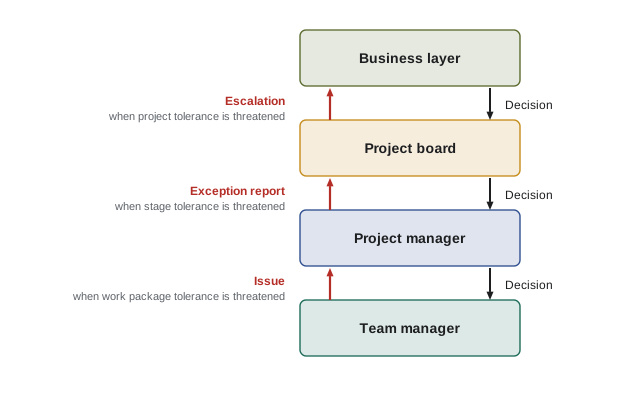
The people dimension is timing and tone. An exception raised early, with clear options, is a sign of good management. One raised late, or presented defensively, erodes trust. Boards should respond promptly; an exception report that waits three weeks for a decision may itself cause further breaches.
Responding to an exception
When the board receives an exception report, it has several options. It can ask for an exception plan to replace the current stage plan, approve a change in tolerances, accept a reduction in scope, ask for more information, or, in serious cases, decide that the project is no longer justified and request premature closure. The decision should be based on the business case: which option gives the best remaining value?
Worked problem
Comparing exception options
The stage from the earlier example is forecast at 700,000 against a budget of 600,000. The project manager presents three options. A: accept the overrun, keeping full scope. B: defer two should-have features worth an estimated 60,000 of effort, bringing the forecast to 640,000, with an estimated annual benefit loss of 20,000. C: add a specialist for 25,000 who is expected to recover efficiency and bring the forecast to 655,000. The project's benefits are assessed over five years without discounting for simplicity. Which option has the lowest five-year cost including lost benefits?
Show solution
- Option A: extra cost 100,000; no lost benefits; total 100,000.
- Option B: extra cost 40,000; lost benefits 20,000 × 5 = 100,000; total 140,000.
- Option C: extra cost 55,000 including the specialist; no lost benefits; total 55,000, if the efficiency recovery is credible.
Answer: Option C is lowest at 55,000, but it depends on the specialist delivering the expected efficiency, so the board should test that assumption. Its forecast of 655,000 is still above the 648,000 limit, so whichever option is chosen the board must approve an exception plan with revised stage tolerances.
This example shows that exceptions are decisions involving judgment, risk and trust. The numbers inform the decision, but the board must also weigh confidence in the forecasts, the team's capacity and the effect on stakeholders.
Targets across organizations
When suppliers are involved, targets may also appear in contracts, and the two do not always align. A supplier's contract may fix a price and date that become the supplier's targets, while the customer's stage tolerances allow different flexibility. Mismatches cause friction: the customer board may want to trade time for quality while the supplier is contractually bound to a date. Aligning work package tolerances with contract terms where possible, and agreeing in advance how contract changes will be handled, reduces this friction.
Benefits and risk tolerances in practice
Benefits and risk tolerances are the hardest to manage day to day because they are less tangible than cost and time. Benefits tolerances are usually expressed as a range for the expected benefits in the business case, and the forecast is reviewed at each stage boundary. If the expected benefits fall below the tolerance, for example because a key user group will not adopt a product or because market conditions have changed, the executive must consider whether the project is still justified. This is a people decision as much as a financial one, because it often means telling sponsors and teams that the value they hoped for has shrunk.
Risk tolerance describes how much aggregated threat exposure the organization will accept, often expressed as an expected loss or as a limit on particular kinds of risk, such as no risks of serious harm to people above a low likelihood. Risk appetite comes from the business layer and reflects the organization's culture: some organizations accept considerable risk in pursuit of innovation, others very little. When a project's risk profile moves beyond the agreed tolerance, the board must decide whether to accept the higher exposure, invest in responses or change the project.
Worked problem
Checking aggregated risk exposure
A stage has a risk tolerance of an expected loss not above 150,000. Open threats: supplier delay, probability 40 % and impact 200,000; key specialist leaving, probability 25 % and impact 120,000; data migration errors, probability 30 % and impact 150,000. Is the tolerance at risk?
Show solution
- Supplier delay: 0.40 × 200,000 = 80,000.
- Specialist leaving: 0.25 × 120,000 = 30,000.
- Migration errors: 0.30 × 150,000 = 45,000.
- Total expected loss: 80,000 + 30,000 + 45,000 = 155,000.
Answer: Aggregated exposure of 155,000 exceeds the 150,000 tolerance. The project manager should consider responses, such as a retention arrangement for the specialist that might halve that probability, and report the position to the board.
Common mistakes
MistakeSetting tolerances without discussing the plan with the project manager.
InsteadAgree tolerances in a conversation about forecasts and risks at each stage boundary.
MistakeWatching one target in isolation.
InsteadLook across all seven targets to spot hidden trade-offs.
MistakeRaising an exception only after a tolerance has been exceeded.
InsteadRaise it as soon as a breach is forecast.
MistakePresenting an exception without options or a recommendation.
InsteadExplain cause, impact, options and a recommendation.
MistakeLeaving exception reports waiting for weeks.
InsteadDecide promptly so the delay does not cause further breaches.
Summary and key terms
- PRINCE2 7 has seven performance targets: benefits, cost, time, quality, scope, risk and sustainability.
- Tolerances flow down the layers but should be agreed in conversation.
- Tolerances that are too tight, too loose or unbalanced distort behaviour.
- Watching several targets together reveals hidden trade-offs.
- Exceptions are raised on forecast breaches; earned value supports forecasting.
- Each level escalates to the level that set its tolerance, with options and a recommendation.
- Boards respond with exception plans, revised tolerances, scope changes or closure, based on remaining value.
- Performance target
- One of seven aspects of performance a project manages: benefits, cost, time, quality, scope, risk and sustainability.
- Tolerance
- The permissible deviation from a target before escalation is needed.
- Exception
- A situation where a tolerance is forecast to be exceeded.
- Exception report
- A report from the project manager to the board describing a forecast breach and options.
- Exception plan
- A plan that replaces the current plan following an exception.
- Earned value
- The planned value of work actually completed.
- Cost performance index
- Earned value divided by actual cost.
- Schedule performance index
- Earned value divided by planned value.
- Estimate at completion
- The forecast total cost when the work is complete.
- Goodhart's law
- The observation that a measure used as a target may stop being a good measure.
Practice problems
Work each problem on paper first, then reveal the answer to check.
List the seven performance targets.
Show answer
Benefits, cost, time, quality, scope, risk and sustainability.
EV 180,000 and AC 200,000. CPI?
Show answer
0.90.
BAC 500,000 and CPI 0.90. EAC?
Show answer
About 555,600.
Budget 500,000 with +10 % tolerance; EAC 555,600. Exception?
Show answer
Yes; the limit is 550,000.
EV 270,000 and PV 300,000. SPI?
Show answer
0.90.
Who does a project manager escalate a forecast stage breach to?
Show answer
The project board, through an exception report.
Give one effect of tolerances that are too tight.
Show answer
Frequent exceptions for minor variation and board fatigue.
What does Goodhart's law warn about?
Show answer
A measure used as a target may stop being a good measure.
Name two options a board has when it receives an exception report.
Show answer
Request an exception plan or approve revised tolerances.
Why should exceptions be raised on forecasts?
Show answer
So the board can act before the deviation becomes a fact.
Lesson quiz · 5 questions
Score 60% or more to complete this lesson.
Create a free account to save your progress, take quizzes and earn a certificate.