
PRIN-120 · Lesson 7 of 12 · 29 min
Communication and stakeholder engagement
Communication is the people element in action. Every PRINCE2 report, meeting, review and handover is communication, and every stakeholder's view of a project is shaped by what they hear, when they hear it and from whom. PRINCE2 7 treats communication as a planned, controlled, two-way exchange between the project and its ecosystem, described in the communication management approach. This lesson covers how to identify and analyse stakeholders, plan engagement, design the communication management approach and check whether communication is working. Stakeholder negotiation and communication planning from a PMI perspective are covered in PMP-121.
Stakeholders in PRINCE2 terms
A stakeholder is any individual, group or organization that can affect, be affected by or perceive itself to be affected by a project. The last part of that definition matters: people who believe they will be affected behave as stakeholders whether or not the project agrees. Stakeholders include the board and team, but also users who are not represented directly, operational managers, support teams, customers, suppliers, regulators, unions, communities and the media. Some are supporters, some are sceptics and some do not yet know the project exists.
Stakeholder engagement is the process of identifying, analysing, planning and carrying out actions to influence and involve stakeholders. It is closely linked to leading change, because the groups most affected by change are often the most important stakeholders, and to the business case, because stakeholder support affects whether benefits are realized.
Identifying and analysing stakeholders
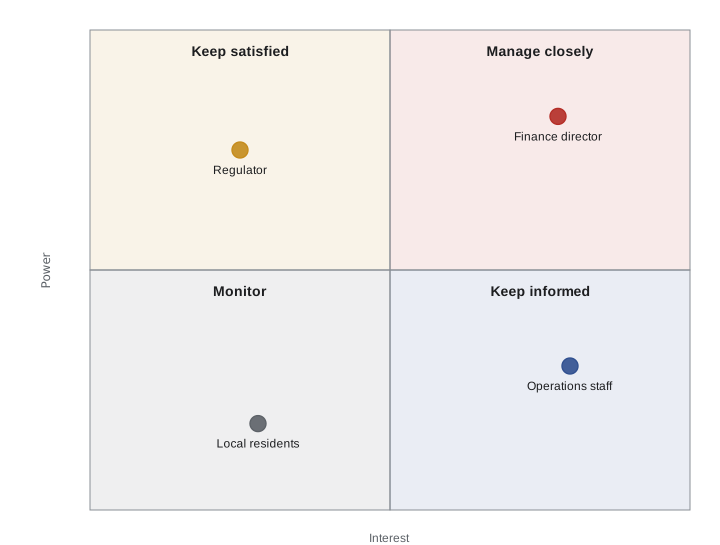
Identification starts with the mandate and the change impact assessment, and grows through workshops, interviews and the knowledge of board members and team managers. Analysis then asks, for each stakeholder: what is their interest in the project, how much influence do they have, what is their current attitude and what do we need from them? A widely used tool is the power-interest grid, which places stakeholders according to their power to affect the project and their interest in it.
Worked problem
Placing stakeholders on the grid
A project to relocate a records centre scores stakeholders from 1 to 10 for power and interest. Finance director: power 9, interest 8. Records staff (60 people): power 4, interest 9. Privacy regulator: power 8, interest 3. Neighbouring businesses: power 2, interest 4. Using 5.5 as the dividing line on both axes, place each stakeholder and suggest an approach.
Show solution
- Finance director: high power, high interest, so manage closely with regular personal briefings.
- Records staff: low power individually, high interest, so keep informed and involve, recognizing that collectively they affect adoption.
- Privacy regulator: high power, low interest, so keep satisfied with timely, formal assurance on data handling.
- Neighbouring businesses: low power, low interest, so monitor and provide notice of disruption such as moving days.
Answer: The grid gives a starting strategy. Judgment still matters: records staff score low on power individually but could derail the move if they resist, so their engagement deserves more effort than the quadrant alone suggests.
Engagement levels and gaps
A second useful analysis compares each stakeholder's current level of engagement with the level the project needs. A simple five-point scale runs from unaware, through resistant, neutral and supportive, to leading. Where the gap between current and desired is large, the project needs deliberate engagement actions. Where a stakeholder is already supportive and needs to stay that way, light-touch communication may be enough.
| Stakeholder | Current | Desired | Gap | Action |
|---|---|---|---|---|
| Finance director | Neutral | Leading | 2 | Involve in benefits planning; ask to co-present at staff briefing |
| Records staff | Resistant | Supportive | 2 | Listening sessions; visit new site; involve in layout design |
| Privacy regulator | Unaware | Neutral | 2 | Early formal notification and privacy impact assessment |
| IT support team | Supportive | Supportive | 0 | Keep informed through monthly updates |
| Union representative | Neutral | Supportive | 1 | Consult on shift patterns before they are finalized |
The communication management approach
In PRINCE2 7 the communication management approach is the management product that describes how the project will communicate with its stakeholders. It is created during initiation, approved by the board as part of the project initiation documentation and reviewed at each stage boundary. It typically covers who needs what information, why, in what format, how often, from whom and through what channel, as well as how feedback will be gathered and how the approach itself will be evaluated.
| Stakeholder group | Information needed | Format and channel | Frequency | Sender | Feedback route |
|---|---|---|---|---|---|
| Project board | Progress against tolerances, risks, decisions needed | Highlight report by email; board meeting | Monthly; at boundaries | Project manager | Board meeting discussion |
| Records staff | What is changing, when, what it means for them | Team briefings; intranet page; Q and A sessions | Fortnightly | Senior user with line managers | Q and A; anonymous question box |
| Privacy regulator | Data handling during the move | Formal letter; meeting | At key milestones | Executive | Formal response |
| IT support | Technical schedule and changes | Team channel; checkpoint summary | Weekly | Team manager | Channel replies |
| Neighbouring businesses | Moving dates and disruption | Letter; site notice | Two weeks before each move | Project support | Contact phone number |
Note that the senior user and line managers, not the project manager, send messages to staff about the change. That reflects the point from lesson 5: people take their cues from their own leaders. The project manager drafts and coordinates, but the most important messages about change should come from those who lead the business.
Two-way communication
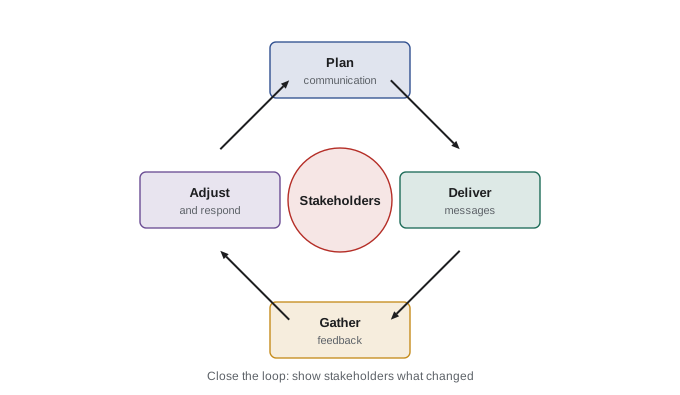
Communication that flows only outward is broadcasting. PRINCE2 7 stresses that communication should be two-way: the project needs to hear concerns, ideas, risks and reactions as much as stakeholders need to hear about progress. Feedback routes such as question sessions, surveys, user representatives, suggestion channels and informal conversations give stakeholders a voice and give the project early warning of problems. Feedback that is gathered but never acted on, however, damages trust faster than no feedback at all, so the project should close the loop by showing what it heard and what it did.
PRINCE2 reports as communication
Many of PRINCE2's management products are communication tools. Checkpoint reports carry information from team managers to the project manager. Highlight reports carry it from the project manager to the board. End stage reports and exception reports support board decisions. The end project report and lessons report carry information to the business layer and future projects. Designing these well is part of communication. A highlight report that runs to twenty pages is unlikely to be read; one that shows status against tolerances, key risks, decisions needed and forecasts on a single page is more likely to support management by exception.
Worked problem
The cost of a meeting
A weekly project coordination meeting lasts 90 minutes and involves 11 people with an average loaded cost of 72 dollars an hour. The team proposes replacing it with a 30-minute meeting for 5 people plus a written update that takes the project manager 45 minutes to prepare and each of 11 people 10 minutes to read. Compare weekly costs.
Show solution
- Current: 1.5 hours × 11 people × 72 = 1,188 dollars a week.
- Proposed meeting: 0.5 × 5 × 72 = 180 dollars.
- Written update preparation: 0.75 × 72 = 54 dollars.
- Reading: 11 × (10 ÷ 60) × 72 = 132 dollars.
- Proposed total: 180 + 54 + 132 = 366 dollars, saving 822 dollars a week.
Answer: The proposal saves about 822 dollars a week, or around 40,000 dollars over a year of 48 working weeks, while keeping everyone informed. Communication design is also a cost decision.
Inclusive and accessible communication
Stakeholders differ in language, literacy, digital access, disability and preferred channels. Communication that works for head office managers may not reach shift workers without email, people who need screen readers or communities who prefer another language. An inclusive approach offers several channels, uses plain language and follows accessibility standards for documents and web content.
In Canada, federal institutions must respect the Official Languages Act, which means communications with the public and many internal communications must be available in English and French. Federally regulated organizations have duties under the Accessible Canada Act, and Ontario organizations have duties under the Accessibility for Ontarians with Disabilities Act, including accessible web content. A project in these settings should build bilingual and accessible communication into its plans and budget from the start.
Is communication working?
Communication should be evaluated, not assumed. Simple measures include whether stakeholders can correctly state key facts about the change, attendance and participation at briefings, the number and nature of questions received, survey results and changes in engagement levels over time. The communication management approach should say how and when these checks will happen, and stage boundaries are a natural point to review and adjust it.
Worked problem
Checking understanding
Two weeks before the records move, a five-question quiz is sent to the 60 records staff. 42 respond. Correct answers to 'What date does your team move?' are given by 36 respondents. What is the response rate, the correct-answer rate among respondents and the minimum share of all staff known to know the date?
Show solution
- Response rate: 42 ÷ 60 = 70 %.
- Correct among respondents: 36 ÷ 42 = 86 %.
- Known correct among all staff: 36 ÷ 60 = 60 %.
Answer: Only 60 % of staff are confirmed to know their move date two weeks out. Line managers should confirm the date with each team member directly, and the approach should be adjusted for those who did not respond.
Information overload and message design
More communication is not always better. Stakeholders who receive frequent, long or irrelevant messages stop reading them, and then miss the ones that matter. Good message design starts with the audience: what do they need to know, what do they need to do, and by when? A short message that leads with the action required, explains why in a sentence or two and points to further detail for those who want it will usually be read. Consistent subject lines or labels help people recognize project messages and decide which to read first.
It also helps to separate information from decisions. A highlight report that buries a request for a board decision on page six risks the decision being missed. Many project managers put decisions needed at the top of every report, with a deadline, so that board members can act even if they read nothing else. The same principle applies to staff messages: if people must complete training by a certain date, say so in the first line.
| Design choice | Weak version | Stronger version |
|---|---|---|
| Opening line | Project update for March | Action needed: book your training session by 12 April |
| Length | Two pages of progress detail | Five lines with a link to more detail |
| Decisions | Mentioned in the conclusion | Listed first with a deadline |
| Language | Internal acronyms and jargon | Plain language suited to the audience |
| Feedback | No way to respond | A named contact and a question channel |
Finally, communication must be consistent. When the project, the program, line managers and suppliers all send messages, they can contradict each other. A shared calendar of planned communications and a single source of key facts, such as dates and locations, reduce the risk of mixed messages that undermine trust.
Common mistakes
MistakeCommunicating only through formal reports.
InsteadUse a mix of channels suited to each stakeholder group.
MistakeBroadcasting without gathering feedback.
InsteadBuild two-way communication and close the loop on feedback.
MistakeHaving the project manager deliver all messages about change.
InsteadHave business leaders and line managers deliver key change messages.
MistakeRelying on the power-interest grid alone.
InsteadUse judgment, especially for low-power groups who affect adoption.
MistakeAssuming communication worked because it was sent.
InsteadCheck understanding and engagement, and adjust the approach.
Summary and key terms
- Stakeholders include anyone who can affect, be affected by or perceive themselves affected by the project.
- Analysis covers interest, influence, attitude and what the project needs from each stakeholder.
- The power-interest grid and engagement gap table guide engagement strategies.
- The communication management approach is approved in initiation and reviewed at stage boundaries.
- Communication should be two-way, with feedback acted on and the loop closed.
- PRINCE2 reports are communication tools and should be concise and decision-focused.
- Communication should be inclusive, accessible and evaluated for effectiveness.
- Stakeholder
- Anyone who can affect, be affected by or perceive themselves affected by the project.
- Stakeholder engagement
- Identifying, analysing, planning and acting to involve and influence stakeholders.
- Power-interest grid
- A tool placing stakeholders by power and interest to suggest engagement strategies.
- Engagement level
- A stakeholder's current or desired stance, from unaware to leading.
- Communication management approach
- The management product describing how the project will communicate.
- Two-way communication
- Communication that includes feedback from stakeholders as well as messages to them.
- Highlight report
- A regular progress report from the project manager to the board.
- Channel
- The medium through which a message is delivered, such as a meeting or intranet page.
- Plain language
- Writing that the intended audience can understand the first time they read it.
- Closing the loop
- Showing stakeholders what was heard and what was done in response.
Practice problems
Work each problem on paper first, then reveal the answer to check.
Which quadrant suits high power and low interest?
Show answer
Keep satisfied.
Name the five engagement levels used in this lesson.
Show answer
Unaware, resistant, neutral, supportive and leading.
When is the communication management approach created?
Show answer
During initiation.
When should it be reviewed?
Show answer
At each stage boundary, and when needed.
Meeting of 8 people for 1 hour at 60 dollars an hour. Cost?
Show answer
480 dollars.
50 staff, 40 respond, 30 correct. Share of all staff confirmed correct?
Show answer
30 ÷ 50 = 60 %.
Who should deliver key messages about change to staff?
Show answer
Business leaders and line managers.
Why close the loop on feedback?
Show answer
Feedback ignored damages trust more than no feedback.
Give two PRINCE2 reports that are communication tools.
Show answer
Highlight report and exception report.
Why might a low-power group still need intensive engagement?
Show answer
Collectively they may determine adoption and benefits.
Lesson quiz · 5 questions
Score 60% or more to complete this lesson.
Create a free account to save your progress, take quizzes and earn a certificate.