
PRIN-130 · Lesson 1 of 12 · 26 min
How PRINCE2 practices work
This course is an independent study of three of the seven PRINCE2 practices: business case, organizing and plans. PRINCE2® is a registered trademark of PeopleCert. Every explanation, example and question here is original; none of it reproduces the official manual or real exam questions. When you sit a PRINCE2 exam, the official PRINCE2 7 manual is the authority, and in the Practitioner exam it is the only book you may consult.
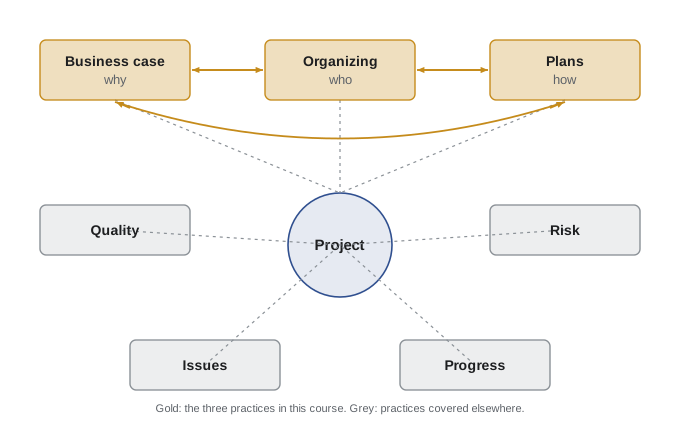
PRIN-110 studied the seven principles, the beliefs that make a project a PRINCE2 project. PRIN-120 studied people and the project context. This course turns to the practices: the aspects of project management that must be addressed continually and in parallel throughout a project. Where the principles say what must be true, the practices describe how a project makes them true. Three practices answer three basic questions that any sponsor asks before committing money and people: why are we doing this (business case), who is doing what (organizing) and how, when and for how much will it be done (plans).
What a practice is
PRINCE2 7 describes seven practices: business case, organizing, plans, quality, risk, issues and progress. Earlier editions called these themes; the seventh edition renamed them practices to emphasize that they are things people do, not topics to read about. Each practice is described in a consistent way: its purpose, how it relates to the principles, guidance for effective use, the management products that support it, the techniques that help, and how it is tailored for different situations.
| Practice | Question it answers | Main principle it supports | Covered in |
|---|---|---|---|
| Business case | Why? Is the project desirable, viable and achievable? | Ensure continued business justification | This course, lessons 2–4 |
| Organizing | Who? Who is accountable, responsible and consulted? | Define roles, responsibilities and relationships | This course, lessons 5–6 |
| Plans | How, how much and when? | Focus on products; manage by stages | This course, lessons 7–10 |
| Quality | What does fit for purpose mean, and how will we know? | Focus on products | PRIN-131 |
| Risk | What might happen, and what will we do about it? | Manage by exception | PRIN-131 |
| Issues | What has happened, and how do we control change? | Manage by exception | PRIN-131 |
| Progress | Where are we now, and where will we end up? | Manage by stages; manage by exception | PRIN-131 |
The three practices in this course are tightly linked. The business case cannot be written without estimates of cost and time, which come from plans. Plans cannot be approved without someone with the authority to approve them, which the organizing practice establishes. And the organization cannot decide whether to continue without a business case that is updated as plans change. In practice, the three develop together during starting up and initiating a project, and they are refreshed at every stage boundary.
Practices, principles and processes
The principles, practices and processes are designed to work together. Principles are the non-negotiable beliefs. Practices are the aspects of management that run throughout the project. Processes are the step-by-step journey from start to finish, and each process draws on several practices. For example, the initiating a project process uses the business case practice to refine the business case, the organizing practice to confirm the project management team, and the plans practice to produce the project plan. PRIN-140 and PRIN-141 study the processes in detail.
| Element | Nature | Example related to plans |
|---|---|---|
| Principle | A belief that must be applied for the project to be PRINCE2 | Focus on products: plans are built around the products to be delivered |
| Practice | An aspect of management addressed continually | The plans practice: plan levels, planning steps, product-based planning, estimating |
| Process | A set of activities carried out at a point in the journey | Managing a stage boundary: produce the next stage plan |
| Management product | A document or record used to manage the project | Stage plan, product description, project plan |
| Technique | A method that helps carry out a practice | Product-based planning, three-point estimating |
An important consequence is that a practice is not a phase. The business case is not written once and filed. It is created in outline before the project starts, detailed during initiation, updated at every stage boundary and used after the project to confirm benefits. The same is true of plans and of the project's organization. Thinking of practices as threads that run through the whole timeline, rather than as boxes on a schedule, is one of the most useful habits a PRINCE2 student can develop.
Management products
Each practice is supported by management products. These are not the specialist products the project exists to create, such as a new building or a software system. They are the documents and records the project uses to manage itself: plans, registers, reports and approaches. PRINCE2 deliberately keeps the number of management products modest and allows them to be combined, held in tools rather than documents, or simplified for small projects.
| Practice | Typical management products | When they are created |
|---|---|---|
| Business case | Business case; benefits management approach | Outline in starting up; detailed in initiation; updated at stage boundaries |
| Organizing | Project management team structure and role descriptions; communication management approach | Starting up and initiation; reviewed at stage boundaries |
| Plans | Project plan; stage plans; team plans; exception plans; product descriptions; the project product description | Project product description in starting up; project plan in initiation; stage plans at each boundary |
Students sometimes memorize the products without understanding why they exist. A better approach is to ask, for each product, what decision it supports and who uses it. A business case supports the decision to invest and to continue investing; the executive owns it. A stage plan supports the decision to authorize a stage; the project board approves it. A product description supports the decision to accept a product; the people named as reviewers and approvers use it. If you know the decision, you can usually work out the contents.
Minimum requirements and tailoring
PRINCE2 describes what must be done for each practice, as a minimum, for a project to be following the method. Beyond the minimum, it offers guidance that may be adopted, adapted or omitted. This distinction is central to tailoring, which PRIN-110 discussed as a principle and PRIN-150 covers in depth. Tailoring does not mean skipping the business case on a small project; it means keeping the business case to the length and formality the project needs.
Worked problem
Deciding how much of a practice a small project needs
A three-month internal project will replace the booking system for a community centre at a cost of about 40,000. The centre manager asks whether the project really needs a business case, a project management team and plans. What would a proportionate approach look like for each practice?
Show solution
- Business case: still required, because someone must judge whether 40,000 is justified. A one-page document with options, costs, expected benefits and main risks is enough.
- Organizing: the roles still exist, but one person can hold several. The centre manager might be executive and senior user; the software vendor's contact the senior supplier; a staff member the project manager.
- Plans: one combined project and stage plan, perhaps a single page with a product breakdown, a simple schedule and a budget, is enough for a project of this size.
- All three should still be updated if something significant changes, such as a cost increase that weakens the case.
Answer: Each practice is applied, but lightly: a short business case, combined roles with clear accountability and a single simple plan. What is never tailored away is the purpose each practice serves.
Running example: Ridgeline Water
To keep the examples connected, most lessons in this course follow one invented organization. Ridgeline Water is a mid-sized municipal water utility serving about 60,000 customer connections. Its meters are read manually every quarter, estimated bills are common, and leaks on the customer side often go unnoticed for months. The utility's board is considering a project to replace manual meters with smart meters that report readings automatically. The figures used are illustrative and simplified; they are chosen to make the arithmetic clear rather than to describe any real utility.
| Feature | Ridgeline Water today | What the project might change |
|---|---|---|
| Meter reading | Manual, quarterly, by four readers | Automatic, daily |
| Billing | Many estimated bills; frequent disputes | Bills based on actual use |
| Leak detection | Customers notice leaks only when bills arrive | Continuous-flow alerts within days |
| Data | Four readings a year per customer | Hourly or daily consumption data |
| Staff | Readers, billing clerks handling disputes | Fewer reading routes; new data and field roles |
Over the coming lessons we will build Ridgeline Water's business case, appraise options, define its benefits, set up its project management team and produce its plans. By the end, you will have seen how the three practices fit together in one project, and the capstone will ask you to do the same for a different case.
Checking that a practice is working
Because practices run throughout the project, it is useful to have simple checks that show whether each one is alive or merely documented. The code below represents three practices as lists of yes-or-no checks and reports which ones are healthy. The checks are a teaching device, not an official PRINCE2 list.
checks = {
    "business case": {
        "options compared, including do nothing": True,
        "reviewed at last stage boundary": False,
        "benefits have owners and measures": True,
    },
    "organizing": {
        "executive named and available": True,
        "assurance independent of project manager": True,
        "change authority defined": False,
    },
    "plans": {
        "plans built from products": True,
        "estimates show basis and range": False,
        "tolerances recorded in stage plan": True,
    },
}
for practice, items in checks.items():
    met = sum(items.values())
    status = "healthy" if met == len(items) else "needs attention"
    print(f"{practice:14} {met}/{len(items)}  {status}")
    for name, ok in items.items():
        if not ok:
print(f"{'':16}- missing: {name}")business case 2/3 needs attention
- missing: reviewed at last stage boundary
organizing 2/3 needs attention
- missing: change authority defined
plans 2/3 needs attention
- missing: estimates show basis and rangeTwo of the three practices show a gap. The business case has not been reviewed at the last stage boundary, which undermines the principle of continued business justification. The plans have estimates without a stated basis or range, which makes tolerances hard to set. Neither gap is unusual; both are the kind of thing an assurance review would pick up.
How this course is organized
Lessons 2 to 4 cover the business case practice, including investment appraisal and benefits management. Lessons 5 and 6 cover the organizing practice. Lessons 7 to 10 cover the plans practice, including product-based planning and how plans connect to stages and tolerances. Lesson 11 practises exam technique for these practices, and lesson 12 is a capstone that brings them together. FIN-201 covers investment appraisal in more depth for readers who want the finance background, and CON-210 covers critical path scheduling in construction.
Common mistakes
MistakeTreating each practice as a phase that is completed and then put away.
InsteadTreat practices as threads that run through the whole project and are refreshed at each stage boundary.
MistakeMemorizing management products without knowing what decision each supports.
InsteadAsk who uses each product and for which decision; the contents then follow.
MistakeDropping the business case or project board on a small project.
InsteadKeep every practice but scale its formality to the project.
MistakeConfusing management products with specialist products.
InsteadManagement products help manage the project; specialist products are what the project delivers.
MistakeStudying the three practices separately.
InsteadStudy them together: the business case needs plans, plans need approvers, and approvers need the business case.
Summary and key terms
- PRINCE2 7 has seven practices: business case, organizing, plans, quality, risk, issues and progress.
- Practices are aspects of management addressed continually and in parallel throughout a project.
- The business case answers why, organizing answers who, and plans answer how, how much and when.
- Each practice is supported by management products and techniques and can be tailored.
- Tailoring scales formality; it never removes the purpose a practice serves.
- The three practices in this course depend on one another and develop together.
- Ridgeline Water, an invented utility, is the running example for this course.
- Practice
- An aspect of project management that must be addressed continually and in parallel throughout a PRINCE2 project.
- Management product
- A document or record used to manage a project, as opposed to a specialist product the project delivers.
- Specialist product
- A product the project exists to create, such as a building, system or service.
- Technique
- A method that helps carry out a practice, such as product-based planning.
- Minimum requirement
- What must be done for a practice for the project to be following PRINCE2.
- Tailoring
- Adapting the method to suit the project's size, complexity, risk and context.
- Business case practice
- The practice that establishes and maintains the justification for the project.
- Organizing practice
- The practice that defines and establishes the project's structure of accountability and responsibility.
- Plans practice
- The practice that facilitates communication and control by defining the means of delivering products.
- Theme
- The name earlier PRINCE2 editions used for what the seventh edition calls a practice.
Practice problems
Work each problem on paper first, then reveal the answer to check.
List the seven PRINCE2 7 practices.
Show answer
Business case, organizing, plans, quality, risk, issues and progress.
Which practice answers the question who?
Show answer
Organizing.
What did earlier editions call the practices?
Show answer
Themes.
Give one difference between a management product and a specialist product.
Show answer
A management product helps manage the project; a specialist product is what the project delivers.
Which principle does the business case practice mainly support?
Show answer
Ensure continued business justification.
When is the business case first created?
Show answer
In outline before or during starting up a project, then detailed in initiation.
Why should practices not be treated as phases?
Show answer
Because they run continually throughout the project and are refreshed at stage boundaries.
On a small project, may the executive and senior user be the same person?
Show answer
Yes, roles can be combined if accountability remains clear and the combination does not create a conflict.
Name two management products of the plans practice.
Show answer
For example, the project plan and product descriptions.
What question should you ask to understand a management product?
Show answer
What decision does it support and who uses it?
Lesson quiz · 5 questions
Score 60% or more to complete this lesson.
Create a free account to save your progress, take quizzes and earn a certificate.