
PRIN-130 · Lesson 8 of 12 · 26 min
Product-based planning I: product breakdown structures and product descriptions
Product-based planning is the technique at the centre of PRINCE2 planning and the practical expression of the principle of focusing on products. Instead of starting with a list of tasks, the planner starts by defining what the project must deliver, breaks it down into its component products, describes each product and its quality criteria, and only then works out the order in which products must be created and the activities needed to create them. PRIN-110 explained why the focus on products matters. This lesson and the next show how to do it.
PRINCE2 describes product-based planning in four main steps: write the project product description; create the product breakdown structure; write product descriptions; and create the product flow diagram. This lesson covers the first three. Lesson 9 covers the product flow diagram and how it leads to a schedule.
Why start with products
Planning from products has several advantages over planning from activities. It reduces the risk of missing work, because every product must be identified and every product needs activities. It clarifies scope, because what is in the product breakdown is in scope and what is not is out. It makes quality explicit, because every product has a description with quality criteria. And it helps communication, because users and sponsors understand products such as a customer portal or a trained team far more readily than lists of tasks.
| Planning from activities | Planning from products |
|---|---|
| Starts with what people will do | Starts with what must be delivered |
| Scope implied by the task list | Scope defined by the product breakdown |
| Quality often defined late | Quality criteria defined for each product up front |
| Easy to miss work no one thought to list | Every product needs activities, so gaps are easier to see |
| Progress measured by effort spent | Progress measured by products completed and accepted |
The project product description
The project product description describes the final product the project will deliver: the overall output that the users will accept at the end. It is written during starting up a project, usually by the project manager with the senior user and executive, and it is part of the project brief. It records the purpose of the final product, its composition, the customer's quality expectations, the acceptance criteria and how acceptance will be confirmed, and the project-level quality tolerances. It is the starting point for the product breakdown and the basis on which the project will be closed.
| Element | Meaning | Ridgeline Water |
|---|---|---|
| Title | Name of the final product | Operational smart-metering service |
| Purpose | What the final product is for | To provide daily actual readings and leak alerts for all connections |
| Composition | Major products that make up the final product | Installed meters, communication network, data platform, billing integration, customer alerts and portal, trained staff, updated processes |
| Customer quality expectations | Key quality requirements in the customer's words | Readings must be reliable enough to bill without estimates; alerts must reach customers quickly |
| Acceptance criteria | Measurable criteria for acceptance | At least 98 % of meters report daily for 60 days; at least 99.5 % of bills based on actual reads; alerts sent within 24 hours of a continuous-flow event |
| Acceptance method and responsibilities | How and by whom acceptance will be confirmed | Senior user confirms from operational reports after 60 days of live running |
| Project-level quality tolerances | Permitted variation in acceptance criteria | Daily reporting may be 97–98 % in districts with known radio constraints |
Customer quality expectations and acceptance criteria are not the same. Expectations are what the customer wants, often in general terms; acceptance criteria are measurable conditions that, if met, mean the customer will accept the product. Turning expectations into criteria is one of the most valuable conversations in starting up a project, because disagreements discovered now are cheap to resolve.
The product breakdown structure
A product breakdown structure (PBS) is a hierarchy of all the products the plan must produce. At the top is the final product from the project product description. Below it are major products, and below those their components, down to a level suitable for the plan. A PBS can be drawn as a tree, written as an indented list or held in a planning tool. PRINCE2 encourages including management products as well as specialist products, so that the plan accounts for the effort of producing them, and including external products, which the project needs but does not create.
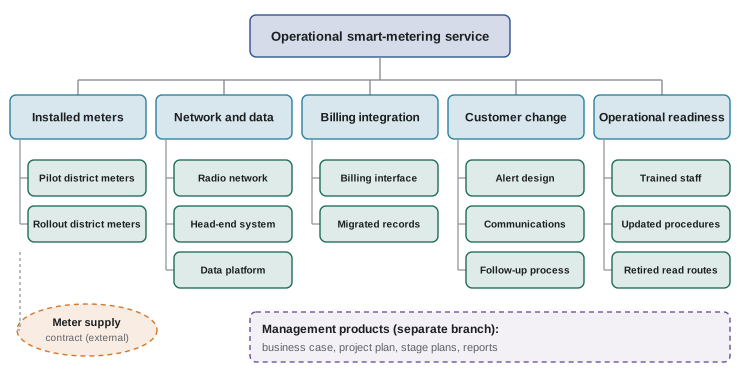
Conventions vary, but a common one is to draw specialist products as rectangles, external products as ellipses and intermediate groupings, which are not real products but help organize the structure, in a different style. The important thing is that the PBS includes everything that must be produced or obtained, and nothing else. Each box at the lowest level should be a product that can be described, built and checked.
| Type | Meaning | Ridgeline Water examples |
|---|---|---|
| Specialist product | A product the project creates to deliver its outputs | Installed meters, billing interface, alert templates, training course |
| Management product | A product used to manage the project | Business case, project plan, stage plans, highlight reports |
| External product | A product the project needs but someone else provides | Meter supply contract, radio licence approval, existing billing system |
| Release | A set of products handed over together | All products needed for one district group to go live |
External products deserve special attention. Ridgeline Water depends on a radio spectrum authorization from Innovation, Science and Economic Development Canada for its meter network, and on the existing billing system, which the project does not own. Neither is in the project's control, so each should appear in the PBS and in the risk register, with an owner who will monitor it.
Building a PBS step by step
A practical way to build a PBS is to work with the people who know the products: users, suppliers and specialists. Start with the final product, ask what it is made of, and keep asking until each product is small enough to estimate and check. Then walk through the structure looking for gaps: training, documentation, data migration, handover and decommissioning of old systems are often forgotten. The code below holds part of Ridgeline Water's PBS as a nested structure and lists the lowest-level products, which are the ones that will need product descriptions and activities.
pbs = {
    "Operational smart-metering service": {
        "Installed meters": {"Pilot district meters": {}, "Rollout district meters": {},
                             "Meter supply contract (external)": {}},
        "Network and data platform": {"Radio network": {}, "Head-end system": {}, "Data platform": {}},
        "Billing integration": {"Billing interface": {}, "Migrated meter records": {}},
        "Customer change": {"Alert design": {}, "Customer communications": {}, "Follow-up process": {}},
        "Operational readiness": {"Trained staff": {}, "Updated procedures": {},
                                  "Decommissioned reading routes": {}},
    }
}

def leaves(tree, path=()):
    for name, sub in tree.items():
        if sub:
            yield from leaves(sub, path + (name,))
        else:
            yield path + (name,)

items = list(leaves(pbs))
external = [p for p in items if "(external)" in p[-1]]
print(f"{len(items)} lowest-level products, {len(external)} external")
for p in items:
print(" " + " > ".join(p[1:]))14 lowest-level products, 1 external Installed meters > Pilot district meters Installed meters > Rollout district meters Installed meters > Meter supply contract (external) Network and data platform > Radio network Network and data platform > Head-end system Network and data platform > Data platform Billing integration > Billing interface Billing integration > Migrated meter records Customer change > Alert design Customer change > Customer communications Customer change > Follow-up process Operational readiness > Trained staff Operational readiness > Updated procedures Operational readiness > Decommissioned reading routes
The listing shows fourteen lowest-level products, one of them external. Note that decommissioned reading routes appears as a product. Ending the old way of working is part of the change, and if it is not planned as a product, the old routes may continue running alongside the new system, eroding the reading-cost benefit in the business case. A PBS that includes the ending of old processes is a sign that the planner has connected the plan to the benefits.
Product descriptions
A product description is written for each significant product in the PBS. It records the product's purpose, composition, derivation (what it is developed from), format and presentation, the development skills required, the quality criteria and tolerances, the quality method, and the people responsible for producing, reviewing and approving it. Product descriptions are written early, when the product is planned, so that everyone knows what is expected before work begins.
| Element | Example: alert design |
|---|---|
| Purpose | Define the content, channel and timing of alerts sent to customers when a continuous flow suggests a leak |
| Composition | Alert rules; message wording for text, email and letter; escalation rule for large flows |
| Derivation | Leak analytics from the data platform; customer research from the pilot; plain-language guidelines |
| Format and presentation | Rule specification and approved message templates |
| Development skills required | Customer communications, data analysis, accessibility review |
| Quality criteria | Messages tested with at least 20 customers; at least 80 % understand what to do; accessible formats available; false alert rate below 5 % in pilot data |
| Quality tolerance | False alert rate up to 7 % if large-flow escalation is in place |
| Quality method | Usability testing with customers; review by customer operations and accessibility specialist |
| Quality responsibilities | Producer: customer change team; reviewers: customer operations, accessibility specialist; approver: senior user |
Quality criteria are the heart of a product description. They should be measurable, so that a reviewer can say whether the product meets them, and they should trace back to the customer's quality expectations. Vague criteria such as user-friendly or high quality cannot be checked. PRIN-131 covers the quality practice, including quality methods and the quality register; here the point is that product-based planning creates the product descriptions that the quality practice uses.
required = ["purpose", "composition", "derivation", "quality criteria",
            "quality method", "producer", "reviewer", "approver"]
vague = ["user-friendly", "high quality", "robust", "appropriate", "as required"]
descriptions = {
    "Alert design": {"purpose": "x", "composition": "x", "derivation": "x",
                     "quality criteria": "80 % of tested customers understand the action",
                     "quality method": "x", "producer": "x", "reviewer": "x", "approver": "x"},
    "Trained staff": {"purpose": "x", "composition": "x",
                      "quality criteria": "staff are trained to a high quality",
                      "producer": "x", "approver": "x"},
}
for name, d in descriptions.items():
    missing = [f for f in required if f not in d]
    crit = d.get("quality criteria", "")
    fuzzy = [w for w in vague if w in crit.lower()]
    status = "ok" if not missing and not fuzzy else "revise"
    print(f"{name}: {status}")
    if missing:
        print("   missing:", ", ".join(missing))
    if fuzzy:
print(" vague criteria:", ", ".join(fuzzy))Alert design: ok Trained staff: revise missing: derivation, quality method, reviewer vague criteria: high quality
The trained staff description is missing its derivation, quality method and reviewer, and its only criterion is vague. A better criterion might be that every billing clerk completes the course and passes a practical assessment of handling an exception alert, with a pass mark of 80 %. Simple checks like this are not part of PRINCE2, but they help project support and project assurance catch weak descriptions before work starts.
How much detail
Product descriptions should be proportionate. A major product with many users and high risk deserves a full description; a minor internal product may need only a title, purpose and one or two quality criteria. On agile projects, product descriptions are often lightweight and supplemented by user stories with acceptance criteria. What matters is that, for every product, the people producing, reviewing and approving it agree in advance what good looks like.
Worked problem
Deciding the level of detail
Ridgeline Water's PBS has fourteen lowest-level products. The project manager has limited time before initiation must finish. Which products should get full product descriptions first?
Show solution
- Prioritize products on which benefits depend: alert design, follow-up process and billing interface.
- Prioritize products with external dependencies or suppliers: rollout district meters, radio network and the meter supply contract.
- Give simpler descriptions to internal administrative products such as updated procedures.
- Record which descriptions are outline and when they will be completed, normally before the work package is authorized.
Answer: Start with products that carry the benefits or depend on suppliers and external parties, and complete the rest before their work packages are authorized.
Common mistakes
MistakeStarting a plan with a list of activities.
InsteadStart with the project product description and product breakdown structure.
MistakeConfusing customer quality expectations with acceptance criteria.
InsteadTurn expectations into measurable acceptance criteria during starting up.
MistakeLeaving external products out of the PBS.
InsteadInclude them, with owners, and record the dependency as a risk.
MistakeForgetting products such as training, data migration and decommissioning.
InsteadWalk the PBS looking for the products of change and of ending old ways of working.
MistakeWriting quality criteria such as user-friendly.
InsteadWrite measurable criteria that a reviewer can check.
Summary and key terms
- Product-based planning defines products before activities and expresses the principle of focusing on products.
- The project product description defines the final product, acceptance criteria and project-level quality tolerances.
- The product breakdown structure is a hierarchy of all products, including management and external products.
- External products are outside the project's control and should be monitored as dependencies.
- Product descriptions record purpose, composition, derivation, quality criteria, methods and responsibilities.
- Quality criteria must be measurable and trace to customer quality expectations.
- Detail in product descriptions should be proportionate to the product's importance and risk.
- Product-based planning
- A technique that plans from the products to be delivered rather than from activities.
- Project product description
- A description of the project's final product, including acceptance criteria.
- Product breakdown structure
- A hierarchy of all the products to be produced or obtained by a plan.
- Product description
- A description of a product's purpose, composition, derivation, quality criteria and responsibilities.
- External product
- A product the project needs but does not create.
- Customer quality expectations
- The customer's key quality requirements for the final product.
- Acceptance criteria
- Measurable conditions that the final product must meet to be accepted.
- Quality criteria
- Measurable characteristics a product must have to be approved.
- Derivation
- The source products or information from which a product is developed.
- Release
- A set of products handed over to users together.
Practice problems
Work each problem on paper first, then reveal the answer to check.
Name the four steps of product-based planning.
Show answer
Write the project product description, create the PBS, write product descriptions, create the product flow diagram.
When is the project product description written?
Show answer
During starting up a project.
What is the difference between customer quality expectations and acceptance criteria?
Show answer
Expectations are what the customer wants; criteria are measurable conditions for acceptance.
How are external products often drawn in a PBS?
Show answer
As ellipses or ovals.
Give one example of an external product for Ridgeline Water.
Show answer
The meter supply contract or the existing billing system.
Why include management products in a PBS?
Show answer
So the plan accounts for the effort of producing them.
Name four elements of a product description.
Show answer
For example purpose, composition, quality criteria and quality responsibilities.
Rewrite 'staff well trained' as a measurable criterion.
Show answer
For example: every clerk completes the course and scores at least 80 % on a practical assessment.
Why include decommissioned reading routes as a product?
Show answer
To make sure the old process ends so the benefit is realized.
Which products should get full descriptions first?
Show answer
Those that carry benefits or depend on suppliers and external parties.
Lesson quiz · 5 questions
Score 60% or more to complete this lesson.
Create a free account to save your progress, take quizzes and earn a certificate.