
PRIN-130 · Lesson 7 of 12 · 26 min
The plans practice I: plan levels, planning steps and estimating
The purpose of the plans practice is to facilitate communication and control by defining the means of delivering the products: where and how, by whom, and estimating when and how much. A plan is not just a schedule. In PRINCE2 a plan describes what products will be delivered, how they will be delivered, the activities and resources needed, the timescale, the costs, the quality approach, the tolerances and the risks. Plans are the basis of control because progress can only be judged against something; they are also a communication tool, telling everyone involved what is expected of them.
This lesson covers the levels of plan in PRINCE2, the steps of planning and the techniques used to estimate effort, duration and cost. Lessons 8 and 9 cover product-based planning, the technique at the heart of PRINCE2 planning, and lesson 10 connects plans to stages, tolerances and exception plans.
Why plan at several levels
No single plan can serve every audience. The business layer and the board need to see the whole project at a level of detail that supports investment decisions. The project manager needs a detailed plan for the current stage. Team managers need detailed plans for their work packages. PRINCE2 therefore uses several levels of plan, each with its own audience, level of detail and time horizon.
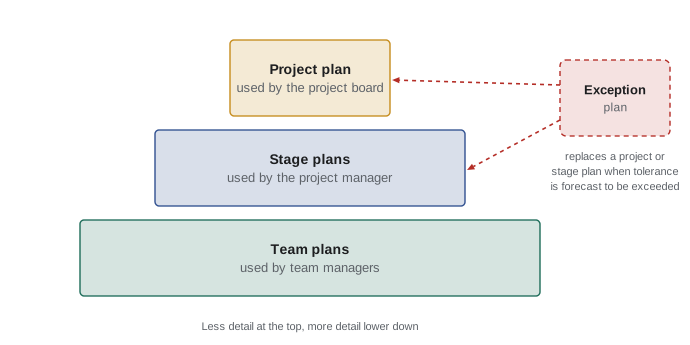
| Plan | Used by | Detail and horizon | When produced | Ridgeline Water example |
|---|---|---|---|---|
| Project plan | Project board, business layer | Whole project, at the level of major products and stages | Initiating a project | Pilot, then three rollout stages of district groups, with costs and milestones |
| Stage plan | Project manager, board | One management stage in detail | Before each stage, at the stage boundary | Rollout stage 1: districts 1–6, with weekly installation targets |
| Team plan | Team managers | One work package or team's work in detail | When a work package is accepted | Meter installation team: district 3, crew assignments by street |
| Exception plan | Board (or business layer) | Replaces a stage or project plan | When a tolerance is forecast to be exceeded and the board asks for one | A revised rollout stage after supply delays |
Team plans are optional in the sense that PRINCE2 does not prescribe their format; a supplier may use its own planning tools and methods. The project manager needs only to be confident that the team plan can deliver the work package within its tolerances. Exception plans replace the plan they modify; they are not extra plans layered on top.
Planning horizons
A central idea of the plans practice is that it is impossible to plan an entire project in detail at the start with any confidence. The planning horizon, the period over which accurate planning is possible, is usually short. PRINCE2 deals with this by planning the whole project at a high level and only the next stage in detail. When that stage nears its end, the next stage is planned in detail, using everything learned so far. This is one of the main reasons for management stages, and it links the plans practice directly to the principle of managing by stages.
| Approach | Strength | Weakness |
|---|---|---|
| Detailed plan for the whole project at the start | Gives an impression of certainty | Detail far ahead is guesswork and soon out of date |
| No overall plan, plan as you go | Flexible | No basis for an investment decision or for setting project tolerances |
| PRINCE2: high-level project plan plus detailed next-stage plan | Supports the investment decision and gives realistic detail where it is needed | Requires discipline to replan at each stage boundary |
The steps of planning
PRINCE2 recommends a consistent approach to producing any plan. In plain terms, the steps are: design the plan, which means deciding its format, tools, estimating methods and level of detail; define and analyse the products using product-based planning; identify the activities and dependencies needed to deliver the products; prepare estimates of effort and duration; prepare the schedule; and analyse the risks to the plan. The plan is then documented with its budget, tolerances and assumptions. Steps are often revisited, because analysing risks may change the activities or the schedule.
| Step | Main question | Typical output |
|---|---|---|
| Design the plan | What format, tools and level of detail suit this project? | Planning approach and conventions |
| Define and analyse products | What must be delivered? | Product breakdown structure, product descriptions, product flow diagram |
| Identify activities and dependencies | What work produces each product, in what order? | Activity list and dependency network |
| Prepare estimates | How much effort, time and cost? | Estimates with basis and ranges |
| Prepare the schedule | When will activities happen, with which resources? | Schedule, resource plan, milestones |
| Analyse risks | What threats and opportunities affect the plan? | Risk responses built into the plan |
| Document the plan | What must decision-makers know? | Plan text, budget, tolerances, assumptions, quality approach |
Putting product definition before activity identification is distinctive. Many planning methods start with a list of activities; PRINCE2 starts with the products and derives the activities from them. That ensures every activity contributes to a defined product, and that each product has quality criteria by which it can be accepted. Lessons 8 and 9 develop this in detail.
Estimating
An estimate is a forecast of the effort, duration or cost of an activity or product. Every estimate is uncertain, and good planning makes that uncertainty visible rather than hiding it behind a single number. Several techniques are commonly used, and plans often combine them.
| Technique | How it works | When it is useful | Watch out for |
|---|---|---|---|
| Top-down | Estimate the whole, then divide it among parts | Early, when detail is limited | Missing work hidden in the parts |
| Bottom-up | Estimate each part, then add them up | When products and activities are known in detail | Optimism in each part adds up |
| Comparative (analogous) | Base the estimate on similar past work | When reliable records of past projects exist | Differences in scale or context |
| Parametric | Use a rate per unit, such as hours per meter installed | Repetitive work with good data | Rates that do not hold at different volumes |
| Three-point | Estimate optimistic, most likely and pessimistic values | Whenever uncertainty matters | Ranges that are too narrow |
| Expert judgment and group estimating | Ask experienced people, often several together | Novel work | Anchoring on the first number mentioned |
Parametric estimating suits much of Ridgeline Water's work. If a crew can install about 24 meters a day in a typical residential district, 60,000 meters need about 2,500 crew-days. With ten crews working 220 days a year, that is a little over a year of installation, before allowing for difficult sites, access refusals and weather. The rate must come from evidence, ideally from the pilot stage, and the plan should record it as an assumption.
Three-point estimates and ranges
Three-point estimating asks for an optimistic estimate (O), a most likely estimate (M) and a pessimistic estimate (P). A common way to combine them, from the PERT technique, weights the most likely value four times as heavily as the extremes, and gives a rough standard deviation as one sixth of the range.
Worked problem
A three-point estimate for billing integration
The IT team estimates the billing integration work package at 60 days optimistic, 80 days most likely and 130 days pessimistic. What is the PERT expected duration and approximate standard deviation?
Show solution
- E = (60 + 4 × 80 + 130) ÷ 6 = (60 + 320 + 130) ÷ 6 = 510 ÷ 6 = 85 days.
- σ ≈ (130 − 60) ÷ 6 = 70 ÷ 6 ≈ 11.7 days.
- The expected value, 85 days, is higher than the most likely value, 80 days, because the pessimistic tail is long.
Answer: About 85 days expected, with a standard deviation of roughly 12 days. Planning to the most likely value of 80 days would understate the likely duration.
When several uncertain activities are combined, simple addition of most likely values tends to understate the total, because delays in one activity are rarely offset by gains elsewhere. A simulation shows the effect. The code below draws random durations for three sequential work packages from triangular distributions and reports the chance of finishing within various targets. The random seed is fixed so the result is reproducible.
import random
rng = random.Random(130)
packages = {                      # (optimistic, most likely, pessimistic) days
    "data platform":       (30, 40, 70),
    "billing integration": (60, 80, 130),
    "customer portal":     (25, 35, 60),
}
most_likely_total = sum(m for _, m, _ in packages.values())
pert_total = sum((o + 4 * m + p) / 6 for o, m, p in packages.values())
runs = 20000
totals = sorted(sum(rng.triangular(o, p, m) for o, m, p in packages.values()) for _ in range(runs))
print(f"sum of most likely values: {most_likely_total} days")
print(f"sum of PERT expected values: {pert_total:.1f} days")
for target in (155, 170, 185, 200):
    share = sum(t <= target for t in totals) / runs
    print(f"chance of finishing within {target} days: {share:.0%}")
print(f"80th percentile: {totals[int(0.8 * runs)]:.0f} days")sum of most likely values: 155 days sum of PERT expected values: 165.8 days chance of finishing within 155 days: 12% chance of finishing within 170 days: 39% chance of finishing within 185 days: 69% chance of finishing within 200 days: 88% 80th percentile: 193 days
The sum of the most likely values is 155 days, but the simulation gives only about a 12 % chance of finishing that quickly, and even the PERT total of about 166 days is met less than half the time. The 80th percentile, about 193 days, is the duration the team would meet four times in five; a project manager might use something like it for the schedule, and set time tolerance to cover the range the board is willing to accept. The simulation does not make the estimates more accurate; it makes the consequences of their uncertainty visible, which is the information the board needs to set tolerances.
Who estimates
PRINCE2 expects estimates to come from the people who will do the work, wherever possible. Team managers estimate the work packages they will deliver, and the senior supplier confirms that the supplier side can achieve them. The project manager assembles the estimates, challenges them and adds management activities such as reviews and reporting. An estimate imposed from above without the agreement of those doing the work is a target, not an estimate, and it tends to produce exceptions later.
| Who | Contribution to estimates |
|---|---|
| Team managers and specialists | Estimate effort and duration for their products and activities |
| Senior supplier | Confirms supplier estimates and resource availability |
| Project manager | Assembles, challenges and adds management effort; records basis and assumptions |
| Project assurance | Checks estimates are realistic and consistent with past performance |
| Project board | Approves the plan, with its budget and tolerances, based on the estimates |
Budgets within a plan
A plan's budget is more than the sum of activity costs. PRINCE2 guidance describes several components that a project budget may include: the cost of the planned work, a risk budget for responding to risks, a change budget for approved changes, and cost tolerance. Keeping these separate makes it clear which money is for planned work, which is for known risks and changes, and which is the board's allowance for variation.
| Budget component | Purpose | Who controls it | Rollout stage 1 example ($000) |
|---|---|---|---|
| Planned cost of work | Cost of the activities in the plan | Project manager within stage tolerance | 4,500 |
| Risk budget | Funds planned responses to identified risks | Project manager, as agreed with the board | 150 |
| Change budget | Funds approved requests for change | Change authority within limits | 150 |
| Cost tolerance | Allowance for variation before escalation | Board (stage), business layer (project) | +5 %, about 240 |
Separating these amounts protects the plan. A project manager who uses the change budget to cover overruns on planned work hides a performance problem; one who uses cost tolerance to fund changes hides scope growth. Reporting each component separately in highlight reports lets the board see what is really happening.
Common mistakes
MistakeTreating a schedule as the whole plan.
InsteadInclude products, quality, resources, costs, tolerances, assumptions and risks.
MistakePlanning the whole project in detail at the start.
InsteadPlan the project at a high level and the next stage in detail.
MistakeListing activities before defining products.
InsteadDefine products first and derive the activities from them.
MistakeGiving single-point estimates with no basis.
InsteadRecord the basis of each estimate and show its range.
MistakeAdding most likely values to get the project duration.
InsteadUse expected values or simulation; most likely values understate totals.
Summary and key terms
- Plans facilitate communication and control by defining how, by whom, when and for how much products will be delivered.
- PRINCE2 uses project, stage and team plans, with exception plans replacing a plan when needed.
- Because the planning horizon is short, the next stage is planned in detail and the project at a high level.
- Planning steps start with designing the plan and defining products before identifying activities.
- Estimating techniques include top-down, bottom-up, comparative, parametric, three-point and expert judgment.
- Three-point estimates and simulation make uncertainty visible and inform tolerances.
- Budgets separate planned work, risk budget, change budget and cost tolerance.
- Plans practice
- The practice that facilitates communication and control by defining how products will be delivered.
- Project plan
- A high-level plan for the whole project used by the board.
- Stage plan
- A detailed plan for one management stage.
- Team plan
- A plan for a team's work, usually one or more work packages.
- Exception plan
- A plan that replaces a project or stage plan after a forecast tolerance breach.
- Planning horizon
- The period over which accurate, detailed planning is possible.
- Estimate
- A forecast of the effort, duration or cost of work.
- Three-point estimate
- An estimate built from optimistic, most likely and pessimistic values.
- Parametric estimating
- Estimating using a rate per unit of work, such as meters installed per crew-day.
- Risk budget
- Money set aside to fund planned responses to identified risks.
Practice problems
Work each problem on paper first, then reveal the answer to check.
Name the three main levels of plan in PRINCE2.
Show answer
Project plan, stage plan and team plan.
Who uses the project plan?
Show answer
The project board and the business layer.
When is a stage plan produced?
Show answer
At the stage boundary before the stage begins.
Does an exception plan add to or replace the existing plan?
Show answer
It replaces it.
Why does PRINCE2 plan only the next stage in detail?
Show answer
Because the planning horizon is short; detail far ahead is unreliable.
O = 10, M = 14, P = 24. PERT expected value?
Show answer
15.
O = 10, P = 24. Approximate standard deviation?
Show answer
About 2.3.
What step comes before identifying activities?
Show answer
Defining and analysing the products.
Who should normally estimate a work package?
Show answer
The team manager and specialists who will do the work.
Name the four budget components discussed.
Show answer
Planned cost of work, risk budget, change budget and cost tolerance.
Lesson quiz · 5 questions
Score 60% or more to complete this lesson.
Create a free account to save your progress, take quizzes and earn a certificate.