
PRIN-130 · Lesson 11 of 12 · 32 min
Business case, organizing and plans in exam scenarios
This lesson turns from the practices themselves to how they are tested. PRINCE2 exams are set by PeopleCert, and this course has no access to real exam questions; every question here is original and written to practise reasoning, not to predict exam content. PRIN-101 described the Foundation and Practitioner exams, and PRIN-160 covers exam strategy in depth. Here the focus is narrower: how questions about the business case, organizing and plans are typically framed, the traps they set, and a reliable method for working through them.
As summarized in PRIN-101 and PRIN-120, the PRINCE2 7 Foundation exam is a closed-book, multiple-choice paper of 60 questions in 60 minutes with a pass mark of 36, and the Practitioner exam is a 150-minute, 70-question objective test based on a scenario, with a pass mark of 60 %, in which candidates may consult the official PRINCE2 7 manual. Formats change from time to time, so always check the current exam guidance from PeopleCert or your accredited training provider before you sit an exam.
What each exam tests
Foundation questions test whether you know and understand the method: definitions, purposes, responsibilities and relationships. Practitioner questions test whether you can apply the method to a scenario: choosing the most appropriate action, identifying which role should do something, or judging whether an extract from a management product is appropriate. For the three practices in this course, the difference looks like this.
| Practice | Foundation-style focus | Practitioner-style focus |
|---|---|---|
| Business case | Purpose; outputs, outcomes, benefits and dis-benefits; who owns the business case; when it is updated | Whether a business case entry is appropriate; what to do when justification weakens; whether a benefit is well defined |
| Organizing | Purpose; the three interests; role responsibilities; project assurance versus quality assurance | Which role should act in a situation; whether a proposed role combination is acceptable; who approves a change |
| Plans | Purpose; plan levels; steps of planning; product-based planning terms | Whether a product description or plan extract is appropriate; how to sequence products; how tolerances should be set or allocated |
A reasoning method
Scenario questions can feel ambiguous because several options sound reasonable. A consistent method helps. The steps below are a study aid; they are not an official technique, but they reflect how the method itself is structured.
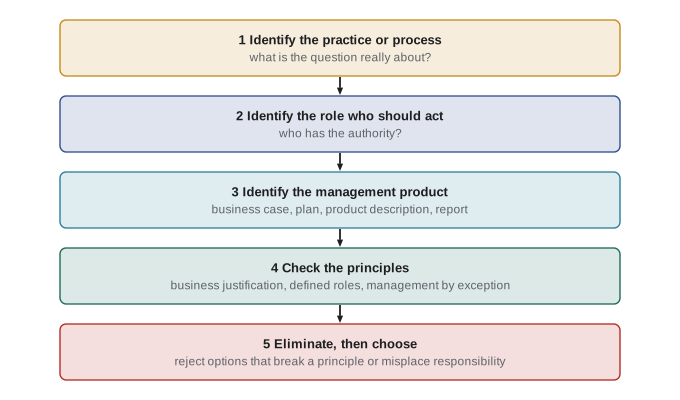
| Step | Question to ask | Typical clue in the question |
|---|---|---|
| 1. Practice or process | Is this about why (business case), who (organizing) or how, when and how much (plans)? | Words such as benefit, justification, role, approve, estimate, stage, product |
| 2. Role | Who is accountable or responsible here? | Executive, senior user, project manager, team manager, assurance, change authority |
| 3. Management product | Which product records or supports this decision? | Business case, benefits management approach, product description, stage plan |
| 4. Principles | Does any option break a principle? | Skipping justification, blurring roles, ignoring tolerances, planning activities before products |
| 5. Eliminate and choose | Which options are wrong, and which remaining option is most appropriate? | Absolute words such as always and never; options that are true but irrelevant |
Common traps
Several traps recur in questions on these practices. Recognizing them speeds up elimination.
| Trap | Example of a wrong option | Why it is wrong |
|---|---|---|
| The project manager owns the business case | The project manager decides whether the project remains justified | The executive owns the business case and decides |
| Benefits confused with outputs | The benefit is that the new system is installed | Installation is an output; a benefit is a measurable improvement |
| Assurance done by the wrong person | The project manager carries out user assurance | Assurance must be independent of the project manager |
| Quality assurance treated as project assurance | Quality assurance is a board responsibility | Quality assurance is independent of the project management team |
| Activities before products | Start by listing all tasks | Product-based planning defines products first |
| Exception plan added to, not replacing, the plan | Produce an exception plan alongside the stage plan | An exception plan replaces the plan it modifies |
| Benefits stop at closure | Benefits are no longer reviewed once the project closes | The benefits management approach continues after closure |
Worked scenario 1: a weakening business case
Worked problem
Which action is most appropriate?
Scenario: Ridgeline Water's pilot stage is ending. Measured leak savings are 40 % below forecast, and the updated business case now shows a negative net present value for full rollout unless alerts are redesigned. The project manager is preparing the end stage report. Which action is most appropriate for the project manager? A) Recommend to the board that the project continues to rollout as planned, since the pilot was completed on time. B) Update the business case with the measured savings and present options, including redesigning alerts or closing the project, for the board to decide. C) Ask the senior user to approve a revised benefit forecast so that the business case remains positive. D) Close the project because the business case is negative.
Show solution
- Practice: business case; process: managing a stage boundary.
- Role: the project manager prepares; the executive and board decide.
- Product: the updated business case and the end stage report.
- Principles: continued business justification; the board decides on continuation.
- Eliminate A (ignores weakened justification), C (manipulates the forecast) and D (the project manager cannot close the project on their own authority).
Answer: B. The project manager updates the business case and presents options; the board decides whether the project remains justified.
Worked scenario 2: role combinations
Worked problem
Is the proposed structure appropriate?
Scenario: For a small follow-on project, an upgrade to the customer portal, the executive proposes that she also acts as senior user, that the project manager also provides project support, and that the project support officer carries out business assurance. Which statement is correct? A) All three combinations are appropriate for a small project. B) The executive–senior user and project manager–support combinations are acceptable, but support should not carry out business assurance. C) None of the combinations is acceptable. D) Only the project manager–support combination is acceptable, because the executive must never be senior user.
Show solution
- Practice: organizing.
- Executive and senior user combined: acceptable, especially on internal projects.
- Project manager and project support combined: acceptable on small projects.
- Support doing assurance: not acceptable, because support works for the project manager and is not independent.
Answer: B. Two combinations are acceptable; assurance must remain independent of the project manager and project support.
Worked scenario 3: a product description
Worked problem
Is this product description entry appropriate?
Scenario: A draft product description for the training product states under quality criteria: 'Training will be delivered to a high standard and staff will be satisfied.' Is this entry appropriate? A) Yes, because it expresses the customer's quality expectations. B) No, because quality criteria should be measurable, for example a pass mark on a practical assessment. C) Yes, because quality criteria are defined later by the quality register. D) No, because quality criteria belong only in the project product description.
Show solution
- Practice: plans, specifically product descriptions; related to quality.
- Quality criteria must be measurable so that reviewers can judge the product.
- Customer quality expectations belong in the project product description; product descriptions need specific criteria.
Answer: B. The criteria are not measurable. A better entry would specify, for example, that every clerk completes the course and scores at least 80 % on a practical assessment.
Worked scenario 4: who approves
Worked problem
Which role should approve the change?
Scenario: The board has delegated authority to the project manager to approve changes up to 10,000 each from a 150,000 change budget. A team manager requests a change costing 25,000 that would not breach stage tolerances. Who should approve it? A) The project manager, because it is within stage tolerance. B) The team manager, because it is their work package. C) The project board, or whoever the board has designated for changes above 10,000, because it exceeds the project manager's delegated limit. D) The business layer.
Show solution
- Practice: organizing (change authority); related to issues.
- The project manager's delegated limit is 10,000 per change.
- The change exceeds that limit, so it goes to the board or to any higher change authority the board has designated.
- It does not affect project tolerances, so the business layer is not involved.
Answer: C. Delegated change authority has limits; changes above them return to the board or its designated change authority.
Using the manual in the Practitioner exam
In the Practitioner exam, the official manual is a resource, not a crutch. Candidates who look up every question run out of time. A better approach is to know the structure of the manual well enough to find a topic in seconds, and to use it to confirm details such as the exact contents of a management product or a role's responsibilities. Tabs or a personal index of key pages, if the exam rules allow annotation, can help; check the current rules for what is permitted in the book. The code below works out a simple time budget for a 150-minute paper of 70 questions.
minutes, questions = 150, 70
reserve = 15                       # minutes kept for review at the end
per_q = (minutes - reserve) / questions
print(f"time per question: {per_q:.2f} minutes (about {per_q * 60:.0f} seconds)")
checkpoints = [10, 20, 30, 40, 50, 60, 70]
for q in checkpoints:
    print(f"after question {q:2}: aim to be at about {q * per_q:5.0f} minutes")
lookups = 12
lookup_time = 1.5
print(f"{lookups} manual look-ups at {lookup_time} min each use {lookups * lookup_time:.0f} minutes, "
f"{lookups * lookup_time / (minutes - reserve):.0%} of working time")time per question: 1.93 minutes (about 116 seconds) after question 10: aim to be at about 19 minutes after question 20: aim to be at about 39 minutes after question 30: aim to be at about 58 minutes after question 40: aim to be at about 77 minutes after question 50: aim to be at about 96 minutes after question 60: aim to be at about 116 minutes after question 70: aim to be at about 135 minutes 12 manual look-ups at 1.5 min each use 18 minutes, 13% of working time
With 15 minutes reserved for review, each question gets just under two minutes. Twelve look-ups of a minute and a half each use about 13 % of the working time, which is manageable; thirty look-ups would use a third of it. Knowing the practices well enough to answer most questions without the manual, and using it only to confirm, is the practical lesson.
Studying these practices
The most effective way to study the three practices is to work through one realistic case, as this course has done with Ridgeline Water, and to ask at every point who should do what and which management product records it. Flashcards help for definitions, but scenario practice builds the judgment Practitioner questions need. When you get a practice question wrong, identify which step of the reasoning method failed: did you misidentify the practice, the role, the product or the principle?
| Study activity | Builds | Suggested frequency |
|---|---|---|
| Definitions and role responsibilities from the manual | Foundation recall | Short daily sessions |
| Mapping a case to products and roles | Understanding of how practices connect | Once per practice |
| Original scenario questions with reasoning written out | Practitioner judgment | Several sets per week before the exam |
| Timed practice papers from an accredited provider | Pace and stamina | Two or three before the exam |
| Reviewing wrong answers by reasoning step | Targeted improvement | After every practice set |
Common mistakes
MistakeChoosing an option because it sounds sensible in general management terms.
InsteadChoose the option most consistent with PRINCE2 roles, products and principles.
MistakeLetting the project manager make decisions that belong to the board.
InsteadCheck who is accountable before choosing an action.
MistakeLooking up every Practitioner question in the manual.
InsteadAnswer from understanding and use the manual to confirm details.
MistakeTreating true but irrelevant statements as correct answers.
InsteadAsk whether the option answers the specific question asked.
MistakeRelying on remembered exam questions or unofficial dumps.
InsteadPractise with original scenarios and accredited materials; unofficial dumps breach exam rules and teach nothing.
Summary and key terms
- Foundation questions test knowledge and understanding; Practitioner questions test application to a scenario.
- Formats change; check current exam guidance from PeopleCert or an accredited provider.
- A five-step method helps: practice or process, role, management product, principles, eliminate and choose.
- Common traps include ownership of the business case, benefits versus outputs and independent assurance.
- Delegated change authority has limits; changes above them return to the board.
- In the Practitioner exam, use the manual to confirm details, not to answer every question.
- Scenario practice with written reasoning builds the judgment Practitioner questions require.
- Foundation exam
- The entry-level PRINCE2 exam testing knowledge and understanding of the method.
- Practitioner exam
- The PRINCE2 exam testing application of the method to a scenario, with the official manual allowed.
- Scenario
- A description of a project situation on which exam questions are based.
- Distractor
- A wrong option designed to look plausible.
- Elimination
- Removing options that break a principle or misassign a responsibility.
- Accredited training provider
- An organization authorized to deliver official PRINCE2 training.
- Open book
- An exam in which a specified reference may be consulted.
- Time budget
- A planned allocation of exam time per question with reserved review time.
- Reasoning method
- A structured sequence of questions used to work through scenario items.
- Exam guidance
- Official information about the format and rules of an exam.
Practice problems
Work each problem on paper first, then reveal the answer to check.
Which exam allows the official manual?
Show answer
The Practitioner exam.
Name the five steps of the reasoning method in this lesson.
Show answer
Practice or process; role; management product; principles; eliminate and choose.
An option says the project manager decides whether to close the project. Right or wrong?
Show answer
Wrong; the board decides, and the executive owns the business case.
An option lists installed meters as a benefit. Right or wrong?
Show answer
Wrong; it is an output.
Can project support carry out business assurance?
Show answer
No; it is not independent of the project manager.
A change exceeds the change authority's limit but not stage tolerance. Who approves?
Show answer
The board or whoever it has designated above that limit.
150 minutes, 70 questions, 15 minutes reserved. Time per question?
Show answer
About 1.9 minutes.
Why avoid looking up every Practitioner question?
Show answer
You will run out of time.
Where should you check current exam formats?
Show answer
PeopleCert or an accredited training provider.
What should you do after getting a practice question wrong?
Show answer
Identify which reasoning step failed.
Lesson quiz · 5 questions
Score 60% or more to complete this lesson.
Create a free account to save your progress, take quizzes and earn a certificate.