
PRIN-130 · Lesson 2 of 12 · 27 min
The business case practice I: purpose, development and options
The purpose of the business case practice is to establish mechanisms to judge whether a project is, and remains, desirable, viable and achievable, as a means of supporting decision-making about initial and continued investment. Those three words carry most of the weight. A project is desirable if its benefits outweigh its costs, dis-benefits and risks. It is viable if it can actually deliver the products needed. It is achievable if the products, once delivered, can produce the outcomes and benefits expected. A project can fail any one of these tests while passing the others.
PRIN-110 discussed the principle of continued business justification: a project must have a valid reason to start, that reason must remain valid throughout, and the justification must be recorded and approved. This lesson looks at the practice that makes the principle work: who writes the business case, how it develops over time, what it contains and how options are compared. Lesson 3 then covers investment appraisal, and lesson 4 covers benefits management.
Desirable, viable and achievable
| Test | Question | Evidence that answers it | Ridgeline Water example |
|---|---|---|---|
| Desirable | Do the benefits outweigh the costs, dis-benefits and risks? | Investment appraisal, benefits, risk summary | Savings from reading, fewer disputes and earlier leak detection exceed the cost of meters and systems |
| Viable | Can the project deliver the products? | Plans, supplier capacity, technical feasibility | A supplier can install 60,000 meters in two years and integrate them with billing |
| Achievable | Will the products lead to the outcomes and benefits? | Change management, adoption, operations readiness | Billing staff will use actual reads; customers will respond to leak alerts |
The three tests map neatly onto the other practices. Desirability draws on the business case and risk practices. Viability draws heavily on plans: a project with no credible plan is not viable however attractive its benefits. Achievability draws on the people element and change management, which PRIN-120 covered: outputs that nobody uses deliver no benefits. A useful exam habit is to ask, when a scenario describes a problem with justification, which of the three tests is failing.
Outputs, outcomes and benefits
The business case rests on a chain of cause and effect. The project delivers outputs, which are its specialist products. People use the outputs, producing outcomes, which are the results of the change. Outcomes lead to benefits, which are measurable improvements that one or more stakeholders see as positive and which contribute to the organization's objectives. Some outcomes also produce dis-benefits, which are measurable results seen as negative by one or more stakeholders.
| Link in the chain | Definition | Ridgeline Water example |
|---|---|---|
| Output | A specialist product handed over to users | 60,000 smart meters installed and connected to the billing system |
| Outcome | The result of change from using outputs | Bills are based on actual daily readings; leaks are detected within days |
| Benefit | A measurable improvement seen as positive | Meter-reading cost falls by 380,000 a year; billing disputes fall by 70 % |
| Dis-benefit | A measurable result seen as negative | Some customers object to detailed consumption data; temporary billing errors during cutover |
Separating these links matters because the project manager is responsible for outputs, but the benefits usually appear after the project has closed and depend on other people's behaviour. That is why the senior user, who represents those who will use the outputs, is accountable for specifying the benefits and for realizing them, while the executive is accountable for the business case as a whole.
Who is responsible
Responsibilities for the business case are spread across the project management team and the business layer. The table summarizes them in plain terms; the official manual gives the authoritative responsibility descriptions.
| Role or layer | Business case responsibilities (summary) |
|---|---|
| Business layer (commissioning organization) | Provides the mandate and any corporate standards for business cases; sets project tolerances, including benefits tolerance; holds the senior user to account for benefits after closure |
| Executive | Owns the business case; ensures it remains valid; makes the investment decision on the board |
| Senior user | Specifies benefits; is accountable for realizing them; confirms forecasts are realistic |
| Senior supplier | Confirms the products can be delivered within cost and time estimates; confirms supplier-side assumptions |
| Project manager | Prepares and updates the business case on the executive's behalf; assesses the impact of issues and risks on it |
| Project assurance | Checks that the business case is maintained, that benefits are measurable and that the case reflects current forecasts |
| Project support | Keeps version control of the business case and related records |
A frequent misunderstanding is that the project manager owns the business case because they write it. Writing is delegated; ownership is not. If the case weakens, it is the executive who must decide whether the project continues, and who answers to the business layer for that decision.
How the business case develops
The business case evolves through the project. It begins as a brief statement of reasons in the project mandate, becomes an outline business case in the project brief during starting up, becomes a detailed business case during initiation, is updated at every stage boundary and whenever an exception is considered, and is used after closure to confirm whether benefits have been realized.
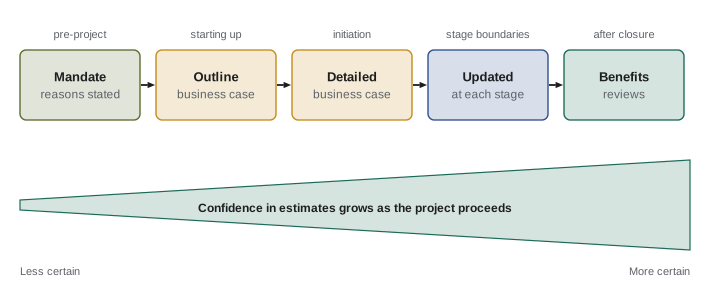
| Point in the project | State of the business case | Decision it supports |
|---|---|---|
| Mandate | Reasons for the project, often a few sentences | Whether to start up a project |
| Starting up a project | Outline business case: reasons, options, expected benefits and rough costs | Whether to initiate the project |
| Initiating a project | Detailed business case with investment appraisal, benefits and risks | Whether to authorize the project |
| Each stage boundary | Updated with actual costs, revised forecasts and current risks | Whether to authorize the next stage |
| Exception | Updated to show the impact of each option | Which exception option to choose, or whether to close prematurely |
| After closure | Used as the baseline for benefits reviews | Whether benefits are being realized and what to do if not |
What a business case contains
PRINCE2 provides guidance on the content of a business case, which organizations often adapt to their own templates. In plain terms, a typical business case covers an executive summary, the reasons for the project, the options considered, the expected benefits and dis-benefits, the timescale, the costs, an investment appraisal, the major risks and a recommendation. The test of a good business case is not its length but whether a decision-maker can see clearly why this option is recommended and what it will take to realize the benefits.
| Section | What it should answer | Common weakness |
|---|---|---|
| Executive summary | What is recommended and why, in a few lines | Written last and rushed |
| Reasons | What problem or opportunity the project addresses | Describes the solution instead of the problem |
| Business options | What alternatives were considered, including doing nothing | Only one real option presented |
| Expected benefits | What improvements, how measured, by whom and when | Benefits vague or not measurable |
| Expected dis-benefits | What negative results are expected | Omitted entirely |
| Timescale | When costs fall and when benefits start | Benefits assumed from day one |
| Costs | Project costs and ongoing operating and maintenance costs | Ongoing costs left out |
| Investment appraisal | Comparison of costs and benefits over time | No discounting or sensitivity |
| Major risks | What could undermine the case | Copied from the risk register without assessing impact on benefits |
Options: do nothing, do minimum, do something
A business case should compare genuine options. PRINCE2 guidance commonly describes three kinds: do nothing, do minimum and do something. Do nothing is the baseline: what happens if the organization makes no change. It is rarely free, because problems usually grow. Do minimum is the least change that addresses the most pressing need. Do something covers one or more fuller solutions. Comparing options against the do nothing baseline shows what each option really adds.
| Option | Ridgeline Water | Indicative cost | Main benefit |
|---|---|---|---|
| Do nothing | Keep manual quarterly reading | No project cost; rising reading costs and disputes | None beyond the status quo |
| Do minimum | Drive-by radio meters read monthly from a van | Lower capital cost | Fewer estimated bills; some reading savings |
| Do something | Fixed-network smart meters with daily reads and leak alerts | Highest capital cost | Largest savings, leak detection and customer data |
Options can be compared first on qualitative criteria, which helps eliminate weak options before detailed appraisal. The code below scores the three options against weighted criteria that reflect the three tests of justification. Scoring is a structured way of recording judgment; it does not replace investment appraisal, but it makes assumptions visible and open to challenge.
weights = {"benefit": 0.35, "cost": 0.25, "deliverability": 0.20, "adoption": 0.20}
# scores 1 (poor) to 5 (excellent); for cost, 5 means cheapest
options = {
    "do nothing":   {"benefit": 1, "cost": 5, "deliverability": 5, "adoption": 5},
    "do minimum":   {"benefit": 3, "cost": 4, "deliverability": 4, "adoption": 4},
    "do something": {"benefit": 5, "cost": 2, "deliverability": 3, "adoption": 3},
}
for name, s in options.items():
    total = sum(weights[c] * s[c] for c in weights)
    print(f"{name:13} {total:.2f}")
# sensitivity: does the ranking change if benefit is weighted less?
alt = {"benefit": 0.25, "cost": 0.35, "deliverability": 0.20, "adoption": 0.20}
print("with cost weighted more:")
for name, s in options.items():
print(f"{name:13} {sum(alt[c] * s[c] for c in alt):.2f}")do nothing 3.60 do minimum 3.65 do something 3.45 with cost weighted more: do nothing 4.00 do minimum 3.75 do something 3.15
With the original weights, do minimum scores 3.65, do nothing 3.60 and do something only 3.45. With cost weighted more heavily, do nothing rises to 4.00 and do something falls to 3.15. The scoring therefore does not settle the decision: it shows that the case for change depends on how much the organization values the benefits relative to cost, which is exactly the question investment appraisal in lesson 3 will answer with money rather than scores. Do nothing scoring well is a warning that the benefits of change need to be quantified convincingly.
The business case in the public sector
Public organizations add their own requirements to the business case. In the Government of Canada, the Treasury Board's Policy on Planning and Investment and its Directive on the Management of Projects and Programmes set expectations for how departments plan, approve and oversee projects, including assessing project complexity and risk and reporting on benefits. The directive has been revised since its first version, so check the current text on the Treasury Board Secretariat site. Provinces and municipalities have their own capital planning rules; many Canadian municipalities use multi-year capital budgets approved by council, which would govern a utility such as Ridgeline Water.
Whatever the framework, the PRINCE2 business case can usually be mapped onto it. Public templates may use different headings, require economic as well as financial analysis, or ask for alignment with strategic priorities, but the underlying questions are the same: why, which option, at what cost and with what benefits and risks.
Keeping the business case alive
The most common failure of the business case practice is not a poor initial document but a document that is never revisited. Costs rise, benefits are revised downward, a competitor launches a similar product, or a policy change removes the problem the project was solving. A business case that is not updated cannot tell the board when the project has stopped being worth doing. PRINCE2 makes the update a routine part of every stage boundary and every exception, so that the question is asked regularly rather than only when someone is brave enough to raise it.
Worked problem
When the business case weakens mid-project
At the end of stage 2, Ridgeline Water's project manager reports that meter prices have risen 18 % and that a provincial or state program will now subsidize 30 % of the cost of smart meters for utilities that install them by a fixed date. What should happen to the business case, and who decides what to do?
Show solution
- The project manager updates the business case with the new meter cost and the subsidy, including any conditions such as the deadline.
- Project assurance checks the updated figures and whether the deadline is achievable in the plan.
- The executive, with the board, reviews whether the project remains desirable, viable and achievable.
- If the subsidy deadline requires a faster schedule, the board may change the plan or stage tolerances, and may need to ask the business layer if project tolerances are affected.
Answer: The update may well strengthen the case despite the price rise, but the decision belongs to the executive and board, informed by an updated business case and plan. The point is that both changes are captured at the stage boundary rather than discovered later.
Common mistakes
MistakeAssuming the project manager owns the business case because they write it.
InsteadThe executive owns it; the project manager prepares and updates it on the executive's behalf.
MistakePresenting a single option and calling it a business case.
InsteadCompare genuine options, including do nothing and do minimum.
MistakeTreating do nothing as having no cost.
InsteadEstimate what doing nothing will cost as problems grow.
MistakeListing outputs as benefits.
InsteadBenefits are measurable improvements that result from outcomes, not the products themselves.
MistakeWriting the business case once and filing it.
InsteadUpdate it at every stage boundary, at exceptions and after closure.
Summary and key terms
- The business case practice judges whether a project is and remains desirable, viable and achievable.
- Outputs lead to outcomes, which lead to benefits and sometimes dis-benefits.
- The executive owns the business case; the senior user is accountable for benefits; the project manager prepares it.
- The business case develops from reasons in the mandate to outline, detailed and updated versions.
- Options should include do nothing and do minimum as well as fuller solutions.
- Public organizations add their own frameworks, which the PRINCE2 business case can map onto.
- A business case that is not updated cannot tell the board when to stop.
- Business case
- The justification for a project, based on estimated costs, risks and expected benefits.
- Desirable
- Having benefits that outweigh costs, dis-benefits and risks.
- Viable
- Able to deliver the products needed.
- Achievable
- Able to produce the expected outcomes and benefits once products are delivered.
- Output
- A specialist product handed over to users.
- Outcome
- The result of change derived from using the project's outputs.
- Benefit
- A measurable improvement from an outcome, seen as positive by one or more stakeholders.
- Dis-benefit
- A measurable result seen as negative by one or more stakeholders.
- Outline business case
- An early version of the business case produced during starting up a project.
- Do nothing option
- The baseline option describing what happens if no change is made.
Practice problems
Work each problem on paper first, then reveal the answer to check.
Name the three tests the business case practice applies.
Show answer
Desirable, viable and achievable.
Which test fails if a supplier cannot deliver the products?
Show answer
Viable.
Which test fails if staff refuse to use the new system?
Show answer
Achievable.
Who owns the business case?
Show answer
The executive.
Who is accountable for realizing benefits?
Show answer
The senior user.
When is the outline business case produced?
Show answer
During starting up a project.
What is a dis-benefit?
Show answer
A measurable result seen as negative by one or more stakeholders.
Why include a do nothing option?
Show answer
It is the baseline against which other options show what they add.
Is installed smart meters a benefit or an output?
Show answer
An output.
Name two points at which the business case is updated.
Show answer
At each stage boundary and when an exception is considered.
Lesson quiz · 5 questions
Score 60% or more to complete this lesson.
Create a free account to save your progress, take quizzes and earn a certificate.