
ROB-100 · Lesson 10 of 12 · 26 min
Safety, ethics and robots at work
Robots are powerful machines. An industrial arm can swing a heavy tool faster than a person can react, a mobile robot can pin someone against a wall, and a drone's propellers can cut skin. As robots move out of fenced cells and into shared workplaces, hospitals, streets and homes, keeping people safe becomes both more important and more complicated. Robots also raise wider questions: what happens to jobs, who is responsible when something goes wrong, how the data robots collect should be handled, and which decisions should never be handed to machines. This lesson introduces the hazards robots pose, risk assessment and the hierarchy of controls, the main safety standards for industrial robots in Canada and the United States, the four ways people and robots can safely share space, a worked safety-distance example, the rules for drones, and the main ethical and social questions. It is an awareness-level introduction: designing and approving robot safety systems requires qualified people working with the full standards and applicable law.
Robot hazards
Most robot injuries come from a small set of hazards. Impact and collision occur when a moving robot or its tool strikes a person. Crushing and trapping occur when a person is caught between the robot and a fixed object, such as a fence, a machine or a wall, which is especially dangerous because the robot can keep pushing. Hazards also come from the robot's tool or process: welding arcs, cutting blades, lasers, hot parts and dropped loads. Unexpected movement is a major cause of serious accidents: a robot that appears stopped may only be waiting for a signal, or may restart when someone resets a fault, so people entering a robot's space for maintenance or to clear a jam are at particular risk. Electrical, hydraulic and pneumatic energy can be released during maintenance. Mobile robots add hazards from collisions with people and vehicles, tipping, and falling loads, and drones add hazards from propellers, falling and battery fires. Studies of robot accidents have long found that many happen not during normal operation but during programming, maintenance and troubleshooting.
Risk assessment and the hierarchy of controls
Robot safety starts with risk assessment, a systematic process described in the general machinery safety standard ISO 12100. The team identifies every task people will do with or near the robot, including setup, normal operation, programming, cleaning and maintenance; identifies the hazards in each; estimates each risk from the severity of possible harm and its likelihood, considering how often people are exposed and whether they could avoid the harm; and then reduces each risk until it is acceptable. Risk reduction follows a hierarchy of controls, preferring measures at the top. First, eliminate the hazard or design it out, for example by limiting the robot's speed and force or removing pinch points. Second, use engineering controls and safeguards: fixed guards and fences, interlocked doors that stop the robot when opened, light curtains, laser scanners and pressure-sensitive mats that detect a person and stop or slow the robot, and safety-rated control functions. Third, use administrative controls: procedures, training, signs and supervision. Last, use personal protective equipment. Lockout and tagout procedures, which isolate and lock every energy source before maintenance, are essential whenever people work inside a robot's reach.
Industrial robot safety standards
The core international standards for industrial robot safety are ISO 10218-1, which covers the robot itself and is aimed at manufacturers, and ISO 10218-2, which covers robot applications and robot cells and is aimed at integrators, the companies that design and install robot systems. Both were revised in 2025, replacing the 2011 editions. The revision makes functional safety requirements more explicit, adds cybersecurity requirements, shifts the focus from the robot system to the whole robot application, including the workpieces and tools, and absorbs the guidance on collaborative applications that was previously published separately as the technical specification ISO/TS 15066, including limits on the force and pressure a robot may exert on different parts of the human body. The term collaborative robot has given way to collaborative application, because safety depends on the whole application, not just the robot: a lightweight arm carrying a knife is not safe to work beside just because the arm is labelled collaborative.
In Canada, the national standard for industrial robot safety is CSA Z434, Industrial robots, robot applications and robot cells. Its 2026 edition adopts ISO 10218-1:2025 and ISO 10218-2:2025 with Canadian deviations and replaces the 2014 edition, which adopted the 2011 ISO standards. Occupational health and safety is mainly regulated by the provinces and territories, with federally regulated workplaces under the Canada Labour Code. Provincial regulations require employers to guard machinery, prevent unexpected start-up and use lockout during maintenance, and several provinces reference CSA Z434 or require that robots be installed and safeguarded in line with recognized standards. In Ontario, for example, the Regulation for Industrial Establishments sets machine-guarding and lockout duties and, in some circumstances, requires a pre-start health and safety review before new equipment is used. Inspectors and courts look to CSA Z434 as the benchmark of good practice even where it is not named in law.
Four ways to share space safely
For decades, industrial robots worked behind fences, and people entered their cells only after the robot was stopped. Collaborative applications let people and robots share space under specific safety measures. The robot standards describe four main methods, which can be combined:
- Monitored standstill (called safety-rated monitored stop in the older standards): the robot stops and its stop is monitored by a safety function while a person enters the shared space, for example to load a part, and resumes only when the person leaves.
- Hand guiding: a person moves the robot directly by hand, using a guiding device with an enabling switch, for example to position a heavy part.
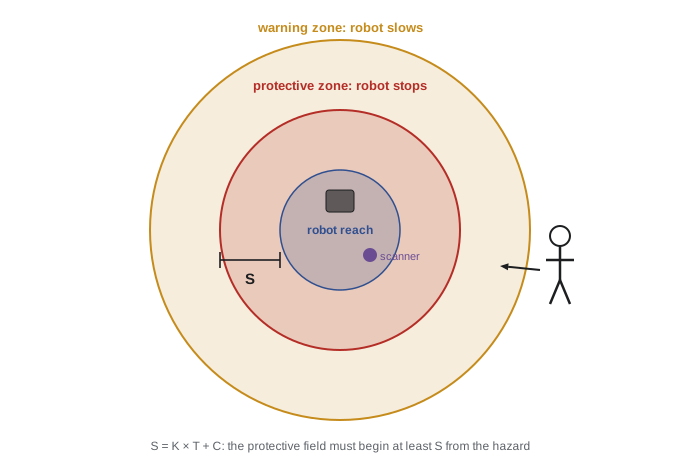
- Speed and separation monitoring: sensors such as laser scanners track how close people are, and the robot slows down as they approach and stops before contact could occur.
- Power and force limiting: the robot is designed and limited so that if it does contact a person, the forces and pressures stay below thresholds for the body region involved, so contact is not expected to cause injury.
Choosing among them depends on the task, the robot's speed and payload, the tool and the risk assessment. Many applications with collaborative arms still need guarding around sharp tools or fast motions.
A worked safety-distance example
A safeguard that stops a robot must detect a person far enough away that the robot stops before the person can reach the hazard. The machinery standard ISO 13855 gives a formula for the minimum distance, \( S = K \times T + C \), where \( K \) is the approach speed of a person, \( T \) is the total stopping time of the system, from detection to the robot coming to rest, and \( C \) is an additional distance that allows for a person reaching through or over the detection zone, which depends on the type of sensing device. For whole-body approach, the standard uses a walking speed of 1,600 mm/s. The values below are for illustration only; real calculations must use the standard, the measured stopping times of the actual robot and the device manufacturers' data.
Worked problem
Minimum distance for a laser scanner
A laser scanner detects people approaching a robot cell. The scanner responds in 0.08 s, the safety controller in 0.02 s, and the robot, at the speed and load used, takes 0.40 s to stop, as measured. Use K = 1,600 mm/s and an allowance C = 1,200 mm for the scanner's mounting height. How far from the hazard must the protective field begin? If the robot's stopping time increases to 0.60 s with a heavier load, how much farther out must it begin?
Show solution
- Total stopping time: \( T = 0.08 + 0.02 + 0.40 = 0.50 \) s.
- \( S = 1{,}600 \times 0.50 + 1{,}200 = 800 + 1{,}200 = 2{,}000 \) mm.
- With the heavier load: \( T = 0.70 \) s, so \( S = 1{,}600 \times 0.70 + 1{,}200 = 2{,}320 \) mm.
- The field must begin 320 mm farther out, which shows why stopping times must be measured at the worst-case speed and payload and rechecked when the application changes.
Answer: 2.0 m from the hazard, rising to 2.32 m with the heavier load (illustrative values).
Mobile robots, service robots and drones
Safety standards also cover other robots. Industrial mobile robots are addressed by standards such as ANSI/A3 R15.08 in the United States and ISO 3691-4 for driverless industrial trucks, which cover how mobile robots detect people and obstacles, how fast they may travel and how sites must be prepared. Personal care robots, such as mobility aids and companion robots, are covered by ISO 13482, and medical robots by medical device rules. Drones are regulated by aviation authorities.
In Canada, drones are regulated by Transport Canada under Part IX of the Canadian Aviation Regulations. Drones from 250 g up to 25 kg must be registered and marked, and pilots need a Basic or Advanced pilot certificate depending on where they fly; Basic operations must stay well away from bystanders and controlled airspace, while Advanced certificate holders can fly closer to people and in controlled airspace with authorization. Drones must normally fly below 122 m (400 ft) and within visual line of sight. Amendments published in March 2025, mostly in force from 4 November 2025, added rules for medium drones from 25 kg to 150 kg, extended visual line-of-sight operations, and lower-risk beyond-visual-line-of-sight flights in sparsely populated areas under a new Level 1 Complex Operations pilot certificate, for which pilots must be at least 18, and an RPAS Operator Certificate for organizations. Check Transport Canada's current rules before flying.
Ethics and society
Robots raise questions that go beyond safety engineering. The most discussed is work. Robots take over tasks, and sometimes whole jobs, which can displace workers and depress wages in affected occupations and regions, while also creating new jobs in building, programming and maintaining robots, raising productivity and filling roles employers cannot staff. Economists continue to debate the balance, and the effects depend heavily on how employers, unions and governments manage transitions through retraining, redeployment and social support. Responsibility is another question: when an autonomous robot causes harm, responsibility may lie with the manufacturer, the integrator, the operator, the software developer or the owner, and product liability, negligence and insurance law are still adapting to autonomous machines. Privacy matters because robots carry cameras, microphones and maps of homes and workplaces; who collects that data, where it is stored and how it is used are governed by privacy laws such as PIPEDA and provincial laws in Canada and a patchwork of federal and state laws in the United States. Bias can enter through perception systems that work less well for some people, for example detecting people with darker skin less reliably if trained on unrepresentative data. Robots that look or act like people raise questions about deception and emotional dependence, especially for children and older adults. And lethal autonomous weapons, which could select and engage targets without meaningful human control, are the subject of ongoing international debate at the United Nations.
Professional bodies offer guidance. Engineering codes of ethics in both countries put public safety first, and the IEEE has published work on ethically aligned design for autonomous and intelligent systems. Good practice for roboticists includes thinking about who could be harmed as well as who benefits, involving workers and users in design, testing for bias, protecting data, being honest about what a robot can and cannot do, and keeping meaningful human oversight where decisions carry serious consequences.
| Question | Examples | Practices that help |
|---|---|---|
| Work | Displacement, new roles, job quality | Consultation, retraining, redeployment |
| Responsibility | Who is liable when an autonomous robot causes harm | Clear safety cases, documentation, insurance |
| Privacy | Cameras and maps in homes and workplaces | Data minimization, consent, security |
| Bias | Perception that works worse for some people | Representative data, testing across groups |
| Deception | Social robots seeming to care | Honest design and disclosure |
| Weapons | Autonomous targeting | Meaningful human control, international law |
Common mistakes
MistakeAssuming a robot labelled collaborative is safe in any application.
InsteadAssess the whole application, including the tool, speed and task.
MistakeEntering a stopped robot's space without locking out its energy.
InsteadUse lockout and tagout before maintenance inside the robot's reach.
MistakeJumping to training and signs as the main safeguards.
InsteadWork down the hierarchy, starting with design and engineering controls.
MistakeUsing catalogue stopping times in safety-distance calculations.
InsteadMeasure stopping times at worst-case speed and payload.
MistakeTreating ethics as someone else's job.
InsteadConsider workers, users, privacy and bias throughout design.
Summary and key terms
- Robot hazards include impact, crushing, tool hazards, unexpected movement and stored energy.
- Risk assessment under ISO 12100 identifies tasks and hazards and reduces risks using the hierarchy of controls.
- ISO 10218-1 and -2 were revised in 2025 and absorbed ISO/TS 15066.
- Canada uses CSA Z434 and provincial OHS law; the US uses ANSI/A3 R15.06 and OSHA's general rules.
- People and robots share space through monitored standstill, hand guiding, speed and separation monitoring and power and force limiting.
- Safety distance follows S = K × T + C, with measured stopping times.
- Robots raise questions about work, responsibility, privacy, bias, deception and weapons.
- Risk assessment
- Systematic identification and evaluation of hazards and risks.
- Hierarchy of controls
- Ranking of risk-reduction measures from elimination to PPE.
- Lockout and tagout
- Isolating and locking energy sources before maintenance.
- ISO 10218
- The international safety standard for industrial robots and robot applications.
- Collaborative application
- An application where people and robots share space under specific safety measures.
- Monitored standstill
- A monitored stop while a person is in the shared space.
- Speed and separation monitoring
- Slowing and stopping the robot based on distance to people.
- Power and force limiting
- Limiting contact forces below injury thresholds.
- Integrator
- A company that designs and installs robot systems.
- Operational safety distance
- The minimum distance at which a safeguard must detect a person.
Practice problems
Work each problem on paper first, then reveal the answer to check.
When do many robot accidents happen?
Show answer
During programming, maintenance and troubleshooting.
What is the first step in the hierarchy of controls?
Show answer
Eliminate or design out the hazard.
Which ISO standard covers general machinery risk assessment?
Show answer
ISO 12100.
Which document did the 2025 ISO 10218 revision absorb?
Show answer
ISO/TS 15066.
Name the four collaborative methods.
Show answer
Monitored standstill, hand guiding, speed and separation monitoring, power and force limiting.
S for K = 1,600 mm/s, T = 0.3 s, C = 850 mm?
Show answer
1,330 mm.
Why measure stopping time at full payload?
Show answer
Heavier loads take longer to stop.
What is lockout and tagout?
Show answer
Isolating and locking energy sources before maintenance.
Give one ethical question raised by home robots.
Show answer
Privacy of camera, audio and map data.
Why is collaborative robot now discouraged as a safety term?
Show answer
Safety depends on the whole application, not the robot alone.
Lesson quiz · 5 questions
Score 60% or more to complete this lesson.
Create a free account to save your progress, take quizzes and earn a certificate.