
ROB-100 · Lesson 2 of 12 · 26 min
A short history of robotics
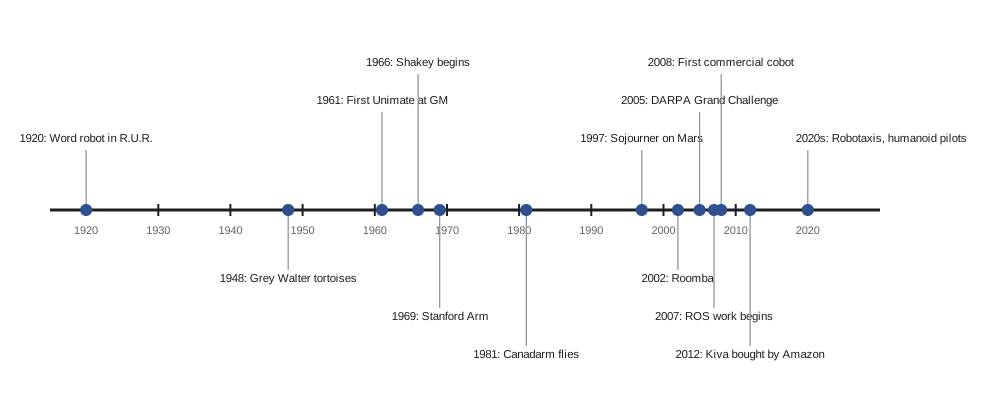
Robots feel modern, but the dream of machines that move and work on their own is ancient, and the robots of today grew out of centuries of clockwork, decades of control theory and computing, and a series of key inventions in the second half of the twentieth century. Knowing the history helps explain why robots look and work the way they do, why industrial arms came long before household robots, and why some problems that looked easy in the 1960s are still being solved today. This lesson traces the story from early automata to the word robot itself, through the first industrial robots, the rise of mobile and intelligent robots, robots in space, and the recent wave of collaborative robots, autonomous vehicles, drones and humanoids. Along the way it notes several Canadian and American contributions that shaped the field.
Automata and the idea of artificial workers
Ancient myths and writings describe mechanical servants and moving statues, and engineers in several civilizations built real automata. In the first century CE, Hero of Alexandria described machines driven by water, steam, weights and ropes, including a programmable cart whose path was set by winding cords around its axle in a particular pattern, an early example of storing a sequence of actions in a mechanism. In the thirteenth century, the engineer Ismail al-Jazari described water clocks and musical automata with camshafts that triggered actions in sequence. European clockmakers of the eighteenth century built astonishing figures, such as the writing and drawing automata of Pierre Jaquet-Droz, which could write short texts using interchangeable cams. These machines had no sensing and no decision-making: they replayed a stored sequence. But they showed that complex motion could be encoded and reproduced by a machine, an idea that runs straight through to the taught paths of modern industrial robots.
The Industrial Revolution added another key idea: programmable machines in production. The Jacquard loom of 1804 used chains of punched cards to control the pattern woven into cloth, so a change of cards changed the product without rebuilding the machine. Punched cards later carried data into early computers. Through the nineteenth and early twentieth centuries, steam engines and then electric motors powered ever more automated factories, but each machine was built for one job, and changing products meant rebuilding the line.
Where the word robot came from
The word robot first appeared in the 1920 play R.U.R. (Rossum's Universal Robots) by the Czech writer Karel Čapek. Čapek credited his brother Josef with suggesting the word, based on the Czech robota, meaning forced labour or drudgery. Čapek's robots were artificial people grown from synthetic material rather than metal machines, and the play ends with them rebelling against their makers, a theme science fiction has returned to ever since. In the 1940s the American writer Isaac Asimov wrote stories about robots governed by his Three Laws of Robotics and coined the word robotics itself, in a 1941 story. Asimov's laws are fiction, not engineering, and real robots cannot interpret them, but they made people think about robot safety and ethics long before real robots existed. The word and the fiction shaped public expectations, which is one reason people often picture humanoids when they hear the word robot, even though most real robots look nothing like people.
Feedback, servos and computers
Real robots needed three technical foundations that came together in the mid-twentieth century. The first was feedback control. Engineers had used feedback for centuries, as in James Watt's centrifugal governor of 1788, which automatically regulated a steam engine's speed, but in the 1930s and 1940s control theory became a rigorous mathematical subject, driven by the needs of amplifiers, gun directors and aircraft. Norbert Wiener's 1948 book Cybernetics popularized the idea that machines and animals alike use feedback to pursue goals. The second foundation was the servomechanism: a motor whose position is measured and corrected by feedback so it can be driven to a commanded position accurately. The third was the digital computer and numerical control. In the late 1940s and 1950s, John T. Parsons and the MIT Servomechanisms Laboratory developed numerically controlled machine tools, in which coded instructions on punched tape guided cutting tools along precise paths. Numerical control showed that a general-purpose machine could be reprogrammed for new parts by changing its instructions.
In the late 1940s and early 1950s, the neurophysiologist William Grey Walter in England built small wheeled robots he called tortoises, which used light and touch sensors and simple analogue circuits to seek light and steer around obstacles. They had no computer, yet they showed surprisingly lifelike behaviour from simple sensing and feedback, an idea that would return decades later in behaviour-based robotics.
The first industrial robots
The industrial robot was born from a patent and a partnership. In 1954 the American inventor George Devol applied for a patent on programmed article transfer, a machine that could be taught a sequence of movements and repeat them. He met the engineer and entrepreneur Joseph Engelberger, and together they founded Unimation. The first Unimate robot went to work in 1961 at a General Motors plant in Ewing Township, New Jersey, lifting hot die-cast metal parts and stacking them, a dirty and dangerous job. The Unimate was a hydraulic arm with its program stored on a magnetic drum. Engelberger promoted robots tirelessly and is often called the father of robotics.
Industrial robots spread through the 1960s and 1970s, especially in car manufacturing, for spot welding, painting and material handling. In 1969 Victor Scheinman at Stanford designed the Stanford Arm, an all-electric, computer-controlled arm with six joints, which became a model for later research and industrial arms. Unimation licensed its technology to Kawasaki in Japan in 1968, and Japanese companies went on to dominate robot manufacturing. In 1973 the German company KUKA built a robot with six electromechanically driven axes, and in 1974 ASEA in Sweden, a forerunner of ABB, launched the IRB 6, one of the first all-electric, microprocessor-controlled industrial robots. In 1978 Unimation introduced the PUMA arm, developed with support from General Motors, which became a standard in research labs for decades. In the 1980s the SCARA arm, developed in Japan, made fast, precise assembly of small parts practical, especially in electronics.
Thinking machines: Shakey and the birth of mobile robotics
While industry focused on arms that repeated taught motions, researchers asked whether robots could reason. From 1966 to 1972, the Stanford Research Institute (now SRI International) built Shakey, often called the first mobile robot able to reason about its own actions. Shakey had a camera, a range finder and bump sensors, and it was connected by radio to a large computer. Given a command such as pushing a block from one room to another, it built a model of its surroundings, planned a sequence of actions and executed them, slowly and in a carefully prepared environment. Shakey's legacy is huge: the A* search algorithm used today in route planning and video games, the STRIPS planning system and the Hough transform for finding lines in images all grew out of the project. Shakey also showed how hard the real world is. Planning worked well in a clean model, but the robot spent long minutes thinking and struggled whenever reality differed from its model.
In the 1980s, Rodney Brooks at MIT argued for a different approach. Instead of building a complete model of the world and planning in it, his behaviour-based robots layered simple reactive behaviours, such as avoiding obstacles and wandering, that connected sensing directly to action. These robots reacted quickly and robustly, if not very cleverly. Brooks later co-founded iRobot, whose Roomba vacuum, launched in 2002, became the first robot many households owned. Modern robots typically combine both traditions: fast reactive layers for safety and smooth motion, and deliberative layers for planning, as lesson 8 explains. Through the 1990s, probabilistic methods, which treat sensing and motion as uncertain and reason with probabilities, transformed mobile robotics, making reliable localization and mapping possible.
Robots in space: Canadarm and the rovers
Space has been a showcase for robotics, and Canada has played an outsized role. The Shuttle Remote Manipulator System, known as the Canadarm, was designed and built in Canada by Spar Aerospace with the National Research Council and first flew on the space shuttle Columbia in 1981. The 15-metre arm deployed and retrieved satellites, helped repair the Hubble Space Telescope and assisted astronauts on spacewalks. Its successor, Canadarm2, built by MDA, was installed on the International Space Station in 2001, followed in 2008 by Dextre, a two-armed robot that performs delicate maintenance tasks. Canada is building Canadarm3 for the planned Lunar Gateway station. On planetary surfaces, NASA's Sojourner rover explored a small area of Mars in 1997, and the Spirit and Opportunity rovers that landed in 2004 were planned for 90-day missions but lasted far longer: Opportunity drove for more than 14 years. Curiosity, landing in 2012, and Perseverance, in 2021, carry autonomous navigation systems that let them plan their own drives between waypoints chosen on Earth, because radio signals take several minutes to travel between the planets. Perseverance also carried the Ingenuity helicopter, which in 2021 made the first powered, controlled flight on another planet.
Challenges, collaboration and the modern wave
In the 2000s, competitions accelerated progress. The DARPA Grand Challenges of 2004 and 2005 asked autonomous vehicles to cross desert courses; no vehicle finished in 2004, but five did in 2005, led by Stanford's Stanley. The 2007 Urban Challenge required driving in traffic, and many of its participants went on to lead self-driving car efforts, including the Google project that became Waymo. The DARPA Robotics Challenge of 2012 to 2015 pushed humanoid and other robots to perform disaster-response tasks, such as driving a vehicle, opening doors and turning valves, revealing how difficult such tasks remained.
Several other developments shaped today's robots. In 2007 work began on the Robot Operating System at Stanford and then at Willow Garage, giving researchers and companies a shared set of open-source tools; ROS 2, rebuilt for industrial and commercial use, is now standard in much of the field. In 2008 Universal Robots of Denmark sold what is widely described as the first commercially successful collaborative robot, a lightweight arm designed to work near people without fences under the right conditions. In 2012 Amazon bought Kiva Systems, whose mobile robots carry shelves to workers, starting a boom in warehouse robotics. Deep learning, which made a breakthrough in image recognition in 2012, gave robots far better vision. Consumer drones became widespread in the 2010s. In the 2020s, driverless taxi services began carrying paying passengers in several US cities, and a growing number of companies began piloting humanoid robots in warehouses and factories. Canadian companies have contributed too: Clearpath Robotics of Waterloo, Ontario, became known for research and industrial mobile robots before being acquired by Rockwell Automation in 2023, and Kinova of Quebec builds assistive and research arms.
| Era | Key developments | What it added |
|---|---|---|
| Antiquity to 1800s | Automata, Jacquard loom | Stored sequences of motion and programmable machines |
| 1920s to 1950s | The word robot, feedback control, servos, numerical control | Vocabulary, theory and precise motion control |
| 1960s to 1970s | Unimate, Stanford Arm, Shakey | Industrial robots and robots that plan |
| 1980s to 1990s | SCARA, behaviour-based robots, Canadarm, Sojourner | Assembly, reactive control, space robotics |
| 2000s | Roomba, DARPA challenges, ROS | Consumer robots, autonomous driving, shared software |
| 2010s to 2020s | Cobots, warehouse robots, deep learning, drones, robotaxis, humanoid pilots | Robots working near people and in open environments |
Worked problem
Reading growth from a history
The IFR reports about 542,000 industrial robots installed worldwide in 2024, which it describes as more than double the number of a decade earlier. If installations exactly doubled over 10 years, what average annual growth rate does that imply?
Show solution
- Doubling in 10 years means \( (1 + r)^{10} = 2 \).
- Take the tenth root: \( 1 + r = 2^{1/10} \approx 1.072 \).
- So \( r \approx 0.072 \), about 7.2 % a year.
- Real growth was uneven: installations fell in some years and jumped in others.
Answer: About 7.2 % a year on average; an uneven path that roughly doubles over a decade.
Common mistakes
MistakeAssuming robots began with computers.
InsteadRecognize the long line from automata, looms and feedback to modern robots.
MistakeTreating Asimov's Three Laws as real engineering rules.
InsteadTreat them as fiction; real safety comes from standards, design and risk assessment.
MistakeThinking the first robots were humanoids.
InsteadNote that the first industrial robots were arms doing dirty and dangerous jobs.
MistakeIgnoring the role of competitions and open-source software.
InsteadSee how DARPA challenges and ROS accelerated the field.
MistakeAssuming early successes meant the hard problems were solved.
InsteadRemember Shakey's lesson: the real world is messier than any model.
Summary and key terms
- Automata and programmable looms showed that sequences of motion and work could be stored in machines.
- The word robot comes from Čapek's 1920 play R.U.R.; Asimov coined robotics.
- Feedback control, servomechanisms and numerical control laid the technical foundations.
- The first Unimate industrial robot started work at General Motors in 1961.
- Shakey pioneered planning and perception; behaviour-based robots stressed fast reaction.
- Canadarm, Canadarm2, Dextre and the Mars rovers made space a showcase for robotics.
- Competitions, ROS, cobots, deep learning and drones drove the modern wave.
- Automaton
- A self-operating machine that replays a stored sequence of actions.
- R.U.R.
- Karel Čapek's 1920 play that introduced the word robot.
- Servomechanism
- A motor system that uses feedback to reach a commanded position.
- Numerical control
- Control of a machine tool by coded instructions.
- Unimate
- The first industrial robot, installed in 1961.
- Shakey
- An SRI mobile robot (1966 to 1972) that planned its own actions.
- Behaviour-based robotics
- An approach that layers simple reactive behaviours.
- Canadarm
- Canada's robotic arm for the space shuttle, first flown in 1981.
- ROS
- The Robot Operating System, an open-source robotics software framework.
- Collaborative robot
- A robot designed for applications where it shares space with people.
Practice problems
Work each problem on paper first, then reveal the answer to check.
What did Hero of Alexandria's programmable cart store?
Show answer
A sequence of movements, set by cords wound on its axle.
What does the Czech word robota mean?
Show answer
Forced labour or drudgery.
Who coined the word robotics?
Show answer
Isaac Asimov, in 1941.
Where and when did the first Unimate go to work?
Show answer
At a General Motors plant in New Jersey in 1961.
Name one algorithm that came out of the Shakey project.
Show answer
A* search (also STRIPS, Hough transform).
What did Rodney Brooks argue for?
Show answer
Behaviour-based robots that link sensing directly to action.
Who built the original Canadarm?
Show answer
Spar Aerospace with the National Research Council.
Why do Mars rovers need autonomous navigation?
Show answer
Signals take minutes to travel between Earth and Mars.
What was notable about the 2005 DARPA Grand Challenge?
Show answer
Five vehicles finished; none had in 2004.
Doubling in 10 years implies roughly what annual growth?
Show answer
About 7.2 % a year.
Lesson quiz · 5 questions
Score 60% or more to complete this lesson.
Create a free account to save your progress, take quizzes and earn a certificate.