
ROB-100 · Lesson 11 of 12 · 25 min
Careers in robotics
Robotics offers careers for people with very different interests and backgrounds. Some roboticists design mechanisms or electronics; others write perception, planning or control software; others integrate robots into factories, keep them running, test them, sell them, manage robotics projects or study how people interact with them. Robotics work happens in large manufacturers and small start-ups, in logistics companies, hospitals, farms, mines, space agencies, universities and government labs. This lesson describes the main roles in robotics, the education and credentials that lead to them in Canada and the United States, the skills employers look for, what the labour-market data says, and how to start building experience and a portfolio now. Labour-market figures are given at the time of writing (October 2026); check the latest government data, because they change every year.
Roles in robotics
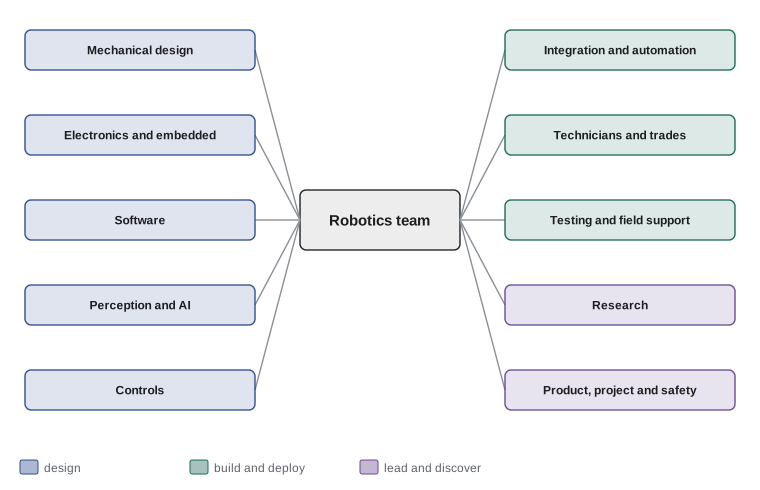
Robotics teams combine many specialties. Some of the most common roles are:
- Robotics engineer: a broad title for engineers who design, build and test robots and robot systems, often specializing in mechanical, electrical or software aspects.
- Mechanical or mechatronics engineer: designs structures, joints, drive trains, grippers and enclosures, and analyses strength, motion and heat.
- Electrical and embedded systems engineer: designs circuit boards, power systems, motor drives and the firmware running on microcontrollers.
- Software engineer, robotics: writes the robot's software, from drivers and ROS 2 nodes to navigation and fleet management.
- Perception, planning, controls and machine learning engineers: specialists in computer vision, sensor fusion, motion planning, control and learning, often with graduate degrees.
- Automation or controls engineer and robot integrator: designs and installs robot cells in factories, programs industrial robots and PLCs, and ensures the system meets safety standards.
- Robotics or automation technician and technologist: builds, installs, troubleshoots, calibrates and maintains robots and automated equipment.
- Industrial mechanics, millwrights and industrial electricians: skilled trades who install and maintain automated machinery, increasingly including robots.
- Test, field and applications engineers: test robots, support customers and adapt robots to new uses.
- Research scientists: push the frontiers of robotics in universities, government labs and company research groups, usually with a PhD.
- Product managers, project managers, sales engineers and safety specialists: connect technology to customers, schedules, markets and regulations.
Education pathways
Most robotics engineering roles require a bachelor's degree in an engineering field, such as mechanical, electrical, computer, mechatronics or software engineering, or in computing science. A growing number of universities offer robotics or mechatronics degrees and specializations, and the Robotics program this course belongs to is modeled on a four-year degree in computing science with a robotics major. Specialist roles in perception, planning, learning and research often require a master's or doctoral degree. Technician and technologist roles usually require a two- or three-year college diploma or an associate's degree in electromechanical, mechatronics, automation or electronics engineering technology. Skilled trades in industrial maintenance are learned through apprenticeship. Many people move between these paths: technicians become technologists or engineers, and engineers move into management or start companies.
In Canada, engineer is a regulated title. To practise engineering and call yourself a professional engineer (P.Eng., or ing. in Quebec), you must be licensed by the engineering regulator in your province or territory, such as Professional Engineers Ontario or APEGA in Alberta. Licensing normally requires a degree accredited by the Canadian Engineering Accreditation Board (CEAB), or an equivalent assessment, several years of supervised work experience, often four, and a professional practice and ethics exam. Graduates usually register as engineers-in-training while they gain experience. A computing science degree is a strong route into robotics software roles, but holders cannot use the engineer title without licensing. Engineering technologists can earn the C.E.T. designation through provincial associations such as OACETT in Ontario, and industrial mechanic (millwright) and industrial electrician are Red Seal trades, with interprovincial standards and provincial apprenticeship systems.
Skills employers look for
Employers consistently ask for a mix of technical and professional skills. On the technical side, programming is nearly universal: Python for scripting, prototyping and machine learning, and C++ for performance-critical robot software, along with Linux, version control with Git and, increasingly, ROS 2. Mathematics, especially linear algebra, calculus, probability and statistics, underpins kinematics, control, estimation and learning. Mechanical design skills include computer-aided design (CAD), mechanics and materials; electrical skills include circuits, sensors, motors and embedded programming. Industrial automation roles value experience programming industrial robots and PLCs and knowledge of safety standards. On the professional side, robotics is team work across disciplines, so communication, documentation, systematic debugging, curiosity, persistence and respect for safety matter as much as technical brilliance. Hands-on experience, showing that you can make real hardware work, is often what distinguishes candidates.
| Skill area | Examples | How to start |
|---|---|---|
| Programming | Python, C++, Linux, Git | Introductory programming courses, small projects |
| Robot software | ROS 2, simulation, navigation | ROS 2 tutorials and a simulated robot |
| Mathematics | Linear algebra, calculus, probability | Mathematics courses, coding the equations |
| Mechanical | CAD, mechanisms, materials | Design and 3-D print simple parts |
| Electrical | Circuits, sensors, motors, microcontrollers | Microcontroller kits and sensor projects |
| Automation | Industrial robots, PLCs, safety | College courses, vendor training, co-op terms |
| Professional | Teamwork, writing, debugging | Team competitions, documented projects |
The labour market
Government labour-market data does not usually have a single robotics occupation, because robotics work is spread across engineering, technology, software and trades occupations. Looking at those occupations gives a picture of the market.
In Canada, the federal Job Bank publishes wages and three-year employment outlooks by occupation and region, using the National Occupational Classification (NOC). Robotics job titles fall under groups such as mechanical engineers (NOC 21301), electrical and electronics engineers (21310), computer engineers (21311), software engineers and designers (21231), mechanical and electrical engineering technologists and technicians, and industrial mechanics and electricians. Outlooks are rated by region as limited, moderate, good or very good and can differ sharply between provinces, so the best approach is to look up the occupation and region you are interested in on Job Bank, alongside Statistics Canada's Labour Force Survey and provincial labour-market sites. Employers frequently report shortages of skilled trades and automation technicians, particularly in manufacturing regions of Ontario and Quebec, and co-operative education programs, which alternate study terms with paid work terms, are a common route into robotics jobs.
Worked problem
Reading labour-market numbers
A Canadian job posting for an automation technologist offers $42 per hour for a 37.5-hour week, and another for a robotics software developer offers $92,000 a year. Convert the hourly wage to an annual figure for 52 paid weeks and compare. Then, if an occupation with 20,000 workers is projected to grow 8 % over ten years, how many new jobs does that represent, and roughly what is the annual growth rate?
Show solution
- Hourly to annual: \( 42 \times 37.5 \times 52 = \$81{,}900 \).
- The software developer posting is about $10,100 a year higher, before comparing benefits, overtime and location.
- New jobs: \( 20{,}000 \times 0.08 = 1{,}600 \).
- Annual rate: \( (1.08)^{1/10} - 1 \approx 0.0077 \), about 0.8 % a year.
Answer: About $81,900 a year for the technologist role; 1,600 new jobs, about 0.8 % a year.
Building experience now
You do not need to wait for a degree to start building robotics experience. Robotics competitions, such as FIRST Robotics, VEX Robotics and university teams building rovers, autonomous cars, drones and underwater vehicles, teach design, teamwork and working to deadlines, and employers know and value them. Personal projects with low-cost kits and microcontrollers build hands-on skills; lesson 12 walks through a first project. Free and open resources, including ROS 2 tutorials, simulators and online courses, let you learn robot software on an ordinary computer. Co-operative education and internships give paid work experience and often lead to job offers. Contributing to open-source robotics projects shows that you can work on real code with others. Throughout, keep a portfolio: a simple website or repository with photos, videos, code and short write-ups of what you built, what went wrong and what you learned. A short video of a robot actually working, with an honest description of your part in it, is one of the most persuasive things a candidate can show.
Professional communities and lifelong learning
Robotics changes quickly, so learning never stops. Professional and industry organizations help people stay current and build networks. In Canada, these include engineering regulators and associations, technology associations, and industry groups for manufacturing and automation; in the United States, they include A3, the Association for Advancing Automation, and engineering societies. International organizations include the IEEE Robotics and Automation Society, which runs major conferences such as ICRA and IROS and publishes leading journals, and the International Federation of Robotics, whose statistics this course has used. Meetups, conferences, trade shows and online communities are good places to see new robots and meet people working in the field. Ethics and safety are part of professional practice too: licensed engineers have a legal duty to put public safety first, and every roboticist shares the responsibility to build machines that are safe and fair.
A day in the life What does robotics work actually look like? A robotics software engineer at a warehouse-robot company might start the day reviewing logs from robots that stopped unexpectedly overnight, replaying the recorded sensor data in a visualization tool to see what the robot perceived. After a team stand-up meeting, they might write and test a change to the local planner in simulation, open a code review, and then take the change to a test area where a few real robots run through a set of standard scenarios. In the afternoon they might meet with the hardware team to discuss a new lidar, or with customer support about a site where robots are slowing down near a shiny floor.
An automation technologist at a parts plant has a different day. They might start by checking alarms on a line of robot cells, replacing a worn gripper finger, recalibrating a vision camera after a part change, and adjusting a robot program on the teach pendant to shave a second off a cycle. Later they might work with an integrator commissioning a new cell, verifying that its light curtains and interlocks stop the robot as designed, and training operators on safe recovery procedures. A research scientist might spend days designing an experiment, weeks collecting data with a robot hand, and months writing a paper; a field engineer might spend a week installing robots at a customer site in another province or state. Robotics work tends to mix desk work, lab work and time on the shop floor or in the field, which many people find one of its attractions.
Broadening who builds robots Robotics, like engineering and computing generally, has historically drawn mostly from a narrow slice of society, and women, Indigenous people, Black people and people with disabilities remain under-represented in both countries. This matters not only for fairness but for the robots themselves: teams with varied experience are more likely to notice when a robot's perception works poorly for some people, when a design is hard to use for someone with limited mobility, or when an application will affect a community in unexpected ways. Many organizations run outreach programs, scholarships, mentoring networks and inclusive robotics competitions to widen participation, and many employers have programs for new graduates, career changers and people returning to work. If you are starting out, look for mentors and communities who can help, and if you are already in the field, consider being that mentor for someone else.
Choosing your direction With so many possible roles, it helps to notice what you enjoy most as you study. If you like taking things apart and building them, mechanical design or technician work may suit you; if you enjoy puzzles and code, robot software or perception; if you like seeing whole systems work in real factories, integration and automation; if you enjoy explaining technology and working with people, applications engineering, sales or product management. Your first job need not define your whole career: robotics skills transfer well between industries, and many people move from one specialty to another as their interests grow.
Common mistakes
MistakeAssuming robotics careers need only one discipline.
InsteadExpect to work across mechanical, electrical and software boundaries.
MistakeCalling yourself an engineer in Canada without a licence.
InsteadRemember that engineer is a regulated title in Canadian provinces and territories.
MistakeReading national labour data as local reality.
InsteadCheck data for your own region and occupation.
MistakeBuilding a portfolio of course grades only.
InsteadShow working projects with code, videos and honest write-ups.
MistakeOverlooking technician and trades paths.
InsteadConsider college and apprenticeship routes, which are in high demand.
Summary and key terms
- Robotics careers span design, software, perception, controls, integration, maintenance, research and management.
- Engineering roles usually need a bachelor's degree; specialist and research roles often need graduate study.
- Technicians, technologists and trades come through college programs and apprenticeship.
- Licensing rules for the engineer title differ between Canada and the United States.
- Employers want programming, mathematics, hardware skills and teamwork.
- Labour-market data is spread across engineering, technology, software and trades occupations.
- Competitions, projects, co-op terms, open source and a portfolio build experience.
- Robotics engineer
- An engineer who designs, builds and tests robot systems.
- Robot integrator
- A company or engineer that designs and installs robot applications.
- Mechatronics
- The integration of mechanical, electrical and computing engineering.
- Technologist
- A college-trained specialist who applies engineering technology.
- Apprenticeship
- Paid on-the-job training combined with classroom instruction.
- Accredited program
- A degree program approved by an engineering accreditation body.
- Professional licence
- Legal authorization to practise engineering and use the title.
- Co-operative education
- Study alternating with paid work terms.
- Portfolio
- A collection of projects that shows your skills.
- Labour-market outlook
- A projection of future employment in an occupation.
Practice problems
Work each problem on paper first, then reveal the answer to check.
Name three roles in robotics.
Show answer
Robotics engineer, software engineer, integrator, technician, researcher, product manager.
What does an integrator do?
Show answer
Designs and installs robot cells and ensures they meet safety standards.
Which programming languages are most common in robotics?
Show answer
Python and C++.
What credential do technicians usually hold?
Show answer
A college diploma or associate's degree.
Why do robotics roles need teamwork skills?
Show answer
Robots combine disciplines that must work together.
Annual pay for $40/h, 40 h/week, 52 weeks?
Show answer
$83,200.
Growth of 10 % on 50,000 jobs adds how many?
Show answer
5,000.
What makes a portfolio persuasive?
Show answer
Working projects with code, video and honest write-ups.
Name a robotics competition.
Show answer
FIRST Robotics or VEX Robotics.
Which IEEE society focuses on robotics?
Show answer
The IEEE Robotics and Automation Society.
Lesson quiz · 5 questions
Score 60% or more to complete this lesson.
Create a free account to save your progress, take quizzes and earn a certificate.