
SLS-140 · Lesson 7 of 12 · 19 min
Sales engagement platforms and sequences
▶ Video coming soon A video version of this lesson is on the way.
Owen Pelletier's inside team at Ridgeline works from a sales engagement platform connected to the CRM. Each morning, each rep opens a queue of the day's steps: emails ready to review and send, calls to make, a professional networking message to write, a follow-up for someone who opened a proposal twice. In September, Owen ran an experiment that the whole sales team still talks about. One rep enrolled 400 contacts from a purchased list of local businesses in a generic five-email sequence with no personal changes. Another rep built a list of 60 organizations that had leases or software renewals coming up, researched each one, and enrolled them in a sequence of three emails and two calls, rewriting the first email for each contact. After four weeks the first sequence had produced 3 meetings and 2 unsubscribe complaints that mentioned spam. The second had produced 11 meetings.
A sales engagement platform is software that helps sellers plan, carry out and track outreach across email, phone, social networks and other channels, usually through sequences of steps. Some are stand-alone products; most major CRMs now include similar features. This lesson explains how sequences work, how to design one that respects buyers, how to read the results, and the anti-spam rules that apply in Canada and the United States. Prospecting strategy, such as building ideal customer profiles and cold calling skills, is the subject of SLS-210; this lesson is about the tool.
What a sequence is
A sequence (some tools call it a cadence or a playbook) is a planned series of outreach steps sent or performed over a period of time, which stops when the contact replies, books a meeting or asks to be removed. A typical business sequence might run for two to four weeks and include several emails, a few phone calls and perhaps a message on a professional networking site. Each step has a timing ("day 3"), a channel, a template or instructions, and a rule for whether it runs automatically or waits for the seller.
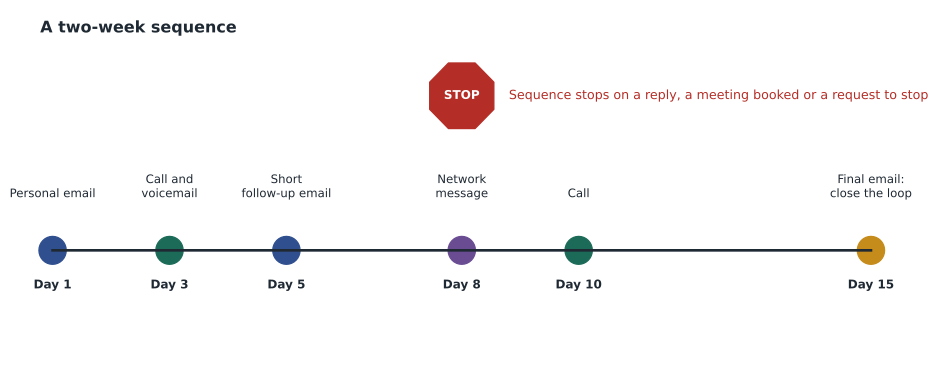
The engagement platform handles the timing. When a step is due, it either sends an email automatically or puts a task in the seller's queue. It records what happened (sent, opened, clicked, replied, bounced, call connected) and logs it to the CRM. When the contact replies, the platform pauses or ends the sequence so that the contact does not keep receiving automated messages after a real conversation has started.
Automated and manual steps
Most platforms let sellers choose, step by step, whether an email is sent automatically from a template or held for the seller to review and personalize. The choice matters. Fully automated sequences can reach more people with less effort, but they produce the generic messages buyers have learned to ignore, and they make mistakes at scale: a merge field that inserts the wrong first name, a sequence that keeps running after the contact replied by phone. Manual steps take longer but produce better messages and catch errors.
Owen's team now uses a simple rule: the first email to any new contact is always reviewed and personalized by the rep, with at least one sentence that could only have been written to that person. Later follow-up emails can be automatic, but every call and networking message is done by a person. "If a machine wrote it and a machine sent it, the buyer can tell," Owen says.
Designing a sequence that respects the buyer
A good sequence feels to the buyer like a series of helpful, relevant messages from a person, not like a machine. Several principles help.
| Principle | In practice |
|---|---|
| Start with a reason | Enrol contacts who have a likely need, such as a lease ending, a new office or a known problem, not everyone on a list |
| Make each step add something | Each message offers new information, a useful example or a simple question, not "just following up" |
| Keep it short | Short emails with one clear question get more replies than long ones |
| Vary the channel | Mix email, phone and networking messages; some buyers prefer one channel |
| Space it out | Leave a few days between steps; daily messages feel like pressure |
| End it gracefully | A final message that offers to stop contacting is respectful and often gets a reply |
| Stop on any signal | A reply, a meeting, an out-of-office saying the person has left, or a request to stop ends the sequence |
The final "close the loop" email is worth a closer look, because it often draws more replies than the steps before it. A version Owen's team uses reads: "I haven't heard back, so I'll assume the timing isn't right and won't keep emailing. If your printer lease comes up next year and you'd like a comparison, just reply to this and I'll pick it up." It is honest, it removes pressure and it leaves the door open.
Reading sequence results
Engagement platforms report on each sequence and each step. The most useful measures are reply rate (replies divided by contacts enrolled), positive reply rate (replies that show interest), meeting rate (meetings booked divided by contacts enrolled), bounce rate and unsubscribe rate. Open rates are less reliable than they used to be, because some email systems now open messages automatically to scan them or to protect privacy, which inflates the count, and others block the tracking images that record an open. Many teams now treat opens as a weak signal at best.
Worked problem
Comparing Owen's two sequences
Sequence A enrolled 400 contacts and produced 18 replies, 3 meetings and 9 unsubscribes. Sequence B enrolled 60 contacts and produced 21 replies, 11 meetings and 1 unsubscribe. Calculate the reply rate, meeting rate and unsubscribe rate for each, and the number of contacts needed per meeting.
Show solution
- Sequence A reply rate.
- \[18 \div 400 = 0.045\]
- Sequence A meeting rate.
- \[3 \div 400 = 0.0075\]
- Sequence A unsubscribe rate.
- \[9 \div 400 = 0.0225\]
- Sequence A contacts per meeting.
- \[400 \div 3 \approx 133\]
- Sequence B reply rate.
- \[21 \div 60 = 0.35\]
- Sequence B meeting rate.
- \[11 \div 60 \approx 0.183\]
- Sequence B unsubscribe rate.
- \[1 \div 60 \approx 0.017\]
- Sequence B contacts per meeting.
- \[60 \div 11 \approx 5.5\]
Answer: Sequence A needed about 133 contacts per meeting; sequence B needed about 5 or 6. The targeted, personalized sequence produced almost four times as many meetings from fewer than one-sixth as many contacts, and far fewer people asked to be removed.
Results should be compared over enough contacts to mean something. A sequence sent to 12 people that gets 3 replies looks impressive, but a few people more or less would change the rate a great deal. Sales operations teams often wait until a few hundred contacts have been through a sequence before drawing firm conclusions, and the statistics behind that caution are part of SLS-214.
Deliverability
Deliverability is whether emails actually reach the inbox rather than being blocked or sent to spam. Email providers judge senders on several signals: whether the sending domain is properly authenticated with standard records (SPF, DKIM and DMARC), how many messages bounce, how many recipients mark messages as spam, and how many recipients engage. Since 2024, major email providers such as Gmail and Yahoo have required senders of large volumes of email to authenticate their domains, keep spam complaints low and offer easy unsubscribing. Sending hundreds of generic emails to a purchased list is one of the fastest ways to damage a company's sender reputation, which then hurts every email the company sends, including invoices and service messages. Many companies send sales sequences from a separate domain for this reason, and limit how many messages each seller can send per day.
The law on commercial email and messages
Sequences send commercial messages, and both Canada and the United States regulate them. The rules differ significantly, and sellers must follow the rules of the country where the recipient is located.
In Canada, commercial electronic messages, including email, text messages and direct messages on social networks, are governed by Canada's Anti-Spam Legislation, known as CASL. CASL is a consent-based law: you generally need the recipient's consent before you send a commercial message. Consent can be express (the person clearly agreed, for example by ticking an unticked box to receive messages) or implied in specific situations, such as an existing business relationship based on a purchase within the past two years or an inquiry within the past six months. Another implied-consent situation is when the person has conspicuously published their business email address without saying they do not want messages, and the message is relevant to their business role. Every message must identify the sender, include contact information and offer an unsubscribe mechanism that works and is honoured within 10 business days. Penalties for organizations can reach 10 million dollars per violation. The CRTC, the Competition Bureau and the Office of the Privacy Commissioner share enforcement.
Because CASL requires consent, Ridgeline's CRM records a consent status, consent type, consent date and source for every contact, and the engagement platform will not enrol a contact without a valid status. For implied consent based on a purchase or inquiry, the CRM calculates the expiry date automatically. Owen's purchased-list experiment raised a hard question here: many contacts on purchased lists have not consented to anything, and "conspicuous publication" only applies if the address was actually published by the person and the message relates to their role. After Grace reviewed the list with Ridgeline's lawyer, the company stopped buying lists for email outreach.
Companies that sell across the border must follow both sets of rules: CASL applies to messages sent to recipients in Canada, even from the United States, and CAN-SPAM applies to commercial email sent to recipients in the United States. SLS-150 Sales Law and Ethics covers these laws in more depth. The practical lesson for sellers is to check the contact's consent and opt-out status before enrolling them, never to remove an unsubscribe link from a template, and to treat any "please stop" in a reply as an unsubscribe request.
Engagement in retail
Retail stores use similar tools for follow-up rather than prospecting. Juniper & Pine's texting tool sends a thank-you message after delivery, a reminder before a mattress comfort exchange period ends and a check-in a few weeks after a large purchase, but only to customers who agreed at the point of sale to receive texts. Associates can also send one-to-one messages from the clienteling app. Tessa Yellowbird, the store's e-commerce and marketing coordinator, manages the automated messages, and she has one rule borrowed from Owen's team: every automated message must be something the customer would be glad to receive, not something the store wishes they would read.
Personalization that is real
Many engagement platforms offer to personalize messages automatically by inserting merge fields such as the contact's first name, company and job title, or by having AI write an opening line from the person's public profile. Buyers have learned to recognize both. A first line that mentions a person's university or a recent post they wrote, followed by a generic pitch, often reads as surveillance rather than interest. Real personalization connects the reason for the message to something specific about the buyer's situation: a lease that is ending, a new office, a problem common in their industry, or something they said to a colleague. Owen's test for a first email is whether the buyer could tell, from the message alone, why they in particular were contacted. If the answer is no, the message is not ready to send.
Common mistakes
MistakeA sequence should be sent to as many contacts as possible.
InsteadEnrol contacts with a likely need; targeted sequences produce more meetings and fewer complaints.
MistakeFully automated sequences save time with no downside.
InsteadAutomation produces generic messages and mistakes at scale; review and personalize at least the first message.
MistakeOpen rates show how interested buyers are.
InsteadOpens are unreliable because of automatic scanning and privacy protection; use replies and meetings.
MistakeCAN-SPAM rules apply to every email a Canadian company sends.
InsteadFollow the rules where the recipient is located: CASL for recipients in Canada, CAN-SPAM for recipients in the United States.
MistakeA reply saying "please stop" can be ignored if the unsubscribe link was not used.
InsteadTreat any request to stop as an unsubscribe and record it across all tools.
Summary and key terms
- A sales engagement platform plans, sends and tracks outreach across channels, usually through sequences.
- A sequence is a timed series of steps that stops when the contact replies, books a meeting or asks to stop.
- Respectful sequences target people with a likely need, add something at each step, stay short, vary channels, space steps out and end gracefully.
- Reply and meeting rates are better measures than open rates; compare results over enough contacts.
- Deliverability depends on domain authentication, low bounces and complaints, and genuine engagement.
- CASL in Canada requires consent and an unsubscribe honoured within 10 business days; CAN-SPAM in the United States is opt-out but sets strict content rules; marketing texts need special care under both countries' laws.
- Sales engagement platform
- Software that helps sellers plan, carry out and track outreach across channels.
- Sequence
- A planned, timed series of outreach steps that stops when the contact responds.
- Reply rate
- Replies divided by the number of contacts enrolled.
- Deliverability
- Whether emails reach the recipient's inbox.
- CASL
- Canada's Anti-Spam Legislation, a consent-based law on commercial electronic messages.
- CAN-SPAM Act
- The US federal law setting rules for commercial email, based on opt-out.
- Express consent
- Clear, positive agreement to receive messages.
Practice problems
Work each problem on paper first, then reveal the answer to check.
A sequence enrolled 250 contacts and booked 10 meetings. What is the meeting rate, and how many contacts per meeting?
Show answer
10 divided by 250 is 0.04; 250 divided by 10 is 25 contacts per meeting.
Why are open rates now a weak signal?
Show answer
Some systems open emails automatically for scanning or privacy, and others block tracking images.
Name three signals that should stop a sequence.
Show answer
A reply, a meeting booked, an unsubscribe or request to stop, or an out-of-office saying the person has left.
Within how many business days must unsubscribe requests be honoured under both CASL and CAN-SPAM?
Show answer
10 business days.
Lesson quiz · 5 questions
Score 60% or more to complete this lesson.
Create a free account to save your progress, take quizzes and earn a certificate.