
SLS-211 · Lesson 11 of 12 · 18 min
Discovery notes and summaries
▶ Video coming soon A video version of this lesson is on the way.
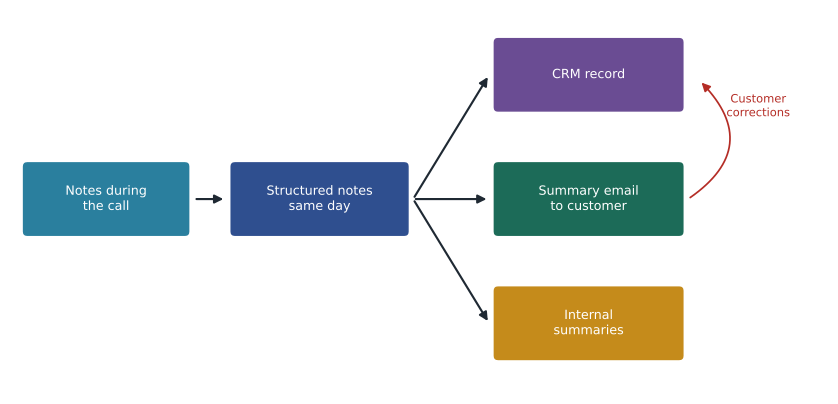
The morning after her site visit at Eastgate Physiotherapy, Friday, October 16, 2026, Maya sent Carla Bennett a one-page email. It listed what Maya had understood about the clinic's printing, the numbers they had worked out together, the questions still open and the next steps both of them had agreed to. Carla replied before lunch with two corrections and one addition, and forwarded the email to the clinic's two owners with a single line: "This is the printer thing I mentioned. Worth reading."
That email did more work than any brochure could. It confirmed that Maya had understood, it gave Carla something she could pass to the people who would decide, and it turned a conversation into a shared record. This lesson is about the notes a seller takes during discovery and the summaries they write afterwards: what to capture, how to structure it, how to check it and how to share it.
Why notes matter
Memory is unreliable, and sales conversations are full of details that matter later: exact numbers, names, dates, the customer's own words for their problem. A seller juggling a dozen opportunities cannot keep them all in their head. Good notes protect the seller from forgetting, protect colleagues who take over an account, and protect the customer from having to repeat themselves.
| Who uses discovery notes | What they need from them |
|---|---|
| The seller, next week | Exact numbers, open questions, promised follow-ups |
| The manager | Whether the deal is real, how big and how soon |
| The proposal or solutions team | Requirements, constraints and decision criteria |
| The service team after the sale | What the customer was promised and why they bought |
| A colleague who takes over the account | Everything, without calling the customer to start again |
Taking notes during the call
Taking notes while listening is a skill. Writing everything down makes the seller a stenographer, not a listener; writing nothing leaves gaps. Darnell's team followed a few habits.
| Habit | Why |
|---|---|
| Say you will take notes | Customers expect it and it signals that what they say matters |
| Write the customer's exact words for key points | "Exactly the wrong look" is more useful later than "Dale concerned about image" |
| Write numbers and names precisely | A wrong figure in a proposal destroys credibility |
| Mark open questions as they come up | So they can be asked before the call ends |
| Use paper or a simple document, not a busy screen, on video | The customer sees you looking at them, not reading |
| Do not write down information you should not keep | For example, patient details overheard during a clinic visit |
The last habit matters in health care, law and other sensitive settings. During the Eastgate visit, Maya saw printed exercise programs with patients' names on them. She did not note any names. Under PIPEDA, a seller has no reason to collect that information, and collecting it creates a risk for both companies. Notes should record what the seller needs to know about the business, not personal information about the customer's clients.
Structuring the notes
Notes are easier to use if they follow the same structure every time. Ridgeline's structure followed the discovery topics from lesson 2 and the decision topics from lesson 7.
| Section | What to capture | Eastgate example |
|---|---|---|
| Situation | Facts and numbers about how things work now | 3 printers; about 20 staff; lease ends January 31, 2027 |
| Problems | What is not working, in the customer's words | "Mondays are a nightmare"; jams about 4 a week per printer |
| Impact | Costs and risks, hard and soft, with how they were estimated | About 4,800 dollars a year in jam time; 1,800 in overtime; privacy risk of home printing |
| Priorities and outcomes | What success would look like | Monday programs printed at the clinic, without jams |
| Decision criteria | What will matter in choosing, with weights if known | Reliability first; a lease the clinic can leave; cost |
| Decision process and people | Who decides, how, when | Carla up to 5,000 dollars; owners decide above; first-Wednesday meetings, papers a week before |
| Open questions | What is still unknown | Can the old lease be ended early, and at what cost? |
| Next steps | Who does what by when | Carla: lease terms by Oct 23. Maya: options by Nov 6 |
Facts, estimates, opinions and assumptions
Discovery notes mix several kinds of information, and confusing them causes trouble later. A proposal that presents a seller's assumption as the customer's fact can embarrass everyone.
| Kind | Definition | Example | How to mark it |
|---|---|---|---|
| Fact | Confirmed by data or document | Lease ends January 31, 2027 (from the lease) | State it plainly, with its source |
| Estimate | The customer's or seller's best guess | About 15 minutes per jam (Carla) | "About", with who estimated it |
| Opinion | What someone believes or feels | "The owners will want to keep costs flat" (Carla) | Attribute it: "Carla thinks…" |
| Assumption | Something the seller has not checked | Volume will stay the same after the new program starts | Mark it to check: "Assumed; confirm" |
Writing it into the CRM
Ridgeline's CRM, described in SLS-140, held a discovery section on each opportunity. Maya copied her structured notes into it within a day of each call, attached the photos of the printer counters, and updated the stakeholder map and the next step. Darnell's rule was: if it is not in the CRM, it did not happen. That rule was not bureaucracy; when Maya was away for two days in November, Farida Haddad answered a question from Priya Nandakumar at Westgate & Rowe in ten minutes, because everything she needed was on the record.
Ridgeline also used an AI assistant that drafted call summaries from recorded calls. SLS-140 showed that these drafts were useful but made mistakes: in one Keystone summary it recorded three rooms instead of two and annual billing instead of monthly. Maya treated every AI draft as a first draft, checked each number and name against her own notes, and corrected it before saving.
Worked problem
Checking an AI draft
An AI summary of Maya's Westgate & Rowe call lists 16 specific facts: names, numbers, dates and requirements. Checking against her notes, Maya finds 2 wrong and 1 missing that should have been included. What share of the listed facts was correct, and how many facts should the corrected summary contain?
Show solution
- Correct listed facts: 16 − 2 = 14.
- Share correct: 14 ÷ 16 = 0.875, or about 88 in 100.
- Corrected summary: 16 listed facts, with the 2 wrong ones fixed, plus 1 missing fact added = 17 facts.
Answer: About 88 in 100 of the listed facts were right. That sounds good, but two wrong facts in a customer email would have been enough to damage trust, which is why every draft is checked.
The summary email
A discovery summary, sometimes called a recap or confirmation letter, is a short written account sent to the customer after a discovery conversation. It records what the seller understood, the numbers agreed, the open questions and the next steps. It is one of the most powerful and most neglected tools in selling.
| Purpose | How it helps |
|---|---|
| Confirms understanding | The customer can correct anything wrong before it reaches a proposal |
| Shows the seller listened | Customers rarely receive a summary; it stands out |
| Travels inside the customer's organization | Contacts forward it to the people who decide |
| Creates a shared record of next steps | Both sides know who is doing what |
| Uses the customer's words | People respond to their own description of their problem |
A good summary is short. Darnell's guide was a single screen, written in plain language, with the customer's problem in their own words at the top and next steps with dates at the bottom. It should not contain a sales pitch. Its job is to show understanding, not to persuade, and it is far more persuasive for not trying to be.
| Part | Maya's summary to Carla, October 16 |
|---|---|
| Thanks and purpose | "Thanks for the time yesterday. Here is what I understood, so you can correct anything I got wrong." |
| The problem, in her words | "The printers jam about four times a week each, Mondays are 'a nightmare', and the front desk has been printing exercise programs at home on Sunday nights to cope." |
| What it costs | "Using your figures, the jams cost about 4,800 dollars a year in staff time and the Sunday printing about 1,800 in overtime, on top of the 7,500 you pay the leasing company. Patient names on home-printed programs is a concern you said you'd raise with the owners." |
| What matters most | "Reliability first, then a lease you can leave if it doesn't work, then cost." |
| How the decision works | "You can approve up to 5,000 dollars; above that, the owners decide at their first-Wednesday meeting, with papers a week before." |
| Open questions | "Can the current lease end early, and what would that cost?" |
| Next steps | "You: send the lease terms by October 23. Me: two options with prices by November 6, in time for the December 2 owners' meeting." |
Carla's two corrections were small: the clinic had nine clinicians plus a new part-time one, and the Sunday printing was done by two people, not three. Her addition was the most valuable line in the reply: "The owners care a lot about the patient-name thing. I'd lead with that." Maya would not have known that without sending the summary.
Summaries for internal audiences
Sellers also summarize discovery for colleagues: a manager reviewing the pipeline, a solutions specialist designing a configuration, or the service team preparing for installation. These summaries use the same facts but a different emphasis.
| Audience | What they most need |
|---|---|
| Sales manager | Size, timing, decision process, risks and what help the seller needs |
| Solutions or design team | Requirements, volumes, constraints, site details and success measures |
| Service and installation team | What was promised, dates, access, people to contact, sensitivities |
| Account manager taking over | The whole picture, especially why the customer bought and what they worry about |
For Westgate & Rowe, Maya's internal summary to Ridgeline's installation planner highlighted two things that would never appear in a product specification: the firm's tax season ran from February to April, so nothing could be installed then except in the week before the lease ended, and the landlord had to approve anything mounted on a wall. Those two lines prevented a scheduling mistake that would have cost the deal.
Keeping records appropriately
Discovery notes contain information the customer shared in confidence: costs, internal frustrations, names of people who are unhappy, plans not yet announced. Treat them accordingly. Ridgeline's policy was that discovery notes stayed in the CRM, where access was limited to the account team and managers, and were not copied into personal email or messaging apps. Notes were written as if the customer might one day read them, which ruled out unkind descriptions of people and guesses about their motives.
That last rule is worth taking seriously. Customer contacts sometimes ask to see what a supplier has recorded about them, and under PIPEDA, individuals have a right to access personal information an organization holds about them. More simply, a note that would embarrass the seller if the customer saw it is a note that should not be written. "Dale is impatient and dislikes long meetings" is useful and fair. "Dale is difficult" is neither.
Finally, notes should be kept only as long as they are useful. Ridgeline archived discovery notes on closed opportunities after the period set in its records policy, keeping the summary and the decision but not every detail.
A good test of any set of notes is whether a colleague who has never met the customer could read them and hold a sensible ten-minute conversation with them the next day. If they could not, something important is missing.
Common mistakes
MistakeRelying on memory after a discovery call.
InsteadTake structured notes during the call and complete them the same day.
MistakeWriting your own paraphrase instead of the customer's words.
InsteadRecord the customer's exact words for the problem and key concerns.
MistakeMixing assumptions with facts.
InsteadMark facts, estimates, opinions and assumptions differently.
MistakeSaving an AI-drafted summary without checking it.
InsteadCheck every name, number and date against your own notes.
MistakeTurning the summary email into a sales pitch.
InsteadKeep it short and factual: understanding, numbers, open questions and next steps.
Summary and key terms
- Discovery notes protect the seller, colleagues and the customer from lost details.
- During calls, say you will take notes, record the customer's exact words, write numbers and names precisely, mark open questions and avoid collecting personal information you do not need.
- Structure notes around situation, problems, impact, priorities, decision criteria, decision process and people, open questions and next steps.
- Distinguish facts, estimates, opinions and assumptions.
- Enter notes in the CRM promptly and check AI-drafted summaries against your own notes.
- A short discovery summary email confirms understanding, shows you listened, travels to decision makers and creates a shared record of next steps; it should not pitch.
- Internal summaries use the same facts with emphasis suited to managers, designers, installers or account managers.
- Discovery notes
- A structured record of what was learned in a discovery conversation.
- Discovery summary
- A short written account sent to the customer after discovery, confirming understanding and next steps.
- Estimate
- A best guess, recorded with who made it.
- Assumption
- Something the seller has not yet checked, marked to be confirmed.
- Internal summary
- A discovery summary written for colleagues, emphasizing what each audience needs.
Practice problems
Work each problem on paper first, then reveal the answer to check.
Classify: "The owners will probably want a three-year term." (said by the office manager)
Show answer
An opinion, to be recorded as Carla's view.
An AI draft lists 20 facts; 3 are wrong. What share is correct?
Show answer
17 ÷ 20 = 0.85, or 85 in 100.
Name two things a discovery summary email should include.
Show answer
Any two of: the problem in the customer's words, agreed numbers, decision criteria, decision process, open questions, next steps with dates.
Lesson quiz · 5 questions
Score 60% or more to complete this lesson.
Create a free account to save your progress, take quizzes and earn a certificate.