
SLS-211 · Lesson 2 of 12 · 19 min
Planning a discovery call
▶ Video coming soon A video version of this lesson is on the way.
Eastgate Physiotherapy had filled in Ridgeline's website form on a Friday in late September 2026. The message from Carla Bennett, the clinic's office manager, was short: "Our printer lease ends in January and the machines are always jamming. Can someone call me?" Owen Pelletier, Ridgeline's inside sales lead, phoned her the same afternoon, confirmed that the clinic had three printers and about twenty staff, and booked a forty-five-minute discovery call with Maya for Wednesday, October 7.
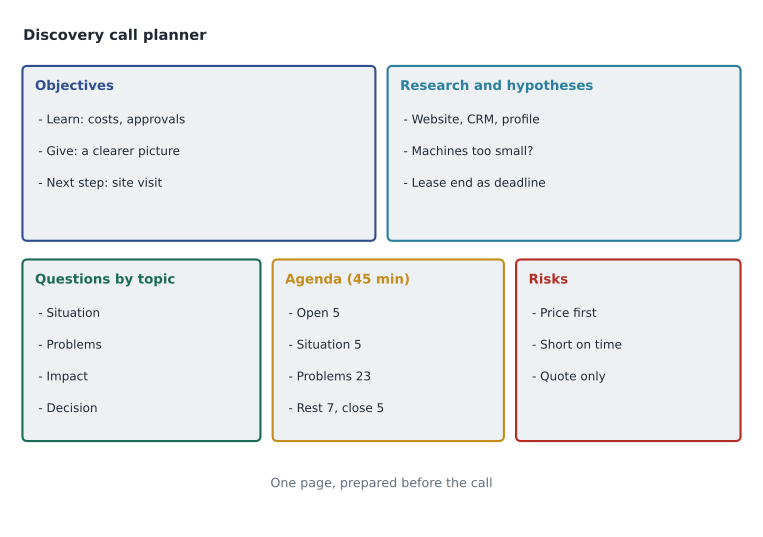
Maya's instinct was to prepare a short presentation on Ridgeline's managed print service. At the discovery lab on September 30, Darnell asked her to put the slides away and instead spend an hour planning the conversation. "A discovery call you have not planned is a chat," he said. "Chats are pleasant. They do not tell you whether there is a deal, how big it is or who decides." This lesson follows that hour of planning.
What a discovery call is for
A discovery call is a conversation whose main purpose is to understand the customer's situation, not to present a solution. It is often the first substantial meeting in a sale, though in larger deals there may be several. By the end, a good discovery call should leave both sides better informed: the seller knows whether there is a problem worth solving and how the customer will decide, and the customer has thought more clearly about their own situation and knows whether this seller is worth more of their time.
Darnell asked his team to set three kinds of objective for every call: what they wanted to learn, what they wanted the customer to come away with, and what next step they would ask for. Writing them down beforehand sounds bureaucratic, but it changes how a seller behaves in the room. A seller who knows they must leave with the names of everyone involved in the decision will ask about it. A seller who has no such objective usually forgets.
| Objective type | Question it answers | Maya's Eastgate objectives |
|---|---|---|
| Learning | What do I need to find out? | How the printers are used; what jams cost in time; what the lease costs; who approves spending; what happens in January |
| Customer value | What should Carla gain from the call? | A clearer picture of what the printing problem costs and what options exist |
| Next step | What commitment will I ask for? | A site visit to see the printers and read their counters, with Carla present |
Researching before the call
Research before a discovery call has two purposes. It lets the seller skip questions the customer would find tiresome, such as "What does your company do?", and it lets them ask sharper ones, such as "I noticed you opened a second treatment area last spring. Did that change how much you print?" Buyers notice the difference. A seller who has done no homework is asking the customer to do the seller's work for free.
Maya spent about forty minutes on research. Darnell suggested a simple rule of thumb: the more valuable the opportunity, the more research is justified, but even a small call deserves fifteen minutes.
| Source | What Maya found | How she would use it |
|---|---|---|
| Clinic website | Two owner physiotherapists, eight other clinicians, a new pelvic-health program, online booking | Ask whether the new program added paperwork or printing |
| Ridgeline's CRM | No previous contact with Eastgate; Owen's call notes: three printers, about twenty staff, lease ends January | Avoid asking Carla to repeat what she told Owen; confirm instead |
| Professional network profile | Carla had moved from a hospital admin role two years earlier | Expect familiarity with privacy rules for health records |
| Industry knowledge | Clinics print intake forms, exercise sheets, receipts and insurance forms | Prepare questions about each kind of printing |
| Ridgeline's other clinic customers | Northfield Family Clinic signed a managed print contract in October | Mention, with Northfield's permission, what a similar clinic changed |
Research also produces hypotheses: educated guesses about what the customer's problems might be. Maya's hypotheses were that the jams came from machines too small for the volume, that staff time spent clearing them was larger than the clinic realized, and that the lease renewal date created a natural deadline. A hypothesis is not a conclusion. Its job is to guide questions, and a good seller is ready to drop it the moment the customer says something that contradicts it.
Choosing the topics
A discovery call usually covers the same broad areas, in an order that feels natural to the customer. Darnell's team used five topics, and lesson 3 shows how to turn each topic into well-built questions.
| Topic | What the seller wants to understand | Example question for Eastgate |
|---|---|---|
| Situation | How things work today, in facts and numbers | "Walk me through what gets printed in a normal day." |
| Problems | What is not working and why | "When a printer jams, what usually happens next?" |
| Impact | What the problems cost or put at risk | "How much of the front-desk team's day goes to that?" |
| Priorities and outcomes | What would change if it were fixed, and how important it is | "If printing simply worked, what would that free your team to do?" |
| Decision | Who decides, how, by when and on what basis | "Besides you, who would be involved in deciding on new equipment?" |
New sellers often prepare plenty of situation questions and too few of the others, because situation questions are easy to think of. They are also the questions customers find most tedious. Lesson 3 explains research suggesting that successful sellers ask fewer situation questions and more questions about problems and their consequences. Maya cut her list of situation questions from eleven to five, using her research to answer the rest.
Writing an agenda
An agenda for a discovery call is a short plan of what will be covered, in what order and for how long. Sharing it with the customer, briefly, at the start of the call does three things: it shows respect for their time, it lets them add anything important, and it makes it natural to ask about the decision process near the end, because the agenda said you would.
Worked problem
Building a 45-minute agenda
Maya has 45 minutes with Carla. She wants at least half the call spent on problems and impact, five minutes for an opening and five for agreeing next steps. How should she divide the time?
Show solution
- Fixed parts: opening 5 minutes and next steps 5 minutes, so 45 − 10 = 35 minutes remain.
- At least half the call on problems and impact: 45 ÷ 2 = 22.5, so allow 23 minutes.
- Remaining time: 35 − 23 = 12 minutes for situation, priorities and the decision process.
- Split the 12 minutes: situation 5, priorities 3, decision process 4.
- Check: 5 + 5 + 23 + 3 + 4 + 5 = 45 minutes.
Answer: Opening 5, situation 5, problems and impact 23, priorities 3, decision process 4, next steps 5. The agenda is a guide, not a script; if Carla wants to spend longer on one topic, Maya follows her.
Maya's spoken version of the agenda took about twenty seconds: "I thought we could start with how printing works at the clinic today and what's going wrong, talk about what it's costing you, and then, if it makes sense, how a decision like this gets made at Eastgate and what a sensible next step might be. Is there anything you'd like to make sure we cover?" Carla added one item: she wanted to know whether the clinic could get out of its lease early.
Planning the next step before the call
Sellers who leave a discovery call without a clear next step often lose the opportunity, not because the customer said no, but because nothing was agreed and both sides moved on. Planning the next step in advance means deciding what would be a reasonable, specific commitment if the call goes well, and what fallback to suggest if it does not.
| If the call shows… | Next step Maya would ask for | Why |
|---|---|---|
| A clear problem with real cost | A site visit within two weeks to see the machines and read their page counters | Data makes the impact concrete and brings Maya on site |
| A problem, but unclear cost | Carla tracks jams and time lost for one week | The customer gathers evidence, which builds her own conviction |
| No real problem | A polite close and a note to call before the January renewal | Better to stop now than chase a deal that does not exist |
| A bigger issue than printing | A second call including one of the owners | Bigger problems need the people who control bigger budgets |
Neil Rackham's research, discussed in lesson 3, distinguished an advance, a specific action that moves the sale forward, from a continuation, in which the conversation ends pleasantly with nothing agreed. "Send me some information" is usually a continuation. "Let's look at your printers together on Tuesday at ten" is an advance.
Preparing for the conversation going wrong
Good planning includes thinking about what might derail the call. Maya listed three risks. Carla might want a price before discussing anything else. She might be short of time because a staff member was away. Or she might have already decided to renew with her current supplier and be using the call to get a comparison quote. For each, Maya planned a response.
| Risk | Planned response |
|---|---|
| Carla asks for a price straight away | Give an honest range ("Clinics your size usually spend between 300 and 500 dollars a month") and explain that a firm price depends on volume and machines, which the call will clarify |
| Carla has only 15 minutes | Skip to problems and impact, then ask for a second call or a site visit |
| Carla only wants a comparison quote | Ask what would have to be true for her to consider changing; if nothing would, say so and offer to stay in touch |
| A physiotherapist joins unexpectedly | Welcome them, ask what they would most like from the call, and adjust the agenda |
Discovery calls by video and telephone
Maya's call with Carla was on video. Remote discovery calls follow the same plan, but they need a little more structure, because people tolerate less silence and drift on a screen than in a room. Maya tested her camera and connection, closed every other window, kept her planner on paper beside the keyboard so she would not seem to be reading from the screen, and told Carla at the start that she would be taking notes. SLS-120 covered video technique in depth; the discovery-specific point is that the agenda matters even more on video, because it gives both people a shared map.
If a call is recorded, the customer must know. Ridgeline's practice was to ask permission at the start of any recorded call, which meets the consent rules in Canada, and to keep recordings only as long as its retention policy allowed. Maya chose not to record the Eastgate call, because Carla would be describing health-clinic operations and Maya preferred that she speak freely.
What happened on October 7
The call ran 48 minutes. Carla confirmed the three printers and the January 31 lease end, and described a problem Maya had not guessed: the jams were worst on Monday mornings, when the clinic printed the week's exercise programs for patients, and the front desk had started printing them at home on Sunday nights to avoid the delays. Maya asked for and got her planned advance, a site visit on October 15. She also learned that Carla could approve purchases up to 5,000 dollars, and that anything larger went to the two owners, who met on the first Wednesday of each month.
Afterwards, Darnell asked her to score the call against her objectives. She had met all three, but had missed one learning goal: she had not asked what the current lease cost, because Carla's Sunday-night story had taken over the conversation. She added it to the list for the site visit.
Common mistakes
MistakePreparing a product presentation instead of a discovery plan.
InsteadPlan learning objectives, value for the customer, and a specific next step to ask for.
MistakeAsking questions the customer has already answered or that research could answer.
InsteadSpend time on research and confirm known facts rather than asking for them again.
MistakeTreating hypotheses as conclusions.
InsteadUse hypotheses to choose questions, and drop them as soon as the customer contradicts them.
MistakeSpending most of the call on situation questions.
InsteadPlan for at least half the call on problems, impact and priorities.
MistakeEnding with 'I'll send you some information'.
InsteadPlan a specific advance, such as a site visit or a meeting with another decision maker, and ask for it.
Summary and key terms
- A discovery call aims to understand the customer's situation, not to present a solution.
- Set three kinds of objective: what to learn, what the customer should gain and what next step to ask for.
- Research before the call lets the seller skip tedious questions, ask sharper ones and form hypotheses, which guide questions but must be dropped if contradicted.
- Plan questions across five topics: situation, problems, impact, priorities and outcomes, and the decision.
- A short agenda shared at the start shows respect, invites additions and makes it natural to discuss the decision process.
- Plan the next step in advance, distinguishing an advance, which moves the sale forward, from a continuation, which does not.
- Prepare for likely risks, adapt the plan for video, and follow consent rules for recording.
- Discovery call
- A conversation whose main purpose is to understand the customer's situation before proposing anything.
- Call objective
- A specific result the seller plans to achieve in a call: something to learn, value to give or a next step to secure.
- Hypothesis
- An educated guess about the customer's problem, used to guide questions.
- Agenda
- A short plan of what a call will cover, in what order and for how long.
- Advance
- A specific action agreed by the customer that moves the sale forward.
- Continuation
- A call that ends pleasantly but with no specific commitment to move the sale forward.
Practice problems
Work each problem on paper first, then reveal the answer to check.
A seller has 30 minutes, needs 4 minutes to open and 4 to close, and wants half the call on problems and impact. How many minutes are left for other topics?
Show answer
30 − 8 = 22 minutes for the body; half of 30 is 15 for problems and impact; 22 − 15 = 7 minutes for situation, priorities and the decision process.
Is "Send me your brochure and I'll look at it" an advance or a continuation? Why?
Show answer
Usually a continuation: it commits the customer to nothing specific and does not move the decision forward.
Give one good reason to share an agenda at the start of a discovery call.
Show answer
Any of: it respects the customer's time; it lets them add topics; it makes discussing the decision process natural later.
Lesson quiz · 5 questions
Score 60% or more to complete this lesson.
Create a free account to save your progress, take quizzes and earn a certificate.