
SLS-211 · Lesson 6 of 12 · 18 min
Mapping stakeholders
▶ Video coming soon A video version of this lesson is on the way.
When Maya joined Ridgeline at the end of August 2026, Darnell had already been working on Prairie Valley School Division for more than a year. The division ran 14 schools and a central office, bought printing supplies from four different companies and had told Ridgeline informally that a formal request for proposals for managed print was coming. In Maya's first two weeks, Darnell took her to three meetings at the division office and two school visits. After the last one, he handed her a blank sheet of paper and said, "Draw me everyone who will have a say in this, and what each of them wants."
Maya drew four boxes. Darnell's version had nine. The difference is the subject of this lesson: in most business-to-business sales, the decision is made by a group, not a person, and the seller who understands only one or two of its members is guessing about the rest.
Buying is done by groups
Large purchases in organizations involve several people with different jobs, different concerns and different amounts of influence. Gartner's research on business buying has repeatedly found that a typical buying group for a complex solution includes somewhere between six and ten decision makers, each bringing information they have gathered separately. Even a small purchase at a small clinic, such as Eastgate's printers, involved Carla, the two owners and, indirectly, the front-desk staff who used the machines every day.
A stakeholder in a sale is anyone who will be affected by the decision or can affect it. Stakeholder mapping is the practice of identifying those people, understanding what each of them cares about and how much influence they have, and planning how to engage each one. It is closely related to the buying centre idea from SLS-110, which described the roles people play in organizational buying. This lesson turns that idea into a working tool.
Roles in the buying group
Different writers use different labels for the roles stakeholders play. One of the most widely used sets comes from Robert Miller and Stephen Heiman's *Strategic Selling* (1985), which described four kinds of buying influence. Many sales teams add a few more roles that the four do not cover well.
| Role | Who they are | What they care about | Prairie Valley example |
|---|---|---|---|
| Economic buyer | The person who gives final approval and controls the budget | Return on the money, risk, fit with priorities | The superintendent of business administration, then the board |
| User buyers | People who will use the solution day to day | Whether it makes their work easier | School office staff and teachers who print |
| Technical buyers | People who screen options against specifications and rules | Compliance, standards, security, procurement rules | The IT manager and the procurement officer |
| Coach | Someone who wants you to succeed and guides you | A good outcome for their organization, and often credibility for themselves | A high-school principal on the technology committee |
| Champion | A coach with influence who actively argues for the solution internally | Solving a problem they own | The same principal, once convinced |
| Blocker | Someone who opposes the change, openly or quietly | Protecting a current arrangement, workload or reputation | Possibly a school that liked its own supplier |
| Gatekeeper | Someone who controls access to information or people | Following process; managing time | The procurement officer once the RFP is issued |
One person can play more than one role. Colleen Sawatzky, Prairie Valley's procurement officer, was a technical buyer, because she checked every bid against the RFP's rules, and a gatekeeper, because once the RFP was issued on September 14, all contact with the division about the bid had to go through her. Roles also change over time. The principal began as a coach, giving Maya useful background, and became a champion when he told the technology committee that the schools needed one supplier and one phone number.
Building the map
Darnell's team used a simple grid with two dimensions: how much influence each person has over the decision, and how much support they currently show for the seller's approach. Plotting stakeholders on the grid shows where to spend time.
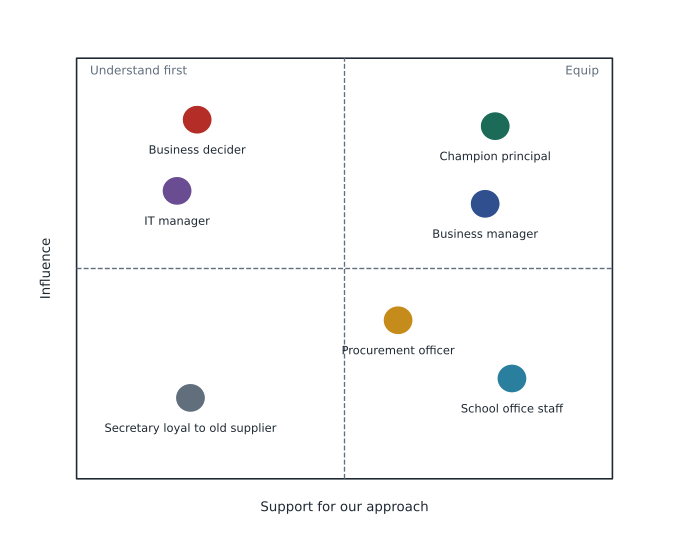
| Quadrant | Meaning | What to do |
|---|---|---|
| High influence, supportive | Your champions | Equip them with evidence and keep them informed |
| High influence, neutral or opposed | The people who can make or break the deal | Understand their concerns first; adjust the solution if they are right |
| Low influence, supportive | Helpful allies | Ask for their stories and examples; keep them involved |
| Low influence, neutral or opposed | Usually less urgent | Listen; their concerns can spread if ignored |
The map is only as good as the information behind it. Maya filled in each box by asking, not assuming. Her most useful single question at every meeting was a version of: "Besides you, who will have a say in this, and what will matter most to them?" People are usually willing to describe their colleagues' concerns, and the answers often reveal roles the seller had not thought about.
What each stakeholder wants
For each person on the map, Darnell asked Maya to write down three things: their business interest, what they need for the organization; their personal interest, what they want for themselves, such as recognition, less workload or avoiding blame; and their main concern about the change. Personal interests are not cynical. They are part of being human, and a solution that ignores them meets quiet resistance.
| Stakeholder | Business interest | Personal interest | Main concern |
|---|---|---|---|
| Business decider | Savings the board can see | Not being blamed if service gets worse | Locked into a long contract with a poor supplier |
| Business manager, Patricia Klassen | One invoice instead of four | Less month-end reconciliation work | Disruption during the school year |
| IT manager, Ken Fehr | Secure devices on the network | A clean handover before he retires in the spring | Another system for his successor to learn |
| Procurement officer, Colleen Sawatzky | A fair, defensible process | No complaints or challenges from losing bidders | Any appearance of bias toward one bidder |
| Principal, technology committee | Fewer printer complaints from teachers | Being seen as the person who fixed it | A promise that is not kept |
| School office staff | Printers that work | Fewer calls from frustrated teachers | Learning a new ordering process |
This table changed Ridgeline's proposal. Ken Fehr's concern about his successor led Maya to add a written network-configuration handover and a training session for the incoming IT manager. Patricia Klassen's interest in one invoice became a headline in the response. The decider's fear of being locked in led, in the later negotiation described in SLS-213, to an early-termination clause for missed service levels. None of those came from asking what the division wanted to buy; all of them came from asking what each person cared about.
Finding the economic buyer
New sellers often spend most of their time with the person who contacted them, who is rarely the person who approves the money. Talking only to that person means the seller learns the economic buyer's priorities second-hand, if at all. Finding and, where possible, meeting the economic buyer is one of the main goals of discovery in larger deals.
| Question | What it uncovers |
|---|---|
| "Who else would need to approve a change like this?" | The approval chain |
| "Above what amount does a purchase need a different sign-off?" | Approval limits, such as Carla's 5,000 dollars at Eastgate |
| "What would the person signing want to see before agreeing?" | The economic buyer's criteria, second-hand |
| "Would it make sense for me to meet them, with you, before we finalize anything?" | Access, asked for with the contact's help rather than around them |
The last question matters. Going around a contact to reach their boss usually damages the relationship and may turn a coach into a blocker. Asking the contact to arrange the meeting, and offering them a role in it, keeps them on side. At Eastgate, Carla agreed to bring one of the owners to the site-visit debrief; at Northfield, Janet arranged a fifteen-minute call with Dr. Ravi Anand.
Quiet stakeholders and blockers
Some of the most important people never attend a sales meeting. At Prairie Valley, one school secretary had ordered toner from the same local shop for eleven years and was friendly with its owner. She had no formal role in the decision, but if she told her principal that the new system was worse, word would spread. Maya made a point of visiting her school, asking how she ordered supplies and what had gone wrong in the past, and noting that she would be one of the first trained.
A blocker is not an enemy. Most opposition comes from a real concern: workload, loyalty, fear of failure or a bad experience with change. The useful response is to understand the concern and, where it is fair, address it in the solution. Occasionally a blocker's concern is so central that it reveals the solution is wrong, and the seller should change it.
Keeping the map current
Stakeholder maps go stale quickly. People change jobs, retire, gain or lose influence, and change their minds. Ken Fehr's planned retirement meant that his successor, who had not yet been hired when Maya first drew the map, would become a technical buyer during installation and the main user of Ridgeline's reporting afterwards. Maya added a box for "incoming IT manager" and a note to meet them as soon as they were named.
Ridgeline kept stakeholder maps in the CRM, as SLS-140 described: each contact linked to the opportunity with a role, an influence rating, a support rating and a note of their main concern. Darnell reviewed the maps for large deals at every pipeline meeting, asking two questions: "Who on this map have you not met?" and "Whose concern have you not addressed?"
Worked problem
Counting coverage
Maya's Prairie Valley map has 9 stakeholders. She has met 6 of them. Of the 4 she rates as high influence, she has met 3. What share of all stakeholders, and of high-influence stakeholders, has she met?
Show solution
- All stakeholders: 6 ÷ 9 = 0.667, or about 67 in 100.
- High influence: 3 ÷ 4 = 0.75, or 75 in 100.
- The one high-influence person not yet met is the decider.
Answer: She has met about two-thirds of the group and three of the four most influential people. The gap that matters most is the decider, so her next priority is a meeting arranged through the business manager.
Stakeholders in small organizations
Stakeholder mapping is not only for large public bodies. In small organizations the group is smaller, but the roles still exist, and they are often concentrated in a few people. At Eastgate Physiotherapy, Carla Bennett was the coach and a user buyer; the two owner physiotherapists were joint economic buyers; and the front-desk staff were the users who felt the problem most. There was also a quiet technical buyer Maya almost missed: a contractor who looked after the clinic's computers and network, who would need to approve connecting new printers.
In owner-managed businesses, the economic buyer may also be the founder whose name is on the door, and personal interests can weigh heavily: pride in the business, worry about cash, loyalty to a long-standing supplier who is also a friend. Those interests are legitimate. A seller who understands them can propose terms, such as a lease the clinic can leave if service is poor, that answer them directly.
Whatever the size of the organization, the same two review questions apply: who on the map have you not met, and whose concern have you not addressed?
Common mistakes
MistakeTreating the person who called you as the decision maker.
InsteadAsk who else is involved and who approves the money.
MistakeGoing around a contact to reach their boss.
InsteadAsk the contact to arrange the meeting and give them a role in it.
MistakeIgnoring people with no formal role.
InsteadFind quiet stakeholders whose views will spread, and listen to them.
MistakeTreating blockers as enemies.
InsteadUnderstand the concern behind the opposition and address it if it is fair.
MistakeDrawing the map once and never updating it.
InsteadReview it regularly as people change jobs, influence and opinions.
Summary and key terms
- Organizational purchases are made by buying groups, often six to ten people for complex solutions.
- A stakeholder is anyone affected by or able to affect the decision.
- Miller and Heiman described economic, user and technical buyers and coaches; teams often add champions, blockers and gatekeepers.
- One person can hold several roles, and roles change.
- An influence and support grid shows where to spend time.
- For each stakeholder, record business interest, personal interest and main concern; these often reshape the solution.
- Finding the economic buyer is a key discovery goal, best done with the contact's help.
- Quiet stakeholders and blockers usually have real concerns worth understanding.
- Keep the map current in the CRM and review who has not been met and whose concerns are unaddressed.
- Stakeholder
- Anyone who will be affected by a buying decision or can affect it.
- Stakeholder mapping
- Identifying the people in a buying group, their interests, influence and support, and planning how to engage them.
- Economic buyer
- The person who gives final approval and controls the budget.
- Technical buyer
- A person who screens options against specifications, standards or rules.
- Champion
- An influential person who actively argues for the seller's solution inside the customer's organization.
- Blocker
- A stakeholder who opposes the change, openly or quietly, usually because of a real concern.
Practice problems
Work each problem on paper first, then reveal the answer to check.
Which role is the IT manager at Prairie Valley most likely to play?
Show answer
A technical buyer, screening the solution against network and security requirements.
A seller has met 4 of 10 stakeholders, including 2 of 5 high-influence ones. What share of high-influence stakeholders has she met?
Show answer
2 ÷ 5 = 0.4, or 40 in 100.
Write a question that asks a contact to help you meet the economic buyer.
Show answer
For example: "Would it make sense for the three of us to meet before anything is finalized?"
Lesson quiz · 5 questions
Score 60% or more to complete this lesson.
Create a free account to save your progress, take quizzes and earn a certificate.