
SLS-211 · Lesson 12 of 12 · 20 min
Role-play lab: a discovery call
▶ Video coming soon A video version of this lesson is on the way.
The last discovery lab of the fall was on Wednesday, November 11, 2026. Instead of a talk, Darnell ran a role-play. He would play a prospect, Maya would run a full 40-minute discovery call, and Owen Pelletier, Ridgeline's inside sales lead, would score it with the team's discovery scorecard. Afterwards Owen would run a shorter call of his own with Maya playing the customer. The prospect was a realistic composite Darnell had built from several past deals.
This lesson walks through the lab: the brief, Maya's preparation, key moments of the call with annotations, the scorecard, the debrief and the plan Maya left with. It brings together every lesson in the course. At the end is a checklist you can use for your own discovery calls and role-plays.
The brief
Darnell gave Maya the same information a real seller would have: a web enquiry and a few public facts. He kept the rest, including the real problem, for the call.
| Item | What Maya was given |
|---|---|
| Prospect | Harvest Lane Credit Union, a fictional credit union with a head office and 6 branches in and around Regina |
| Contact | Simone Albrecht, facilities and operations manager |
| Enquiry | "We want a quote for a video system for our head-office boardroom. Board meets monthly." |
| Public facts | About 140 staff; a new remote-appointment service for members launched last spring; head-office renovation planned for 2027 |
| Time | 40 minutes, by video |
Darnell's hidden script, revealed afterwards, contained three layers: the boardroom problem Simone asked about; a larger problem with remote member appointments in the branches, which she would mention only if asked the right questions; and a decision process involving the chief executive and the board's audit committee.
Maya's preparation
Maya used the one-page planner from lesson 2. Her objectives were to learn what was wrong with board meetings and what it cost, to find out whether the branches had related problems, and to understand who decided; to give Simone a clearer picture of options; and to leave with a site visit to the boardroom and one branch.
| Planner section | What Maya wrote |
|---|---|
| Hypotheses | Remote directors have trouble hearing; branches may have similar issues with the new remote-appointment service |
| Situation questions (few) | How many directors join remotely? What equipment is in the room now? |
| Problem and implication questions | What happens when a remote director can't hear? What does it do to decisions? What happens with member video appointments? |
| Need-payoff question | "If every director could take full part, what would that mean for the board?" |
| Decision questions | Who approves? Does the board have to approve? When is the budget set? |
| Planned advance | Site visit to the boardroom and one branch within two weeks |
| Risks | Simone wants a price only; a budget already fixed; a supplier already chosen |
Key moments of the call
The full call ran 39 minutes. These excerpts show the turning points, with Owen's notes.
| Time | What happened | Owen's note |
|---|---|---|
| 0:00–2:30 | Maya thanked Simone, shared a short agenda and asked whether she wanted to add anything. Simone added "rough cost". | Clear agenda; invited additions; noted the price request |
| 2:30–6:00 | Maya asked how board meetings work now. Simone: 11 directors, 5 usually remote, one ceiling microphone, a laptop camera. | Only two situation questions; research covered the rest |
| 6:00–11:00 | Maya asked what happens when remote directors can't hear. Simone: they ask for things to be repeated, and twice a vote was delayed to the next meeting. | Good problem and implication questions; found a governance impact |
| 11:00–13:00 | Maya started to describe Ridgeline's boardroom kit. She stopped herself and asked, "Before I go there, is the boardroom the only place video is a problem?" | Early-pitch moment caught and recovered |
| 13:00–22:00 | Simone described the branches: members book remote appointments with advisors, and calls often start late because advisors share one laptop and headset per branch. | The hidden, larger problem, found by asking about other places |
| 22:00–27:00 | Maya and Simone estimated the cost of late appointments together (see the worked example). | Customer's numbers; conservative; checked aloud |
| 27:00–33:00 | Maya asked who decides. Simone: the chief executive approves up to a limit; larger spending goes to the board's audit committee, which meets in late January. | Decision process and a key date found |
| 33:00–37:00 | Maya gave an honest price range for the boardroom and explained it depended on the room and microphones. | Handled the price request without anchoring on a number |
| 37:00–39:00 | Maya summarized and asked for a site visit to the boardroom and the busiest branch next Thursday. Simone agreed. | Clear summary; specific advance |
Worked problem
Estimating the cost of late remote appointments
Simone said the branches hold about 40 remote member appointments a week, and about 1 in 8 starts roughly 10 minutes late while an advisor waits for the shared laptop or fixes the audio. Advisors cost the credit union about 45 dollars an hour. Using 52 weeks, what does the lost advisor time cost each year?
Show solution
- Appointments per year: 40 × 52 = 2,080.
- Late appointments: 2,080 ÷ 8 = 260.
- Time lost: 260 × 10 minutes = 2,600 minutes = 2,600 ÷ 60 = about 43.3 hours.
- Cost: 43.3 × 45 = about 1,950 dollars.
Answer: The measurable cost is about 1,950 dollars a year in advisor time: modest. Simone said the bigger issue was members, several of whom had complained that the credit union seemed disorganized, at a time when it was trying to grow its remote service. Maya recorded that as a soft impact in Simone's words.
The worked example illustrates something Darnell wanted the team to notice. The measurable cost was small, but the soft impact, members' first impression of a new service the credit union was promoting, was large and strategic. Maya did not inflate the number to match the importance. She kept the two separate, as lesson 5 taught.
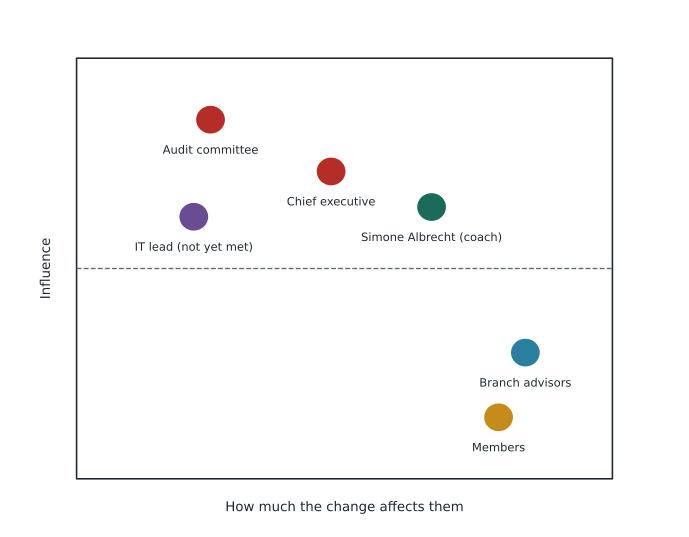
The scorecard
Ridgeline's discovery scorecard had ten items, each scored 0, 1 or 2. Owen scored Maya's call immediately afterwards, then the three of them discussed each item.
| Item | What earns 2 points | Maya's score |
|---|---|---|
| Preparation | Research used; objectives and agenda clear | 2 |
| Opening | Agenda shared; customer invited to add | 2 |
| Balance of questions | Few situation questions; most time on problems and impact | 2 |
| Problem behind the request | Found the underlying or wider problem | 2 |
| Impact | Quantified with the customer; hard and soft kept separate | 2 |
| Avoiding the early pitch | No product talk before the need is clear | 1 |
| Stakeholders | Learned who is involved and their concerns | 1 |
| Decision criteria and process | Learned criteria, steps and dates | 1 |
| Listening | Follow-up questions built on the customer's answers; customer talked most | 2 |
| Close of call | Accurate summary; specific advance agreed | 2 |
Worked problem
Adding up the score
Using the scorecard above, what was Maya's total, and what share of the maximum was it?
Show solution
- Items scored 2: preparation, opening, balance, problem behind the request, impact, listening and close = 7 × 2 = 14.
- Items scored 1: early pitch, stakeholders, decision criteria and process = 3 × 1 = 3.
- Total: 14 + 3 = 17 out of a maximum of 10 × 2 = 20.
- Share: 17 ÷ 20 = 0.85, or 85 in 100.
Answer: Maya scored 17 of 20. Ridgeline's guide treated 16 or more as ready to run discovery on large accounts without a manager present.
The debrief
Darnell ran the debrief using a simple structure: what went well, what to change, and one specific thing to practise. He asked Maya to speak first, because sellers learn more from their own assessment than from being told.
| Part of the debrief | What was said |
|---|---|
| What went well (Maya) | "I didn't take the boardroom request at face value. Asking whether video was a problem anywhere else found the branches." |
| What went well (Owen) | "The estimate was done together, out loud, with her numbers. She agreed with it before you wrote it down." |
| What to change (Maya) | "I started pitching the boardroom kit at minute 11. I caught it, but I shouldn't have started." |
| What to change (Darnell) | "You learned who approves, but not what the audit committee will look for. And you never asked about the IT lead." |
| One thing to practise | Before any product mention, ask one more question: "Where else does this happen?" or "What would this mean for…?" |
Owen's own call, with Maya playing a clinic manager, scored 13 of 20. He asked good questions but spent nearly half the call on situation questions and left without a specific next step. Darnell's advice to him was the same as his advice to Maya in September: plan the advance before the call, and ask for it.
What happened next
Harvest Lane was a role-play, so the site visit never happened. But Maya applied the debrief the next day. At the Westgate & Rowe follow-up, she asked Priya Nandakumar what the managing partner would look for at the December 15 partners' meeting, which she had not asked before. The answer, "proof it won't disrupt tax season", went straight into the mutual action plan from lesson 7. And on her Eastgate plan, she added a question for Carla about who looked after the clinic's computers, because the new printers would connect to the network.
Discovery checklist
Use this checklist before, during and after your own discovery calls and role-plays.
| Stage | Check |
|---|---|
| Before | Research done; hypotheses written; objectives for learning, value and next step; agenda; risks planned |
| Opening | Thank, share agenda, invite additions, confirm time available |
| Situation | Only the facts research could not supply |
| Problems and implications | Ask what is not working and what it affects; look for the problem behind the request and other places it appears |
| Impact | Estimate hard costs with the customer's numbers; record soft impacts in their words |
| Need-payoff | Let the customer describe the value of solving it |
| Decision | Criteria and weights; steps, approvers, dates and outside approvals; stakeholders and their concerns |
| Insight | If you have a new, relevant, supported idea, ask permission to share it |
| Close | Summarize in the customer's words; ask for a specific advance |
| After | Notes in the CRM the same day; summary email within a day; stakeholder map and plan updated |
The course ends where SLS-212, Sales Presentations, Demos and Proposals, begins. A seller who has done discovery well knows what to present, to whom, in what words and against which criteria. The presentation becomes a confirmation of what the customer already believes, not an attempt to persuade them of something new.
Running your own role-play
Role-plays work best with a few simple rules. The person playing the customer prepares a short hidden script with at least one problem that will appear only if the seller asks the right questions, as Darnell's did. The seller gets the same limited brief a real seller would have. A third person scores the call against the scorecard while it happens, noting times, so the debrief can point to specific moments rather than general impressions.
Keep role-plays short enough to repeat. A full forty-minute call is valuable once or twice a term; ten-minute drills on one skill, such as asking three implication questions in a row or responding to an early price request, can be run every week. Rotate roles, too. Playing the customer is one of the best ways to learn what good discovery feels like from the other side of the table, and most sellers find it changes how they ask questions.
Common mistakes
MistakeTreating a role-play as a performance to get through.
InsteadTreat it as practice with a scorecard and a specific improvement to work on.
MistakeDebriefing only by listing faults.
InsteadCover what went well, what to change and one specific thing to practise.
MistakeInflating a small measurable cost to match a large soft impact.
InsteadKeep hard and soft impacts separate and report each honestly.
MistakeLearning who approves but not what they will look for.
InsteadAsk what the approver will want to see before they agree.
MistakeLeaving a role-play without applying it.
InsteadUse the debrief point in your next real call.
Summary and key terms
- The final lab brought the course together in a scored role-play.
- Maya prepared with research, hypotheses, objectives, questions across all discovery topics, a planned advance and planned responses to risks.
- In the call she used few situation questions, found a wider problem behind the boardroom request by asking where else video was a problem, caught an early pitch, estimated a modest hard cost with the customer while recording a larger soft impact, learned the decision process and agreed a specific advance.
- She scored 17 of 20 on a ten-item scorecard.
- The debrief covered what went well, what to change and one thing to practise.
- The discovery checklist covers preparation, opening, questions, impact, decision, insight, close and follow-up.
- Role-play
- A practice sales conversation in which a colleague plays the customer.
- Discovery scorecard
- A list of discovery skills, each scored, used to assess a call.
- Debrief
- A structured review after a call or role-play covering what went well, what to change and what to practise.
- Composite prospect
- A realistic fictional customer built from several real cases for practice.
- Discovery checklist
- A list of checks to follow before, during and after a discovery call.
Practice problems
Work each problem on paper first, then reveal the answer to check.
A scorecard has 10 items scored 0 to 2. A seller scores 2 on 5 items, 1 on 4 items and 0 on 1. What is the total and the share of the maximum?
Show answer
5 × 2 + 4 × 1 = 14; 14 ÷ 20 = 0.7, or 70 in 100.
A branch network holds 30 remote appointments a week and 1 in 10 starts 12 minutes late. At 40 dollars an hour over 50 weeks, what is the cost?
Show answer
1,500 appointments; 150 late; 1,800 minutes = 30 hours; 30 × 40 = 1,200 dollars.
What question helped Maya find the credit union's wider problem?
Show answer
"Before I go there, is the boardroom the only place video is a problem?"
Lesson quiz · 5 questions
Score 60% or more to complete this lesson.
Create a free account to save your progress, take quizzes and earn a certificate.