
SLS-213 · Lesson 10 of 12 · 20 min
Closing techniques and their risks
▶ Video coming soon A video version of this lesson is on the way.
Carl Jensen kept an old sales training binder in the back office at Juniper & Pine. It came from a course he had taken in his first year, and it listed 27 named closing techniques, each with a script. Aiden found it in October and spent a lunch break reading it. Some of the techniques seemed sensible. Others made him uncomfortable. When he asked Carl about it, Carl laughed. "I used about three of those, and I stopped using two of them after a customer told me exactly what I was doing."
Sales books and courses have been naming and teaching closing techniques for at least a century. This lesson describes the most common ones, looks at what the evidence says about whether they work, and separates the techniques that help customers decide from those that pressure them into decisions they may regret. It also covers the legal lines that high-pressure closing can cross in Saskatchewan and the rest of Canada.
What the evidence says
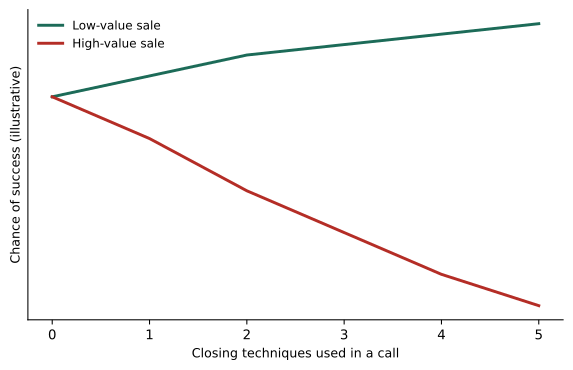
There is surprisingly little rigorous research on closing techniques, given how widely they are taught. The best-known evidence comes from Neil Rackham's work for *SPIN Selling* (1988). Rackham's team observed thousands of sales calls and analysed how sellers' behaviour related to outcomes. They found that in low-value sales, where the customer could decide quickly and the risk of a bad decision was small, using closing techniques was associated with a modest increase in success. In high-value sales, the relationship reversed: the more closing techniques a seller used, the less likely the call was to succeed. Rackham also described a company in which training sellers in closing techniques was followed by a fall in sales of its more expensive products.
Rackham's explanation was that pressure works when the stakes are low and the customer can decide on impulse, but creates resistance when the decision is large, considered and involves other people. Professional buyers in particular recognize techniques and resent them. His research had limits: it relied on observation rather than controlled experiments, it was done in the 1970s and 1980s, and much of it came from a consulting business that sold training. But it has never been convincingly contradicted, and it is consistent with research on persuasion more generally, which finds that people who feel manipulated tend to resist.
Common closing techniques
The table describes the techniques most often taught, how they work and how risky they are. Risk here means the chance of damaging trust, producing a regretted purchase or crossing a legal line.
| Technique | How it works | Example | Risk |
|---|---|---|---|
| Summary close | Summarize what has been agreed and ask | "So that's three devices at 412 a month from January. Shall we go ahead?" | Low |
| Direct question | Simply ask for the order | "Would you like to go ahead?" | Low |
| Alternative choice | Offer a choice between two yes options | "Would delivery on Tuesday or Thursday suit you better?" | Low to medium |
| Assumptive close | Act as though the decision is made | "I'll book the installer for the 14th." | Medium |
| Trial or puppy dog close | Let the customer try the product first | A two-week RoomFlow trial; a 90-night mattress exchange | Low, if the trial is genuine |
| Balance sheet (Ben Franklin) | List the reasons for and against together | Writing pros and cons with the customer | Low to medium |
| Urgency or scarcity close | Stress a deadline or limited supply | "The price goes up on the first." | High, unless strictly true |
| Takeaway close | Suggest the customer may not qualify or the offer may be withdrawn | "I'm not sure this is right for you after all." | High |
| Sharp angle close | Turn a request into a condition | "If I can get it delivered Friday, will you buy today?" | Medium |
| Sympathy or emotional close | Appeal to the seller's needs | "I really need this sale to make my month." | High |
Low-risk techniques
The summary close and the direct question are the techniques lesson 9 recommended. They are transparent: the customer knows exactly what is being asked. They work in both retail and B2B, and they work better when the seller has done good discovery and handled objections, because then the customer is ready.
The alternative choice close can be low-risk when both choices are genuine and the customer has already shown readiness. "Would you like the grey or the navy?" is helpful to a shopper who has been deciding between them. It becomes manipulative when it is used to skip the decision to buy at all, with a customer who has not yet said they want either.
The trial close, in the sense of letting a customer try before committing, is often the most customer-friendly technique of all. Juniper & Pine's 90-night mattress comfort exchange and Ridgeline's two-week RoomFlow trial lower the customer's risk and let the product prove itself. The risk is in the details: a trial that rolls automatically into a paid contract without clear notice can breach consumer law and creates angry customers.
The balance sheet close, often attributed to Benjamin Franklin's description of how he made decisions, can be genuinely useful when the seller helps the customer list real pros and cons honestly. It becomes manipulative when the seller helps with the pros and leaves the customer alone with the cons.
Medium-risk techniques
The assumptive close acts as though the customer has decided. It can feel natural and efficient with a customer who is clearly ready, and many experienced sellers use a gentle version: "Let's get the delivery booked." With a customer who has not decided, it is presumptuous, and professional buyers find it irritating. The test is whether the customer has actually signalled a decision.
The sharp angle close turns a customer's request into a condition: "If I can get it delivered by Friday, will you buy today?" It can be a legitimate if-then trade, as lesson 6 described. It becomes a pressure tactic when the seller already knows the request can be met and is using it to extract a commitment the customer had not intended to make.
High-risk techniques
The urgency or scarcity close relies on a deadline or limited supply. Robert Cialdini's research on influence found that scarcity is a powerful motivator: people value things more when they believe they may lose the chance to have them. That is exactly why false scarcity is so damaging. If the deadline or shortage is real, telling the customer is helpful information: "The promotion ends Sunday" or "We have two left in that colour, and the next shipment is in March." If it is invented, it is a lie, and in many cases an illegal one.
The takeaway close suggests the customer may lose the opportunity, or may not qualify, to provoke them into wanting it more. The sympathy close asks the customer to buy to help the seller. Both are manipulative: they work by triggering emotions unrelated to whether the product suits the customer. Darnell banned both at Ridgeline.
Where pressure becomes illegal
Some high-pressure closing practices are not just unethical but illegal.
In Canada, the Competition Act prohibits false or misleading representations to the public about a product or its price, including false claims about how long a sale price will last or how limited the supply is. Its bait and switch provision makes it reviewable to advertise a product at a bargain price that the seller does not supply in reasonable quantities, having regard to the business and the advertisement. Saskatchewan's Consumer Protection and Business Practices Act lists unfair practices, including misleading representations about price, availability or a consumer's need for a product, and taking advantage of a consumer who cannot reasonably protect their own interests. A consumer harmed by an unfair practice may be able to cancel the contract or claim damages. SLS-150 covers these laws in more detail.
Worked problem
Is this urgency legal?
Juniper & Pine's flyer advertises a dishwasher at 699 dollars, down from 949, "while quantities last". The store has 40 in stock and the promotion runs for two weeks. On the first Saturday, a customer asks for the advertised model. Aiden finds that only 2 remain, because a contractor bought 35. Can Aiden tell the customer the deal is gone and steer him to a more expensive model?
Show solution
- The store did stock a reasonable quantity relative to its usual dishwasher sales, so the advertisement itself was not bait.
- The flyer said "while quantities last", which warned customers that supply was limited.
- Two units remain, so Aiden must offer the advertised model at the advertised price if the customer wants it.
- If the customer wants a different model, Aiden can show alternatives honestly, but must not disparage the advertised model to push the more expensive one.
- If the advertised model sells out, the store's policy is to offer a rain check at the sale price.
Answer: Aiden must offer one of the two remaining units at 699 dollars. He can show other models if the customer is interested, but steering him away from an available advertised item, or criticizing it to sell something pricier, would look like bait and switch. Juniper & Pine's rain-check policy covers the case where the stock runs out.
Manipulation and dark patterns
Many of the pressure techniques used in person have online equivalents, sometimes called dark patterns: countdown timers that reset, "only 2 left" messages that are not true, pre-ticked add-ons and cancellation processes designed to be difficult. The Competition Bureau has taken action against misleading online urgency and drip pricing, and regulators in both countries increasingly treat these practices as deceptive. SLS-254 covers online selling; the principle is the same everywhere. Pressure that depends on the customer not understanding what is happening is manipulation, whatever the channel.
A test for any technique
Darnell and Bev used the same simple test, though they worded it differently. Darnell's version was: "Would the technique still work if the customer knew exactly what you were doing?" A summary close works even if the customer knows it is a summary close, because it simply asks them to decide. A takeaway close stops working the moment the customer recognizes it, because it depends on deception.
Bev's version was: "Would you be happy if your mother were the customer?" A customer who buys under pressure and regrets it returns the product, cancels the order, writes a review and tells their friends. In retail, high-pressure closing increases returns and cancellations. In B2B, it destroys renewals. Either way, the short-term sale costs more than it gains.
Worked problem
What does a pressured sale really earn?
An associate uses urgency tactics and closes 10 more furniture sales a month than a colleague, at an average of 1,150 dollars each with a gross margin of 45 in 100. But 4 of those 10 customers return the furniture within 30 days. Each return costs the store about 180 dollars in pickup, inspection and resale markdown, and the returned items earn nothing. What does the extra closing really earn each month?
Show solution
- Gross profit per kept sale: 1,150 × 0.45 = 517.50 dollars.
- Kept sales: 10 − 4 = 6, earning 6 × 517.50 = 3,105 dollars.
- Cost of returns: 4 × 180 = 720 dollars.
- Net gain: 3,105 − 720 = 2,385 dollars, compared with 10 × 517.50 = 5,175 dollars if none had been returned.
Answer: The 10 extra sales earn about 2,385 dollars, less than half of what they appear to earn, before counting bad reviews and lost referrals. Pressure that leads to returns is expensive.
Common mistakes
MistakeLearning dozens of scripted closing techniques.
InsteadMaster a few transparent ones, such as the summary close and the direct question.
MistakeUsing closing techniques heavily in large, considered sales.
InsteadRemember Rackham's finding that technique-heavy closing reduced success in high-value sales.
MistakeCreating false urgency or scarcity.
InsteadShare deadlines and stock levels only when they are true; invented urgency can be illegal.
MistakeSteering customers away from an advertised item to a pricier one.
InsteadOffer the advertised item honestly; show alternatives only if the customer is interested.
MistakeJudging a technique by short-term closes.
InsteadCount returns, cancellations, complaints and lost renewals as part of its real result.
Summary and key terms
- Many closing techniques are taught, but evidence for them is thin.
- Rackham's research found that closing techniques were associated with slightly more success in low-value sales and less success in high-value sales, where buyers recognize and resist pressure.
- Low-risk techniques include the summary close, the direct question, genuine alternative choices, genuine trials and honest pros-and-cons lists.
- Medium-risk techniques, such as the assumptive and sharp angle closes, depend on whether the customer is truly ready.
- High-risk techniques include false urgency or scarcity, the takeaway and the sympathy close. The Competition Act and Saskatchewan consumer protection law prohibit misleading urgency, bait and switch and other unfair practices, and dark patterns are the online equivalent.
- A useful test: would the technique still work if the customer knew exactly what you were doing? Pressured sales often produce returns and lost renewals that cancel out their gains.
- Closing technique
- A named method for asking for, or prompting, a customer's commitment.
- Summary close
- Summarizing what has been agreed and asking the customer to go ahead.
- Assumptive close
- Acting as though the customer has already decided.
- Scarcity
- The perception that something may soon be unavailable, which increases its perceived value.
- Bait and switch
- Advertising a bargain the seller does not intend to supply, to move customers to something more expensive.
- Dark pattern
- An online design that pushes users into choices they might not otherwise make.
Practice problems
Work each problem on paper first, then reveal the answer to check.
Why did Rackham think closing techniques hurt in large sales?
Show answer
Pressure works on small, quick decisions but creates resistance in large, considered decisions, especially among professional buyers.
A store has two advertised units left. A customer asks for one. What must the associate do?
Show answer
Offer an available advertised unit at the advertised price; alternatives can be shown only if the customer is interested.
State Darnell's test for a closing technique.
Show answer
Would it still work if the customer knew exactly what you were doing?
Lesson quiz · 5 questions
Score 60% or more to complete this lesson.
Create a free account to save your progress, take quizzes and earn a certificate.