
SLS-213 · Lesson 6 of 12 · 18 min
Anchors, ranges and concessions
▶ Video coming soon A video version of this lesson is on the way.
At the third workshop session, Darnell ran an experiment. He split the room into two groups and handed each a short description of a used office copier, identical except for one line. One group's sheet said the seller had first asked for 9,500 dollars; the other said 5,500. He asked everyone to write down what they thought a fair final price would be. The first group's average was just over 7,800 dollars. The second group's was just under 5,900. Same machine, same information, very different answers. "That," Darnell said, "is an anchor."
This lesson covers how first offers shape negotiations, when to make the first offer and when to wait, how to use ranges, and how to plan concessions so that each one moves the deal forward without giving away more than necessary.
Anchoring
Anchoring is the tendency for people's estimates to be pulled toward a number they have seen recently, even when that number is not relevant. Amos Tversky and Daniel Kahneman described it in 1974, in a famous experiment where people's estimates of the share of African countries in the United Nations were influenced by a number produced by spinning a wheel. In negotiation, the most powerful anchor is usually the first offer.
Adam Galinsky and Thomas Mussweiler (2001) studied first offers in a series of negotiation experiments. They found that whichever side made the first offer tended to get a better final outcome, because the first offer anchored the other side's sense of what was reasonable. Earlier, Gregory Northcraft and Margaret Neale (1987) had shown that even experienced real estate agents' valuations of a house were pulled toward the listing price they were given, although the agents believed the listing price had not affected them.
Galinsky and Mussweiler also found a defence. Negotiators who received an aggressive first offer were less anchored by it if they deliberately focused on their own alternatives and the other side's likely walk-away point, rather than on the offer itself. In other words, preparation, from lessons 4 and 5, is the best protection against being anchored.
Should you make the first offer?
The research suggests that making the first offer is usually an advantage, but not always. The key is how much you know.
| Situation | Recommendation | Why |
|---|---|---|
| You know the market and the other side's likely range well | Make the first offer | You can set an anchor that is ambitious but credible |
| You know little about value or the other side's limits | Let the other side go first | You risk anchoring too low (as a seller) and leaving money on the table |
| A published price exists | The price list is already the anchor | Your job is to defend it with value, not to replace it |
| A formal tender | Your bid is your first offer | Price it with the later best and final offer in mind (lesson 7) |
In most selling, the seller does make the first offer, in the form of a quote, a proposal or a price tag. That is an advantage if the price is set thoughtfully: ambitious enough to leave room to move, credible enough that the buyer does not dismiss it. An anchor that is wildly high can backfire, making the buyer feel the seller is not serious or not honest, and ending the conversation before it starts.
Justifying the anchor
An anchor is more effective when it comes with a reason. "Our price is 70,800 dollars a year" invites a counter-offer. "Our price is 70,800 dollars a year; that includes 44 devices, four-hour service response at every school, toner delivery and school-by-school reporting, and it is about 9,000 dollars less than you spend today" anchors the price to value. The second version also gives the buyer something to discuss other than the number.
Ranges
Some negotiators prefer to offer a range rather than a single number. Daniel Ames and Malia Mason (2015) studied range offers in a series of experiments and found that the type of range matters.
| Type of range | Example (target 68,000) | What the research found |
|---|---|---|
| Bolstering range: target at the bottom | "68,000 to 71,000 dollars" | Tended to produce better outcomes than a point offer of 68,000, without seeming aggressive |
| Bracketing range: target in the middle | "66,000 to 70,000 dollars" | Similar to a point offer at the midpoint |
| Backdown range: target at the top | "65,000 to 68,000 dollars" | Tended to produce worse outcomes; the other side heard the low end |
Ames and Mason suggested that a bolstering range works partly because the other side reads it as politely signalling flexibility, and partly because the high end acts as an additional anchor. The practical point for sellers is simple: if you give a range, make sure the bottom of the range is a figure you would be pleased to get. Buyers almost always hear the end of the range that favours them.
Was and now prices in retail
Retailers use anchoring constantly through reference prices: the "was" price beside the "now" price, the manufacturer's suggested price beside the store's price. These anchors are legal only when they are honest. In Canada, the Competition Act's ordinary selling price rules require that a "regular" price used for comparison was either charged for a substantial volume of the product, or offered in good faith for a substantial period, before the sale. The Competition Bureau has brought cases against retailers whose "was" prices were rarely charged. Juniper & Pine's policy is to show a "was" price only if the item was sold at that price for at least the previous 90 days.
Concessions
Once offers are on the table, negotiation proceeds largely through concessions. How concessions are made sends signals, and those signals shape what the other side expects next.
Four principles cover most of what a seller needs to know.
Trade, don't give. Every concession should be linked to something in return. The simplest way is the if-then form: "If you can commit to a five-year term, then I can bring the page price down." A concession given freely teaches the other side that pushing works, and they will push again.
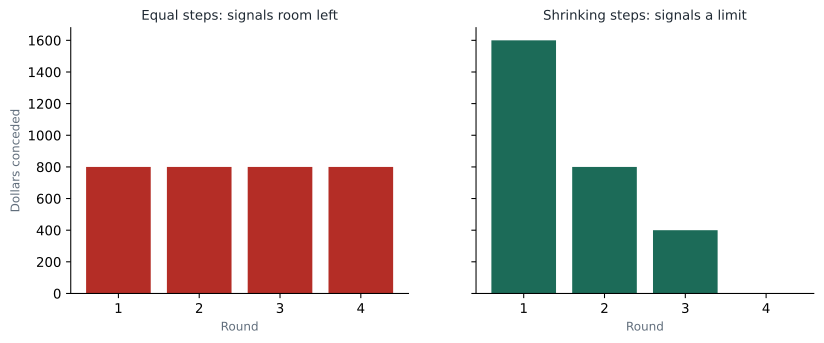
Make concessions smaller as you go. A pattern of decreasing concessions signals that you are approaching your limit. A pattern of equal or increasing concessions signals that there is plenty more room.
Make few concessions. Many small concessions invite many small requests. A few well-planned ones are clearer.
Concede on what is cheap for you and valuable to them first. Lesson 4's planning table lists these. Price is usually the most expensive concession, so it should rarely be the first.
Worked problem
Planning a concession schedule
Ridgeline's Prairie Valley proposal is 70,800 dollars a year and its walk-away is 63,540. Darnell plans up to three price concessions, each smaller than the last, each traded for something: 1,600 dollars a year for a five-year term instead of three; 800 dollars for a single toner ordering process; 400 dollars for signing by December 4. If all three are used, where does the price end up, and how much room is left above the walk-away?
Show solution
- After the first concession: 70,800 − 1,600 = 69,200 dollars.
- After the second: 69,200 − 800 = 68,400 dollars.
- After the third: 68,400 − 400 = 68,000 dollars.
- Total conceded: 1,600 + 800 + 400 = 2,800 dollars, about 4 in 100 of the proposal.
- Room left above the walk-away: 68,000 − 63,540 = 4,460 dollars.
Answer: With all three planned concessions, the price would be 68,000 dollars a year, about 4 in 100 below the proposal, with 4,460 dollars of room still above the walk-away price. Each step is smaller than the last and each is traded for something Ridgeline values.
Reciprocity and its limits
Concessions work partly through reciprocity, the strong social norm that people should return favours. Robert Cialdini's *Influence* (1984) describes many experiments showing how powerful the norm is. A negotiator who makes a concession creates a feeling in the other side that they should concede in return.
Reciprocity can be used manipulatively. A seller who opens with an inflated price, then makes a big show of "giving" a discount, is exploiting reciprocity without giving anything real. Buyers who notice this lose trust quickly. The ethical use of reciprocity is to make genuine trades and to name them: "I've moved on the term; can you move on the toner process?"
The nibble
A nibble is a small extra request made after the main terms are agreed: "Great, and you'll include free delivery, right?" Nibbles work because the other side, relieved to have reached agreement, does not want to reopen it over something small. Buyers use nibbles on sellers constantly, and some sellers use them on buyers.
The defence is to plan for it. Know in advance which small extras you can give, and still trade them: "I can include delivery if we can schedule it for Tuesday, when the truck is already in your area." If a nibble is not something you can give, say so warmly and firmly. Agreeing to every nibble can turn a profitable deal into an unprofitable one, as lesson 8 shows.
Splitting the difference
When two offers are close, someone often suggests splitting the difference. It feels fair, and sometimes it is the quickest way to finish. But it rewards whoever made the more extreme opening offer, and it skips the search for trades that could make both sides better off. A seller who is offered a split should check where the midpoint sits relative to their target and walk-away, and consider proposing a trade instead: "Rather than splitting it, could we keep the price and add the extra training sessions?"
Concessions in retail
Retail associates have fewer concessions available, but the same principles apply. Juniper & Pine's associates can waive haul-away, adjust delivery fees by up to 50 dollars, apply package pricing and price-match within policy. Bev teaches them to treat each of these as a trade. Waiving the haul-away fee might be traded for booking delivery on a quieter weekday. A delivery adjustment might be traded for adding a protection plan. The customer still feels they have gained something, and the store gets something in return.
Carl's advice to Aiden was to avoid the phrase "Let me see what I can do" unless he meant it. "It tells them there's more," Carl said. "If you're going to the manager, say what you're asking for and why. If there's nothing more, tell them kindly that this is the best price, and talk about what they're getting."
Responding to the other side's anchor
Sellers are not always the first to name a number. Procurement teams and experienced shoppers often open with a low figure of their own: "Our budget for this is 50,000," or "I'll give you 1,200 for the sofa." The research on anchoring suggests three responses. First, do not treat the number as the starting point for splitting the difference; if it is far outside the realistic range, say so calmly and explain why, without making a counter-offer that accepts its framing. Second, deliberately bring your own reference points back into the conversation: the price list, the value the customer has agreed, the cost of the problem being solved. Third, think about your own alternatives and the customer's, as Galinsky and Mussweiler recommended, before responding.
Darnell's practical advice was to avoid answering an extreme anchor with a number at all. "If they say 50 and we're at 70, don't say 65. Say: 'That's well below what this kind of service costs anywhere; can we look at what's driving your budget?' Get back to interests, and only talk numbers when the numbers are realistic."
Common mistakes
MistakeMaking an extreme first offer that destroys credibility.
InsteadAnchor ambitiously but credibly, and justify the anchor with value.
MistakeGiving a range whose bottom is your target.
InsteadIf you use a range, make the bottom a figure you would be pleased to get.
MistakeGiving concessions without asking for anything.
InsteadUse if-then: tie every concession to something in return.
MistakeMaking equal or growing concessions.
InsteadMake each concession smaller than the last to signal you are near your limit.
MistakeAgreeing to every nibble after the deal is done.
InsteadPlan which small extras you can give, and trade them too.
Summary and key terms
- Anchoring pulls estimates toward numbers people have recently seen; in negotiation the first offer is the strongest anchor.
- Research by Galinsky and Mussweiler found first movers tend to get better outcomes, and that focusing on your own alternatives and the other side's limits reduces the effect of an aggressive anchor.
- Make the first offer when you know the market well; let the other side go first when you do not.
- Justify anchors with value.
- Bolstering ranges, with the target at the bottom, tended to outperform point offers in Ames and Mason's experiments; backdown ranges tended to do worse.
- Reference prices in retail must be honest under Canadian ordinary selling price rules.
- Trade concessions with if-then offers, make them smaller and fewer, and concede first on what is cheap for you and valuable to them.
- Use reciprocity honestly, plan for nibbles, and look for trades before splitting the difference.
- Anchoring
- The tendency for estimates to be pulled toward a recently seen number.
- First offer
- The opening proposal in a negotiation, which often acts as an anchor.
- Bolstering range
- A range offer with the negotiator's target at the less favourable end for the other side.
- If-then offer
- A concession explicitly linked to something in return.
- Reciprocity
- The social norm that people should return favours and concessions.
- Nibble
- A small extra request made after the main terms are agreed.
Practice problems
Work each problem on paper first, then reveal the answer to check.
A seller plans concessions of 1,000, 600 and 300 dollars from a 25,000-dollar offer. Where does the price end?
Show answer
25,000 − 1,900 = 23,100 dollars.
Your target is 8,000 dollars. Write a bolstering range.
Show answer
For example, "8,000 to 8,600 dollars", with the target at the bottom.
A buyer asks for free delivery after agreeing the price. What is this called, and how might you respond?
Show answer
A nibble; offer delivery as a trade, such as on a day the truck is already nearby, or decline warmly.
Lesson quiz · 5 questions
Score 60% or more to complete this lesson.
Create a free account to save your progress, take quizzes and earn a certificate.