
SLS-213 · Lesson 5 of 12 · 20 min
Interests, positions and BATNA
▶ Video coming soon A video version of this lesson is on the way.
In the second week of October 2026, Dale Petrie, Keystone Grain Equipment's operations director, told Maya that he would sign the meeting-room technology deal only if Ridgeline took 15 in 100 off the equipment price. He said it firmly, and he said it twice. Maya's first thought was that 15 in 100 was well beyond her authority and probably beyond Darnell's. Her second thought, after the workshop on interests, was to ask why.
"Fifteen is a big number," she said. "Help me understand where it comes from." Dale paused. Then he explained that any capital purchase over 20,000 dollars at Keystone needed approval from the owners' board, which met only quarterly, and the next meeting was not until January. Ridgeline's equipment and installation quote was 21,900 dollars. Fifteen in 100 off would bring it under the limit. He did not actually need the discount. He needed the purchase under 20,000 dollars, so he could approve it himself and have the rooms working before the dealer meetings in January.
That conversation is the subject of this lesson: the difference between what people say they want and why they want it, and the alternatives that give each side its real negotiating power.
Positions and interests
A position is what a negotiator says they want: "15 in 100 off", "a three-year contract, not five", "delivery on Friday". An interest is the reason behind the position: a need, worry, goal or constraint. Fisher, Ury and Patton's *Getting to Yes* made this distinction central, using the story of two people arguing over a single orange. Each insisted on having it; they eventually split it in half. Only afterward did they discover that one wanted the juice and the other wanted the peel for baking. Had they talked about interests, each could have had all of what they needed.
Positions usually conflict, because each side states the outcome that suits it. Interests often do not, because there may be several ways to satisfy them. Dale's position, 15 in 100 off, conflicted directly with Ridgeline's. His interest, approving the purchase himself before January, could be met in other ways.
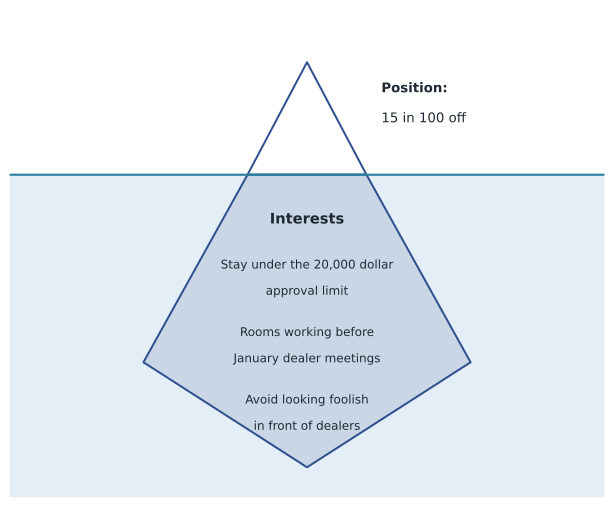
Finding interests
Interests are found mainly by asking and listening, using the skills from SLS-120 and SLS-211. Useful questions include:
- "Help me understand why that matters."
- "What would that allow you to do?"
- "What happens if you don't get that?"
- "If we could solve that a different way, would that work for you?"
It also helps to think about the different kinds of interest a person might have. Some are substantive: money, time, quality, risk. Some are procedural: how the decision is made, who approves it, how fair the process feels. Some are relational: trust, reputation, the relationship with the seller or with colleagues. And some are personal: looking competent to the boss, avoiding blame if the project goes wrong, being able to leave on time on Friday. A buyer's personal and procedural interests are often stronger than their substantive ones, and much less likely to be stated.
| Kind of interest | Dale Petrie at Keystone | Elaine and Victor Morales |
|---|---|---|
| Substantive | Working video rooms before January; reasonable cost | Matching appliances; a total near 6,000 dollars |
| Procedural | Approving within his own 20,000-dollar limit | Deciding together; not being rushed |
| Relational | A supplier who will support the rooms | Trusting the store after a bad experience elsewhere |
| Personal | Not being embarrassed in front of dealers again | A kitchen finished before family visits in late November |
Using interests to create options
Once the interests are clear, the negotiation becomes a problem to solve together. Maya went back to the Keystone quote with Darnell and looked at how the 21,900 dollars was made up. It contained 17,600 dollars of hardware, 3,100 dollars of installation and 1,200 dollars of on-site training. The training was a service, not a capital item, and Ridgeline could deliver it as part of a RoomFlow subscription instead.
Worked problem
Meeting the interest without the full discount
Keystone's quote is 21,900 dollars: hardware 17,600, installation 3,100 and training 1,200. Dale can approve capital purchases under 20,000 dollars. Maya proposes moving the training into a three-year RoomFlow subscription (spread over the term) and giving 4 in 100 off the hardware in exchange for the three-year term instead of an annual one. What is the new capital amount, and how much has Ridgeline given up compared with a 15 in 100 equipment discount?
Show solution
- Hardware discount: 17,600 × 0.04 = 704 dollars.
- New capital amount: (17,600 − 704) + 3,100 = 16,896 + 3,100 = 19,996 dollars.
- The training (1,200 dollars) is still paid, as part of the subscription over three years.
- A 15 in 100 discount on the full 21,900 would have been 21,900 × 0.15 = 3,285 dollars.
- Ridgeline's real concession is the 704-dollar hardware discount, and it gains a three-year subscription.
Answer: The capital amount becomes 19,996 dollars, under Dale's limit. Ridgeline gives up 704 dollars instead of 3,285, and wins a three-year RoomFlow term. Dale gets what he actually needed: approval in his own hands and rooms working by January.
This is integrative negotiation in practice. Neither side split the difference. They looked behind the position, found the real constraint, and redesigned the deal so that both sides were better off than a compromise would have left them.
BATNA: the best alternative
The second big idea in this lesson is the BATNA, the *best alternative to a negotiated agreement*, a term coined by Fisher and Ury. Your BATNA is what you will do if this negotiation fails. It is not your walk-away point, though the two are related: your walk-away point should be set by how good your BATNA is.
A strong BATNA is the main source of negotiating power. A buyer who has another acceptable supplier ready to sign can walk away from a bad offer; a buyer who has no alternative cannot. The same is true of sellers. A seller with a full pipeline can hold firm on price; a seller who must close this deal to meet quota is likely to concede.
| Party | BATNA in the Prairie Valley bid | How strong? |
|---|---|---|
| Ridgeline | Lose the contract; keep selling RoomFlow to the division and bid again in five years | Moderate: the revenue matters, but the account is not essential to this year's plan |
| Prairie Valley | Award the contract to the next-best bidder, or extend the current supplier for a year | Fairly strong: two other compliant bids were received |
BATNAs can be improved. A seller improves theirs by building a pipeline so that no single deal is desperate. A buyer improves theirs by getting competitive quotes. Both sides can also weaken the other's BATNA, for example a seller by showing why the competitor's offer is weaker than it looks, but this must be done honestly.
Estimating the other side's BATNA
You rarely know the other side's BATNA exactly, but you can estimate it. In a public tender, the alternatives are the other bids, and some information about them may be known: Ridgeline knew that the incumbent supplier had bid, because its sales rep had mentioned it at a conference, and Maya had a fair idea of its pricing from schools that had shared their invoices. In retail, a customer's BATNA is usually another store's offer, and customers often show it, as the Moraleses did with their competitor's quote.
It is equally important not to overestimate the other side's BATNA. Many sellers assume the customer can easily go elsewhere when switching would in fact cost the customer time, risk and disruption. Those switching costs are part of the BATNA, and they often favour the current supplier or the seller who has already done the discovery.
The zone of possible agreement
When you combine each side's walk-away point, you get the zone of possible agreement, or ZOPA: the range of outcomes both sides would prefer to no deal. If the buyer's highest acceptable price is above the seller's lowest acceptable price, a ZOPA exists and a deal is possible. If not, no deal can be reached on price alone, though adding other issues may create one.
Worked problem
Finding the ZOPA in the Prairie Valley bid
The division currently spends about 78,000 dollars a year on printing and has told suppliers it expects savings of at least 10 in 100. Ridgeline's walk-away price is 63,540 dollars a year (lesson 4). Its proposal is 70,800 dollars. Assuming the division's ceiling is set by its savings goal, what is the ZOPA, and where does Ridgeline's proposal sit?
Show solution
- Division's ceiling: 78,000 × (1 − 0.10) = 70,200 dollars a year.
- Ridgeline's floor: 63,540 dollars a year.
- ZOPA: from 63,540 to 70,200 dollars a year, a width of 70,200 − 63,540 = 6,660 dollars.
- Ridgeline's proposal of 70,800 is 70,800 − 70,200 = 600 dollars above the division's likely ceiling.
Answer: The ZOPA runs from about 63,540 to 70,200 dollars a year. Ridgeline's proposal sits just above it, so some movement will be needed, but a deal is clearly possible.
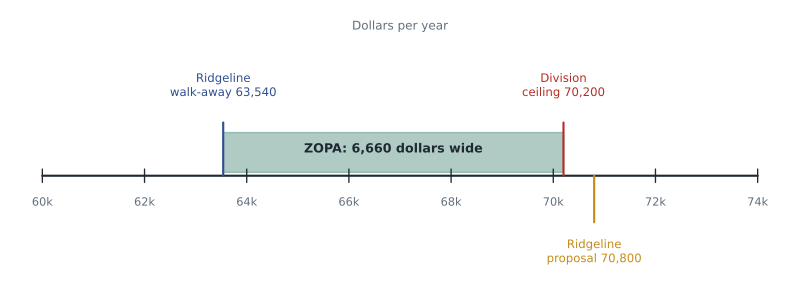
A ZOPA calculation is only as good as its estimates, and in real negotiations both sides keep their walk-away points private. The value of the exercise is in thinking clearly about where a deal could land and how much room exists, not in pretending to know the other side's numbers.
Interests and BATNA in retail
In retail, the same ideas apply on a smaller scale. When the Moraleses returned on October 17, their BATNA was the competitor's package, which lesson 2 showed was 52 dollars more expensive once services were added, and which also had a six-week delivery wait. Their position was "Can you beat their price?" Their interests, which Carl had learned on the first visit, were staged delivery around the countertop installation on November 6, confidence after a bad experience, and finishing before family visited at the end of November.
Carl did not cut the price. He showed the like-for-like comparison, offered staged delivery at no extra charge (fridge the following week, range and dishwasher on November 9), confirmed the delivery dates in writing, and pointed out the store's price adjustment policy if the price dropped within 14 days. The Moraleses signed that afternoon, and also bought protection plans on the refrigerator and range.
When there is no ZOPA
Sometimes the walk-away points do not overlap. A customer's budget is 3,000 dollars and the cheapest suitable product costs 3,800. A procurement department will not pay more than the incumbent and the seller cannot go that low. In those cases a good negotiator does not keep conceding past the walk-away point. Instead, they look for ways to change the deal: a smaller scope, a phased purchase, different payment terms, a refurbished product, or a different product altogether. If none works, they walk away politely and leave the door open. A deal below the walk-away point is worse than no deal, by definition.
Interests inside the seller's own company
Interests are not only on the customer's side. A seller negotiating a large deal is often also negotiating inside their own company: with a manager who must approve a discount, a service team that must deliver a faster response time, or a finance team that wants different payment terms. Each of those people has interests too. The service manager at Ridgeline cared less about price than about whether a four-hour response time at 14 schools could be staffed without overtime. Maya found that when she brought him into the planning early and asked what he would need, he proposed a schedule that made the faster response possible. Sellers who treat internal colleagues as obstacles get slower approvals; sellers who understand their interests get creative help.
Internal negotiation follows the same principles as external negotiation. Ask why before arguing, look for options that meet several interests at once, and agree on objective criteria, such as margin rules or service capacity, rather than relying on who pushes hardest.
Common mistakes
MistakeArguing about positions.
InsteadAsk why the other side wants what they ask for, and look for ways to meet that interest.
MistakeSplitting the difference by reflex.
InsteadLook for options that meet both sides' interests better than a compromise would.
MistakeConfusing your BATNA with your walk-away point.
InsteadYour BATNA is what you will do without a deal; let it set your walk-away point.
MistakeOverestimating the other side's alternatives.
InsteadCount their switching costs, delays and risks as part of their BATNA.
MistakeConceding below your walk-away point when there is no ZOPA.
InsteadChange the shape of the deal or walk away politely.
Summary and key terms
- A position is what a negotiator says they want; an interest is why.
- Positions often conflict where interests do not, so finding interests opens up new options.
- Interests can be substantive, procedural, relational or personal, and the last three are often unstated.
- Interest-based negotiation redesigns the deal to meet both sides' needs, as when Keystone's quote was restructured to fall under a 20,000-dollar approval limit.
- The BATNA, the best alternative to a negotiated agreement, is the main source of negotiating power and should set the walk-away point.
- BATNAs can be improved and should be estimated for both sides, including switching costs.
- The ZOPA is the range between the two sides' walk-away points; if there is none, change the deal or walk away.
- Position
- What a negotiator says they want.
- Interest
- The need, worry, goal or constraint behind a position.
- BATNA
- The best alternative to a negotiated agreement: what a party will do if this negotiation fails.
- ZOPA
- The zone of possible agreement: the range of outcomes both sides prefer to no deal.
- Switching costs
- The time, money, risk and disruption a buyer faces in changing suppliers.
Practice problems
Work each problem on paper first, then reveal the answer to check.
A buyer's ceiling is 48,000 dollars and the seller's floor is 44,500. What is the width of the ZOPA?
Show answer
48,000 − 44,500 = 3,500 dollars.
Give one question that helps uncover an interest behind a position.
Show answer
For example: "Help me understand why that matters," or "What would that allow you to do?"
Why might a customer's BATNA be weaker than it first appears?
Show answer
Because switching costs such as time, risk, delays and disruption are part of it.
Lesson quiz · 5 questions
Score 60% or more to complete this lesson.
Create a free account to save your progress, take quizzes and earn a certificate.