
SLS-213 · Lesson 7 of 12 · 20 min
Negotiating with procurement
▶ Video coming soon A video version of this lesson is on the way.
On Wednesday, October 21, 2026, Prairie Valley's procurement officer, Colleen Sawatzky, emailed the three suppliers on the shortlist. Ridgeline was one of them; the incumbent supplier and a national office-products company were the others. Each was invited to a 45-minute clarification meeting the following week and asked to submit a best and final offer, or BAFO, by noon on Friday, October 30. Colleen's email was polite, precise and unmistakably firm: the BAFO would be evaluated using the same scoring weights published in the original request, price would count for 40 points out of 100, and there would be no further rounds.
Many salespeople dread procurement. They see procurement officers as gatekeepers whose only job is to drive prices down and who stand between the seller and the people who actually value the solution. That view is understandable, and partly true. But it is incomplete, and sellers who hold it tend to negotiate badly with procurement. This lesson explains what procurement does, the tactics procurement teams commonly use, and how to negotiate with them effectively and respectfully.
What procurement does
Procurement (also called purchasing or sourcing) is the function in an organization responsible for buying goods and services. Its job is broader than getting the lowest price. A procurement team is usually responsible for value for money over the life of a contract, fair and transparent treatment of suppliers, managing risk, making sure contracts protect the organization, and following the organization's purchasing rules and the law.
In public bodies such as school divisions, municipalities and health authorities, those rules are strict. Saskatchewan school divisions follow their own purchasing policies and are covered by trade agreements, including the New West Partnership Trade Agreement and the Canadian Free Trade Agreement, which require open competition above set dollar thresholds and fair, consistent evaluation of bids. The details vary by organization and change over time, so sellers should always read the actual rules in each request for proposals. The practical effect is that public procurement officers often cannot negotiate the way a private buyer can. They may not be allowed to discuss one supplier's price with another, to change the evaluation criteria after bids close, or to award to a bidder who did not follow the process.
Private companies have procurement rules too, though usually more flexible ones. Keystone Grain Equipment, a family-owned manufacturer, has no procurement department at all; Dale Petrie makes buying decisions within his approval limit, as lesson 5 showed. A large national retailer or bank may have a procurement team of dozens of people, with category managers who specialize in particular kinds of purchase.
How procurement fits into the buying decision
Procurement rarely decides alone. In most organizations, users and managers define what is needed, finance sets budgets, legal reviews contracts, and procurement runs the process and negotiates terms. SLS-110 called this group the buying centre. A seller who has built relationships with users and managers, but ignored procurement, can be surprised late in the sale when procurement imposes requirements the users never mentioned.
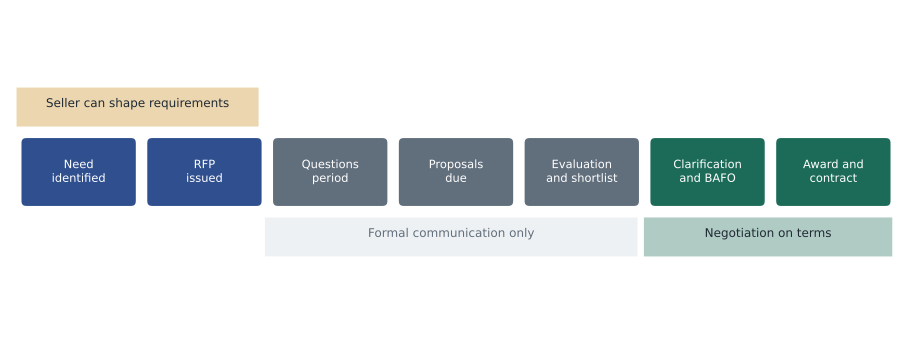
The figure shows an important pattern. In formal procurement, a seller has the most influence over what is required before the request for proposals is written, through conversations with users about their needs. Once the request is issued, the requirements are fixed and communication is usually restricted to formal questions. Negotiation on terms happens near the end, if at all. Maya's early meetings with Prairie Valley's facilities manager in August, before the request existed, were therefore some of the most valuable time she spent on the deal, because they helped the division understand that fleet consolidation mattered as much as page price.
Common procurement tactics
Procurement professionals are trained negotiators, and they use well-known tactics. Recognizing them helps a seller respond calmly rather than react.
| Tactic | What it looks like | A good response |
|---|---|---|
| Competitive pressure | "Your price is 12 in 100 higher than another bidder's." | Ask what is being compared; restate total value; do not cut price on an unverified claim |
| The flinch | A visible reaction of shock at your price | Stay calm and silent for a moment; restate what the price includes |
| Limited authority | "I can't go back to the committee with that number." | Ask what the committee needs to see; offer to help build the case |
| Deadline pressure | "We need your final answer by tomorrow at noon." | Respect genuine deadlines; do not concede more because of time |
| Salami slicing | A series of small requests, each reasonable on its own | Ask for the full list of requests before responding to any |
| Good cop, bad cop | One buyer is friendly, another is harsh | Treat them as one team; respond to the substance, not the mood |
| Silence | Long pauses after your offer | Let the silence sit; do not fill it with a concession |
None of these tactics is unethical in itself, and sellers use most of them too. What matters is not to be moved by them. A seller who drops the price because a procurement officer flinched has rewarded the flinch, and will see it again.
Some claims deserve particular care. Competitive pressure is the most common: "the other bidder is cheaper". In private negotiations this may or may not be true. In a public tender, a procurement officer usually cannot reveal another bidder's price, so a vague comparison is more likely to be a prompt than a fact. Either way, the right response is to ask what is being compared and to explain the value of your offer, not to cut your price blindly.
Total cost of ownership
The most effective argument with procurement is usually total cost of ownership (TCO): the full cost of a purchase over its life, including the purchase price, running costs, support, training, downtime and disposal. Procurement teams increasingly evaluate bids on TCO rather than price alone, and many public requests for proposals ask for it. SLS-222 covers TCO in depth.
Worked problem
Comparing bids on total cost
Prairie Valley's current supplier bid a lower page price than Ridgeline but kept a larger fleet. Over five years, its bid is 62,900 dollars a year in charges plus an estimated 4,800 dollars a year in staff time for next-day service (versus Ridgeline's four-hour service). Ridgeline's best and final offer is 66,000 dollars a year with an estimated 1,200 dollars a year in staff time. Which is cheaper over five years on this basis?
Show solution
- Incumbent annual total: 62,900 + 4,800 = 67,700 dollars.
- Ridgeline annual total: 66,000 + 1,200 = 67,200 dollars.
- Five-year totals: 67,700 × 5 = 338,500 dollars and 67,200 × 5 = 336,000 dollars.
- Difference: 338,500 − 336,000 = 2,500 dollars over five years in Ridgeline's favour.
Answer: On total cost, Ridgeline's offer is about 2,500 dollars cheaper over five years, even though its charges are 3,100 dollars a year higher. The difference depends on the staff-time estimate, which is why Maya documented how she calculated it.
TCO arguments must be credible. Procurement officers see many inflated savings claims, and a TCO calculation built on unrealistic assumptions damages trust. Maya's staff-time estimate came from the division's own service logs, which the facilities manager had shared during discovery, and her proposal showed the calculation openly.
The clarification meeting
Ridgeline's clarification meeting took place on Tuesday, October 27. Colleen Sawatzky was joined by the facilities manager and the division's business manager. The questions were specific: how Ridgeline would handle the transition from the old fleet without disrupting classes, what happened if a device failed during exams, whether page prices could change during the term, and whether Ridgeline could match a lower page price that another bidder had offered.
Darnell answered the last question, as planned in lesson 4. He did not ask what the other price was, because he knew Colleen could not say. He explained Ridgeline's pricing, pointed to the fleet reduction and service levels, and said Ridgeline would review its page price for the BAFO in light of the volume and term the division could commit to. That was an if-then signal, not a promise.
Building the best and final offer
A BAFO is exactly what it sounds like: the seller's last chance to improve its bid. In a formal process, there may be no further negotiation after it. That changes the strategy. Lesson 6's planned concession schedule assumed several rounds of give and take. A single BAFO calls for deciding in advance how much of the planned room to use, and packaging it clearly.
Worked problem
Ridgeline's BAFO
Ridgeline's original proposal was 70,800 dollars a year and its walk-away 63,540. After the clarification meeting, the team believed price would decide the contract between Ridgeline and the incumbent. They decided to use most of the planned concessions and one more, traded for a five-year term with two optional one-year extensions and a single toner-ordering process: page and device charges reduced to 66,000 dollars a year, plus school-by-school reporting and two training sessions per school each year. What margin does 66,000 dollars give, and how far is it above the walk-away?
Show solution
- Delivery cost (lesson 4): 49,560 dollars a year, plus about 2,100 dollars for the training sessions = 51,660 dollars.
- Gross profit: 66,000 − 51,660 = 14,340 dollars.
- Margin: 14,340 ÷ 66,000 = about 0.217, or about 22 in 100.
- Without the training cost, the margin would be (66,000 − 49,560) ÷ 66,000 = about 0.249.
- Distance above the 63,540 walk-away: 66,000 − 63,540 = 2,460 dollars.
Answer: At 66,000 dollars a year the margin is about 22 in 100 once training is counted, right at Rob Kowalski's minimum. Darnell took the offer to Rob, who approved it because of the five-year term and the reference value for neighbouring divisions. The team noted that the training sessions had pushed the true margin lower than the price alone suggested.
Ridgeline submitted its BAFO on Thursday, October 29, a day early. On Tuesday, November 10, Colleen emailed to say that Ridgeline had been selected, subject to the board's approval and a signed contract. Lesson 11 follows what happened next.
Respecting the process
Sellers sometimes try to go around procurement by appealing directly to users or senior managers once a formal process has started. In public procurement this is often prohibited: most requests for proposals name a single point of contact and say that contacting anyone else about the bid may disqualify the supplier. Even in private companies, going around procurement usually damages the relationship. Maya stopped all contact with the facilities manager about the bid on September 14, the day the request was issued, and kept her communications to Colleen in writing.
Respecting the process also means honesty in bids. A bid that promises service levels a company cannot meet, or that hides charges in fine print, may win the contract and then fail, and public bodies keep records of supplier performance. Procurement officers in neighbouring divisions talk to each other.
Procurement in retail
Retail associates rarely deal with procurement departments, but they do meet buyers who negotiate like procurement officers: the customer furnishing a rental property who wants a volume discount, the small business owner buying appliances for staff rooms, the contractor buying for a renovation client. Juniper & Pine handles these through a trade and business account program, with set discounts by volume, so that associates do not have to improvise. When a customer asks for business pricing, Aiden's job is to refer them to the program rather than negotiate a one-off deal.
Common mistakes
MistakeSeeing procurement only as an obstacle.
InsteadUnderstand that procurement is responsible for value, fairness, risk and compliance, and work with that.
MistakeCutting price because a procurement officer flinched or mentioned a cheaper bid.
InsteadAsk what is being compared and restate total value; do not reward tactics.
MistakeInfluencing requirements only after the request is issued.
InsteadDo your discovery and education early, before formal requirements are written.
MistakeGoing around procurement once a formal process has started.
InsteadFollow the process and communicate only through the named contact.
MistakeMaking inflated total cost claims.
InsteadBuild TCO calculations from the customer's own data and show your working.
Summary and key terms
- Procurement is responsible for value for money, fair treatment of suppliers, risk and compliance, not just low prices.
- Public bodies follow strict rules, including trade agreements and purchasing policies, that limit how they can negotiate.
- In formal processes, sellers influence requirements before a request is issued and negotiate terms near the end.
- Common procurement tactics include competitive pressure, the flinch, limited authority, deadlines, salami slicing, good cop bad cop and silence; respond to the substance, not the tactic.
- Total cost of ownership is the most effective argument, if built honestly from the customer's data.
- A best and final offer is a single last chance, so decide in advance how much room to use.
- Respect the process, especially single points of contact, and never overpromise in a bid.
- Procurement
- The function responsible for buying goods and services, including value, fairness, risk and compliance.
- Request for proposals (RFP)
- A formal document inviting suppliers to propose how they would meet a stated need.
- Best and final offer (BAFO)
- A shortlisted supplier's final improved bid, usually with no further negotiation.
- Total cost of ownership (TCO)
- The full cost of a purchase over its life, including running, support and disposal costs.
- Salami slicing
- A tactic of making a series of small requests, each reasonable on its own.
- Single point of contact
- The one person in a formal procurement through whom all supplier communication must go.
Practice problems
Work each problem on paper first, then reveal the answer to check.
Bid A is 40,000 dollars a year with 3,000 a year of staff time. Bid B is 41,500 with 1,000 of staff time. Which is cheaper over four years?
Show answer
A: 43,000 × 4 = 172,000; B: 42,500 × 4 = 170,000. Bid B is 2,000 dollars cheaper.
A procurement officer says, "Another bidder is 10 in 100 cheaper." What should you do first?
Show answer
Ask what is being compared, then restate the value of your offer, rather than cutting your price on an unverified claim.
Why might contacting users after an RFP is issued be risky?
Show answer
Many RFPs prohibit contact outside the named point of contact and may disqualify a supplier who breaks the rule.
Lesson quiz · 5 questions
Score 60% or more to complete this lesson.
Create a free account to save your progress, take quizzes and earn a certificate.