
SLS-214 · Lesson 6 of 12 · 23 min
Quotas and attainment
▶ Video coming soon A video version of this lesson is on the way.
On October 23, Darnell joined the Friday session to talk about the number every seller watches most closely: quota. Maya had a ramp quota of 75,000 dollars for her first quarter, which ended on November 30, and a full quota of 150,000 dollars a quarter after that. "Most new reps think quota is a number someone made up," Darnell said. "Sometimes it is. A good quota comes from the territory, the plan and the history, and you should know how yours was set."
A quota is the sales target assigned to a seller or team for a period. Quota attainment is the share of the quota achieved. This lesson explains how quotas are set, how they are split across quarters, how attainment is measured and read, and how quotas connect to pay.
What a quota is for
Quotas do several jobs at once. They turn the company's revenue plan into individual targets, so that if everyone reaches quota, the company reaches its plan. They tell sellers what is expected. They provide the basis for commission and bonus plans. And they give managers a common yardstick for comparing sellers in different territories. A quota that does one of these jobs badly, for example by being impossible to reach, undermines the others.
At Ridgeline, field account executives carry a quota of 600,000 dollars of new first-year revenue a year. SLS-101 described Maya's pay plan: a base salary of 52,000 dollars, commission of 5 in 100 on first-year revenue up to quota and 8 in 100 above it, and a quarterly RoomFlow bonus. The quota is measured on first-year revenue, as lesson 2 explained, so a five-year agreement counts only its first twelve months.
How quotas are set
There are two broad approaches, and most companies combine them.
| Approach | How it works | Strength | Weakness |
|---|---|---|---|
| Top-down | Start from the company revenue plan and divide it among sellers | Ties quotas to what the business needs | Can ignore what territories can actually produce |
| Bottom-up | Estimate what each territory can produce from its accounts, history and pipeline | Grounded in reality and seen as fair | Totals may fall short of the plan |
| Blended | Set a top-down total, then distribute it using bottom-up estimates of potential | Balances need and fairness | More work and judgment |
Ridgeline used a blended method. Rob and the leadership team set the total from the revenue plan. Grace then estimated each territory's potential from the number and size of accounts, current customers and their renewal dates, and past results, which lesson 9 covers. Territories with more potential got larger quotas, within a band, so that a seller in a rich territory was not paid generously for little effort and a seller in a thin one was not set up to fail.
Ramping new sellers
A new seller cannot produce a full quota immediately, because deals take time to develop. Most companies use a ramp quota: a reduced target for the first one to three quarters. Maya's first quarter, September to November, carried 50 in 100 of a full quarter, which is 75,000 dollars. From December she carried the full 150,000 dollars a quarter.
Ramps matter for fairness and for planning. Without a ramp, a new seller misses quota in every early quarter and may leave before the deals she started have closed. Without accounting for ramps, a company's plan assumes revenue from new sellers that will not arrive for months. Grace's capacity model counted a new seller as half a seller in the first quarter, which is how the team's numbers in lesson 1 treated Maya.
Splitting quotas by season
An annual quota can be split evenly across quarters, but most businesses are seasonal. Ridgeline's history showed that schools buy in the fall, clinics and offices are slower in summer, and the end of the fiscal year in November brings a rush of decisions.
Worked problem
Seasonal quarterly quotas
Ridgeline's team booked 701,000, 744,000, 591,000 and 772,000 dollars in its last four quarters (the first, second and third quarters of fiscal 2026 and the fourth quarter of fiscal 2025). Use these to split a 600,000-dollar annual quota across the four quarters, rounding to the nearest hundred dollars.
Show solution
- Add the four quarters.
- \[701{,}000 + 744{,}000 + 591{,}000 + 772{,}000 = 2{,}808{,}000\]
- Find each quarter's share: 701 ÷ 2,808 ≈ 0.250; 744 ÷ 2,808 ≈ 0.265; 591 ÷ 2,808 ≈ 0.210; 772 ÷ 2,808 ≈ 0.275.
- Multiply 600,000 by each share and round.
- \[600{,}000 \times \frac{701}{2{,}808} \approx 149{,}800\]
- \[600{,}000 \times \frac{744}{2{,}808} \approx 159{,}000\]
- \[600{,}000 \times \frac{591}{2{,}808} \approx 126{,}300\]
- \[600{,}000 \times \frac{772}{2{,}808} \approx 164{,}900\]
- Check that the four add up to 600,000.
Answer: About 149,800 dollars in the first quarter, 159,000 in the second, 126,300 in the third and 164,900 in the fourth. The four add to 600,000 dollars.
Grace recommended this seasonal split for fiscal 2027, with one caution. One year of history is a thin basis, and the third quarter of 2026 was weaker than usual for reasons lesson 12 examines. She suggested averaging two or three years once Ridgeline had them, so that one bad quarter did not set next year's pattern.
Measuring attainment
Attainment is the simplest calculation in this course, but it is the one sellers care about most.
Worked problem
Third-quarter attainment
In the third quarter each of Ridgeline's five established account executives had a quota of 150,000 dollars. Their bookings were: Kevin Moreau 171,000, Lisa Tran 138,000, Nadia Petrov 120,000, Andrew Ferguson 96,000 and Sam Whitehorse 66,000 dollars. Calculate each attainment and the team's.
Show solution
- Kevin: 171,000 ÷ 150,000 = 1.14, or 114 in 100.
- Lisa: 138,000 ÷ 150,000 = 0.92, or 92 in 100.
- Nadia: 120,000 ÷ 150,000 = 0.80, or 80 in 100.
- Andrew: 96,000 ÷ 150,000 = 0.64, or 64 in 100.
- Sam: 66,000 ÷ 150,000 = 0.44, or 44 in 100.
- Team bookings and quota.
- \[\frac{171{,}000 + 138{,}000 + 120{,}000 + 96{,}000 + 66{,}000}{5 \times 150{,}000} = \frac{591{,}000}{750{,}000} = 0.788\]
Answer: Attainments were 114, 92, 80, 64 and 44 in 100. Only Kevin reached quota, and the team reached about 78.8 in 100.
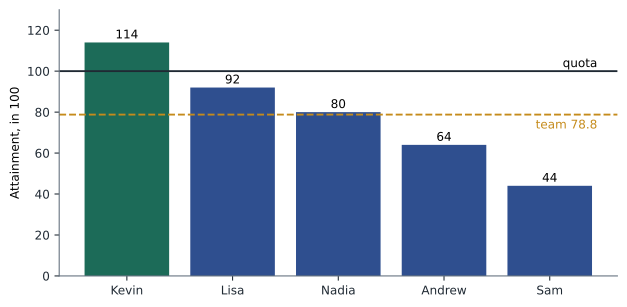
The distribution is as important as the total. A team at 78.8 in 100 with everyone between 70 and 90 has a different problem from a team with the same total made up of one star and several sellers far behind. Ridgeline was closer to the second picture. Andrew's late-stage losses (lesson 3) and Sam's long medical leave in July explained much of the spread. Sam's quota had not been reduced for his leave, which Grace pointed out was a fairness problem the next plan should fix.
Reading attainment fairly
Attainment compares results with a target, so it is only as fair as the target. Darnell gave Maya four questions to ask before judging any attainment figure.
| Question | Why it matters |
|---|---|
| Was the quota set on the territory's real potential? | A seller in a thin territory can work hard and still miss |
| Was the seller ramping, on leave or covering another territory? | Capacity changes should change quota |
| Are bookings credited consistently? | Splits, house accounts and renewals can be credited differently |
| Is one large deal driving the result? | A single contract can swing attainment by tens of points |
Credit rules deserve a word. When two people work on the same deal, as Darnell and Maya did on Prairie Valley's school division contract, the company must decide who gets credit. Ridgeline's rule gave the account owner full credit and a supporting seller 20 in 100 as an assist, counted toward the supporting seller's attainment but not double-counted in the team total. Maya would therefore be credited with 20 in 100 of Prairie Valley's first-year value of 66,000 dollars, or 13,200 dollars, if the contract was signed before November 30.
Attainment and pay
Commission plans usually pay a lower rate up to quota and a higher rate above it, which rewards sellers for exceeding target. Some plans also have accelerators at higher levels, or decelerators that reduce the rate after an extreme result.
Worked problem
Commission at two attainment levels
Using Maya's commission rates of 5 in 100 up to quota and 8 in 100 above, calculate the commission for a quarter in which a seller with a 150,000-dollar quota books 171,000 dollars, as Kevin did, and for one in which she books 138,000 dollars, as Lisa did. Treat the quarter on its own for this illustration.
Show solution
- Kevin: commission on the first 150,000 at 5 in 100.
- \[150{,}000 \times 0.05 = 7{,}500\]
- Commission on the 21,000 above quota at 8 in 100.
- \[21{,}000 \times 0.08 = 1{,}680\]
- \[7{,}500 + 1{,}680 = 9{,}180 \text{ dollars}\]
- Lisa: all bookings are below quota.
- \[138{,}000 \times 0.05 = 6{,}900 \text{ dollars}\]
Answer: Kevin would earn 9,180 dollars and Lisa 6,900 dollars. Kevin booked about 24 in 100 more than Lisa but earned about 33 in 100 more commission, because of the higher rate above quota.
Pay plans change behaviour, as Goodhart's law in lesson 1 predicts. A seller just short of quota at the end of a period has a strong reason to pull deals forward, sometimes with discounts. A seller well above quota may hold deals back to start the next period strongly. Grace tracked bookings by week within each quarter so that unusual spikes at quarter end were visible, and Ridgeline's 2027 plan, described in SLS-213, tied larger discounts to a recorded trade so that discounting to hit quota showed up in the data.
Maya's quarter so far
Darnell ended the session by calculating where Maya stood with five weeks to go.
Worked problem
Maya's attainment with five weeks left
Maya's ramp quota for September to November is 75,000 dollars. By November 13 she has won four deals with these first-year values: Northfield Family Clinic 5,808 dollars, Keystone Grain Equipment 21,616 dollars, Halverson Law 15,804 dollars and Lakeview Veterinary Hospital 4,944 dollars. What is her attainment so far, and what would it be with the 13,200-dollar Prairie Valley assist?
Show solution
- Add the four wins.
- \[5{,}808 + 21{,}616 + 15{,}804 + 4{,}944 = 48{,}172 \text{ dollars}\]
- \[\frac{48{,}172}{75{,}000} \approx 0.642\]
- Add the Prairie Valley assist.
- \[\frac{48{,}172 + 13{,}200}{75{,}000} = \frac{61{,}372}{75{,}000} \approx 0.818\]
Answer: Maya is at about 64.2 in 100 of her ramp quota. If Prairie Valley signs before November 30, she reaches about 81.8 in 100. Lesson 8 asks how likely that is and what else might close.
The first-year values come from the deal terms. Northfield's 395 dollars a month for printing and 89 a month for RoomFlow give (395 + 89) × 12 = 5,808 dollars. Halverson Law's first year is 12 months of 567 dollars for three printers, plus 8,100 dollars of furniture and 900 dollars of installation, which is 15,804 dollars. Lakeview's 412 dollars a month gives 4,944 dollars. Keystone's 19,996 dollars of hardware and installation plus the first year of its RoomFlow subscription, 1,620 dollars, gives 21,616 dollars.
Quota and the shape of attainment
Sales leaders often describe a well-set quota as one that most sellers can reach with good effort and some cannot. If almost everyone exceeds quota, it was probably too low and the company pays more commission than it planned. If very few reach it, it was probably too high, and good sellers may leave for companies where they can earn their target pay. Grace checked the distribution of attainment each year, not just the average, and treated a team where only one in five reached quota, as in the third quarter, as a signal to review both the quotas and the causes.
There is no single correct share. Published surveys of how many sellers reach quota are mostly run by vendors and vary widely, so Grace did not rely on them. She compared Ridgeline with itself: in fiscal 2025, three of five account executives had reached their annual quota, and the leadership team regarded that as about right.
Common mistakes
MistakeAssuming a quota is arbitrary.
InsteadFind out how it was set: plan, territory potential and history.
MistakeSplitting an annual quota evenly in a seasonal business.
InsteadSplit it by the share each quarter has historically produced.
MistakeJudging a ramping or absent seller against a full quota.
InsteadAdjust quota for ramp, leave and territory changes.
MistakeLooking only at the team total.
InsteadLook at the distribution across sellers too.
MistakeCounting total contract value toward a first-year quota.
InsteadCredit bookings the same way the quota was set.
Summary and key terms
- A quota turns the company plan into individual targets and drives pay; attainment is bookings credited divided by quota.
- Quotas are set top-down from the plan, bottom-up from territory potential, or blended.
- New sellers carry ramp quotas; Maya's first quarter was 75,000 dollars.
- Seasonal splits use each quarter's historical share; Ridgeline's history gives about 149,800, 159,000, 126,300 and 164,900 dollars for a 600,000-dollar year.
- In the third quarter only one of five sellers reached quota and the team reached about 78.8 in 100.
- Read attainment with the quota's fairness, capacity changes, credit rules and large deals in mind.
- Higher rates above quota reward overachievement but can encourage timing games.
- Quota
- The sales target assigned to a seller or team for a period.
- Quota attainment
- Bookings credited in a period divided by the quota for that period.
- Ramp quota
- A reduced quota for a new seller's first periods.
- Seasonality
- A regular pattern in which some periods produce more sales than others.
- Assist credit
- Partial quota credit given to a supporting seller on a deal owned by someone else.
- Accelerator
- A higher commission rate paid on bookings above a threshold such as quota.
Practice problems
Work each problem on paper first, then reveal the answer to check.
A seller with a 120,000-dollar quarterly quota books 102,000 dollars. What is her attainment?
Show answer
102,000 ÷ 120,000 = 0.85, or 85 in 100.
With 5 in 100 up to a 150,000-dollar quota and 8 in 100 above, what is the commission on 160,000 dollars?
Show answer
7,500 + 10,000 × 0.08 = 8,300 dollars.
Why should a seller on six weeks of leave have a reduced quota?
Show answer
Capacity fell, so an unadjusted quota would make attainment unfair and misleading.
Lesson quiz · 5 questions
Score 60% or more to complete this lesson.
Create a free account to save your progress, take quizzes and earn a certificate.