
SLS-230 · Lesson 11 of 12 · 21 min
Sales culture and ethics
▶ Video coming soon A video version of this lesson is on the way.
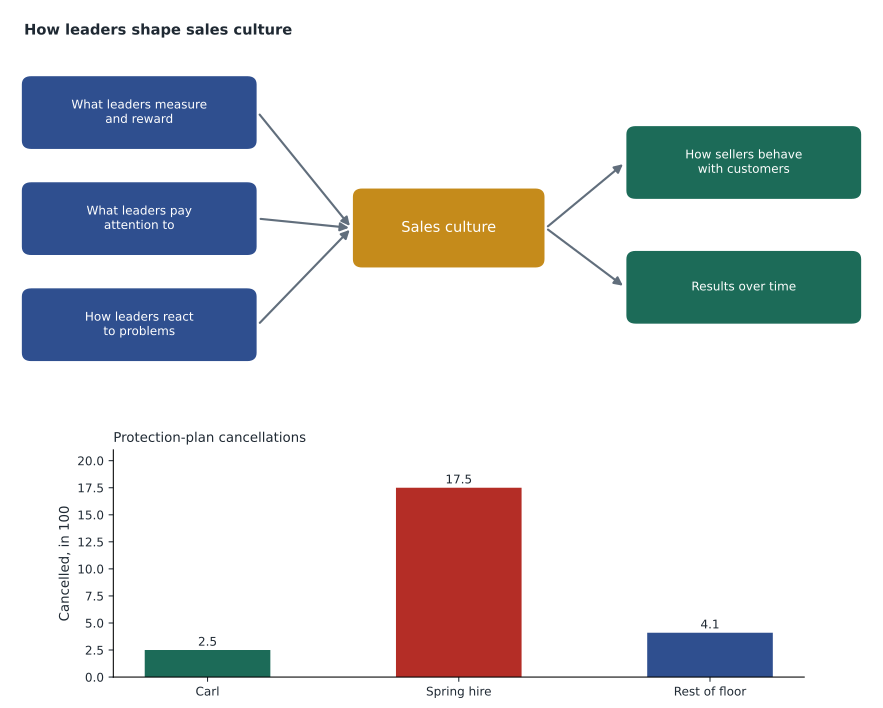
On Wednesday, October 28, 2026, Marcus Dube, Juniper & Pine's operations lead, brought Bev Halvorsen a short report. Customers can cancel an extended protection plan within 30 days for a full refund, and Marcus had counted cancellations by seller for the past six months. Most sellers had a handful. One seller, who had joined in the spring and was now among the store's top sellers of protection plans, had more cancellations than the rest of the floor combined. Two customers had written on the cancellation form that they had not understood they were buying a plan at all.
Bev did not assume the worst, but she did not ignore it either. Across town, Rob Kowalski had a quieter worry. In the last week of every quarter, Ridgeline signed far more deals than in any other week, and some customers later complained that installation dates had been promised that operations could not meet. Neither problem was a crisis. Both were signs of what a sales culture rewards and tolerates. This lesson is about how sales leaders build cultures in which people sell hard and honestly.
What sales culture is
A culture is the set of shared beliefs and habits that shape how people in an organization actually behave, especially when no one is watching. In sales teams, culture shows up in what gets celebrated at the weekly meeting, what managers ask about first, how people talk about customers, what happens when someone misses a target, and what happens when someone bends a rule and hits it. Written values matter less than these daily signals. If a company's values statement says "customer first" but the only thing ever discussed is the number, people learn which one counts.
Leaders shape culture most through three things: what they measure and reward, what they pay attention to, and how they react when something goes wrong. Each of the earlier lessons in this course connects to culture. Pay plans that reward only volume invite corner-cutting. Quotas that most people cannot reach invite desperation. Forecast calls that punish honest bad news teach people to hide it.
When pressure leads to misconduct
The best-known recent example of a sales culture going wrong is Wells Fargo. In 2016, United States regulators and the city of Los Angeles announced penalties of 185 million dollars against the bank after finding that employees, under intense pressure to meet sales goals for opening new accounts, had opened deposit and credit card accounts for customers without their permission. The bank later agreed to pay 3 billion dollars in 2020 to settle criminal and civil investigations into the practices. Investigations found that the problem was not a few bad employees but goals, pay and management pressure that made misconduct predictable.
In Canada, the Financial Consumer Agency of Canada published a review of retail sales practices at the large banks in 2018. It found that the banks' sales cultures, with their focus on selling products and meeting targets, increased the risk of mis-selling and of breaching consumer protection rules, and that controls to manage that risk were not always effective. The banking industry and its regulator changed their rules afterward.
Research on goal-setting helps explain how this happens. Lesson 7 noted that specific, difficult goals usually raise performance. But studies by Maurice Schweitzer, Lisa Ordóñez and Bambi Douma found that people who fall just short of a goal are more likely to misrepresent their results than people with no goal at all, and a 2009 article by Ordóñez and colleagues, "Goals Gone Wild", argued that goals can narrow attention, encourage risk-taking and push people toward unethical shortcuts when set without care. The authors of the article and their critics, including Edwin Locke and Gary Latham, agreed that goals should be set with attention to these risks; they disagreed on how common the harms are. For sales leaders the practical point is that goals and the way they are managed must be designed with misconduct in mind.
Warning signs a leader can measure
Bev and Rob both relied on data to notice problems early, because unhappy customers often leave quietly rather than complain. Useful indicators include cancellations and refunds by seller, complaints, discount exceptions, deals reversed after the quarter closes, and unusual clusters of sales at the end of a period.
Worked problem
Comparing protection-plan cancellations by seller
Over six months, Carl Jensen sold 120 protection plans, of which 3 were cancelled within 30 days. The spring hire sold 80, of which 14 were cancelled. The rest of the floor together sold 410, with 17 cancelled. What is each cancellation rate?
Show solution
- \[\text{Carl} = \frac{3}{120} = 0.025 = 2.5 \text{ in } 100\]
- \[\text{Spring hire} = \frac{14}{80} = 0.175 = 17.5 \text{ in } 100\]
- \[\text{Rest of floor} = \frac{17}{410} \approx 0.041 = 4.1 \text{ in } 100\]
Answer: The spring hire's cancellation rate is about four times the rest of the floor's and seven times Carl's. On its own that does not prove misconduct, but together with two written complaints that customers did not understand what they had bought, it was enough for Bev to review the seller's sales and talk to them.
Bev's conversation with the seller was not an accusation. She asked how they explained the plan to customers and listened to an example. The seller described the plan quickly, near the end of the sale, as "included protection", and did not always say its price separately. They had not meant to mislead anyone; they had copied a phrase they heard from a former employer. Bev coached them on a clear script, required the price of the plan to be read aloud and shown on the screen before payment, and reviewed their next month's cancellations. They fell to two.
Worked problem
Spotting a quarter-end cluster
In the third quarter of fiscal 2026, June to August, Ridgeline's field team won 30 new contracts. Of these, 11 were signed in the last week of the quarter, which is one of thirteen weeks. If signings were spread evenly, how many would be expected in that week? Of the 11, operations later moved the installation date on 6 because the date in the contract could not be met. What share of last-week deals had to be rescheduled?
Show solution
- \[\text{Even spread} = 30 \div 13 \approx 2.3 \text{ contracts per week}\]
- \[\frac{11}{2.3} \approx 4.8 \text{ times the even-spread level}\]
- \[\text{Rescheduled share} = \frac{6}{11} \approx 0.55 = 55 \text{ in } 100\]
Answer: The last week had nearly five times the number of signings an even spread would produce, and more than half of those deals had promised installation dates that could not be kept. Some end-of-quarter clustering is normal, because customers also have budget deadlines, but promises that operations cannot keep damage trust. Rob changed two things for fiscal 2027: installation dates would be confirmed by operations before a contract was sent, and the accelerator would be calculated on year-to-date results, as lesson 8 described, which reduces the reason to rush deals across a quarter line.
Psychological safety and speaking up
Problems are fixed sooner when people feel able to raise them. Amy Edmondson's research on teams, beginning with a 1999 study, describes psychological safety as a shared belief that the team is safe for interpersonal risk-taking: that a person will not be embarrassed or punished for asking a question, admitting a mistake or raising a concern. Teams with more psychological safety tend to learn more from mistakes. In a sales team, that means a seller who has over-promised a delivery date tells the manager the same day, rather than hoping it works out.
Leaders build psychological safety mostly through how they respond. Rob's rule for forecasts in lesson 9, that an early, honest downgrade would never be criticized, was one example. Another was Darnell's habit of starting team meetings by describing one of his own recent mistakes and what he learned. Neither leader lowered standards; they made it clear that the way to fail them was to hide a problem, not to have one.
The rules every sales leader must enforce
Some standards are matters of law, not just culture. Earlier courses in this program covered the laws on how sellers describe products, prices and contracts. A sales leader is responsible for making sure the team follows them, and for responding properly when someone raises a concern.
In Saskatchewan, The Saskatchewan Employment Act requires employers to take reasonable steps to prevent harassment in the workplace and to have a written policy that explains how to report it and how complaints will be investigated. Harassment under the Act includes conduct based on prohibited grounds under The Saskatchewan Human Rights Code, 2018, and other serious or repeated conduct that harms a worker's psychological or physical wellbeing. A manager who hears a complaint must follow the policy, not handle it informally to avoid a fuss. The Act also protects workers from discriminatory action for raising health and safety concerns, including harassment.
Both companies also had rules specific to selling: no promises of delivery or installation dates that operations had not confirmed; prices and add-ons stated clearly before a customer agreed; discounts only within approved limits; no gifts to customers' staff beyond small courtesy items; and customers' personal information used only as permitted. Rob put these rules on one page, called the Ridgeline selling standards, and asked every seller to discuss one of them at each monthly team meeting, using a real situation from their own work.
| Signal a leader sends | What the team learns |
|---|---|
| Asks first about the number | Results matter more than how they were achieved |
| Asks first about the customer, then the number | Results matter, and so does how they are achieved |
| Celebrates a big deal that was later cancelled | Signing is what counts |
| Thanks someone for raising a problem early | Bad news is safe to bring |
| Ignores a top seller's rule-bending | Rules are for average performers |
| Applies the same standard to everyone | The rules are real |
The last row was the hardest test. When the cancellation report came in, it would have been easy for Bev to ignore it because the seller was producing. Rob faced the same test when one of Ridgeline's best sellers asked for a discount exception, beyond his authority, on the last day of the quarter. Rob said no, and explained why in the next team meeting without naming the seller: the limit existed so that every customer was treated fairly and every seller competed on the same terms.
Everyday ethical choices
Most ethical problems in sales are not dramatic. They are small choices made under time pressure: how to describe a delivery date, whether to mention a cheaper option, how to word a forecast. Leaders shape culture through the small choices they make and allow. Darnell and Bev used a few short cases in team meetings to discuss what a good choice looks like.
| Situation | Tempting response | Better response |
|---|---|---|
| A customer asks if a printer model can be delivered before Christmas, but stock is uncertain | Promise delivery to win the order | Give the real situation and offer an alternative that is in stock |
| A cheaper plan would meet the customer's needs | Stay quiet and sell the larger plan | Mention the cheaper option and explain the trade-offs |
| A deal is unlikely to close this month, but the forecast is short | Leave it in commit to avoid a hard conversation | Move it to best case and explain the gap |
| A colleague is booking orders that customers cancel later | Ignore it because they are a top seller | Raise it with the manager or through the reporting channel |
| A competitor's employee offers to share their price list | Accept it quietly | Decline and tell the manager |
Two questions help in most of these cases. Would I be comfortable if the customer later saw exactly what I said and why? And would I be comfortable explaining this choice to my manager, my team and my family? If the answer to either is no, the choice probably needs to change. Leaders make it easier to choose well when they never punish someone for losing a deal by telling the truth, and when they talk openly about the times they faced the same choices themselves.
Common mistakes
MistakeTreating written values as the culture.
InsteadLook at what is measured, rewarded and tolerated day to day.
MistakeAssuming misconduct is caused only by bad individuals.
InsteadCheck whether goals, pay and pressure make it predictable.
MistakeWaiting for complaints before looking for problems.
InsteadTrack cancellations, refunds, discount exceptions and end-of-period clusters by seller.
MistakeMaking exceptions for top sellers.
InsteadApply the same standards to everyone, and explain the reason.
MistakeHandling a harassment complaint informally.
InsteadFollow the written policy, investigate properly and protect the person who raised it.
Summary and key terms
- Sales culture is the shared beliefs and habits that shape how sellers actually behave, set mainly by what leaders measure and reward, what they pay attention to and how they react to problems. Wells Fargo's unauthorized accounts scandal and Canada's 2018 review of bank sales practices show how goals, pay and pressure can make misconduct predictable.
- Research suggests people who narrowly miss goals are more likely to misreport, though how common goal-related harm is remains debated.
- Leaders can watch for warning signs such as cancellations, refunds, complaints, discount exceptions and end-of-period clusters by seller, and respond with inquiry and coaching.
- Psychological safety helps teams raise problems early.
- Leaders must enforce legal standards on harassment, honest selling and data use, follow written complaint policies and apply the same rules to every seller.
- Culture
- The shared beliefs and habits that shape how people in an organization actually behave.
- Mis-selling
- Selling a product a customer does not need or understand, or without proper disclosure.
- Psychological safety
- A shared belief that a team is safe for asking questions, admitting mistakes and raising concerns.
- Cancellation rate
- The share of sales cancelled within a set period.
- Discount exception
- A price reduction beyond a seller's approved limit, needing higher approval.
- Selling standards
- Written rules for how sellers describe products, prices and commitments to customers.
Practice problems
Work each problem on paper first, then reveal the answer to check.
A seller sold 60 plans and 9 were cancelled; the team rate is 4 in 100. What is the seller's rate, and how does it compare?
Show answer
9 ÷ 60 = 0.15, or 15 in 100, nearly four times the team rate.
A team signs 52 deals in a 13-week quarter, 20 in the last week. How does that compare with an even spread?
Show answer
Even spread is 52 ÷ 13 = 4 a week; 20 is five times that.
Give two leader behaviours that build psychological safety.
Show answer
For example: thanking people for raising problems early, and describing one's own mistakes and what was learned.
Lesson quiz · 5 questions
Score 60% or more to complete this lesson.
Create a free account to save your progress, take quizzes and earn a certificate.