
SLS-230 · Lesson 3 of 12 · 20 min
Hiring salespeople
▶ Video coming soon A video version of this lesson is on the way.
Lesson 2 showed that Ridgeline's fiscal 2027 plan needed a seventh field account executive. Rob approved the position on Tuesday, October 13, 2026, and Darnell Brooks became the hiring manager. In the same week, Bev Halvorsen started looking for two seasonal floor sellers to work from mid-November to the end of January at Juniper & Pine Home. The two searches differed in almost every detail, from the pay to the length of the job, but they followed the same basic steps, and both leaders were determined to avoid the hiring mistakes they had made before.
Darnell's worst hire, he admitted, had been a charming candidate who interviewed brilliantly and then struggled for nine months before leaving. "I hired the person I would have enjoyed having lunch with," he said. "I didn't test whether they could do the job." Bev's worst had been a rushed seasonal hire who started two days before Black Friday with no training. This lesson covers how to define what a sales job needs, find and assess candidates fairly and lawfully, and estimate what a poor hire costs.
Start with a success profile
Good hiring starts with a clear picture of what success in the role looks like, written before anyone looks at a résumé. A success profile describes the outcomes the person must deliver, the main tasks of the job, and the skills, knowledge and behaviours those tasks need. It is built from the job itself, not from the habits of the current top performer, though talking to strong performers about what they actually do is a useful input.
Darnell built Ridgeline's profile from three sources: the account executive job description, an analysis of how the team's strongest and weakest sellers spent their time, and interviews with two customers about what they valued in a Ridgeline seller. He then separated the qualities a new hire must have on day one from those Ridgeline could teach.
| Must have on day one | Can be taught at Ridgeline |
|---|---|
| Asks good questions and listens before proposing | Ridgeline's products and pricing |
| Organizes their own week and follows through on commitments | The CRM and Ridgeline's sales process |
| Explains a complex offer clearly in writing and in person | Managed print economics and RoomFlow |
| Handles rejection without losing motivation | Public procurement rules |
| Honest with customers, including about what Ridgeline cannot do | Ridgeline's territory and key customers |
Bev's profile for seasonal sellers was shorter. A seasonal seller needs to be friendly with strangers, reliable about shifts, comfortable on their feet for long days and willing to learn a few product lines quickly. Previous retail experience helps but is not essential, because the store's training covers the products and the point-of-sale system.
Finding candidates
Sales candidates come from referrals by current employees, job boards, professional networks, college and university programs, and people who already know the company as customers or competitors. Referrals often produce good hires because current employees know both the job and the person, but relying on them alone tends to produce a team that looks like its current members. Darnell posted the job publicly, asked his team for referrals, and contacted the sales program at a local college. Bev advertised in the store and online, and invited two former seasonal sellers back.
The job posting described the role, the territory, the base salary range and how commission worked. Saskatchewan does not require employers to publish pay ranges in job postings, but Darnell included one anyway. Several other provinces, including British Columbia, Prince Edward Island, Ontario and New Brunswick, now require pay information in postings, and candidates increasingly expect it. Including the range also saved everyone time: candidates whose expectations were far higher could decide not to apply.
Assessing candidates: what the evidence says
Decades of research on hiring have compared how well different assessment methods predict job performance. A widely cited 1998 review by Frank Schmidt and John Hunter combined results from many studies and found that general mental ability tests, work samples and structured interviews were among the strongest predictors. A 2022 re-analysis by Paul Sackett and colleagues corrected some of the statistical methods in that earlier work and found that most predictors were somewhat weaker than previously thought, but structured interviews came out as one of the best single methods, ahead of unstructured interviews. These are averages across many jobs and studies, and any one hiring decision still involves uncertainty, but the direction of the evidence is clear: structure beats instinct.
A structured interview asks every candidate the same job-related questions, in the same order, and scores the answers against the same written standards. It usually includes behavioural questions, which ask what the candidate did in a real past situation ("Tell me about a time you lost a deal you expected to win"), and situational questions, which ask what they would do in a realistic job situation. An unstructured interview, a friendly conversation that goes wherever it goes, feels informative but is more easily swayed by first impressions and by how much the interviewer likes the candidate.
Darnell's process had four stages: a 20-minute phone screen on motivation and basic fit; a structured interview with him and Lisa Tran, a senior account executive, with five questions scored from 1 to 5; a role-play in which the candidate ran a discovery call with Farida Haddad playing a clinic office manager; and reference checks with two former managers. A role-play is a kind of work sample: it lets the candidate show the skill rather than describe it.
Worked problem
Scoring two finalists with a weighted scorecard
Darnell's scorecard weights the success-profile qualities: discovery and listening 30, organization and follow-through 25, clear communication 20, resilience 15 and honesty 10, out of 100. Each is scored from 1 to 5 from the interview and role-play evidence. Candidate A scored 4, 3, 5, 3, 4. Candidate B scored 5, 4, 3, 4, 4. Which candidate scores higher, and by how much?
Show solution
- Multiply each score by its weight and add, then divide by 100 to keep the 1-to-5 scale.
- \[A = \frac{4(30) + 3(25) + 5(20) + 3(15) + 4(10)}{100} = \frac{120 + 75 + 100 + 45 + 40}{100} = 3.80\]
- \[B = \frac{5(30) + 4(25) + 3(20) + 4(15) + 4(10)}{100} = \frac{150 + 100 + 60 + 60 + 40}{100} = 4.10\]
- \[4.10 - 3.80 = 0.30\]
Answer: Candidate B scores 4.10 against Candidate A's 3.80. Candidate A was the stronger presenter and the more polished interviewee, which is exactly why the weights matter: the role depends more on discovery and follow-through, where B was stronger. Darnell made B the first choice, subject to references.
Bev used a lighter version for seasonal sellers: three behavioural questions, a ten-minute role-play greeting a customer looking at sofas, and a check that the candidate could work the Saturday shifts. She scored every candidate on the same three-point scale and kept her notes, so that if anyone asked why one person was hired and another was not, she could explain.
Many companies also use personality or sales-aptitude tests. Some have reasonable evidence for particular traits, such as conscientiousness, but many commercial tests are sold with stronger claims than their research supports, and some can screen out people unfairly. If a company uses a test, it should know what the test measures, have evidence that it relates to performance in this job, and use it as one input among several.
Hiring fairly and lawfully
In Saskatchewan, The Saskatchewan Human Rights Code, 2018 prohibits discrimination in employment, including hiring, on grounds such as religion, creed, marital status, family status, sex, sexual orientation, disability, age, colour, ancestry, nationality, place of origin, race or perceived race, receipt of public assistance and gender identity. In practice, interviewers should not ask about age, marital or family status, plans to have children, religion, national origin or disability, and should not make hiring decisions on those grounds. If a candidate needs an accommodation to take part in the process, such as a different interview format, the employer has a duty to accommodate them to the point of undue hardship.
The safest practice is the same in both countries: ask only about the job and the candidate's ability to do it, ask every candidate the same core questions, and keep written notes of the reasons for each decision. A question like "Can you work Saturdays from November to January?" is lawful because it is about the job; "Do you have young children at home?" is not, even if the interviewer means it kindly.
Two other legal points matter for sales hiring. First, since June 2023 the Competition Act has made it a criminal offence for unaffiliated employers to agree not to hire or poach each other's employees, or to fix their wages, so Darnell could not agree with a competitor to leave each other's sellers alone. Second, many sellers have signed non-competition agreements with past employers. Ontario has banned most new non-compete clauses since 2021. Saskatchewan has no such statute, but Canadian courts, following the Supreme Court in Shafron v. KRG Insurance Brokers (2009), enforce them only when they are clear and reasonable in time, area and activity, and they often prefer narrower non-solicitation clauses. Darnell asked finalists to share any restrictive agreements so Ridgeline could get advice before making an offer.
What a poor hire costs
Hiring takes time, and leaders under pressure to fill a seat are tempted to take the first acceptable candidate. A rough estimate of what a poor hire costs can help a leader resist that pressure. The cost includes the pay of a person who never becomes productive, the cost of recruiting twice, the manager's time and, often largest, the sales that a good hire would have made in the same period.
Worked problem
Estimating the cost of a poor account executive hire
Suppose Ridgeline hires an account executive at a base salary of 57,600 dollars a year who leaves after nine months, having produced 60,000 dollars of first-year revenue. A good hire would have produced about 240,000 dollars over the same nine months once ramped, and Ridgeline's gross margin on new revenue averages 35 in 100. Recruiting costs about 6,000 dollars each time, and Darnell estimates he spends 80 extra hours on a struggling hire, valuing his time at 60 dollars an hour. What is the rough cost?
Show solution
- \[\text{Base paid} = 57{,}600 \times \tfrac{9}{12} = 43{,}200 \text{ dollars}\]
- \[\text{Margin lost} = (240{,}000 - 60{,}000) \times 0.35 = 63{,}000 \text{ dollars}\]
- Recruiting the replacement: 6,000 dollars. Manager time: 80 × 60 = 4,800 dollars.
- The base salary is not all extra cost, because Ridgeline would have paid a good hire too. The extra cost is the lost margin plus the repeated recruiting and the manager's time:
- \[63{,}000 + 6{,}000 + 4{,}800 = 73{,}800 \text{ dollars}\]
Answer: A poor hire costs Ridgeline roughly 74,000 dollars on these assumptions, more than a year's base salary, most of it in lost margin. The figures are estimates, but they make the case for a careful process and for not filling the seat in a hurry.
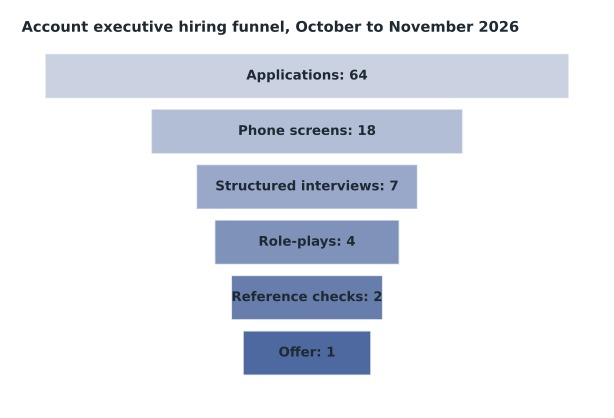
Darnell's search produced 64 applications, 18 phone screens, seven structured interviews, four role-plays and two sets of reference checks. On Friday, November 13, 2026, he planned to make an offer to Candidate B, a former medical-supply seller, with a start date of Monday, January 4, 2027. Bev hired her two seasonal sellers in the first week of November and scheduled their training for the week of November 16, well before the busiest weekends.
Common mistakes
MistakeHiring the candidate the interviewer likes most.
InsteadScore every candidate against a written success profile, using the same structured questions.
MistakeDescribing the job only in terms of the current top performer.
InsteadBuild the profile from the job's outcomes and tasks, separating what must be hired for from what can be taught.
MistakeAsking about family plans, age or religion to make small talk.
InsteadAsk only about the job and the candidate's ability to do it.
MistakeRelying on a commercial personality test as the deciding factor.
InsteadUse tests only with evidence that they predict performance in this job, and as one input among several.
MistakeFilling the seat quickly because the territory is uncovered.
InsteadEstimate what a poor hire would cost and keep the process even when time is short.
Summary and key terms
- Good hiring starts with a success profile that describes the outcomes, tasks and qualities a role needs, separating what must be hired for from what can be taught.
- Candidates come from referrals, public postings, networks and schools; relying only on referrals can narrow the team.
- Research reviews by Schmidt and Hunter and, more recently, Sackett and colleagues find that structured interviews and work samples are among the best predictors of performance, though every prediction is uncertain.
- Structured interviews ask every candidate the same job-related questions and score answers against written standards; role-plays let candidates show sales skills.
- Human rights and anti-discrimination law limit what can be asked and decided, and leaders should ask only about the job and keep notes.
- Non-compete agreements and no-poach agreements raise legal issues.
- A poor hire can cost more than a year's base salary, mostly in lost margin.
- Success profile
- A written description of the outcomes, tasks and qualities that success in a role requires.
- Structured interview
- An interview that asks every candidate the same job-related questions and scores answers against the same standards.
- Behavioural question
- A question asking what a candidate did in a real past situation.
- Role-play
- A simulated sales conversation in which a candidate shows a skill.
- Non-competition agreement
- A promise by an employee not to work for a competitor for a time after leaving.
- Duty to accommodate
- The Canadian legal duty to adjust rules or processes for a protected need, up to undue hardship.
Practice problems
Work each problem on paper first, then reveal the answer to check.
A scorecard weights listening 40, organization 30 and communication 30. A candidate scores 4, 5 and 3. What is the weighted score?
Show answer
(4 × 40 + 5 × 30 + 3 × 30) ÷ 100 = (160 + 150 + 90) ÷ 100 = 4.0.
Why is "Can you work Saturdays?" acceptable when "Do you have children at home?" is not?
Show answer
The first asks about a requirement of the job; the second asks about family status, a protected ground, and is not about the ability to do the job.
A poor hire produced 50,000 dollars of revenue where a good hire would have produced 200,000. Margin is 30 in 100. What margin was lost?
Show answer
(200,000 − 50,000) × 0.30 = 45,000 dollars.
Lesson quiz · 5 questions
Score 60% or more to complete this lesson.
Create a free account to save your progress, take quizzes and earn a certificate.