
SLS-230 · Lesson 2 of 12 · 20 min
Sales strategy and team structure
▶ Video coming soon A video version of this lesson is on the way.
Ridgeline's fiscal year runs from December 1 to November 30. On Tuesday, October 6, 2026, Rob Kowalski held the first of four planning sessions for fiscal 2027 in the small boardroom on Ridgeline's second floor. Darnell Brooks was there for the field team, Owen Pelletier for the inside team, Farida Haddad for account management and Grace Liu for sales operations. Rob opened with a question he had written on the whiteboard: "Who do we want to sell what to, next year, and who on this team should be doing each part of it?"
The question had two halves. The first half, who to sell what to, is sales strategy: the choice of customers, offers and selling approach that the company will put its effort behind. The second half, who should do each part, is sales structure: how the work of selling is divided among people and roles. Rob insisted on settling the first half before the second. "If we design the team first," he said, "we end up selling whatever the team happens to be good at."
At Juniper & Pine Home, Bev Halvorsen faced a smaller version of the same question. The store's sales had grown in appliances and mattresses, while upholstery had flattened, and she wanted to decide before the 2027 season whether to keep every floor seller selling everything or to assign some sellers to departments. This lesson looks at how both leaders connected strategy to structure.
Starting from strategy
Ridgeline's strategy for fiscal 2027 came from the company's business plan. The owners wanted total revenue to grow from about 16.8 million dollars in fiscal 2026 to about 18 million dollars, with more of the growth coming from recurring services such as managed print and the RoomFlow booking software, which bring revenue every month for the life of the contract. Within that, Rob set three sales priorities: win more new customers in the clinics and professional-services segments, where Ridgeline's win rates were highest; grow existing key accounts through account management; and stop chasing large school and municipal tenders unless Ridgeline had a clear advantage, because those had the lowest win rates and the longest cycles.
Each priority implied a kind of selling work. Winning new customers needs prospecting and first meetings, which the inside team does well. Growing existing accounts needs relationships and planning, which account managers do. Closing mid-sized new deals needs discovery, presentations and negotiation, the core of the field account executive's job. Once the work was clear, the structure question became how to divide it.
Ways to divide the work
Sales teams are usually organized along one or more of a few lines. Each has strengths and costs, and most real teams mix two or three of them.
| Structure | How it works | Strengths | Costs |
|---|---|---|---|
| Generalist | Every seller sells everything to anyone in their area | Simple; one contact for the customer; easy coverage | Sellers may not know complex products well |
| Geographic | Each seller owns a territory | Less travel; clear ownership; local knowledge | Territories may differ in potential |
| Product | Sellers specialize by product line | Deep product knowledge | Customers may see several sellers from one company |
| Industry or segment | Sellers specialize by customer type, such as clinics or schools | Understands the customer's world | May need more travel; segments vary in size |
| Account size | Large accounts get dedicated sellers; small ones are served by phone or online | Effort matches value | Hand-offs between groups |
| Function | Different people prospect, close and manage accounts | Specialists do each step well | Hand-offs can lose information and goodwill |
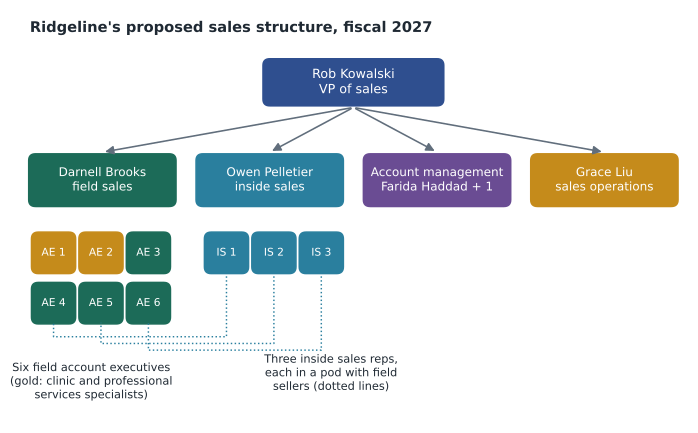
Ridgeline already used three of these. Field account executives each held a geographic territory, the inside team prospected for them, and two account managers looked after the largest customers. For fiscal 2027, Rob proposed adding a light segment layer: two field account executives would become the team's specialists for clinics and professional services, taking the more complex deals in those segments across all territories, while the others kept their territories. The inside team would be organized in pods from December, with each inside rep working with two or three named field sellers, as Owen had already planned.
Rob was careful about the cost of hand-offs. Every time a customer moves from one Ridgeline person to another, from inside rep to field seller or from field seller to account manager, something can be lost: a promise, a preference, a piece of history. The plan included a written hand-over checklist for each step and a rule that the first meeting after a hand-off is always a joint one.
How big should the team be?
Once the work is divided, the next question is how many people each role needs. There are two common ways to answer it. The first starts from the revenue the company wants and works back to the number of sellers needed to deliver it. The second starts from the workload, such as the number of accounts and the time each needs, and works out how many sellers can cover it. Good plans use both, because each catches mistakes the other misses. Andris Zoltners, Prabhakant Sinha and Sally Lorimer, who have written widely on sales force design, recommend this kind of cross-check, and point out that many companies size their sales forces by habit or by what they can afford this year rather than by analysis.
Worked problem
Sizing the field team from the revenue target
For fiscal 2027, Rob wants 3,300,000 dollars of first-year revenue from new field sales. A fully ramped field account executive at Ridgeline has a quota of 600,000 dollars a year, but over the past three years the average seller reached about 85 in 100 of quota. How many fully ramped account executives does the plan need? Ridgeline currently has six, one of whom, Maya Chen, will be in her first full year.
Show solution
- \[\text{Expected revenue per seller} = 600{,}000 \times 0.85 = 510{,}000 \text{ dollars}\]
- \[\text{Sellers needed} = 3{,}300{,}000 \div 510{,}000 = 6.47\]
- Round up, because a fraction of a seller cannot be hired: 7 fully ramped sellers.
- Six sellers, all fully productive, would be expected to deliver 6 × 510,000 = 3,060,000 dollars, about 240,000 dollars short.
Answer: The plan needs the equivalent of about seven fully ramped account executives. With six, the target is not realistic unless productivity improves. Rob's options are to hire a seventh seller early in the year, to lower the target, or to show what will raise each seller's results.
Grace then ran the workload check. Ridgeline's six field territories held about 3,800 accounts in total, but most needed little field time. She estimated the field hours needed for the accounts worth active selling: about 380 tier A accounts at 20 hours a year each and about 900 tier B accounts at 6 hours a year. That came to 7,600 + 5,400 = 13,000 hours. A field seller has roughly 1,800 working hours a year, of which Grace assumed about 1,000 go to direct customer work after travel, internal meetings, training and administration. Thirteen thousand hours divided by 1,000 is 13 sellers, far more than seven. The difference told Rob that the plan depended heavily on the inside team covering tier B accounts by phone and video, which is exactly what the pods were meant to do.
Structure on the sales floor
Retail floors face the same choices on a smaller scale. At Juniper & Pine, every floor seller could sell anything in the store, and walk-in customers were shared by a rotation called the up system: sellers take turns greeting the next customer to come through the door, so that everyone gets a fair share of new customers. Customers who ask for a seller by name go to that seller, and a seller's booked appointments do not count as their turn.
Bev's question was whether to keep that generalist structure. Appliances and mattresses had become more technical, with heat-pump dryers, induction ranges and cooling mattress covers, and customers were asking questions the newer sellers struggled to answer. She considered three options: keep everyone generalist; create two department specialists for appliances who would take all appliance customers; or keep generalists but certify each seller in each department before they could sell it alone.
| Option | Effect on customers | Effect on sellers | Bev's concern |
|---|---|---|---|
| All generalists | One seller for the whole visit | Equal access to every customer | Weak product knowledge in appliances |
| Appliance specialists | Expert help on appliances; hand-off for furniture | Specialists earn more; others lose appliance sales | Fairness and hand-offs |
| Generalists with certification | One seller, who has proved their knowledge | Everyone can earn in every department once certified | Training time before peak season |
She chose the third option for 2027, with a plan to certify every floor seller in appliances by the end of February. Carl Jensen would run the appliance certification as part of his trial of the assistant manager role. The decision kept the up system fair, which Bev cared about, while addressing the knowledge gap that the change in products had created.
Worked problem
Staffing the floor for Saturday traffic
Juniper & Pine's door counter recorded an average of 420 visitors on Saturdays in October 2026, arriving mostly between 10:00 and 17:00. Bev estimates that about 60 in 100 of visitors want help from a seller and that a helped customer takes, on average, 35 minutes of a seller's time. Sellers spend about 75 in 100 of their floor time with customers; the rest goes to follow-ups, paperwork and breaks. How many sellers should be on the floor during those seven hours?
Show solution
- Customers wanting help: 420 × 0.60 = 252.
- \[\text{Seller time needed} = 252 \times 35 = 8{,}820 \text{ minutes} = 147 \text{ hours}\]
- Over a seven-hour peak, that is 147 ÷ 7 = 21 seller-hours of customer time per hour.
- That would mean 21 sellers fully busy every hour, more than the whole floor team. Before trusting the figure, Bev checks the unit being counted. The door counter counts people, but sellers serve shopping groups, and about 160 of the 420 visitors came as part of a couple or family. Counting groups gives about 260, of which 60 in 100 want help: 156 groups.
- \[156 \times 35 = 5{,}460 \text{ minutes} = 91 \text{ hours}\]
- \[91 \div 7 = 13 \text{ hours per hour}; \quad 13 \div 0.75 \approx 17.3\]
- The answer is still more sellers than she has, which tells her that on Saturdays many customers either wait or browse without help.
Answer: Even counting households, Saturday peaks need about 17 sellers on the floor to serve everyone who wants help, while Bev schedules eight or nine. She cannot close the whole gap, but the numbers support adding two seasonal sellers for the Saturdays from mid-November to January and making sure the most experienced sellers work Saturdays.
The example shows a habit good sales leaders share: check whether the unit being counted is the right one. Bev's first calculation counted visitors when sellers actually serve groups. A structure built on the wrong count would have been badly wrong in one direction or the other.
Testing a structure before committing to it
Rob did not finalize the structure on October 6. He asked each leader to test it against three questions before the next session: does every priority in the strategy have a clear owner; does every customer know who to call; and does the structure create incentives that pull in the same direction? The third question mattered because structure and pay are linked. If field sellers are paid only for new customers and account managers only for renewals, the two groups may fight over who gets credit for an expansion deal. Lesson 8 shows how Ridgeline's fiscal 2027 pay plans were written to avoid that.
Both leaders wrote down why they had chosen their structures, what they expected to happen, and what results would make them change course. Bev would review the certification plan in March 2027; Rob would review the segment specialists after two quarters. Writing the reasons down, Rob said, is what turns a structure from a habit into a decision.
Common mistakes
MistakeDesigning the team before deciding the strategy.
InsteadDecide which customers, offers and selling approach to back first, then divide the work.
MistakeSizing the team only from the revenue target.
InsteadCross-check with a workload estimate of the accounts and the time each needs.
MistakeIgnoring the cost of hand-offs in a specialized structure.
InsteadUse hand-over checklists and joint first meetings whenever a customer moves between people.
MistakeCounting the wrong unit when planning coverage.
InsteadCheck whether sellers serve people, households, accounts or transactions, and count that.
MistakeTreating a new structure as permanent.
InsteadWrite down the reasons, the expected results and the review date.
Summary and key terms
- Sales strategy is the choice of customers, offers and selling approach to back; sales structure is how the work of selling is divided.
- Strategy should come first.
- Teams can be organized as generalists, by geography, product, industry or segment, account size or function, and most mix several of these.
- Specialization builds expertise but creates hand-offs, which need checklists and joint meetings.
- Team size can be estimated from the revenue target, dividing by expected revenue per seller, and checked with a workload estimate of accounts and hours.
- Retail floors often share walk-in customers through an up system, and structure decisions there weigh product knowledge against fairness.
- Leaders should check that they are counting the right unit, test structures against clear questions and record the reasons for their choices.
- Sales strategy
- The choice of customers, offers and selling approach that a company puts its sales effort behind.
- Sales structure
- The way the work of selling is divided among people and roles.
- Generalist structure
- An arrangement in which each seller sells everything to any customer in their area.
- Up system
- A retail rotation in which sellers take turns greeting new walk-in customers.
- Hand-off
- The transfer of a customer or deal from one person or team to another.
- Workload method
- Sizing a sales team from the number of accounts and the selling time each needs.
Practice problems
Work each problem on paper first, then reveal the answer to check.
A company wants 2,400,000 dollars of new revenue. Quota is 500,000 dollars and sellers average 80 in 100 of quota. How many sellers are needed?
Show answer
Expected revenue per seller is 500,000 × 0.80 = 400,000 dollars; 2,400,000 ÷ 400,000 = 6 sellers.
A territory has 200 accounts needing 15 hours a year and 600 needing 4 hours. Each seller has 1,000 hours for customer work. How many sellers does the workload method suggest?
Show answer
200 × 15 = 3,000 hours and 600 × 4 = 2,400 hours, total 5,400 hours; 5,400 ÷ 1,000 = 5.4, so about 6 sellers, or fewer if some accounts are covered by phone.
Why did Bev keep the up system when she changed how sellers were trained?
Show answer
It keeps the sharing of walk-in customers fair, and certification solved the product-knowledge problem without taking customers away from generalist sellers.
Lesson quiz · 5 questions
Score 60% or more to complete this lesson.
Create a free account to save your progress, take quizzes and earn a certificate.