
SLS-251 · Lesson 9 of 12 · 19 min
Seasonal resets
▶ Video coming soon A video version of this lesson is on the way.
At 7 p.m. on Sunday, November 8, 2026, an hour after the store closed, six people met at the sales desk with coffee, a printed run sheet and a floor plan covered in coloured highlighter. Noura led the crew: Aiden, two décor associates, Marcus Dube from operations, and one of the delivery drivers, who was there for the heavy lifting. By 3 a.m. the fall displays were gone, the holiday windows and feature tables were in, 14 fixtures had new planograms, and the main aisle had been swept twice. When the store opened at 10 a.m. on Monday, it looked like a different store, which was the point.
A reset is a planned change to a large part of the sales floor: new displays, new planograms, moved fixtures and new signs, done in one coordinated effort. A seasonal reset changes the floor for a new selling season, such as holiday, new year, spring or back to school. Resets are among the most visible things a merchandising team does, and among the easiest to get wrong, because they combine product, labour, safety and timing under a hard deadline. This lesson walks through how Juniper & Pine plans and runs a reset, using the holiday reset of November 2026.
Why stores reset
Stores reset for several reasons at once. The season changes what customers want: throws and candles in November, outdoor furniture in May. New collections arrive and need space. Regular customers stop noticing displays that never change. And the old displays have done their work: their products have sold down, leaving gaps, or have not sold, and need to move to clearance. A reset brings the whole floor up to date in one go, instead of leaving it half old and half new for weeks.
The reset calendar
Juniper & Pine runs six major resets a year, matched to its selling calendar, with smaller changes in between.
| Reset | Timing | Main changes |
|---|---|---|
| New year | First weekend of January | Clearance of holiday goods; storage and organization; bedroom refresh |
| Spring | Early March | Lighter colours and fabrics; dining and entertaining |
| Outdoor living | Early May | Patio furniture, outdoor décor, grills where carried |
| Back to school and dorm | Late July | Small-space furniture, desks, compact appliances |
| Fall | Mid-September | Warm colours, throws, dining for gatherings |
| Holiday | Early November | Holiday décor, gifting, entertaining, the holiday windows |
Planning backward from the night
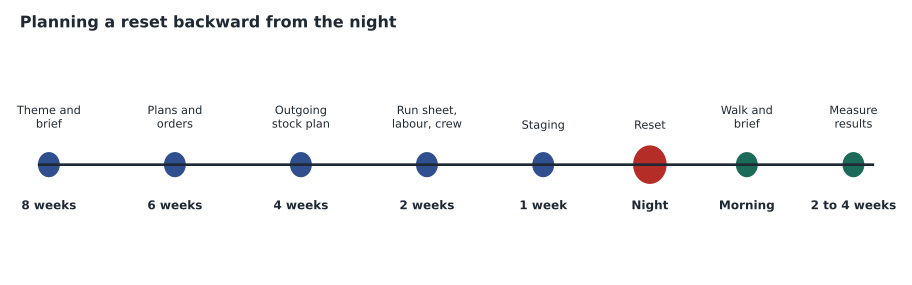
Every reset is planned backward from the night it happens. Noura uses a standard timeline, which she adjusts for the size of the reset.
| When | Task | Who |
|---|---|---|
| 8 weeks before (mid-September) | Set the theme and window brief; confirm products and quantities with buyers | Noura, buyers, Bev |
| 6 weeks before | Draw floor plans and planograms; order props, signs and any new fixtures | Noura, Tessa for signs |
| 4 weeks before | Plan what happens to outgoing products: clearance, storage or return to vendor | Noura, Bev, buyers |
| 2 weeks before | Write the run sheet; estimate labour; book the crew; check stock is arriving | Noura, Marcus |
| 1 week before | Stage products and props in the stockroom by zone; print planograms and signs | Noura, décor team |
| Night of | Run the reset | Reset crew |
| Morning after | Walk the floor, fix problems, brief associates on the new displays | Noura, Bev |
| 2 to 4 weeks after | Measure results | Noura, Bev |
The run sheet
The run sheet is the script for the night. It lists every task, in order, with who does it, how long it should take and what must be finished before it can start. A good run sheet means nobody stands around waiting and nobody has to ask what to do next. The holiday run sheet had 38 tasks grouped into five zones, and its first line was the same as on every run sheet Noura writes: "Walk the exits. Confirm all exit paths are clear and stay clear all night."
Order matters. Fixtures must be moved before products are placed. Old displays must be cleared before new ones are built in the same space. Heavy furniture is moved early, while everyone is fresh and before small items cover the floor. Signs and price tags go up last, when the products are in their final positions. And the final hour is reserved for cleaning, checking exits and fixing whatever went wrong.
Estimating the labour
Before booking a crew, Noura estimates how many hours the reset will take. She uses standard times from past resets for each kind of task, adds them up and compares the total with the hours the crew will be available.
Worked problem
Labour for the holiday reset
The holiday reset includes 14 fixture changes at about 1.5 hours each, 6 vignettes and windows at about 3 hours each, and signage and pricing at about 4 hours in total. The crew is 6 people for 8 hours, from 7 p.m. to 3 a.m. Is the crew big enough, and how much spare time is left?
Show solution
- Hours for fixtures:
- \[14 \times 1.5 = 21\]
- Hours for vignettes and windows:
- \[6 \times 3 = 18\]
- Total planned hours:
- \[21 + 18 + 4 = 43\]
- Hours available:
- \[6 \times 8 = 48\]
- Spare hours:
- \[48 - 43 = 5\]
Answer: The crew has 48 hours available against 43 planned, leaving 5 hours, about 10 in 100, as a buffer for problems. Noura considers a buffer of at least 10 in 100 essential, because something always takes longer than planned. On the night, the reset actually used about 47 hours, almost all of the buffer: one of the window backdrops did not fit and had to be cut down.
Underestimating is the most common planning error. When the crew runs out of time, the last tasks are signage and cleaning, which leaves the store opening with missing price tags and dust on the floor, the two things shoppers notice first.
Outgoing products
A reset brings new products in, but it also has to move the old ones somewhere. Products from the outgoing season generally take one of three paths. Products that will sell again next year and store well, such as some décor, may go to storage. Products that will not, or that the store does not want to keep, move to clearance at a reduced price; SLS-253 covers how markdowns are set. Some products may go back to the vendor if the agreement allows it. Floor models that have been on display for a season are inspected, cleaned and sold as floor models with the condition disclosed.
At Juniper & Pine, outgoing fall products moved to the clearance area that Noura had relocated to the main loop after the traffic study in lesson 1. Its new position was a test of whether clearance sells faster when shoppers can see it.
Smaller changes during opening hours
Not every change can wait for a night reset. New products arrive weekly, best sellers sell out and promotions start and end. Juniper & Pine makes small changes during opening hours, with a few rules. They happen in the quietest hours, usually Tuesday to Thursday mornings. Only one area is worked on at a time, and it is never left half finished when the associate goes on break. Boxes, ladders and carts are kept out of the main aisle and away from exit paths, and a small sign ("We're refreshing this display, back in an hour") tells shoppers what is happening. Anything that needs a ladder above head height, or moving furniture across the main aisle, waits for closed hours.
Shoppers notice work in progress. A half-built display with empty boxes beside it looks careless, while a tidy area with a polite sign looks like a store taking care of itself. Associates working on a display stay available: when a shopper asks a question, the shopper comes first and the display waits.
The reset book
After every reset Noura adds a few pages to a binder she calls the reset book: the run sheet with actual times written beside the planned ones, photographs of every new display and fixture, the list of morning-after problems, and a short note of what she would do differently. The standard times she uses to estimate labour come from this book. So does her habit of checking window backdrops against the window's real measurements, which she started after the holiday backdrop had to be cut down at midnight. A reset book turns each reset into practice for the next one, and it means that the knowledge stays with the store if the person who planned the reset moves on.
Safety during a reset
Resets happen after hours, often late at night, with tired people moving heavy furniture and climbing ladders. They are one of the riskiest times in the store. The rules at Juniper & Pine are firm.
| Rule | Why |
|---|---|
| Exit paths stay clear all night, even when products are staged | People must be able to leave in an emergency at any hour |
| Two people for anything heavy or high | Furniture and ladder work cause most reset injuries |
| Use proper ladders and dollies; never stand on fixtures or furniture | Falls and dropped loads |
| Nobody works alone in the store after hours | Help must be available if someone is hurt |
| Decorations meet flame-resistance requirements and are kept away from lights | Holiday displays add fuel and heat to the store |
| Breaks are scheduled on the run sheet | Fatigue causes mistakes and injuries late at night |
| Stock stays below the sprinkler line in new displays | The building's fire protection must keep working |
Workplace safety law applies at midnight as much as at noon. In Saskatchewan, employers must provide training, safe equipment and supervision under The Saskatchewan Employment Act and its occupational health and safety regulations, and working alone requires a plan for checking on the worker. Juniper & Pine's policy is simpler: nobody works alone after hours.
The morning after
At 8 a.m. on Monday, November 9, two hours before opening, Noura and Bev walked the whole floor with the floor plan. They found what they usually find after a reset: three missing price tags, a planogram where two cushions had been swapped, a lamp on a vignette that was not plugged in, and a seasonal sign with a typing error. All were fixed before opening. They also walked the exit paths and checked that nothing from the night had been left in them.
Then came the step that is easiest to skip: briefing the associates. At the 9:45 huddle, Noura walked the team through the new displays, the story of each, where the cross-merchandised products were stocked and what was now in clearance. Associates who start the day knowing what changed sell from the new displays; associates who discover them while a customer is asking questions do not.
Measuring a reset
A reset should have goals, set before it happens, so that it can be judged afterward. For the holiday reset Noura set three: holiday décor sales at least as high as the same weeks last year, adjusted for the store's overall sales trend; fall clearance sold down by at least two thirds within four weeks; and no exit or sprinkler problems found by the fire inspector or by Marcus. Lesson 11 shows how the first goal can be measured fairly.
Resets also affect the people who are not on the crew. Delivery drivers need to know if the route to the loading door will change, the sales desk needs the new planograms and prices before opening, and the website team needs photographs if online product pages show store displays. Noura sends a short note to every department the Friday before a reset, listing what will move, what will be in clearance and who to ask. Small as it is, the note prevents most of the Monday-morning confusion that used to follow resets.
Common mistakes
MistakePlan a reset in the week before it happens.
InsteadPlan backward from the night, starting about eight weeks before for a major reset.
MistakeAdd a crew member if the reset runs late.
InsteadEstimate labour from standard times and book a buffer of at least 10 in 100 in advance.
MistakeStage products in the aisles to save time.
InsteadExit paths stay clear all night; stage in the stockroom or in areas that do not block exits.
MistakeSigns and tags can be finished in the morning.
InsteadPlan time for them on the night. Missing tags and dirty floors are what shoppers notice first.
MistakeOnce the reset is done, the job is over.
InsteadWalk the floor, brief associates and measure results against goals set beforehand.
Summary and key terms
- A seasonal reset changes a large part of the floor for a new selling season in one coordinated effort.
- Plan backward from the reset night, from theme and orders eight weeks before to staging the week before.
- A run sheet sets the order of tasks, starting with exits and ending with cleaning and checks.
- Estimate labour from standard task times and keep a buffer of at least 10 in 100.
- Plan where outgoing products go: storage, clearance, return to vendor or floor-model sale.
- Keep exits clear, work in pairs for heavy or high tasks, never work alone, and brief associates the morning after.
- Reset
- A planned change to a large part of the sales floor done in one coordinated effort.
- Seasonal reset
- A reset that changes the floor for a new selling season.
- Run sheet
- The ordered list of tasks, people and times for a reset.
- Staging
- Gathering and organizing products and props by zone before a reset.
- Floor model
- A product used for display that is later sold, usually at a discount with its condition disclosed.
Practice problems
Work each problem on paper first, then reveal the answer to check.
A reset has 10 fixtures at 2 hours each and 4 vignettes at 3 hours each, plus 3 hours of signage. How many hours is that?
Show answer
20 plus 12 plus 3 is 35 hours.
A crew of 5 works 7 hours on the reset above. What is the buffer, in hours and roughly per 100?
Show answer
35 hours available against 35 planned leaves no buffer at all; the crew should be larger or the hours longer.
Why is heavy furniture moved early in the night?
Show answer
The crew is fresh, and the floor is clear before small items are placed.
Name two things to check on the morning walk after a reset.
Show answer
Missing price tags, planogram errors, lights not working, sign mistakes and clear exit paths.
Lesson quiz · 5 questions
Score 60% or more to complete this lesson.
Create a free account to save your progress, take quizzes and earn a certificate.