
SLS-253 · Lesson 12 of 12 · 23 min
Case study: planning a season
▶ Video coming soon A video version of this lesson is on the way.
On Friday, November 13, 2026, Bev and Noura presented the spring 2027 plan for the upholstery department to Juniper & Pine's owners. Aiden, Carl, Marcus and Tessa sat at the back of the meeting room. Most of the numbers on the slides had come out of the numbers mornings over the previous nine weeks. This lesson walks through the plan as they presented it. Everything in it is a forecast made in November 2026 for a season that runs from February to July 2027; none of it has happened yet.
Step 1: Start from last spring
A season plan begins with what happened last time. Noura's summary of spring 2026 (February to July) was blunt. Upholstery sold 1,780,000 dollars, about what had been expected. But reductions had reached 10.8 in 100 of sales, well above the 9.3 in 100 the department normally plans, mostly because of the mustard chairs and the slow navy and green sectionals. The gross margin rate had slipped to about 44.5 in 100, compared with 46 in 100 for 2025 as a whole.
| Measure | Spring 2026 result | Comment |
|---|---|---|
| Net sales | 1,780,000 | Close to plan |
| Reductions | 10.8 in 100 of sales | Markdowns on fashion buys that did not sell |
| Gross margin rate | about 44.5 in 100 | Below the department's usual 46 |
| Sell-through, core colours | above plan | Grey and oatmeal ran short twice |
| Sell-through, fashion colours | well below plan | Mustard chairs cleared at three markdowns |
The lesson she drew was that the department did not need to sell more. It needed to buy better: deeper in the colours customers kept asking for, much more cautiously in new ones, and with open-to-buy held back so it could react.
Step 2: Plan the sales
Noura planned spring 2027 sales 4 in 100 above spring 2026. That reflected a modest rise in furniture demand in the city, a full season of the new delivery windows and the spring promotional weekend, but no new styles that would bring in a different kind of customer. She spread the total across the months using the seasonal pattern of the last three years.
Worked problem
The season sales plan
Spring 2026 upholstery sales were 1,780,000 dollars. Plan spring 2027 at 4 in 100 more, rounded to the nearest 10,000 dollars, and check that the monthly plan of 260,000 (February), 300,000 (March), 330,000 (April), 340,000 (May), 320,000 (June) and 300,000 (July) adds up.
Show solution
- 1,780,000 × 1.04 = 1,851,200 dollars, which rounds to 1,850,000.
- Monthly total = 260,000 + 300,000 + 330,000 + 340,000 + 320,000 + 300,000 = 1,850,000 dollars.
Answer: The season sales plan is 1,850,000 dollars, peaking in May when spring moving and renovation projects are at their height.
Step 3: Plan the reductions and the margin
The plan returns reductions to the department's normal level: markdowns of 8 in 100 of sales, employee discounts of 0.5 in 100 and shrink of 0.8 in 100, a total of 9.3 in 100. The initial markup stays at 52 in 100. Lessons 3 and 4 showed what that produces.
Worked problem
The planned gross margin
With an initial markup of 52 in 100, reductions of 9.3 in 100 of sales, workroom costs of 2.0 in 100 and cash discounts of 0.5 in 100, what gross margin rate and dollars does the plan imply on 1,850,000 dollars of sales? What is the markdown budget in dollars?
Show solution
- \[\text{Maintained markup} = 0.52 \times 1.093 - 0.093 \approx 0.475\]
- Gross margin rate ≈ 47.5 − 2.0 + 0.5 = 46.0 in 100.
- Gross margin = 1,850,000 × 0.46 = 851,000 dollars.
- Markdown budget = 1,850,000 × 0.08 = 148,000 dollars.
Answer: The plan returns the gross margin rate to about 46 in 100, or 851,000 dollars, with a markdown budget of 148,000 dollars for the season.
Compared with spring 2026's 44.5 in 100, the plan adds about 1.5 points of margin on roughly the same sales. On 1,850,000 dollars, 1.5 points is about 27,750 dollars, which is why the owners paid close attention to how the plan would keep markdowns down.
Step 4: Plan the stock
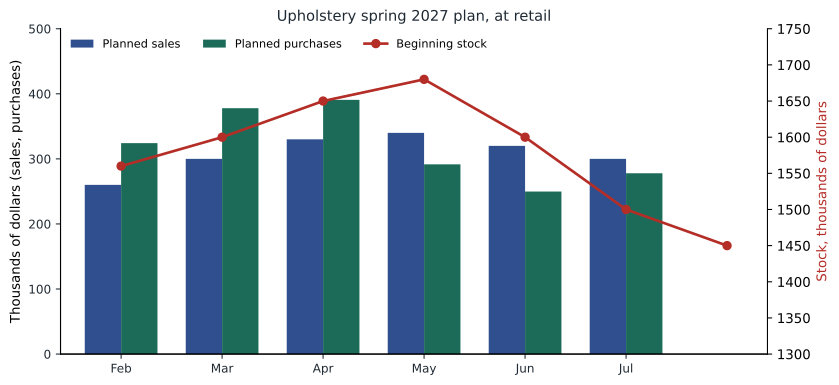
Next, Noura set the stock the department would carry at the start of each month, using stock-to-sales ratios as in lesson 9. She planned February higher than the other months, because the floor must be fully stocked when the season opens and February sales are low, and planned stock to fall through June and July as the season winds down and fall goods begin to arrive in August.
| Month (2027) | Planned sales | Planned BOM | BOM stock-to-sales ratio |
|---|---|---|---|
| February | 260,000 | 1,560,000 | 6.0 |
| March | 300,000 | 1,600,000 | about 5.33 |
| April | 330,000 | 1,650,000 | 5.0 |
| May | 340,000 | 1,680,000 | about 4.94 |
| June | 320,000 | 1,600,000 | 5.0 |
| July | 300,000 | 1,500,000 | 5.0 |
| End of July (EOM) | 1,450,000 |
Step 5: Work out the purchases and open-to-buy
With sales, reductions and stock planned, the purchases for each month follow from the equation in lesson 9.
| Month | Sales | Reductions (9.3 in 100) | EOM | BOM | Planned purchases |
|---|---|---|---|---|---|
| February | 260,000 | 24,180 | 1,600,000 | 1,560,000 | 324,180 |
| March | 300,000 | 27,900 | 1,650,000 | 1,600,000 | 377,900 |
| April | 330,000 | 30,690 | 1,680,000 | 1,650,000 | 390,690 |
| May | 340,000 | 31,620 | 1,600,000 | 1,680,000 | 291,620 |
| June | 320,000 | 29,760 | 1,500,000 | 1,600,000 | 249,760 |
| July | 300,000 | 27,900 | 1,450,000 | 1,500,000 | 277,900 |
| Season | 1,850,000 | 172,050 | 1,912,050 |
Worked problem
Season purchases and the reserve
Planned purchases for the season total 1,912,050 dollars at retail. With an initial markup of 52 in 100, what is that at cost? Juniper & Pine commits 70 in 100 of planned purchases before the season and holds 30 in 100 for reorders. How much is that at retail and at cost?
Show solution
- At cost: 1,912,050 × 0.48 = 917,784 dollars.
- Committed before the season: 1,912,050 × 0.70 = 1,338,435 dollars at retail; at cost, 1,338,435 × 0.48 = 642,448.80 dollars.
- Held in reserve: 1,912,050 × 0.30 = 573,615 dollars at retail; at cost, 573,615 × 0.48 = 275,335.20 dollars.
Answer: The season plan allows about 917,784 dollars of purchases at cost. About 642,449 dollars is committed before February; about 275,335 dollars is held back to reorder winners after the first weeks of sell-through.
Step 6: Check turn and GMROI
Before presenting the plan, Bev asked Noura to check it against the measures from lessons 6 and 7. A plan that hit its sales and margin targets by carrying too much stock would not be an improvement.
Worked problem
Is the plan leaner than 2025?
The plan's seven stock figures (the six BOMs and the final EOM) are 1,560,000; 1,600,000; 1,650,000; 1,680,000; 1,600,000; 1,500,000 and 1,450,000 dollars at retail. The stock carries a 52 in 100 markup. Find the average inventory at retail and at cost, the season's turn at retail and GMROI, and annualize both by doubling (the season is six months). Compare with 2025's upholstery turn at retail of about 2.22 and GMROI of about 2.12.
Show solution
- Average inventory at retail = 11,040,000 ÷ 7 ≈ 1,577,143 dollars.
- Average inventory at cost ≈ 1,577,143 × 0.48 ≈ 757,029 dollars.
- Season turn at retail = 1,850,000 ÷ 1,577,143 ≈ 1.17; annualized ≈ 2.35.
- Season GMROI = 851,000 ÷ 757,029 ≈ 1.12; annualized ≈ 2.25.
Answer: On an annual basis, the plan would turn upholstery stock about 2.35 times at retail, up from about 2.22, and earn a GMROI of about 2.25, up from about 2.12. The improvement comes from carrying about 23,000 dollars less stock at cost on average while holding the margin rate at 46 in 100.
Doubling a six-month figure is a rough way to annualize, because spring and fall seasons are not identical, but it is good enough to show that the plan moves in the right direction.
Step 7: The assortment and the price lines
The dollars in the plan buy the assortment from lesson 10 and are priced using the decisions from lesson 11. The key choices were these.
- Five sofa and sectional styles, 19 SKUs, with deep stock only in grey and oatmeal. The 60 spring sectionals split 27 grey, 20 oatmeal, 7 navy and 6 terracotta, plus a small test of a right-chaise Style A in grey.
- Three sofa price lines at 999, 1,799 and 2,799 dollars, with prices ending in 99, a planned unit mix of 30, 45 and 25 in 100 and a planned average price of 1,809 dollars.
- Two items cut from the assortment (a duplicate recliner and a slow loveseat), with special orders through fabric programs to offer breadth without stock.
- One spring promotional weekend in April, sized so that the promotion's markdowns fit within the 148,000-dollar budget, and no clearance events planned before July.
Step 8: Checkpoints
A plan is only useful if the store checks it against reality and acts. Bev and Noura set out the checkpoints they would use, each tied to a measure from the course.
| When | Measure | Trigger | Action |
|---|---|---|---|
| Every week | Open-to-buy | Falling because sales are below plan | Hold back reorders; review slow sellers |
| Week 4 of the season | Sell-through of test colours and new styles | Below 20 in 100 | Move display; take a first markdown by week 6 if still slow |
| Week 4 of the season | Sell-through of core colours | Above plan | Release reserve open-to-buy for reorders |
| Every month | Markdowns against the 148,000-dollar budget | More than the month's share | Find the cause before more markdowns are taken |
| Every month | Weeks of supply on core SKUs | More than about 8 weeks | Pause reorders |
| End of April | Gross margin rate to date | Below 45 in 100 | Review pricing, discounts and mix with Bev |
Tessa added one note for the July planning. Nothing in Saskatchewan's sales taxes was expected to change during the season, so the GST and PST of 11 in 100 combined would apply throughout.
Step 9: The risks
The owners asked what could go wrong. Noura listed three risks. Furniture demand could weaken if interest rates or the job market changed, which would show up first as falling open-to-buy and rising weeks of supply. Suppliers' lead times could lengthen, making the reserve harder to use for reorders. And a competitor could open nearby or run aggressive promotions, which the weekly competitor check would catch on comparable goods but not on exclusive furniture. For each, the plan's checkpoints gave an early warning and a set of responses, which is the main reason to plan in this much detail.
The owners approved the plan. As the meeting ended, Bev turned to the back of the room. "Nine weeks ago," she said to Aiden, "you asked why an associate needs to know any of this. Half the decisions in that plan came from things you and Carl told Noura on the floor. Keep doing that, and keep doing it with numbers."
The questions the owners asked
The owners' questions were a useful test of the plan. The first was why the plan called for only 4 in 100 growth. Noura answered that the department's problem in 2026 had been margin, not sales, and that forecasting higher sales would have meant buying more stock and taking more risk with no evidence that customers wanted more. The second question was why stock would rise in the spring at all, when the plan was meant to be leaner. Bev pointed out that stock rises to meet the May peak in sales and falls faster afterwards, and that the average stock across the season would still be lower than in 2025.
The third question came from the owner who had started the business. She asked what the plan would look like if sales came in 10 in 100 below forecast. Noura showed that falling sales would reduce open-to-buy automatically each week, that the 30 in 100 reserve would simply not be spent, and that the markdown budget would protect the margin rate unless the slowdown lasted more than two months. "The plan doesn't predict the future," Bev said. "It tells us how we'll know we were wrong, and what we'll do about it."
Common mistakes
MistakeStarting a season plan from a target instead of last season's results.
InsteadBegin with what actually happened and why.
MistakePlanning sales without planning reductions and stock.
InsteadPlan sales, reductions, BOM and EOM together so purchases follow.
MistakeCommitting all purchases before the season.
InsteadHold part of open-to-buy for reorders.
MistakeApproving a plan without checking turn and GMROI.
InsteadMake sure margin targets are not being met by carrying excess stock.
MistakeWriting a plan without checkpoints.
InsteadSet measures, triggers and actions to compare the plan with reality.
Summary and key terms
- A season plan starts from last season's results and their causes.
- Juniper & Pine's spring 2027 upholstery plan forecasts 1,850,000 dollars of sales, 4 in 100 above spring 2026, spread across the months by seasonal pattern.
- Reductions are planned at 9.3 in 100 of sales; with a 52 in 100 initial markup, the gross margin rate returns to about 46 in 100, or 851,000 dollars, with a 148,000-dollar markdown budget.
- Planned stock levels and the purchases equation give monthly purchases totalling 1,912,050 dollars at retail, or 917,784 dollars at cost, with 30 in 100 held back for reorders.
- The plan's annualized turn and GMROI are better than 2025's because it carries less stock at the same margin.
- The assortment, price lines and promotion follow the earlier lessons.
- Weekly and monthly checkpoints on open-to-buy, sell-through, markdowns, weeks of supply and margin turn the plan into a tool for acting during the season.
- Season plan
- A month-by-month plan of sales, reductions, stock and purchases for a selling season.
- Markdown budget
- The planned markdowns for a season, as dollars or a share of planned sales.
- Reserve open-to-buy
- The part of planned purchases held back for reorders and new opportunities.
- Checkpoint
- A planned review of a measure against a trigger, with an agreed action.
Practice problems
Work each problem on paper first, then reveal the answer to check.
Last spring's sales were 900,000 dollars. A plan calls for 5 in 100 growth. What is the new sales plan?
Show answer
900,000 × 1.05 = 945,000 dollars.
A plan forecasts 945,000 dollars of sales at a gross margin rate of 44 in 100. What gross margin does it imply?
Show answer
945,000 × 0.44 = 415,800 dollars.
A season's planned purchases are 1,000,000 dollars at retail, and 25 in 100 is held in reserve. With a 50 in 100 initial markup, how much is the reserve at cost?
Show answer
1,000,000 × 0.25 = 250,000 at retail; × 0.50 = 125,000 dollars at cost.
Lesson quiz · 5 questions
Score 60% or more to complete this lesson.
Create a free account to save your progress, take quizzes and earn a certificate.