
SLS-253 · Lesson 4 of 12 · 25 min
Gross margin
▶ Video coming soon A video version of this lesson is on the way.
Aiden had a good Saturday on October 3, 2026. He sold a sofa, two mattresses and a refrigerator, and his sales total for the day was higher than anyone else's in the furniture gallery. At the numbers morning on October 5, Bev used his day as the example, with his permission. "Aiden sold more than anyone," she said. "Now let's see how much he made for the store." She showed that one of his sales, the refrigerator, had contributed less gross margin than a pair of nightstands sold by a colleague. Nobody was being criticized. The point was that sales and margin are different measures, and a store lives on margin.
Gross margin and markup
Gross margin is net sales minus the cost of goods sold. It is the money available to pay the store's operating expenses and leave a profit. The gross margin rate is gross margin divided by net sales. For a single item sold at its ticket price, with no other costs or discounts, the gross margin rate equals the markup on retail. For a department or a store over a period, the two differ, because gross margin reflects everything that happened between the ticket and the sale: markdowns, employee discounts, shrink, supplier cash discounts and workroom costs.
Retailers often build gross margin up in steps.
- Start with initial markup, the markup on goods when they are first ticketed.
- Subtract reductions (markdowns, employee discounts and shrink) to get maintained markup, as lesson 3 showed.
- Add cash discounts earned by paying suppliers early, and subtract workroom costs such as assembly, repairs and alterations, to get gross margin.
Different retailers draw these lines slightly differently. Some put shrink into cost of goods sold, some put freight there and some treat it as an operating expense, and some report delivery income alongside merchandise sales. When you compare a department's margin with another store's, or with an industry benchmark, check what is included.
Worked problem
From maintained markup to gross margin
Lesson 3 found that upholstery's maintained markup in 2025 was about 47.5 in 100 of net sales. The department earned cash discounts from suppliers worth 0.5 in 100 of net sales and spent 2.0 in 100 of net sales on assembly and touch-up repairs. What was its gross margin rate? On 2025 net sales of 3.6 million dollars, what was its gross margin in dollars?
Show solution
- Gross margin rate ≈ 47.5 + 0.5 − 2.0 = 46.0 in 100.
- Gross margin = 3,600,000 × 0.46 = 1,656,000 dollars.
Answer: Upholstery earned a gross margin of about 46 in 100, or about 1.66 million dollars on 3.6 million dollars of sales.
The store's margin by department
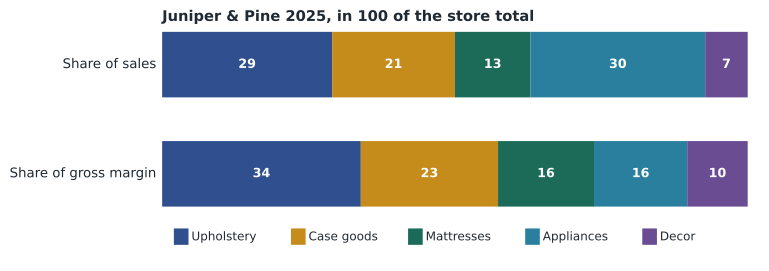
Juniper & Pine's five departments earn very different margins. Appliances are sold by many competitors at similar prices and carry low margins. Mattresses sold under the store's own label and décor that customers cannot easily compare carry high ones. Furniture sits in between.
| Department | 2025 net sales | Gross margin rate | Gross margin |
|---|---|---|---|
| Upholstery (sofas, sectionals, chairs) | 3.6 million | 46 in 100 | 1.656 million |
| Case goods (bedroom and dining) | 2.6 million | 44 in 100 | 1.144 million |
| Mattresses | 1.6 million | 50 in 100 | 0.800 million |
| Appliances | 3.7 million | 21 in 100 | 0.777 million |
| Décor and accessories | 0.9 million | 56 in 100 | 0.504 million |
| Store total | 12.4 million | about 39.4 in 100 | 4.881 million |
The store's overall rate, about 39.4 in 100, is the total gross margin divided by total sales. It is a weighted average of the departments' rates, with each department weighted by its share of sales. That is why the store's rate can change even when no department's rate changes at all.
The mix effect
A change in the share of sales coming from each department is called a change in sales mix. When sales shift toward lower-margin departments, the store's gross margin rate falls; when they shift toward higher-margin ones, it rises. The mix effect is one of the most common reasons a store's margin moves, and one of the most commonly misread. A manager who sees the margin rate drop may assume prices or markdowns are the problem, when the real cause is simply that the store sold more refrigerators and fewer sofas.
Worked problem
A shift toward appliances
Suppose that in 2026 Juniper & Pine's total sales stay at 12.4 million dollars and every department earns the same margin rate as in 2025, but appliance sales rise by 0.5 million dollars and upholstery sales fall by the same amount. What happens to the store's gross margin and its rate?
Show solution
- Change from appliances = +0.5 × 0.21 = +0.105 million dollars.
- Change from upholstery = −0.5 × 0.46 = −0.230 million dollars.
- New gross margin = 4.881 + 0.105 − 0.230 = 4.756 million dollars.
- \[\text{New rate} = \frac{4.756}{12.4} \approx 0.384\]
Answer: Gross margin falls by 125,000 dollars and the rate falls from about 39.4 to about 38.4 in 100, even though sales are unchanged and no department's margin rate moved. The whole change comes from the mix.
Rate or dollars?
Gross margin can be discussed as a rate or as dollars, and the two sometimes point in different directions. A promotion that lowers the price usually lowers the margin rate, but it may raise margin dollars if it sells enough extra units. A store pays its rent and wages with margin dollars, not with a rate, so dollars are what count in the end. The rate matters because it shows how much each sale contributes and warns when something is eroding profitability.
The negotiation course showed that, to keep gross margin dollars unchanged after a price cut d on an item with margin rate m, volume must rise by d ÷ (m − d). The same formula tells a retail buyer how many more units a promotion must sell to pay for itself.
Worked problem
Does a 15 in 100 promotion pay for itself?
A sectional normally sells at a gross margin rate of 46 in 100. A buyer proposes a promotion at 15 in 100 off. Last year, the store sold about 100 of these sectionals in the six weeks the promotion would cover. The buyer expects the promotion to raise unit sales by 25 in 100. Will gross margin dollars rise or fall?
Show solution
- Let the regular price be P. Gross margin per unit at regular price = 0.46P.
- Cost per unit = 0.54P. At the promotion price of 0.85P, margin per unit = 0.85P − 0.54P = 0.31P.
- Without the promotion: 100 × 0.46P = 46P.
- With the promotion: 125 × 0.31P = 38.75P.
- \[\text{Break-even volume increase} = \frac{0.15}{0.46 - 0.15} = \frac{0.15}{0.31} \approx 0.484\]
Answer: Gross margin falls from 46P to 38.75P, about 16 in 100 lower. The promotion would need to raise unit sales by about 48 in 100 just to break even. Unless it brings in extra traffic that buys other goods, or clears stock the store needs to move, it does not pay for itself.
That calculation is why Juniper & Pine plans its promotions around goods it wants to clear, new products it wants to introduce and weekends when shoppers are already looking, rather than discounting its best sellers whenever sales feel slow.
Margin at the sales counter
Associates affect margin in ways a sales report does not show. Bev walked through Aiden's Saturday to make the point.
| Sale | Price | Cost | Gross margin |
|---|---|---|---|
| Three-seat sofa | 2,199 | 1,150 | 1,049 |
| Five-year stain protection plan on the sofa | 199 | 79 | 120 |
| Refrigerator (landed cost) | 1,899 | 1,465 | 434 |
| Two queen mattresses, store label | 2,398 | 1,199 | 1,199 |
| Total | 6,695 | 3,893 | 2,802 |
The refrigerator was more than a quarter of Aiden's sales but contributed only about 15 in 100 of his gross margin. The protection plan, which took two minutes to explain, earned the store more than a quarter as much margin as the refrigerator. The mattresses, at keystone markup, earned the most. Bev drew two lessons. First, associates should know which products and services carry high margins, so they recommend them when they genuinely suit the customer. Second, associates should never discount the low-margin products casually, because a 100-dollar concession on the refrigerator takes almost a quarter of its margin.
Carl Jensen added a third point from the appliance department. "Margin isn't only the ticket," he said. "If I sell a fridge that doesn't fit through the customer's door, we pay for two deliveries and maybe a restocking cost on the return. A good measurement at the start is margin too."
Why many stores pay commission on margin
Juniper & Pine pays its furniture associates commission on gross margin rather than on sales. Many retailers of high-ticket goods do the same. When commission is paid on sales, an associate who gives a 10 in 100 discount loses only 10 in 100 of their commission on that sale, while the store loses a much larger share of its margin. When commission is paid on margin, the associate and the store share the cost of the discount in proportion, and associates think harder before giving one. The appliance department, where margins are thin and prices are set centrally, pays a smaller commission on sales plus a bonus on protection plans and delivery packages.
Worked problem
What a discount costs the associate
A furniture associate earns 8 in 100 of gross margin. On a 2,199-dollar sofa that costs 1,150 dollars, the customer asks for 200 dollars off. How much does the discount cost the store and the associate?
Show solution
- Gross margin at full price = 2,199 − 1,150 = 1,049 dollars; commission = 0.08 × 1,049 = 83.92 dollars.
- Gross margin after the discount = 1,049 − 200 = 849 dollars; commission = 0.08 × 849 = 67.92 dollars.
- The store loses 200 dollars of margin, about 19 in 100 of the margin on the sale; the associate loses 16 dollars of commission.
Answer: The discount reduces the store's margin on the sale by about 19 in 100 and the associate's commission by the same proportion, 16 dollars.
Shrink and the margin you think you earned
Shrink is one of the quieter ways gross margin disappears. It is the difference between the inventory a store's records say it should have and the inventory actually counted, and it comes from theft by shoppers and employees, damage, paperwork and receiving errors, and occasionally supplier fraud. In a furniture store, damage and receiving errors usually matter more than shoplifting, because a sectional is hard to carry out the door; in décor, with small, valuable items near the entrance, theft matters more.
Because a full physical count is done only once or twice a year, retailers record a shrink provision each month, an estimate based on past results, so that monthly margin reports are not overstated. When the count is done, the difference between the provision and the actual shrink is booked as an adjustment. A store that under-provides for shrink will report healthy margins all year and then take a painful adjustment after the count.
Worked problem
The effect of shrink on décor's margin
Décor provided for shrink at 1.0 in 100 of its 2025 sales of 900,000 dollars. The year-end count found shrink of 1.8 in 100. How large was the adjustment, and what did it do to décor's gross margin rate?
Show solution
- Provision = 900,000 × 0.010 = 9,000 dollars.
- Actual shrink = 900,000 × 0.018 = 16,200 dollars.
- Adjustment = 16,200 − 9,000 = 7,200 dollars.
- Effect on the margin rate = 7,200 ÷ 900,000 = 0.008, or 0.8 points.
Answer: The count added 7,200 dollars of shrink, cutting décor's gross margin rate by 0.8 points from what the monthly reports had shown. Marcus moved the smallest, most valuable décor items to a display near the cash desk for 2026.
Common mistakes
MistakeTreating sales and gross margin as the same thing.
InsteadLook at margin dollars and rate as well as sales.
MistakeBlaming prices for a falling margin rate without checking mix.
InsteadSeparate the mix effect from changes in each department's rate.
MistakeJudging a promotion by the extra units it sells.
InsteadCompare margin dollars with and without the promotion, using d ÷ (m − d).
MistakeComparing margins without checking what each includes.
InsteadConfirm how freight, shrink, workroom costs and cash discounts are treated.
MistakeDiscounting low-margin products casually.
InsteadKnow each category's margin before you offer a concession.
Summary and key terms
- Gross margin is net sales minus cost of goods sold; the gross margin rate divides it by net sales.
- Gross margin builds from initial markup, minus reductions to maintained markup, plus cash discounts and minus workroom costs.
- Juniper & Pine's 2025 gross margin was 4.881 million dollars, about 39.4 in 100 of sales, with departments ranging from 21 in 100 for appliances to 56 in 100 for décor.
- The store's rate is a weighted average of the departments' rates, so a shift in sales mix changes it even when no department's rate changes.
- Margin dollars pay the bills; a promotion pays for itself only if volume rises by more than d ÷ (m − d).
- Associates affect margin through what they recommend, the discounts they give and the mistakes they avoid.
- Paying commission on margin aligns associates with the store.
- Gross margin
- Net sales minus cost of goods sold.
- Gross margin rate
- Gross margin divided by net sales.
- Cash discount
- A reduction a supplier gives for paying an invoice early.
- Workroom costs
- Costs of preparing goods for sale, such as assembly and repairs.
- Sales mix
- The share of total sales coming from each department or category.
- Mix effect
- A change in overall margin rate caused by a change in sales mix.
Practice problems
Work each problem on paper first, then reveal the answer to check.
A department with net sales of 500,000 dollars has a gross margin rate of 42 in 100. What is its gross margin in dollars?
Show answer
500,000 × 0.42 = 210,000 dollars.
An item has a margin rate of 40 in 100. A promotion takes 10 in 100 off. By how much must volume rise to keep margin dollars the same?
Show answer
0.10 ÷ (0.40 − 0.10) = 0.10 ÷ 0.30 ≈ 0.333, or about 33 in 100.
If appliance sales rise by 200,000 dollars and décor sales fall by 200,000 dollars, with rates of 21 and 56 in 100, how does gross margin change?
Show answer
+200,000 × 0.21 − 200,000 × 0.56 = 42,000 − 112,000 = −70,000 dollars.
Lesson quiz · 5 questions
Score 60% or more to complete this lesson.
Create a free account to save your progress, take quizzes and earn a certificate.