
SLS-253 · Lesson 9 of 12 · 25 min
Open-to-buy
▶ Video coming soon A video version of this lesson is on the way.
The last of Bev's numbers mornings, on November 9, 2026, was the one Noura had been waiting for. In the spring, she had placed orders with three upholstery suppliers before anyone knew how the season would go, and she had ended up with the mustard chairs from lesson 3 and too many navy sectionals. For spring 2027, the store's owners had asked for a written buying plan before any orders were placed. "We're going to work out how much we can spend each month before we spend it," Bev said. "That number has a name: open-to-buy."
What open-to-buy is
Open-to-buy (OTB) is the amount of merchandise a buyer can still order for a period without exceeding the inventory the plan allows. It is the main budgeting tool in retail buying. A buyer with open-to-buy can place new orders, take advantage of a supplier's special offer or reorder a fast seller. A buyer with none, or with a negative figure, is overbought and should not order more until sales, markdowns or cancellations bring the plan back into balance.
Open-to-buy is calculated from a merchandise plan, which sets out, month by month, the sales a department expects, the reductions it expects to take, and the inventory it wants to have at the start and end of each month. Most retailers build the plan at retail value, because sales, markdowns and inventory targets are all naturally expressed in retail dollars, and convert to cost when orders are placed.
The basic equation
Every dollar of merchandise that leaves the department in a month leaves through sales or reductions. Every dollar that arrives comes through purchases. The inventory at the end of the month must therefore equal the inventory at the start, plus purchases, minus sales and reductions. Rearranging gives the purchases the plan needs:
The abbreviations are standard: BOM for beginning-of-month stock and EOM for end-of-month stock. One month's EOM is the next month's BOM. Reductions are markdowns, employee discounts and shrink, as in lessons 2 and 3. Purchases mean goods received in the month, whenever they were ordered.
Open-to-buy is planned purchases minus the goods already on order for delivery in that month:
Because suppliers quote costs, not retail prices, the buyer converts the retail open-to-buy to cost using the planned initial markup on retail from lesson 2:
Worked problem
Upholstery's open-to-buy for March 2027
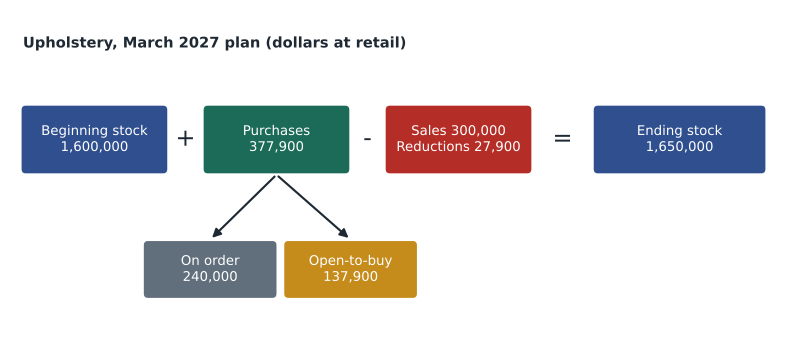
The draft spring plan for upholstery shows, for March 2027: planned sales of 300,000 dollars; planned reductions of 9.3 in 100 of sales; planned BOM of 1,600,000 dollars; and planned EOM of 1,650,000 dollars, all at retail. Noura already has 240,000 dollars at retail on order for March delivery. The planned initial markup is 52 in 100. What is March's open-to-buy at retail and at cost?
Show solution
- Planned reductions = 300,000 × 0.093 = 27,900 dollars.
- Planned purchases = 300,000 + 27,900 + 1,650,000 − 1,600,000 = 377,900 dollars at retail.
- Open-to-buy at retail = 377,900 − 240,000 = 137,900 dollars.
- Open-to-buy at cost = 137,900 × (1 − 0.52) = 137,900 × 0.48 = 66,192 dollars.
Answer: Noura can still order about 137,900 dollars of upholstery at retail for March delivery, which is about 66,192 dollars at cost.
Setting the stock levels
The hardest part of the plan is deciding how much stock to hold. Too little and the floor looks bare and customers cannot find their size or colour; too much and turn, GMROI and markdowns all suffer. Many retailers plan beginning-of-month stock with a stock-to-sales ratio: the BOM stock divided by the month's planned sales, both at retail. A department's history shows what ratios it has needed to support its sales, and the buyer adjusts them for the coming season.
A stock-to-sales ratio of 5.0 means the department starts the month with stock worth five times that month's sales. Furniture stores carry high ratios because customers expect to see each style and colour on the floor before they buy. Upholstery's ratios at Juniper & Pine have averaged a little above 5. The ratio is related to stock turn: a department that holds five months of sales at all times turns its stock a little more than twice a year.
Worked problem
Planning April's opening stock
Upholstery plans April 2027 sales of 330,000 dollars, a little higher than March because of spring promotions. Its planned BOM stock-to-sales ratio for April is 5.0. What BOM stock should the plan show for April? What stock-to-sales ratio does March's plan imply?
Show solution
- April BOM = 330,000 × 5.0 = 1,650,000 dollars at retail.
- March BOM ratio = 1,600,000 ÷ 300,000 ≈ 5.33.
Answer: April should open with 1,650,000 dollars of stock at retail, which is also March's planned EOM. March's plan implies a stock-to-sales ratio of about 5.33, a little higher because March sales are lower.
Open-to-buy changes as the month goes on
Open-to-buy is not calculated once and forgotten. As actual sales come in, the buyer revises the plan. If sales run below plan, less merchandise leaves the department, stock builds up, and the purchases the plan allows fall. If sales run above plan, the buyer gains open-to-buy and can reorder. Most retail systems recalculate open-to-buy every week.
Worked problem
A slow first half of March
Halfway through March 2027, suppose upholstery has sold 120,000 dollars against a plan of 150,000 for the first half. Noura lowers her forecast for the month to 270,000 dollars and keeps the EOM target at 1,650,000 dollars. With reductions still at 9.3 in 100 of sales and 240,000 dollars on order, what happens to March's open-to-buy?
Show solution
- Revised reductions = 270,000 × 0.093 = 25,110 dollars.
- Revised planned purchases = 270,000 + 25,110 + 1,650,000 − 1,600,000 = 345,110 dollars.
- Revised open-to-buy at retail = 345,110 − 240,000 = 105,110 dollars.
- At cost: 105,110 × 0.48 ≈ 50,453 dollars.
Answer: Open-to-buy falls from 137,900 to 105,110 dollars at retail, about 32,790 dollars less, or about 15,739 dollars at cost. Slower sales automatically tighten the buying budget, which is exactly what the plan is designed to do.
This is the discipline the mustard chairs lacked. Had Juniper & Pine been running a merchandise plan in spring 2026, the slow sell-through would have shown up as shrinking open-to-buy within weeks, and the buyer would have had to choose between marking down the chairs and giving up other orders.
Being overbought
When merchandise on order exceeds planned purchases, open-to-buy is negative and the department is overbought for that month. It happens when sales fall short, when a buyer commits early to secure a supplier's price or production slot, or simply when too much was ordered.
Worked problem
Too much on order
If Noura had 420,000 dollars at retail on order for March instead of 240,000, with the original plan, what would March's open-to-buy be?
Show solution
- Planned purchases are 377,900 dollars, as before.
- Open-to-buy = 377,900 − 420,000 = −42,100 dollars.
Answer: March would be overbought by 42,100 dollars at retail. Unless sales rise, the department will end March with about 42,100 dollars more stock than planned.
A buyer who is overbought has several options: ask suppliers to delay or cancel shipments where the contract allows; move goods to another month by changing delivery dates; plan a promotion to raise sales; transfer stock to another location if the company has one; or accept higher stock and plan to work it down over the following months. Each has a cost, which is why preventing overbuying is better than fixing it.
| Situation | What it means | Typical response |
|---|---|---|
| Open-to-buy positive and sales on plan | Room to buy as planned | Place orders for the season's remaining needs |
| Open-to-buy rising because sales exceed plan | Stock is being sold faster than expected | Reorder the best sellers; check supplier lead times |
| Open-to-buy falling because sales are below plan | Stock is building up | Hold back new orders; review slow sellers |
| Open-to-buy negative | Overbought for the month | Delay or cancel orders, move deliveries, or plan a promotion |
Holding some open-to-buy in reserve
Experienced buyers rarely commit all their open-to-buy before a season starts. Keeping part of it in reserve, often called holding back open-to-buy, leaves room to reorder the styles that sell well, to buy new products that appear during the season and to respond when a supplier offers a special price. Juniper & Pine's spring plan commits about 70 in 100 of each month's planned purchases before the season and holds about 30 in 100 for reorders, decided after the first four weeks of sell-through. That reserve is what would have let the store reorder the grey and oatmeal sectionals in lesson 5 without becoming overbought.
Open-to-buy in dollars and in units
Open-to-buy is usually managed in dollars, but buyers also think in units. A dollar budget tells a buyer how much to spend; a unit plan tells the buyer how many sofas, in which styles and colours, the dollars should buy. Lesson 10 takes up that question as assortment planning, and lesson 12 combines the two into a full season plan.
Open-to-buy by classification
A department's open-to-buy is usually split further by classification, the groups of similar items a buyer manages, so that one class does not use up the budget another needs. Juniper & Pine splits upholstery into two classes: sofas and sectionals, and chairs and recliners. Their shares of planned sales give the starting split of open-to-buy, which the buyer then adjusts for each class's stock position.
Worked problem
Splitting March's open-to-buy
Sofas and sectionals are planned at 70 in 100 of upholstery sales in March 2027, and chairs and recliners at 30 in 100. Split March's open-to-buy of 137,900 dollars at retail in the same proportions, and convert each to cost at a 52 in 100 initial markup.
Show solution
- Sofas and sectionals: 137,900 × 0.70 = 96,530 dollars at retail; × 0.48 = 46,334.40 dollars at cost.
- Chairs and recliners: 137,900 × 0.30 = 41,370 dollars at retail; × 0.48 = 19,857.60 dollars at cost.
Answer: Noura can order about 96,530 dollars of sofas and sectionals and about 41,370 dollars of chairs and recliners at retail for March, unless one class's stock is already out of balance.
In practice the split is adjusted. If chairs and recliners start the month with too much stock, their share of open-to-buy is cut and some of it moves to sofas. Retail planning software keeps a separate plan for each class and adds them up to the department, which lets a buyer see exactly where open-to-buy is available and where the department is overbought.
Tracking open-to-buy during the month
Each week, the buyer's open-to-buy report compares the plan with what has actually happened. It shows sales and reductions to date, receipts to date, goods still on order for the month and the revised open-to-buy. The figures are kept at retail, because receipts are recorded at their ticketed retail value as soon as they arrive. Noura planned to review the report every Monday morning in 2027, the same time as Bev's numbers mornings, so that any slowdown in sales would show up in her buying decisions within a week rather than at the end of the month.
Open-to-buy is also a communication tool. When a sales associate reports that customers keep asking for an item the store does not carry, the first question a buyer asks is whether there is open-to-buy to add it. When an operations manager like Marcus warns that the warehouse is full, the open-to-buy report shows whether the stock that is coming is planned or not. Everyone in the store works from the same number.
Common mistakes
MistakeLeaving reductions out of the purchases calculation.
InsteadInclude planned markdowns, discounts and shrink, which remove stock just as sales do.
MistakeMixing retail and cost figures in the same plan.
InsteadBuild the plan at retail and convert open-to-buy to cost with the planned initial markup.
MistakeCalculating open-to-buy once at the start of the season.
InsteadRecalculate it every week as actual sales come in.
MistakeCommitting all open-to-buy before the season starts.
InsteadHold part of it back for reorders and new opportunities.
MistakeIgnoring a negative open-to-buy.
InsteadDelay, cancel or move orders, or plan to sell the extra stock.
Summary and key terms
- Open-to-buy is the merchandise a buyer can still order for a period without exceeding the planned inventory.
- Planned purchases equal planned sales plus planned reductions plus planned end-of-month stock minus planned beginning-of-month stock.
- Open-to-buy equals planned purchases minus merchandise already on order, and is converted to cost by multiplying by one minus the planned initial markup.
- One month's EOM is the next month's BOM.
- A BOM stock-to-sales ratio sets the opening stock from planned sales.
- Open-to-buy is recalculated as sales come in: slower sales reduce it, faster sales increase it.
- A negative open-to-buy means the department is overbought.
- Buyers hold part of their open-to-buy in reserve for reorders and new opportunities.
- Open-to-buy
- The merchandise that can still be ordered for a period without exceeding planned inventory.
- Merchandise plan
- A month-by-month plan of sales, reductions and stock for a department.
- BOM
- Beginning-of-month stock.
- EOM
- End-of-month stock.
- Stock-to-sales ratio
- Beginning-of-month stock divided by the month's sales, both at retail.
- Overbought
- Having more merchandise on order than the plan allows for a period.
Practice problems
Work each problem on paper first, then reveal the answer to check.
A department plans sales of 200,000 dollars, reductions of 16,000 dollars, BOM of 800,000 dollars and EOM of 850,000 dollars, all at retail. What are its planned purchases?
Show answer
200,000 + 16,000 + 850,000 − 800,000 = 266,000 dollars.
If 180,000 dollars at retail is already on order, what is its open-to-buy at retail, and at cost with a 50 in 100 initial markup?
Show answer
266,000 − 180,000 = 86,000 dollars at retail; 86,000 × 0.50 = 43,000 dollars at cost.
A month's planned sales are 150,000 dollars and the BOM stock-to-sales ratio is 4.5. What BOM should be planned?
Show answer
150,000 × 4.5 = 675,000 dollars.
Lesson quiz · 5 questions
Score 60% or more to complete this lesson.
Create a free account to save your progress, take quizzes and earn a certificate.