
SLS-298 · Lesson 10 of 12 · 28 min
Service and loyalty
▶ Video coming soon A video version of this lesson is on the way.
Stage 10 of the simulation turns from the stockroom to the customer. The brief, dated Monday, May 10, 2027, contains the department's post-delivery survey results for February to April, the complaint log, the Home Club report for upholstery, and the notes from the 30-day check-in calls that sellers began in March. The deliverable is a service and loyalty plan: a diagnosis of where service is falling short, service standards for the rest of the season, a recovery guide with clear limits of authority, and a plan for using the Home Club and follow-up contact properly.
In SLS-257, Tessa Yellowbird and Aiden built the case for the Home Club, which the owners approved on November 13, 2026 and which launched on Monday, February 1, 2027. Upholstery is the first department to run a full season with it. The owners will review the program on August 1, so the department's results matter beyond the season.
Why service decides loyalty in upholstery
A sofa is not a purchase customers make often. The average household buys one every seven to ten years. Loyalty in upholstery therefore does not come mainly from repeat sofa purchases. It comes from three other places: the related items a happy customer comes back for (a rug, a chair, pillows, a second room), the friends and family they send, and the reviews they write. All three depend less on the sale itself than on what happens after it: whether the lead time was explained honestly, whether delivery arrived when promised, and whether a problem was fixed without a fight.
This is why the stage 10 brief begins with service data rather than with Home Club sign-ups. A loyalty program can reward customers who are already pleased. It cannot rescue a customer who waited nine weeks for a sofa they were told would take five.
The survey results
Every customer who took delivery of upholstery received a short survey two days after delivery. Between February 1 and April 30, 210 customers answered the question "How likely are you to recommend Juniper & Pine to a friend?" on a scale from 0 to 10.
| Group | Scores | Responses |
|---|---|---|
| Promoters | 9 or 10 | 126 |
| Passives | 7 or 8 | 54 |
| Detractors | 0 to 6 | 30 |
| Total | 210 |
Worked problem
Net promoter score
Using the survey results, what is the department's net promoter score, and how does it compare with the store's October 2026 score of 55?
Show solution
- Share of promoters:
- \[\frac{126}{210} = 0.60\]
- Share of detractors:
- \[\frac{30}{210} \approx 0.143\]
- Net promoter score:
- \[60 - 14.3 \approx 46\]
Answer: The department's score is about 46, nine points below the store's October result. The score is still positive, but it is the clearest sign in the brief that something in the upholstery experience is costing goodwill.
The survey also asked customers to rate their overall satisfaction from 1 to 5, the measure behind the stage 3 quality goal. Of the 210 customers, 185 answered 4 or 5, which is about 88 in 100. That is above spring 2026's 87 but below the season goal of 90, and it tells the same story more gently than the recommend score.
A score is only a starting point. What matters is why the detractors scored low. The survey asked one open question, "What is the main reason for your score?", and Aiden sorted the 30 detractor comments into groups.
| Main reason | Detractors | Share |
|---|---|---|
| Delivery date changed or missed | 13 | 43 in 100 |
| Special-order lead time longer than expected | 8 | 27 in 100 |
| Fabric or quality problem | 5 | 17 in 100 |
| No follow-up after a question or problem | 4 | 13 in 100 |
| Total | 30 |
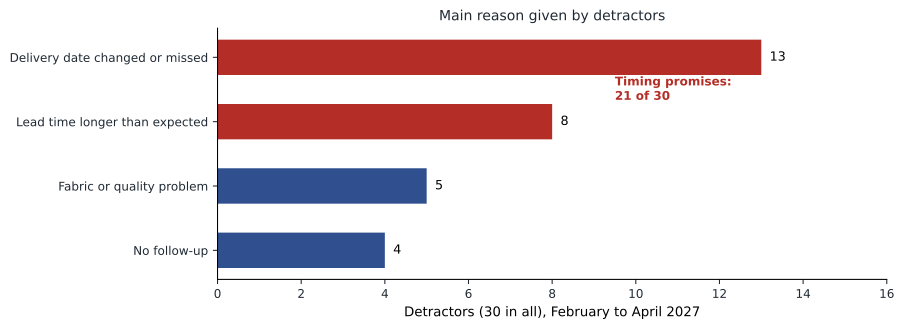
Twenty-one of the 30 detractors, 70 in 100, were unhappy about timing: either the delivery date moved or the special order took longer than they had understood. Only five complained about the product. That points to a department problem the team can fix, because the timing promise is made on the sales floor.
Finding the source of the timing problem
Aiden checked the eight lead-time complaints against the sales records. In six of them, the order form showed the supplier's standard lead time of seven weeks, but the customer said a seller had told them "about five weeks". Sellers were quoting the best case to close the sale. In the other two, the supplier had genuinely been late, and nobody had called the customer before the date passed.
The 13 delivery complaints had a different source. Delivery dates were confirmed when the order was placed, often seven weeks ahead, and were not reconfirmed. When the supplier shipped late or the warehouse could not receive the piece in time, the customer found out when the truck did not come. The store's October 2026 delivery changes, described in SLS-257, had reduced these complaints in other departments, but they had not yet been applied to special orders.
Worked problem
What a detractor costs
Suppose each promoter brings, on average, one referred purchase in the following year and each detractor discourages one purchase. The department's average transaction is 1,790 dollars at a gross margin of 46 in 100. If fixing the timing problems turned half of the 21 timing detractors into passives or promoters, what gross margin might that protect over a year?
Show solution
- Customers moved:
- \[21 \times 0.5 \approx 10\]
- Purchases protected:
- \[10 \times 1 = 10\]
- Gross margin protected:
- \[10 \times 1{,}790 \times 0.46 \approx 8{,}234 \text{ dollars}\]
Answer: Under these assumptions, about 8,200 dollars of gross margin a year. The assumption of one purchase per customer is rough, and the point is not the exact number. It is that the cost of a broken promise is real, and it is larger than the cost of a phone call to reconfirm a date.
Service standards for the rest of the season
A standard is a behaviour, not a hope. "Communicate better" is not a standard; "every customer receives a call or message 48 hours before delivery to confirm the window" is. Aiden wrote five standards for the department, each tied to a cause in the survey.
| Standard | Cause addressed | Measure |
|---|---|---|
| Quote the supplier's standard lead time on every special order, in writing on the order form, and say it out loud | Lead time longer than expected | Lead-time complaints |
| Reconfirm the delivery date with the customer two weeks before and again 48 hours before | Delivery date changed or missed | Delivery complaints; missed deliveries |
| Call the customer the same day if any date slips, with a new date and what the store will do | Missed dates without warning | Calls logged within one day |
| Answer every customer question or problem within one business day, even if only to say when a full answer will come | No follow-up | Response log |
| Inspect every special order on receipt, before the delivery is booked | Fabric or quality problem found at the customer's home | Problems found at receiving rather than at delivery |
Service recovery
Even with good standards, some things will go wrong. Service recovery is how the store responds when they do. Earlier courses taught the basic steps: listen, apologise without excuses, fix the problem, and follow up. In a department where problems are expensive, sellers and leads also need to know how much they can offer without asking.
| Who | Can offer without approval | Examples |
|---|---|---|
| Any seller | Up to 100 dollars in value | Free pillows, a fabric-protection kit, waiving a redelivery fee |
| Department lead (Aiden) | Up to 400 dollars in value | A partial refund, a loan floor model, priority delivery |
| Store manager (Bev) | Above 400 dollars | A full remake at the store's cost, a full refund outside the policy |
Worked problem
Recovering a special-order error
On April 28, a customer took delivery of a custom sofa in the wrong fabric. The order form shows the correct fabric, so the error was the supplier's. The sofa's price was 2,400 dollars. The supplier will remake it at no cost but needs seven weeks. The customer is hosting a family event in three weeks. What should Aiden offer?
Show solution
- Fix the problem: the supplier remakes the sofa at its cost; Aiden confirms the new date in writing.
- Bridge the gap: lend the customer a comparable floor model for the event, delivered within a week and collected when the new sofa arrives. Cost to the store: two delivery trips, about 160 dollars, within Aiden's limit.
- Acknowledge the inconvenience: a 10 in 100 goodwill credit on the order, which Aiden calculates as
- \[2{,}400 \times 0.10 = 240 \text{ dollars}\]
- Total value offered:
- \[160 + 240 = 400 \text{ dollars}\]
- Follow up: Aiden calls the day after the loan sofa arrives and again when the remake ships.
Answer: Aiden can offer the loan floor model and a 240-dollar credit, 400 dollars in all, within his own authority. He does not need to wait for Bev, which matters because speed is part of the recovery. The customer later scored the store 9.
A good recovery is fast, specific and owned by one person. A customer passed between a seller, the warehouse and the supplier will remember the passing more than the fix.
The Home Club in upholstery
The Home Club gives members one point per dollar, with 500 points worth a 10-dollar certificate. That is a reward of 2 in 100 of what members spend, before allowing for points that are never redeemed. SLS-257 assumed 30 in 100 of points would expire unused.
Worked problem
The cost of points in upholstery
From February 1 to April 30, Home Club members bought 548,000 dollars of upholstery. What is the cost of their points at face value, and after expected breakage of 30 in 100?
Show solution
- Face value of points:
- \[548{,}000 \times 0.02 = 10{,}960 \text{ dollars}\]
- Expected cost after breakage:
- \[10{,}960 \times (1 - 0.30) = 7{,}672 \text{ dollars}\]
- Member share of department sales:
- \[\frac{548{,}000}{911{,}000} \approx 0.60\]
Answer: Points cost the department about 7,700 dollars in expected certificates for the period, and 60 in 100 of upholstery sales went to members. Whether that is good value depends on whether members buy more or come back more often, which the August 1 review will test.
Two rules from the owners' approval apply on the floor. Sellers are not paid per sign-up, so nobody has a reason to push the club on a customer who does not want it. And joining does not depend on giving a mobile number for text messages: the 200-point joining bonus is given whether or not a member agrees to texts.
The 30-day check-in
In March, sellers began calling customers about 30 days after delivery to ask how the piece was working out. The calls had two purposes: to catch problems early, and to remind customers of care and warranty information. Many customers also asked about a rug, a chair or pillows to finish the room.
Worked problem
What the check-in calls produced
Between March 1 and April 30, sellers completed 180 check-in calls. Forty-one customers visited the store within three weeks of the call, and 23 bought something, with an average purchase of 310 dollars. What were the sales from these purchases, and what share of calls led to a purchase?
Show solution
- Sales:
- \[23 \times 310 = 7{,}130 \text{ dollars}\]
- Share of calls leading to a purchase:
- \[\frac{23}{180} \approx 0.128\]
Answer: The calls led to 7,130 dollars of sales, and about 13 in 100 of calls led to a purchase. Aiden cannot prove that all of these purchases were caused by the call; some customers would have come back anyway. The calls also found four early problems, two loose legs and two cushion concerns, that were fixed before they became complaints.
Contact rules
Service contact and marketing contact are treated differently by law, and the plan has to keep them apart.
| Contact | Rule in Saskatchewan and Canada |
|---|---|
| Delivery confirmations, warranty and care information | Under CASL, messages that only provide delivery, warranty or safety information do not need consent, but they still identify the store |
| Promotional emails and texts | CASL requires express or implied consent. A purchase gives implied consent for two years; the message must identify the store and include a working unsubscribe |
| Check-in phone calls | Calls to existing customers about their purchase are service calls; the store's own do-not-call list is respected |
| Use of customer information | PIPEDA: use it only for the purposes the customer was told about, and keep it secure |
In practice this means the 48-hour delivery confirmation can go to every customer who gave a phone number for delivery, but a message about a rug sale goes only to customers who have agreed to marketing messages, through the store's marketing system, not from a seller's own phone.
Template: the service and loyalty plan
| Section | What to include |
|---|---|
| Diagnosis | Survey score with working; detractor reasons; the source of the main problem |
| Standards | Each standard tied to a cause, with a measure |
| Recovery | Steps and limits of authority, with one worked case |
| Home Club | Member share, points cost and what the department will do |
| Follow-up | Check-in program, results and contact rules |
| Targets | What will be measured at the midseason review |
Aiden's targets for the midseason review were a net promoter score of 52 or more for May and June deliveries, no more than four timing complaints a month, every delivery reconfirmed 48 hours ahead, and the check-in program kept to all customers within 35 days of delivery.
Model answer and Bev's scoring
Bev scored the plan 18 out of 20. She gave full marks for the diagnosis, because Aiden had checked the complaints against the order forms rather than accepting the survey comments at face value, and for the recovery guide. She took a point from the standards because the lead-time standard did not say what a seller should do when a customer pushes for a faster date, and a point from the Home Club section because it reported the cost of points but not whether members were spending more than non-members.
| Criterion | Excellent (4) | Developing (2) | Aiden |
|---|---|---|---|
| Diagnosis | Score correct; reasons traced to evidence | Score only, or reasons accepted without checking | 4 |
| Standards | Specific behaviours tied to causes, with measures | General intentions | 3 |
| Recovery | Clear steps and limits, with a worked case | No limits of authority | 4 |
| Loyalty | Program cost and effect both assessed | Sign-ups counted only | 3 |
| Contact and compliance | Service and marketing contact separated; law respected | Marketing sent without consent | 4 |
Reflection
Think of a time you were promised a date that was not kept. What would have changed how you felt about the business? Why might a seller quote a shorter lead time than the supplier's, and how would you coach that seller?
Common mistakes
MistakeQuoting the best-case lead time to close a sale.
InsteadQuote the supplier's standard lead time in writing and out loud.
MistakeConfirming a delivery date once, seven weeks ahead.
InsteadReconfirm two weeks and 48 hours before, and call the same day if it slips.
MistakePassing an upset customer between departments.
InsteadOne person owns the recovery, within clear limits of authority.
MistakeJudging the loyalty program by sign-ups alone.
InsteadTrack its cost and whether members buy more or return more often.
MistakeSending sale messages from a seller's own phone.
InsteadSend marketing only to customers who agreed, through the store's system.
Summary and key terms
- In upholstery, loyalty comes mainly from related purchases, referrals and reviews, which all depend on service after the sale.
- The department's net promoter score was about 46, and 70 in 100 of detractors were unhappy about timing promises.
- Service standards are specific behaviours tied to causes, each with a measure.
- Service recovery is fast, specific and owned by one person, with clear limits of authority.
- Home Club points cost about 2 in 100 of member spending before breakage; their value depends on changes in member behaviour.
- Service messages and marketing messages follow different consent rules.
- Net promoter score
- The share of promoters minus the share of detractors, on a 0 to 10 likelihood-to-recommend question.
- Detractor
- A customer who scores 0 to 6 on the recommend question.
- Service standard
- A specific, measurable behaviour the team commits to.
- Service recovery
- The steps taken to put things right when service fails.
- Limit of authority
- The value a person can offer a customer without approval.
- Breakage
- Loyalty points or certificates that are never redeemed.
Practice problems
Work each problem on paper first, then reveal the answer to check.
A survey has 90 promoters, 40 passives and 20 detractors. What is the net promoter score?
Show answer
(90 − 20) ÷ 150 = 0.467, a score of about 47.
Members spend 200,000 dollars on furniture earning 2 in 100 in points, with breakage of 25 in 100. What is the expected cost of points?
Show answer
200,000 × 0.02 × 0.75 = 3,000 dollars.
A seller wants to offer a customer a 150-dollar credit. What should they do?
Show answer
Ask the department lead, because it is above the seller's 100-dollar limit.
Lesson quiz · 5 questions
Score 60% or more to complete this lesson.
Create a free account to save your progress, take quizzes and earn a certificate.