
SLS-298 · Lesson 9 of 12 · 26 min
Managing inventory and shrink
▶ Video coming soon A video version of this lesson is on the way.
Midway through the season the department closes for a few hours on the night of Sunday, May 2, 2027 for a full physical count. The stage 9 brief, dated Monday, May 3, contains the count result, the book inventory, the receiving and damage logs since February, the special-order and returns reports, Marcus's notes and the weekly cycle-count results. The deliverable is a count reconciliation and shrink action plan: what the gap is, where it most likely came from, and what will change.
SLS-252 explained shrink, receiving, counts and loss prevention from the store's operations side, with Marcus Dube teaching. This stage looks at the same subjects from the department's side. Upholstery is not a department where most shrink walks out the door in a pocket. Sofas are heavy. Most of its losses come from damage, paperwork and process, which a department lead can fix.
Preparing for the count
A count is only as good as its preparation. In the week before May 2, Aiden followed the store checklist from SLS-252. Every receipt and transfer was posted, every damage entry was made, the warehouse bays were tidied so that each sectional piece could be seen and its tag read, and special orders waiting for customer pickup were tagged with the customer's name so that they were counted as sold, not as stock. Counting was done in pairs: one person counts and reads the tag, the other records, and a third person recounts a sample of areas chosen at random. Any area where the recount differs is counted again before the team moves on. Aiden assigned Tessa and Carl to the warehouse and himself and Noura to the floor, and Marcus audited 10 areas. Two recount differences were found and fixed that night, both multi-piece sectionals where one piece had been recorded as a whole unit.
The count result
The book inventory is what the records say the department should have: the opening inventory, plus receipts, minus sales, markdowns, discounts and recorded damage, all at retail. The physical inventory is what was counted. The difference is shrink.
Worked problem
Shrink since the January count
The book inventory at retail on May 2 was 1,684,900 dollars and the physical count was 1,672,300 dollars. Department sales from February 1 to May 1 were 911,000 dollars. What is the shrink and its rate, and how does it compare with the 0.8 in 100 target?
Show solution
- Shrink:
- \[1{,}684{,}900 - 1{,}672{,}300 = 12{,}600 \text{ dollars}\]
- Shrink rate:
- \[\frac{12{,}600}{911{,}000} \approx 0.0138\]
- Shrink allowed by the target:
- \[911{,}000 \times 0.008 = 7{,}288 \text{ dollars}\]
- Gap:
- \[12{,}600 - 7{,}288 = 5{,}312 \text{ dollars}\]
Answer: Shrink was 12,600 dollars, about 1.4 in 100 of sales, against a target of 0.8. The department lost about 5,300 dollars more than the plan allowed in three months. At that rate, the season would end with shrink of about 25,000 dollars on 1.85 million of sales, almost double the plan.
A count gap is a symptom, not a diagnosis. Before anyone decides that theft is rising, the gap has to be broken down using the evidence.
Finding the causes
Aiden and Marcus worked through the logs together over two days, using the categories from SLS-252: theft, damage, and process errors such as receiving and paperwork. Each item they could explain was traced to a document; what they could not explain stayed in a separate line.
| Cause | Amount at retail (dollars) | Evidence |
|---|---|---|
| Damage not recorded | 5,900 | Two scuffed floor-model recliners and a sectional arm with a torn seam, moved to clearance without a damage entry; one freight-damaged sofa not claimed from the carrier within the claim window |
| Paperwork and process errors | 3,800 | Two special-order returns refunded but not received back into stock in the system; a recliner exchange delivered without the original being returned on the record |
| Unexplained | 2,900 | Accent pillows and one small ottoman missing from displays near the main aisle; four swatch books missing from the design centre |
| Total | 12,600 |
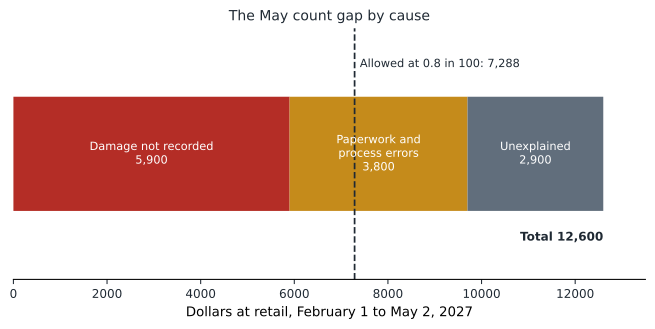
More than three-quarters of the gap, 9,700 dollars, came from damage and process errors, not from theft. Some of the "unexplained" amount may be theft of small items, but it may also be swatch books lent to customers and not returned. This matters for the action plan: a loss-prevention response aimed at shoplifting would have missed most of the problem.
Worked problem
How much was within the department's control?
What share of the gap came from damage and process errors?
Show solution
- \[\frac{5{,}900 + 3{,}800}{12{,}600} = \frac{9{,}700}{12{,}600} \approx 0.77\]
Answer: About 77 in 100 of the shrink came from things the department controls directly: recording damage, claiming freight damage on time, and processing returns and exchanges. Fixing those alone would bring the rate for the period down to about 0.3 in 100.
Damage: recording and claiming
Upholstery damage has two costs. The first is the lost value of the piece. The second, which turned the damage here into shrink, is that nobody recorded it. A recliner moved to clearance at 40 in 100 off without a damage entry leaves the book inventory still expecting it at full retail. When it sells at the lower price, the difference appears as a count gap.
Freight damage is worse, because part of it is recoverable. Most carriers and suppliers accept damage claims only within a short window after delivery, and only with photos and the damage noted on the delivery receipt. The sofa that arrived with a cracked frame in March was signed for without a note, so the claim could not be made. SLS-252's receiving procedure, inspect before signing, note any damage on the carrier's paperwork and photograph it, had been skipped on a busy Saturday.
Paperwork: returns and exchanges
The two special-order returns were refunded to the customer at the counter, but the returned sectionals went straight to the warehouse floor without being received back into stock. The system therefore counted them as sold, and the warehouse count then found two sectionals the records did not expect, while the refunds reduced sales. In this case the paperwork error and the extra stock partly cancelled each other in the count, but the recliner exchange did not: the replacement left the store, and the original never came back on the record.
Unexplained loss and the observe-and-report rule
The missing pillows and ottoman were near the main aisle, where they are easy to pick up. The store's response to suspected theft is the one in SLS-252 and the store's policy: staff observe and report. They greet customers, stay attentive, keep small items where sellers can see them, and tell the manager on duty or Marcus about anything suspicious. They do not chase, block, touch or detain anyone. The law on stopping a suspected shoplifter under the Criminal Code's citizen's arrest provisions is narrow and risky, and the store's policy is stricter than the law because staff and customer safety come first.
Practical steps for the department were simple: move the pillows and the small ottoman away from the main-aisle edge to displays sellers walk past, tether the swatch books to the design centre with a sign-out sheet for books lent to customers, and add the department to Marcus's weekly check of the CCTV coverage map, which uses cameras only in public areas and under the store's privacy policy in line with PIPEDA.
Cycle counts and inventory accuracy
A full count twice a year is not enough to catch errors early. Since February the department had cycle-counted 40 high-value items each week, comparing the system quantity with what was on the floor and in the warehouse.
Worked problem
Inventory record accuracy
In the last weekly cycle count before the full count, 36 of the 40 items matched the system exactly. What was the inventory record accuracy, and how does it compare with the store target of 95 in 100?
Show solution
- \[\frac{36}{40} = 0.90\]
Answer: Accuracy was 90 in 100, below the 95 target. Three of the four mismatches were special orders or exchanges, the same process gap the full count found. Aiden added a rule: every return and exchange is received in the system before the end of the shift, and the manager on duty checks the list at closing.
Keeping the right stock
Shrink is one inventory problem; running out of what sells is another. By early May the grey sectionals were selling faster than planned. Aiden used the reorder-point method from SLS-252.
Worked problem
When to reorder grey sectionals
Grey sectionals are selling about 2.2 a week. The supplier's lead time is 7 weeks, and Aiden keeps a safety stock of 3 units. There are 9 in stock and on the floor. What is the reorder point, and how many weeks of supply are on hand?
Show solution
- Reorder point:
- \[2.2 \times 7 + 3 = 18.4 \approx 18 \text{ units}\]
- Weeks of supply on hand:
- \[\frac{9}{2.2} \approx 4.1 \text{ weeks}\]
Answer: The reorder point is about 18 units, and the department has only 9, about four weeks of supply against a seven-week lead time. Aiden ordered 12 more grey sectionals from the reserve the same day. Some sales in June will still depend on special orders, which customers already accept will take seven weeks.
Aged floor models
The second source of avoidable loss is stock that sits. Floor models older than 120 days lose value through wear and because newer styles replace them. On May 3 the department had seven floor models over 120 days old, with a combined regular retail value of 16,400 dollars. Aiden's plan was to mark them down 25 in 100 in the May reset, move them to the signed clearance area, record each markdown properly, and review any still unsold at the end of June.
Worked problem
The cost of clearing aged floor models
What does a 25 in 100 markdown on 16,400 dollars of floor models cost from the markdown budget, and what is left to sell?
Show solution
- Markdown:
- \[16{,}400 \times 0.25 = 4{,}100 \text{ dollars}\]
- Selling value after markdown:
- \[16{,}400 - 4{,}100 = 12{,}300 \text{ dollars}\]
Answer: The markdown uses 4,100 dollars of the budget. Recording it properly matters as much as the price change: an unrecorded markdown shows up later as shrink, exactly the problem the count found.
Template: the count reconciliation and shrink plan
| Section | What to include |
|---|---|
| Count result | Book, physical, shrink and rate against target, with working |
| Breakdown | Causes with amounts and evidence; unexplained kept separate |
| Controllable share | How much the department can fix directly |
| Actions | One action per cause, with an owner and date |
| Stock health | Inventory accuracy, reorders and aged stock |
| Compliance | Observe-and-report and privacy rules respected |
| Cause | Action | Owner | Date |
|---|---|---|---|
| Unrecorded damage | Damage entry before any piece moves to clearance; weekly damage review | Aiden | From May 4 |
| Freight claims | Inspect and photograph before signing; note damage on carrier paperwork; claim within the window | Marcus's receivers | From May 4 |
| Returns and exchanges | Received in the system before the end of the shift; checked at closing | Manager on duty | From May 4 |
| Small items on display | Move away from main-aisle edge; swatch books tethered with sign-out sheet | Noura and Aiden | May reset |
| Accuracy | Weekly cycle count continues; target 95 in 100 | Aiden | Weekly |
Model answer and Bev's scoring
Bev scored the deliverable 18 out of 20. She gave full marks for the breakdown and for keeping the unexplained amount separate rather than calling it theft. She took a point from the actions because the damage review had no measure of success, and a point from compliance: the plan said "CCTV coverage" without saying who could view footage and for how long it is kept, which PIPEDA's principles require the store to be clear about.
| Criterion | Excellent (4) | Developing (2) | Aiden |
|---|---|---|---|
| Reconciliation | Book, physical, gap and rate correct | Arithmetic errors | 4 |
| Diagnosis | Causes traced to evidence; unexplained separate | Gap blamed on theft without evidence | 4 |
| Actions | One measurable action per cause, with owner and date | Generic actions | 3 |
| Stock health | Accuracy, reorders and aged stock addressed | Shrink only | 4 |
| Compliance | Observe-and-report and privacy fully respected | A risky or unlawful step | 3 |
Reflection
Why might a team be tempted to blame a count gap on theft? What would you say to a seller who wanted to follow a customer they suspected of taking a pillow?
Common mistakes
MistakeAssuming a count gap is theft.
InsteadBreak it down by cause using receiving, damage, returns and exchange records.
MistakeMoving damaged pieces to clearance without recording the damage.
InsteadRecord damage and markdowns before the price changes.
MistakeSigning for a delivery without inspecting it.
InsteadInspect, note damage on the paperwork and photograph it, then claim on time.
MistakeAsking staff to stop or follow suspected shoplifters.
InsteadObserve and report only, as store policy requires.
MistakeWaiting for the next full count to check accuracy.
InsteadCycle-count high-value items every week.
Summary and key terms
- Shrink is book inventory minus physical inventory; the May count found 12,600 dollars, about 1.4 in 100 of sales against a 0.8 target.
- About 77 in 100 came from unrecorded damage and process errors, not theft.
- Record damage and markdowns, claim freight damage on time, and receive returns and exchanges before the end of the shift.
- Staff observe and report suspected theft; they never chase, block, touch or detain.
- Weekly cycle counts, reorder points and a plan for aged floor models keep the stock healthy.
- Book inventory
- The inventory the records say should be on hand, at retail.
- Physical inventory
- The inventory counted, at retail.
- Shrink
- The amount by which book inventory exceeds physical inventory.
- Inventory record accuracy
- The share of items whose system quantity matches the count.
- Reorder point
- Expected demand over the lead time plus safety stock.
- Aged inventory
- Stock that has been on hand longer than a set limit, such as 120 days.
Practice problems
Work each problem on paper first, then reveal the answer to check.
Book inventory is 1,250,000 dollars and the count finds 1,241,000 on sales of 600,000. What is the shrink rate?
Show answer
9,000 ÷ 600,000 = 0.015, or 1.5 in 100.
A recliner selling 1.5 a week has a lead time of 6 weeks and a safety stock of 2. What is the reorder point?
Show answer
1.5 × 6 + 2 = 11 units.
Why does an unrecorded markdown show up as shrink?
Show answer
The book still expects the piece at full retail, so when it sells for less the difference appears as a count gap.
Lesson quiz · 5 questions
Score 60% or more to complete this lesson.
Create a free account to save your progress, take quizzes and earn a certificate.