
SLS-299 · Lesson 1 of 12 · 18 min
The capstone account
▶ Video coming soon A video version of this lesson is on the way.
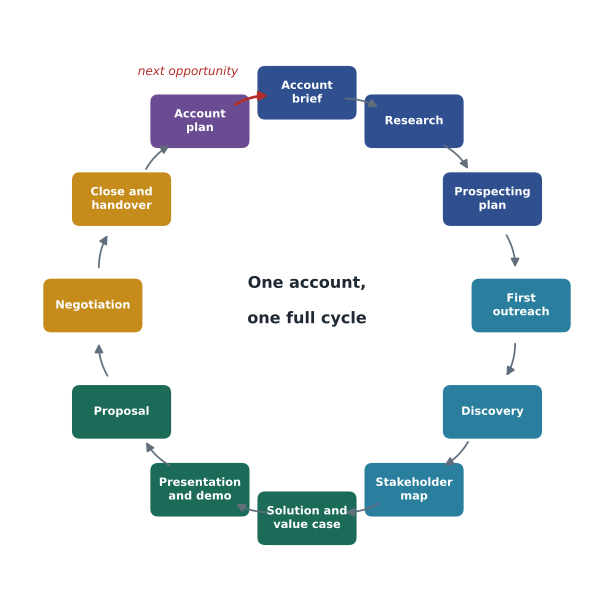
Every course in this program has taught one part of a B2B sale: finding buyers, discovering their problems, presenting, negotiating, forecasting, managing accounts, selling by phone and video, and building a value case. In a real territory those parts do not arrive one at a time. They overlap, they depend on each other, and a weak step early in a deal shows up as a problem months later. This capstone puts them back together. You will work one complete sales cycle on a single account, from the first research to a signed contract, a clean handover and an account plan for the following year.
Ridgeline Workplace Solutions uses the same capstone for its new account executives at the end of their first year, and Maya Chen works through it in this course. Her work is used throughout as the model answer for each stage. Your own deliverables follow the same templates, and they are scored with the same rubrics.
How the capstone works
The capstone is a structured simulation. The account, Wheatland Home Care, is a fictional organization that Darnell Brooks and Farida Haddad built from the kind of opportunity Ridgeline sees every year. Wheatland's people are played by Ridgeline staff who have read a private brief for each role: Farida plays Simone Bélanger, Wheatland's operations manager; Darnell plays Gareth Pruden, its director of finance; Rob Kowalski plays Rachel Okonkwo, its executive director; and Leah Marchand plays Joanne Whitecap, its director of clinical services and privacy officer. Grace Liu supplies the account data, and Owen Pelletier's inside team answers the outreach as Wheatland's front desk would.
The scenario has its own calendar. It opens on Monday, November 16, 2026, when Wheatland's new head-office lease becomes public, and it runs through a signed contract in March 2027, an office move at the end of June 2027 and a first business review in September 2027. Every date in the scenario after the capstone begins is part of the simulation's timeline, not a report of something that has happened. Each capstone session advances the scenario clock to the next stage, so you experience a nine-month cycle in twelve lessons.
| Stage | Lesson | Scenario date | Your deliverable |
|---|---|---|---|
| The account brief | 1 | November 16, 2026 | Capstone plan and success criteria |
| Account research | 2 | November 16 to 20 | One-page account profile |
| Prospecting plan | 3 | November 23 | Qualification score and cadence plan |
| First outreach | 4 | November 24 to December 4 | Messages, call opener and results log |
| Discovery | 5 | December 10 and 17 | Discovery plan and summary letter |
| Stakeholder map | 6 | January 12 to 19, 2027 | Stakeholder map and mutual action plan |
| Solution and value case | 7 | January 26 | Solution design and value case |
| Presentation and demo | 8 | February 2 | Presentation plan and demo script |
| Proposal | 9 | February 9 | Written proposal and pricing |
| Negotiation | 10 | February 16 to 26 | Negotiation plan and final terms |
| Close and handover | 11 | March 9 to 22 | Contract checklist and handover pack |
| Account plan and portfolio | 12 | March to September | Account plan and capstone portfolio |
Meet Wheatland Home Care
Wheatland Home Care is a non-profit agency founded in 1994 that helps older adults and people with disabilities live safely at home. Its caregivers visit clients for personal care, meal preparation and medication reminders, and its nurses provide wound care, assessments and other nursing visits. About 1,150 clients receive at least one visit a week. Wheatland earns most of its revenue under contracts with the Saskatchewan Health Authority, with the rest from private-pay clients.
Wheatland has 240 staff. Of these, 196 work in the field: 162 home care workers and 34 nurses. The other 44 work in offices: schedulers, billing staff, human resources, managers and a small training team. The head office is in Regina, with branch offices in Moose Jaw and Yorkton. Annual revenue is about 14.2 million dollars, and the surplus in a good year is about 2 in 100 of revenue. A volunteer board of nine directors approves the budget and any purchase over 75,000 dollars.
| Fact | Wheatland Home Care |
|---|---|
| Type | Non-profit home care agency, founded 1994 |
| Locations | Head office in Regina; branches in Moose Jaw and Yorkton |
| Staff | 240: 196 field staff (162 home care workers, 34 nurses) and 44 office staff |
| Clients | About 1,150 receiving at least one visit a week |
| Revenue | About 14.2 million dollars a year; surplus about 2 in 100 |
| Governance | Board of nine volunteers; approves purchases over 75,000 dollars |
| Trigger event | New head-office lease signed; move planned for the end of June 2027 |
The trigger for the capstone is a short item in the local business news on Friday, November 13, 2026: Wheatland has signed a ten-year lease on two floors in a business park on the east side of the city and will move its head office at the end of June 2027, when its current lease ends. Rachel Okonkwo, the executive director, posted the news on her professional profile the same day, saying the new office would give Wheatland "room to train our caregivers properly and to bring our branches closer to head office."
Why Wheatland is a good capstone account
Darnell chose this kind of account because it touches almost everything Ridgeline sells and almost everything the program has taught. A move creates a deadline, and a deadline creates urgency that a seller does not have to invent. A head office needs furniture for open-plan scheduling staff, private offices, meeting rooms and a training room. A training room that branch staff join by video needs meeting-room technology. Rooms that three offices share need booking, which is what RoomFlow does. And an agency with three offices and a mix of old printers, leases and fax machines is a natural managed print customer.
The account also carries real complications. Wheatland is a non-profit with a thin surplus, so every dollar is scrutinized. Its finance policy requires three written quotes for any purchase over 25,000 dollars, so Ridgeline will face competitors. It handles personal health information, so a printer fleet that stores scanned documents raises privacy questions. Its board, not a manager, makes the final decision. And the move date is fixed: if furniture arrives late, Wheatland pays for an extra month in its old office.
| Ridgeline offer | Why Wheatland might need it | Course that prepared you |
|---|---|---|
| Office furniture | A new head office with 18 scheduling desks, 6 offices, 3 meeting rooms and a training room | SLS-212, SLS-222 |
| Meeting-room and training-room video | Branch staff could join training without driving to head office | SLS-211, SLS-222 |
| RoomFlow booking | Shared rooms across three offices | SLS-140, SLS-212 |
| Managed print | Nine old printers, mixed leases, faxed physician orders | SLS-211, SLS-222 |
| Account management | A long relationship if the first project goes well | SLS-220 |
What success looks like
A capstone is not won by closing the deal at any price. Darnell and Farida score each deliverable against a rubric, and the rubrics reward the same habits that make a seller trusted over a career: accurate research, honest qualification, questions that uncover real problems, numbers the customer can check, proposals that comply with the law and the customer's rules, negotiation that trades rather than gives away, and a handover that keeps every promise. A learner who walks away from an account that does not fit, with a clear reason, can score well. A learner who wins by overpromising does not.
Each of the twelve stages is scored out of 20 points, for 240 points in all. The minimum standard for completing the capstone is 168 points, which is 70 in 100, with no single stage below 12. Darnell explains the logic in the brief: a seller who is strong in eleven stages and careless in one will still lose deals, because a buyer remembers the careless moment.
Worked problem
Working out the passing standard
The capstone has 12 stages scored out of 20 points each. A learner needs at least 70 in 100 of the total and at least 12 points in every stage. After eleven stages, a learner has 151 points, and every stage so far is 12 or higher. What is the lowest score the learner can earn in the final stage and still complete the capstone?
Show solution
- The total available is 12 × 20 = 240 points.
- \[240 \times 0.70 = 168 \text{ points}\]
- The learner needs 168 − 151 = 17 points in the last stage.
- 17 is also above the 12-point minimum for a single stage, so the stage rule is met.
Answer: 17 points. The total rule decides; the single-stage minimum of 12 is lower and is satisfied as well.
Your first deliverable: the capstone plan
The first deliverable is short. It asks you to set out how you will run the capstone, before you know anything more about Wheatland than the news item and the facts above. Its purpose is to make you think about the whole cycle at the start, which is what experienced sellers do when they take on a new account.
| Section | What to write | Length |
|---|---|---|
| What I know | The facts above, sorted into facts, guesses and unknowns | Half a page |
| What I need to learn first | The five questions research must answer before any outreach | Five lines |
| Possible fit | Which Ridgeline offers might fit, and which might not | Short table |
| Risks | Three things that could make this account a poor use of time | Three lines |
| Personal goals | Two skills from the program you most want to practise in this capstone | Two lines |
Maya's plan sorted the facts carefully. She marked the move date, the number of staff and the board's approval limit as facts from the brief, and she marked "Wheatland needs new furniture" as a guess, because an organization moving to a new office sometimes takes its old furniture with it. Her five research questions were: who is running the move; what Wheatland owns and leases today; how its purchasing policy works; what it spends on printing and travel to training; and which suppliers it already uses. Her three risks were that Wheatland had already chosen a furniture supplier, that its budget was too small for the work, and that the three-quote rule would turn the deal into a price contest.
For her personal goals, Maya chose two skills from earlier courses: holding back her solution until discovery was complete, which Darnell had seen her rush in the Keystone call in SLS-211, and trading concessions instead of giving them, which she had practised in SLS-213. Darnell wrote one comment on her plan: "Good. Now prove the guesses wrong or right before you spend a minute on outreach."
| Criterion | Points | Full points when | Maya |
|---|---|---|---|
| Facts, guesses and unknowns separated | 5 | Every statement is labelled, and no guess is presented as fact | 5 |
| Research questions | 5 | Five questions that would change the approach if answered | 5 |
| Fit assessment | 4 | Each offer is assessed honestly, including possible poor fits | 3 |
| Risks | 4 | Three specific risks, each with a way to test it | 3 |
| Personal goals | 2 | Two goals tied to evidence from earlier work | 2 |
| Total | 20 | 18 |
Maya lost one point on fit because she assumed the managed print offer would fit without noting that Wheatland might be locked into existing leases, and one point on risks because her budget risk had no way to test it. Darnell's feedback was that a risk without a test is a worry, not a plan.
Reflection
- Which stage of the sales cycle do you expect to find hardest, and what evidence from your earlier work supports that?
- What would have to be true about Wheatland for you to recommend walking away?
- How will you keep track of facts, guesses and unknowns as the account develops?
Common mistakes
MistakeThe capstone is about winning the deal.
InsteadThe capstone scores the quality of each stage; an honest decision not to pursue can score well.
MistakeEvery scenario date is something that happened.
InsteadDates after the capstone begins are the simulation's timeline, used so each stage has a realistic setting.
MistakeA trigger event proves the customer needs to buy.
InsteadA trigger is a reason to look; research and discovery must confirm the need.
MistakePlanning can wait until you know more.
InsteadA short plan at the start shows what you need to learn and what could make the account a poor fit.
Summary and key terms
- The capstone works one complete B2B cycle on a single account, Wheatland Home Care.
- It is a structured simulation with role-players and its own calendar running from November 2026 to September 2027.
- Wheatland is a non-profit home care agency moving its head office at the end of June 2027.
- The account fits several Ridgeline offers and carries real complications: a thin budget, a three-quote rule, health information and a board decision.
- Each of twelve stages is scored out of 20, with 168 of 240 points and at least 12 per stage needed to complete.
- The first deliverable is a capstone plan that separates facts, guesses and unknowns.
- Capstone
- A final project that brings the skills of a whole program together.
- Trigger event
- A change in a prospect's situation, such as a move, that creates a reason to buy.
- Role-player
- A person who plays a customer from a private brief during a simulation.
- Rubric
- A scoring guide that lists criteria, points and what earns them.
- Three-quote rule
- A purchasing policy requiring written quotes from three suppliers above a set amount.
Practice problems
Work each problem on paper first, then reveal the answer to check.
Why did Darnell choose an office move as the capstone's trigger?
Show answer
A move creates a real deadline and needs furniture, technology, booking and printing, so it exercises most of what Ridgeline sells and most of the program's skills.
What is the difference between a fact and a guess in Maya's plan? Give one example of each.
Show answer
A fact is stated in the brief, such as the move date; a guess is an assumption, such as Wheatland needing new furniture.
A learner scores 20 in ten stages and 11 in one stage, with one stage left. Can they still complete the capstone?
Show answer
No. A stage below 12 fails the single-stage rule, whatever the total.
Lesson quiz · 5 questions
Score 60% or more to complete this lesson.
Create a free account to save your progress, take quizzes and earn a certificate.