
SLS-299 · Lesson 9 of 12 · 20 min
The proposal
▶ Video coming soon A video version of this lesson is on the way.
Quotes were due at noon on Tuesday, February 9, 2027, in the scenario. Gareth's request for quotes was two pages long. It asked each supplier for a price for the furniture and technology, a delivery and installation plan, warranty terms, service arrangements for all three offices, a statement of how the supplier would meet Joanne's privacy requirements, and a quote that would remain valid until at least March 31. Any optional items had to be priced separately.
The deliverable for this stage is the written proposal itself, with a compliance check against Gareth's request. Farida reviewed Maya's draft on February 8 and Leah Marchand checked the terms.
Structure
SLS-212 taught that a proposal is read by people who were not in the presentation, so it must stand on its own. A board member reading it in March will not have seen the workstation trial or heard Simone's answer about training. Ridgeline's proposal template has ten sections, and Maya kept the whole document to fourteen pages plus appendices.
| Section | Pages | What it contains |
|---|---|---|
| Cover letter | 1 | Thanks, the recommendation in one sentence, and who to call |
| Executive summary | 1 | The one-paragraph case from lesson 7, the three options and the recommendation |
| Your situation | 1 | The move dates, training travel, the fax tray and the schedulers' needs, in Wheatland's words |
| Proposed solution | 3 | Each component, traced to a need, with layout drawings |
| Installation plan | 2 | Week-by-week schedule from order to June 28, with owners |
| Value | 2 | Training value case with low, expected and high cases; five-year printing comparison |
| Price and options | 1 | Options A, B and C, before taxes, with taxes shown separately |
| Privacy and security | 1 | How each of Joanne's four requirements is met |
| Service and warranty | 1 | Service at all three sites, response times, warranty terms |
| Terms and references | 1 | Validity, payment schedule, delivery commitment, three references |
| Appendices | Product specifications, sample wipe certificate, draft privacy agreement |
The compliance matrix
A request for quotes is a set of instructions, and missing one can cost points or disqualify the quote. SLS-212 taught that sellers should build a compliance matrix: a table listing every requirement and where the proposal meets it. Maya included hers as the first page of the appendices, so that Gareth could check it in minutes.
| Gareth's requirement | Where met | Status |
|---|---|---|
| Price for furniture and technology | Price and options, page 11 | Complies |
| Delivery and installation plan | Installation plan, pages 7 and 8 | Complies |
| Warranty terms | Service and warranty, page 13 | Complies |
| Service at all three offices | Service and warranty, page 13 | Complies |
| Privacy requirements | Privacy and security, page 12, and appendix C | Complies |
| Valid until March 31 | Terms, page 14: valid until April 30, 2027 | Exceeds |
| Optional items priced separately | Options B and C priced separately; managed print monthly | Complies |
Price, taxes and payment
Prices in the proposal were before taxes, with the taxes shown on the same page so that Gareth could see the total he would pay. SLS-150 taught that a quoted price must not leave out mandatory charges that the customer will discover later. Ridgeline's quote included delivery, installation and setup in the prices, with no separate fees.
Worked problem
The tax on the one-time total
The one-time total for option C is 88,200 dollars before taxes. In Saskatchewan, furniture and equipment carry GST of 5 in 100 and PST of 6 in 100. What is the total including taxes?
Show solution
- Combined rate: 5 + 6 = 11 in 100.
- \[88{,}200 \times 0.11 = 9{,}702 \text{ dollars of tax}\]
- Total: 88,200 + 9,702 = 97,902 dollars.
Answer: 97,902 dollars including taxes. Wheatland may be able to recover part of the GST through the public service bodies' rebate for qualifying non-profits; the proposal says so and leaves the details to Wheatland's accountant.
Gareth had warned that Wheatland could not pay much before delivery. Maya proposed a payment schedule that matched cash to progress: 30 in 100 of the one-time price when the order is placed, 60 in 100 on delivery and 10 in 100 when Simone signs off the completed installation.
| Payment | When | Share | Amount before taxes (dollars) |
|---|---|---|---|
| Deposit | Order placed, about March 12 | 30 in 100 | 26,460 |
| Delivery | Delivery complete, about June 11 | 60 in 100 | 52,920 |
| Completion | Simone's sign-off, about June 25 | 10 in 100 | 8,820 |
| Total | 100 in 100 | 88,200 |
Total cost over the life of the furniture
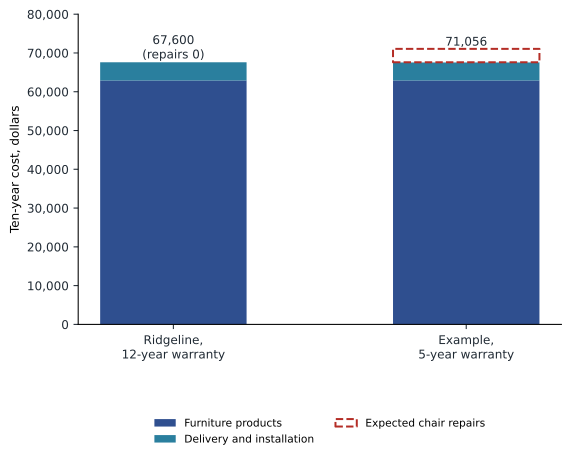
Gareth had asked for a ten-year comparison, and his scoring sheet gave 30 points to price and total cost, not price alone. Maya could not show Corwin's or Northline's figures, which she did not have and should not seek. Instead, she gave Gareth a total-cost template with Ridgeline's figures filled in and blank columns for the other quotes, so that he could complete it himself.
| Ten-year cost item | Ridgeline | Supplier 2 | Supplier 3 |
|---|---|---|---|
| Furniture products | 62,900 | ||
| Delivery and installation | 4,700 | ||
| Task-chair warranty | 12 years | ||
| Expected chair repairs outside warranty | 0 | ||
| Service visits outside warranty | Included for 10 years at all three sites | ||
| Cost if the office is not ready by June 28 | Credit for Ridgeline-caused delay, up to one month of extra rent |
Worked problem
Why the chair warranty matters
Wheatland's 24 office task chairs, at schedulers' and managers' desks, are used all day. Ridgeline's furniture service data shows about 6 in 100 of heavily used task chairs need a repair or replacement each year after the early years, at an average cost of 480 dollars. Compare the expected repair cost over ten years for a chair warranty of 12 years and one of 5 years.
Show solution
- With a 12-year warranty, all ten years are covered: expected cost 0 dollars.
- With a 5-year warranty, years 6 to 10 are not covered: 5 years.
- \[24 \times 0.06 \times 5 = 7.2 \text{ chairs}\]
- \[7.2 \times 480 = 3{,}456 \text{ dollars}\]
Answer: About 3,456 dollars of expected repairs over ten years with a 5-year warranty, and none with a 12-year warranty. Maya put the method in the template so that Gareth could apply it to whatever warranties the other quotes offered.
Maya was careful with the 6 in 100 failure rate. It came from Ridgeline's own service records, so she stated the source and said that it was an estimate for heavily used chairs, not a figure for any particular brand.
Claims that can be checked
Every claim in a proposal must be one Ridgeline can support. Leah checked three in Maya's draft. The claim that RoomFlow reduces double bookings was written exactly as Ridgeline's approved wording from SLS-150: "Across our first six RoomFlow customers, double bookings fell by about four-fifths in the first three months." The claim about Ridgeline's lead time was supported by the factory's written confirmation for this order. A sentence saying Ridgeline offered "the best service in the region" was cut, because no one could prove it. Under the Competition Act, performance claims must be based on adequate and proper testing, and the general impression of a claim, not just its literal words, must not mislead.
| Criterion | Points | Full points when | Maya |
|---|---|---|---|
| Structure | 3 | Stands on its own for a reader who missed the presentation | 3 |
| Compliance | 4 | Every requirement met and shown in a compliance matrix | 4 |
| Price, taxes and payment | 4 | All mandatory charges included, taxes shown, payment schedule matched to progress | 4 |
| Total cost | 4 | Ten-year view with method shown and no claims about competitors' figures | 4 |
| Claims | 3 | Every claim supportable; unprovable claims removed | 2 |
| Clarity | 2 | Numbers match the presentation exactly; plain language | 2 |
| Total | 20 | 19 |
Maya lost a point on claims for the "best service in the region" sentence, even though Leah caught it before the proposal went out.
Reflection
- Could a board member who missed the presentation understand your proposal?
- Which requirement in the customer's request was easiest to miss?
- Which claim in your proposal would you find hardest to prove?
The executive summary
Most committee members read the first page and the price page carefully, and skim the rest. Farida's advice is to write the executive summary last and to make it work for a reader who reads nothing else. It should state the customer's goal, the recommendation, the price, the main reason and the main risk, in that order, in under 250 words.
| Element | Maya's executive summary |
|---|---|
| Goal | "Wheatland's new head office must be working by June 28, with a training room branch staff can join and printing that keeps client information private." |
| Recommendation | "We recommend option C: furniture for the whole office, training-room and meeting-room video, RoomFlow for six rooms, and managed print for all three offices." |
| Price | "88,200 dollars one-time before taxes, plus 985 dollars a month, which is less than Wheatland pays for printing today plus RoomFlow." |
| Main reason | "Using Wheatland's own figures, the training technology recovers its cost in about 22 months, and in under three years even if only half the trips are avoided." |
| Main risk and how it is handled | "The move date cannot slip. Ridgeline's six-week lead time leaves about seven weeks of slack, and we commit to a credit if a delay we cause stops the office being ready." |
Farida checked one figure in the summary: the comparison of the monthly charges with today's costs. Wheatland pays 1,185 dollars a month for printing now; option C's monthly charges are 715 for managed print and 270 for RoomFlow, or 985 dollars. The sentence was accurate, but Farida asked Maya to make it clear that RoomFlow is a new service rather than a replacement, so that no reader could think Ridgeline was claiming RoomFlow saved money on printing.
The delivery commitment
Rachel's question in the presentation, about what to tell the board if the furniture was late, deserved a written answer. Gareth had said that staying in the old office after June 30 would mean paying holdover rent at 150 in 100 of the current rent of 9,800 dollars a month, or 14,700 dollars for each extra month. Leah drafted the commitment carefully, because a promise in a proposal becomes a promise in the contract.
Her wording said that if a delay caused by Ridgeline prevented the office being ready by June 28, Ridgeline would credit Wheatland the extra rent it paid, up to one month, or 14,700 dollars. It excluded delays caused by the landlord's fit-out, by Wheatland changing the layout after the final sign-off, or by events outside either party's control. Darnell approved it because Ridgeline's lead time made the risk small, and because the commitment answered the one question that mattered most to the board. A risk the seller is willing to share is more convincing than a reassurance.
Following the rules of the process
Gareth's request set rules that applied to every supplier: questions had to be sent to him in writing by February 3, and his answers would be shared with all three suppliers; no supplier could contact board members; and late quotes would not be scored. These rules are common in competitive buying, private as well as public, because they keep the process fair. Maya sent two written questions on February 1, one about whether the board table was in scope and one about the delivery address for the branch printers, and received Gareth's answers, shared with all suppliers, on February 4.
She submitted the proposal at 9:40 a.m. on February 9, more than two hours before the deadline, and asked Gareth to confirm receipt, which he did by 10:05. Darnell insists on submitting early. A file that fails to upload at 11:58 is a lost quote, however good it is, and a seller who submits early shows the customer the same reliability she is promising for the installation.
Maya also set the quote's validity to April 30, 2027, a month beyond Gareth's minimum of March 31. A longer validity costs Ridgeline little, because its furniture prices are fixed for the season, and it removes a reason for Wheatland to rush or to ask for a new quote if the board meeting moved. Leah added one condition: the lead time is confirmed when the order is placed, not when the quote is issued, so a very late order could change the delivery dates. Maya put that condition in plain words on the price page rather than in the fine print.
Common mistakes
MistakeA proposal repeats the presentation.
InsteadA proposal must stand alone for readers who were not there.
MistakeShow taxes only on the invoice.
InsteadShow taxes on the price page so the customer sees the real total.
MistakeFill in competitors' numbers for the customer.
InsteadGive the method and your own figures; let the customer fill in the rest.
MistakeStrong adjectives make a proposal persuasive.
InsteadClaims must be supportable; specific facts persuade better than superlatives.
Summary and key terms
- The proposal answered every item in Gareth's request and showed it in a compliance matrix.
- It stood on its own for readers who missed the presentation, in fourteen pages and ten sections.
- Prices included delivery and installation, with taxes shown: 97,902 dollars including GST and PST, with part of the GST possibly recoverable through the public service bodies' rebate.
- Payments followed progress: 30 in 100 at order, 60 at delivery and 10 at completion.
- A ten-year cost template showed Ridgeline's figures and the method, leaving competitors' figures for Gareth.
- Every claim was checked; an unprovable one was removed.
- Compliance matrix
- A table showing where a proposal meets each requirement in a request.
- Payment schedule
- The agreed times and amounts of payments, often linked to progress.
- Total cost of ownership
- All the costs of buying and using something over a period, not just the price.
- Public service bodies' rebate
- A GST rebate available to qualifying non-profits and other public service bodies.
- Adequate and proper test
- Under the Competition Act, the testing required before making a performance claim.
Practice problems
Work each problem on paper first, then reveal the answer to check.
Why did Maya give Gareth a template instead of comparing the other quotes herself?
Show answer
She did not have their figures and should not seek them; the customer can complete the comparison fairly.
With a 3-year chair warranty, what would 24 chairs cost in expected repairs over ten years?
Show answer
24 × 0.06 × 7 × 480 ≈ 4,838 dollars.
What is the deposit on an 85,000-dollar order at 30 in 100?
Show answer
25,500 dollars.
Lesson quiz · 5 questions
Score 60% or more to complete this lesson.
Create a free account to save your progress, take quizzes and earn a certificate.