
SLS-299 · Lesson 2 of 12 · 19 min
Researching the account
▶ Video coming soon A video version of this lesson is on the way.
On the first scenario day, Monday, November 16, 2026, Maya blocked three hours on her calendar for Wheatland research and turned off her email. Darnell's rule for the capstone research week is the same one he uses in real territories: spend enough time to earn a good first conversation, and no more. Research that runs for days is often a way of avoiding the phone.
The deliverable for this stage is a one-page account profile. It is the document Maya will open before every call for the rest of the cycle, so it has to be accurate, current and short enough to read in two minutes.
Where the information comes from
Account research draws on three kinds of sources. Public sources are what anyone can find: the organization's website, news coverage, annual reports, job postings and the public profiles of its leaders. Internal sources are what Ridgeline already knows: CRM history, past quotes, notes from other sellers, and anything a current customer has said. People sources are what others in the market can tell you: a referral, a partner or a current customer who knows the prospect. Each has a different reliability, and a good profile says where each fact came from.
| Source | Type | What Maya found | Reliability |
|---|---|---|---|
| Wheatland's website | Public | Services, three offices, leadership team, annual report for 2025-26 | High for basic facts |
| Annual report and financial statements | Public | Revenue 14.2 million dollars, surplus 286,000 dollars, health authority contracts | High; audited |
| Business news, November 13 | Public | New ten-year lease, move at end of June 2027 | High |
| Rachel Okonkwo's public post | Public | Wants room to train caregivers and to link branches | Medium: a goal, not a plan |
| Job posting, October 2026 | Public | Hiring a training coordinator; mentions "virtual orientation" | Medium |
| Ridgeline CRM | Internal | One record: a 2021 quote for two printers, not pursued | High for the past |
| Owen's inside team | Internal | Simone Bélanger downloaded the office-move checklist on November 6 | High |
| Northfield Family Clinic | People | Dr. Anand sits on a regional health committee with Rachel | Medium |
Two findings changed Maya's view of the account at once. The first was in the CRM: Grace's lead-scoring report showed that Simone Bélanger, Wheatland's operations manager, had downloaded Ridgeline's office-move checklist ten days before the news broke. That was a sign that Simone was already planning the move and was looking at suppliers. The second was the job posting for a training coordinator, which described "a mix of classroom and virtual orientation for staff in our branches." It suggested that Rachel's goal of training caregivers properly already had money and a person attached to it.
Reading the annual report
A non-profit's annual report and financial statements tell a seller how much room the organization has to spend and how it decides. Wheatland's statements showed revenue of about 14.2 million dollars and a surplus of 286,000 dollars, about 2 in 100 of revenue. Wages and benefits were 84 in 100 of expenses, which is typical for home care, where the service is people's time. Occupancy, meaning rent and utilities for the offices, was about 3 in 100. Mileage paid to staff for travel between clients and to training was about 4 in 100.
Worked problem
What the surplus says about the budget
Wheatland's 2025-26 revenue was 14.2 million dollars and its surplus was 286,000 dollars. Its statements also show unrestricted net assets, meaning savings it can spend as the board decides, of 1.1 million dollars, and a board policy to keep at least three months of operating expenses in reserve. Operating expenses were 13.914 million dollars. How much could the board spend from savings without breaking its reserve policy?
Show solution
- Three months of operating expenses is a quarter of the annual total.
- \[13{,}914{,}000 \div 4 = 3{,}478{,}500 \text{ dollars}\]
- The reserve policy asks for 3.48 million dollars, but unrestricted net assets are only 1.1 million dollars.
- Wheatland is already below its own target, so it cannot spend savings without moving further away from it.
Answer: Nothing, under its own policy. The move will have to be paid for from a budget the board approves for it, probably from the year's surplus, a capital campaign or financing, and every dollar will be scrutinized. This tells Maya that cost and cash timing will matter as much as price.
This kind of calculation is not something Maya would show Wheatland. It is background that helps her ask better questions later, such as how the board plans to fund the move and whether payment timing or leasing would help.
Mapping the people
The website listed six leaders. Maya added the roles she expected each to play in an office move, but she marked every role as a guess until discovery confirmed it.
| Person | Title | Likely role in the move | Evidence |
|---|---|---|---|
| Rachel Okonkwo | Executive director | Sponsor; recommends to the board | Public post about the move |
| Gareth Pruden | Director of finance and administration | Controls the budget and the quote process | Signs the annual report's financial section |
| Simone Bélanger | Operations manager | Runs the move day to day | Downloaded the move checklist |
| Joanne Whitecap, RN | Director of clinical services and privacy officer | Cares about privacy of health records | Website lists her as privacy officer |
| Deshawn Miller | Scheduling lead | Represents the 18 schedulers who will use the new office most | Staff page |
| Trevor Nakai | IT contractor, two days a week | Technical approval for anything that connects to the network | Annual report thanks him for IT support |
The account profile
The profile pulls the research into one page with fixed headings. Ridgeline's template has seven sections, and Darnell is strict about keeping it to one page: anything that does not change how Maya would open a conversation belongs in her notes, not the profile.
| Section | Maya's profile entry |
|---|---|
| Snapshot | Non-profit home care agency, 240 staff, head office in Regina, branches in Moose Jaw and Yorkton, revenue 14.2 million dollars |
| Trigger | Ten-year lease on two floors; move at end of June 2027; current lease ends June 30 |
| Likely priorities | Training caregivers, linking branches, staying within a tight budget, protecting client information |
| People | Simone (operations, engaged), Gareth (finance), Rachel (sponsor), Joanne (privacy), Deshawn (users), Trevor (IT) |
| History with Ridgeline | One 2021 printer quote, not pursued; Simone downloaded the move checklist November 6 |
| Hypotheses | Furniture for a new office; video for a training room; booking across three sites; printer fleet consolidation |
| Questions for first contact | How far along the move planning is; who decides; what has been ruled out |
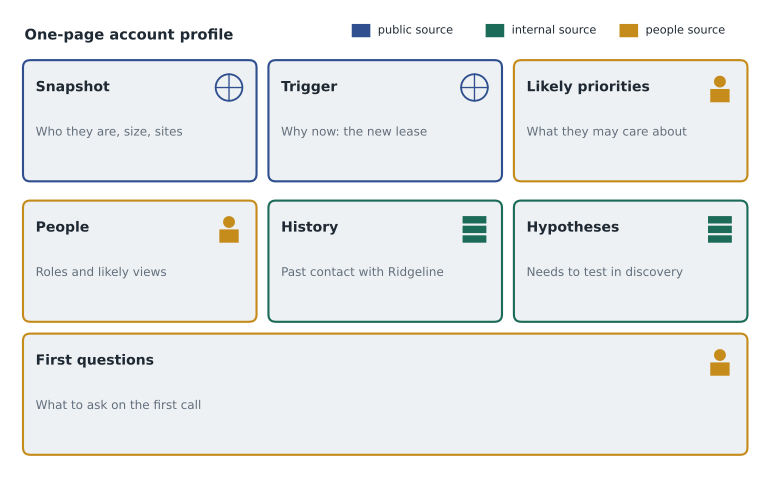
Hypotheses, not conclusions
The most useful part of the profile is the list of hypotheses: specific guesses about what the prospect might need, each of which discovery can confirm or reject. A hypothesis gives the first call a purpose without locking Maya into a pitch. "Wheatland may want branch staff to join training by video, because its job posting mentions virtual orientation" is a hypothesis she can test with one question. "Wheatland needs our training-room package" is a conclusion she has not earned.
Maya wrote four hypotheses and ranked them by evidence. The training-room idea had the most support: Rachel's post, the job posting and the mileage line in the statements. The furniture need was likely but unproven. Booking across three sites was plausible. Printing was the weakest, because nothing in the research suggested Wheatland was unhappy with its printers, so she ranked it last and planned to ask about it only once the larger topics were open.
Using information responsibly
Research can cross lines. The information Maya used was public, published by Wheatland itself, or held in Ridgeline's own CRM. She did not try to find out anything about the people beyond their professional roles, such as their families or home addresses, and she did not use Dr. Anand's connection to ask about Wheatland's internal discussions. Darnell's test is simple: would you be comfortable if the prospect saw exactly how you found each fact?
Customer data in Ridgeline's CRM is also covered by privacy law. In Canada, PIPEDA applies to personal information Ridgeline collects in the course of commercial activity, including business contact details used for selling, unless the information is used only to contact someone about their job; Ridgeline treats sales notes about individuals as personal information and limits them to what is needed. Bill C-36, which would replace much of PIPEDA, had only had first reading when the capstone opens.
| Criterion | Points | Full points when | Maya |
|---|---|---|---|
| Sources | 4 | Public, internal and people sources used, each fact traced to a source | 4 |
| Financial reading | 4 | At least one useful conclusion drawn from the statements, with the working shown | 4 |
| People map | 4 | Every leader listed with a likely role marked as a guess | 4 |
| Hypotheses | 4 | Ranked, specific and testable | 4 |
| One page and current | 2 | Fits one page, dated, nothing that does not affect the first call | 1 |
| Responsible research | 2 | Nothing gathered that the prospect would object to | 2 |
| Total | 20 | 19 |
Maya lost a point because her first draft ran to a page and a half. She moved the source table to her notes and kept only a date and a one-word source next to each profile entry.
Reflection
- Which of your hypotheses has the least evidence, and why did you keep it?
- What would you do if research showed that Wheatland had already chosen a furniture supplier?
- Which piece of information did you decide not to collect, and why?
Turning research into conversation starters
Research is only useful if it changes what the seller says. Darnell asks every new account executive to turn the profile into three conversation starters: short, specific observations that show the seller has done the work and invite the prospect to talk. A good starter names something true about the prospect, connects it to a question, and leaves room for the prospect to correct it.
| Research finding | Weak use | Conversation starter |
|---|---|---|
| New lease, move at end of June | "I see you're moving. We sell furniture." | "A late-June move usually means furniture is ordered by March. Where are you in that timeline?" |
| Job posting mentions virtual orientation | "Our video systems are the best in the region." | "Your training coordinator posting mentioned virtual orientation for the branches. How do branch staff join training today?" |
| Mileage is about 4 in 100 of expenses | "You spend too much on travel." | "For agencies like yours, travel to training is often a quiet cost. Is that something you track?" |
| Three offices | "You need RoomFlow." | "With three offices, how do people find a free room at another site?" |
Each starter in the right-hand column could be wrong, and that is part of its value. If Simone says, "We already run all training by video," Maya learns something important in ten seconds and has not wasted a pitch on it. Darnell calls this "being specific enough to be corrected". A vague opener cannot be corrected, so it teaches the seller nothing.
Checking the research before using it
Public information goes out of date. A leader may have left since the website was updated, a job posting may have been filled, and an annual report describes the past year, not this one. Before her first touch, Maya checked three things: that each of the six leaders still appeared on Wheatland's staff page and professional profiles; that the training coordinator posting was still open, which it was; and that the business news item matched what Wheatland itself had said, which it did.
She also asked Grace whether any other Ridgeline seller had touched Wheatland. The CRM showed that the 2021 printer quote had been prepared by a seller who had since left, for a manager who had also left. That told Maya two useful things: the 2021 history was unlikely to help or hurt her, and Wheatland's management had changed in the last five years, so the current team had no settled view of Ridgeline. She recorded the check and its date on the profile, so that anyone reading it later would know how current it was.
Time spent and when to stop
Maya spent two hours and forty minutes on research, and logged it. Darnell's guideline for an account of this size is two to four hours before first contact. Less than two hours usually means the first call wastes the prospect's time on questions the website answers. More than four usually means diminishing returns: the questions that matter most, such as how the decision will be made and what has been ruled out, can only be answered by the prospect. Research is finished when the seller can open a conversation that is specific, relevant and easy to correct.
Common mistakes
MistakeMore research always means a better first call.
InsteadResearch enough to earn the conversation; the rest is learned by asking.
MistakeA leader's title tells you their role in the decision.
InsteadTitles suggest roles; discovery confirms them.
MistakeHypotheses are what you will propose.
InsteadHypotheses are guesses to test; some will be wrong.
MistakeAnything you can find online is fair to use.
InsteadUse professional, relevant information you would be comfortable showing the prospect.
Summary and key terms
- Account research uses public, internal and people sources, and a good profile traces each fact to its source.
- Wheatland's statements show a thin surplus and reserves below the board's own target, so the move will be tightly budgeted.
- Leaders are mapped with likely roles marked as guesses.
- The one-page profile has seven sections, including ranked hypotheses that discovery can confirm or reject.
- Research must respect privacy law and the prospect's reasonable expectations.
- Account profile
- A one-page summary of what a seller knows about a prospect before contact.
- Hypothesis
- A specific, testable guess about what a prospect might need.
- Unrestricted net assets
- A non-profit's accumulated savings that its board can spend as it decides.
- Operating reserve
- Savings a non-profit keeps to cover a set number of months of expenses.
- PIPEDA
- Canada's federal privacy law for personal information collected in commercial activity.
Practice problems
Work each problem on paper first, then reveal the answer to check.
Why did Simone's download of the move checklist matter more than the news item?
Show answer
It showed she was already planning the move and looking at suppliers before it was public.
Wheatland's operating expenses are 13.914 million dollars. How much is two months of expenses?
Show answer
About 2,319,000 dollars: 13,914,000 ÷ 12 × 2.
Rewrite "Wheatland needs our training room package" as a hypothesis.
Show answer
"Wheatland may want branch staff to join training by video, because its job posting mentions virtual orientation."
Lesson quiz · 5 questions
Score 60% or more to complete this lesson.
Create a free account to save your progress, take quizzes and earn a certificate.