
SLS-299 · Lesson 7 of 12 · 19 min
Solution and value case
▶ Video coming soon A video version of this lesson is on the way.
By Tuesday, January 26, 2027, in the scenario, Maya had what she needed to design a solution: the problems in Wheatland's own words, the constraints from the site visit, Gareth's criteria, Joanne's privacy requirements and Trevor's technical rules. She took her draft to Rob Kowalski's value desk, the weekly session from SLS-222 where sellers test business cases before customers see them.
The deliverable has two parts. The solution design says what Ridgeline would supply and why each part answers something Wheatland said. The value case puts numbers on the parts that can be priced, using Wheatland's data, and states every assumption.
Designing from the problems, not the catalogue
Rob's first test of any solution is a trace: every item in the design must point back to a problem, a constraint or a requirement the customer stated. Items that cannot be traced are either removed or offered as options, never slipped into the main proposal.
| Component | What it includes | Traces to |
|---|---|---|
| Scheduling hub furniture | 18 sit-stand workstations with acoustic screens and dual monitor arms | Deshawn: adjustable desks, quiet, two schedule views |
| Private offices | 6 desk, storage and seating sets | New office floor plan |
| Meeting rooms | Tables and seating for 3 rooms | Floor plan; board table kept |
| Training room | 12 flip-top tables, 24 stacking chairs, instructor station | Rachel: room to train caregivers |
| Lunchroom | Tables and seating | Floor plan |
| Training-room video | Tracking camera, ceiling microphones, large display | Simone: branch hires waiting for group orientation |
| Meeting-room video | Video bars and displays in 2 rooms | Rachel: linking branches to head office |
| RoomFlow | 6 rooms across 3 sites, single sign-on, titles hidden by default | Three offices; Trevor's sign-on rule; Joanne's no-names rule |
| Managed print | 9 devices replaced by 5, badge release, encrypted drives, wipe certificates, secure digital fax | Fax-tray incident; Joanne's four requirements |
One item did not survive the trace. Maya had added laptop leasing for the 44 office staff, because Ridgeline offers it through a leasing partner and the move seemed a natural moment. No one at Wheatland had mentioned laptops. Rob asked her to move it to a list of future possibilities in the account plan, where it would reappear in lesson 12.
Prices for the solution
Ridgeline's standard prices for the components, before taxes, came to the totals below. The furniture prices are Ridgeline's list prices for this range; the technology prices include equipment and configuration; the recurring prices follow Ridgeline's published rates, including the 45 dollars per room per month for RoomFlow used with Keystone in SLS-222.
| Component | Basis | Price (dollars) |
|---|---|---|
| Scheduling hub | 18 × 1,450 | 26,100 |
| Private offices | 6 × 2,200 | 13,200 |
| Meeting rooms | 3 × 3,400 | 10,200 |
| Training room furniture | Package | 9,600 |
| Lunchroom | Package | 3,800 |
| Furniture products | 62,900 | |
| Delivery and installation | 4,700 | |
| Furniture total | 67,600 | |
| Training-room video | Package | 9,800 |
| Meeting-room video | 2 × 4,200 | 8,400 |
| Technology installation and setup | 2,400 | |
| Technology total | 20,600 | |
| One-time total | 67,600 + 20,600 | 88,200 |
| RoomFlow | 6 rooms × 45 a month | 270 a month |
| Managed print | 5 devices × 138 + secure fax 25 | 715 a month |
The one-time total of 88,200 dollars sat inside Gareth's figure of about 100,000 dollars for furniture and technology, including a contingency. Maya noted that she did not know the size of the contingency, so she could not tell how much room was left.
The training value case
The training technology is the part of the solution that behaves like an investment: an up-front cost followed by savings. Maya built its value case from the figures Simone had pulled from Wheatland's records in discovery.
| Line | Basis | Per year (dollars) |
|---|---|---|
| Travel to training avoided | 14,400 × 0.75 (a quarter of trips still needed for hands-on skills) | 10,800 |
| Hotel room rental avoided | 4 sessions × 900, held in the new training room | 3,600 |
| Total annual benefit | 14,400 | |
| RoomFlow subscription | 270 × 12 | 3,240 |
| Net annual benefit | 14,400 − 3,240 | 11,160 |
Worked problem
Payback and net present value
The training technology costs 20,600 dollars and produces a net benefit of 11,160 dollars a year. Wheatland borrows on its line of credit at 6 in 100, which Gareth asked Maya to use as the discount rate. What are the payback period and the five-year net present value?
Show solution
- \[\text{Payback} = \frac{20{,}600}{11{,}160} \approx 1.85 \text{ years} \approx 22 \text{ months}\]
- Present value of each year's benefit at 6 in 100: 10,528; 9,932; 9,370; 8,840; 8,339. Total 47,009.
- \[\text{NPV} = 47{,}009 - 20{,}600 = 26{,}409\]
Answer: Payback in about 22 months and a five-year NPV of about 26,400 dollars at Wheatland's own borrowing rate.
| Year | Net benefit | Discount factor 1 ÷ 1.06ⁿ | Present value |
|---|---|---|---|
| 1 | 11,160 | 0.9434 | 10,528 |
| 2 | 11,160 | 0.8900 | 9,932 |
| 3 | 11,160 | 0.8396 | 9,370 |
| 4 | 11,160 | 0.7921 | 8,840 |
| 5 | 11,160 | 0.7473 | 8,339 |
| Total | 55,800 | 4.2124 | 47,009 |
Testing the assumptions
The figure Rob questioned hardest was the 75 in 100 of trips avoided. It was Maya's estimate, based on Simone's comment that most orientation is classroom content but some skills, such as safe lifting and using a mechanical lift, must be taught in person. Rob's rule from SLS-222 is that every estimate in a value case gets a low and a high case, so the customer can see how much the conclusion depends on it.
| Case | Trips avoided | Net annual benefit (dollars) | Payback | Five-year NPV (dollars) |
|---|---|---|---|---|
| Low | 50 in 100 | 7,560 | About 33 months | About 11,200 |
| Expected | 75 in 100 | 11,160 | About 22 months | About 26,400 |
| High | 90 in 100 | 13,320 | About 19 months | About 35,500 |
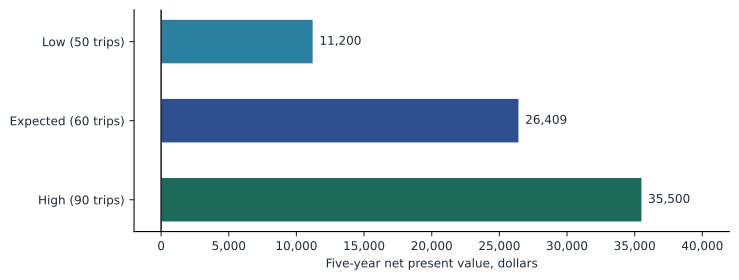
Even in the low case, where only half the trips are avoided, the investment pays back in under three years and has a positive NPV. That is the sentence Maya planned to give Gareth: the case does not depend on her estimate being right.
The printing value case
Managed print is different. It has no up-front investment; it replaces one set of monthly costs with another. SLS-222 taught that forcing an ROI onto a decision like this produces a confusing number, so Maya compared five-year totals instead.
Worked problem
Five years of printing, today against the proposal
Wheatland pays 640 dollars a month in printer leases, about 410 dollars a month for toner and service on the owned printers, and 135 dollars a month for three fax lines. Ridgeline's proposal is 715 dollars a month. One existing lease would have 7 months left at 160 dollars a month when the devices are replaced, and Wheatland would buy it out. Compare five-year costs.
Show solution
- Today: 640 + 410 + 135 = 1,185 dollars a month.
- \[1{,}185 \times 12 = 14{,}220 \text{ dollars a year}; \quad 14{,}220 \times 5 = 71{,}100\]
- \[715 \times 12 = 8{,}580 \text{ dollars a year}; \quad 8{,}580 \times 5 = 42{,}900\]
- Lease buyout: 7 × 160 = 1,120 dollars, so the proposal costs 42,900 + 1,120 = 44,020 dollars over five years.
- Difference: 71,100 − 44,020 = 27,080 dollars.
Answer: About 27,100 dollars lower over five years, or about 5,640 dollars a year before the one-time buyout, while also meeting all four of Joanne's privacy requirements.
Maya also listed, but did not count, the staff time spent on paper jams and faxes, which Simone estimated at about seven hours a week across the three offices. At 32 dollars an hour that would be about 11,600 dollars a year, but the staff would still be paid, so Rob agreed it was soft value: real, worth mentioning, and kept out of the totals.
The assumptions register
| Assumption | Value used | Source | Confidence |
|---|---|---|---|
| Training trips per year | 60 | Wheatland mileage claims, 2025-26 | High |
| Cost per trip | 240 dollars | Mileage plus 2.5 hours at 32 dollars | High |
| Share of trips avoided | 75 in 100 (tested at 50 and 90) | Maya's estimate from Simone's description | Medium |
| Hotel sessions avoided | 4 a year at 900 dollars | Wheatland invoices | High |
| Current printing costs | 1,185 dollars a month | Wheatland lease and service invoices | High |
| Discount rate | 6 in 100 | Gareth: line of credit rate | High |
| Staff time on jams and faxes | 7 hours a week (not counted) | Simone's estimate | Low |
| Criterion | Points | Full points when | Maya |
|---|---|---|---|
| Traceability | 5 | Every component traces to something the customer said; untraced items removed | 4 |
| Pricing | 3 | Prices complete, correct and before taxes | 3 |
| Investment measures | 4 | Payback and NPV correct at the customer's rate | 4 |
| Sensitivity | 4 | Low, expected and high cases for the key estimate | 4 |
| Assumptions | 4 | Every assumption sourced, with hard and soft value separated | 4 |
| Total | 20 | 19 |
Maya lost a point on traceability for the laptop leasing she had added, even though she removed it after Rob's question.
Reflection
- Which component of your solution was hardest to trace to something the customer said?
- If your key estimate were wrong by half, would your case still stand?
- Which value did you decide was soft, and why?
Checking the design with the people who will use it
As the mutual action plan required, Maya sent the solution outline to Simone and Trevor on January 26, without prices, and asked each of them to mark anything that was wrong or missing. Sending a design for checking before the presentation has two purposes. It catches mistakes while they are cheap to fix, and it gives the people who will live with the solution a stake in it.
| Reviewer | Comment | Maya's change |
|---|---|---|
| Trevor | RoomFlow and the video bars must sign in through Wheatland's email accounts | Confirmed both support single sign-on; added a setup day with Trevor |
| Trevor | Staff building cards are proximity cards | Confirmed the printers' badge readers accept the same cards, so no new cards are needed |
| Simone | The training room also hosts the monthly all-staff meeting by video | Raised the training-room camera and microphone specification already included; no price change |
| Simone | Two schedulers work part-time and share a desk | Kept 18 workstations; noted desk-sharing in the layout |
| Deshawn (through Simone) | Monitor arms must hold two 27-inch screens | Confirmed the arm rating |
None of the comments changed the price, but two of them would have caused trouble on installation day if they had been missed. Trevor's point about proximity cards would otherwise have surfaced only when the first printer refused to release a job.
Offering options
SLS-222 taught that a single take-it-or-leave-it proposal forces the customer into a yes or no, while a small set of honest options lets the customer choose the level of investment. Rob asked Maya to prepare three options for the presentation, each complete in itself.
| Option | Includes | One-time (dollars) | Monthly (dollars) |
|---|---|---|---|
| A: Move essentials | All furniture, delivery and installation | 67,600 | None |
| B: Training and booking | Option A plus training-room and meeting-room video and RoomFlow | 88,200 | 270 |
| C: Complete | Option B plus managed print across three sites | 88,200 | 985 |
Option C has the same one-time price as option B because managed print has no up-front charge; it adds 715 dollars a month, which is less than Wheatland pays for printing today. Maya planned to recommend option C and to explain why, while making sure that options A and B were genuine choices rather than decoys. SLS-222 warned that an option designed only to make another look good is a manipulation that buyers often recognize.
The case in one paragraph
Before any presentation, Rob asks sellers to write the whole value case in one paragraph that the executive sponsor could repeat to the board. Maya's version for Rachel read: "For about 88,000 dollars, Wheatland gets a head office designed for its schedulers and a training room that branch staff can join by video. Using Wheatland's own figures, the training technology pays for itself in about two years and keeps paying after that, even if only half the trips are avoided. Replacing the printers costs less than today, protects client information and is installed on the same schedule. Ridgeline's lead time leaves seven weeks of slack before the move." Rob changed one phrase: "pays for itself" became "recovers its cost", because a board member might read "pays for itself" as a promise rather than an estimate.
Common mistakes
MistakeAdd everything the customer might buy.
InsteadPropose what traces to the customer's problems; keep the rest as options or future ideas.
MistakeUse the seller's discount rate.
InsteadUse the customer's rate, such as its cost of borrowing.
MistakeEvery part of the solution needs an ROI.
InsteadUse payback and NPV for investments; compare totals for cost replacements.
MistakeA single expected case is enough.
InsteadShow low and high cases for any estimate the conclusion depends on.
Summary and key terms
- The solution design traces every component to a problem, constraint or requirement Wheatland stated; laptop leasing failed the test and moved to future ideas.
- Standard prices total 88,200 dollars one-time, plus 270 dollars a month for RoomFlow and 715 for managed print.
- The training technology pays back in about 22 months with a five-year NPV of about 26,400 dollars at Wheatland's 6 in 100 rate, and stays positive even if only half the trips are avoided.
- Managed print costs about 27,100 dollars less than today over five years and meets Joanne's privacy requirements.
- The assumptions register sources every figure and keeps soft value out of the totals.
- Solution design
- A description of what a seller will supply and why each part answers a customer need.
- Traceability
- The link between each component of a solution and something the customer said.
- Value case
- A quantified argument for a purchase, built from the customer's data and stated assumptions.
- Sensitivity analysis
- Testing how a result changes when a key assumption is lower or higher.
- Soft value
- A real benefit that does not directly change the customer's spending, such as staff time saved.
Practice problems
Work each problem on paper first, then reveal the answer to check.
Why did laptop leasing come out of the solution?
Show answer
No one at Wheatland had mentioned laptops, so it did not trace to a stated need.
If trips avoided were 60 in 100, what would the net annual benefit be?
Show answer
14,400 × 0.6 + 3,600 − 3,240 = 8,640 + 360 = 9,000 dollars.
Why compare five-year totals for printing instead of calculating an ROI?
Show answer
There is no up-front investment; it replaces one monthly cost with another.
Lesson quiz · 5 questions
Score 60% or more to complete this lesson.
Create a free account to save your progress, take quizzes and earn a certificate.