
VIS-410 · Lesson 10 of 12 · 26 min
Professional networks and associations
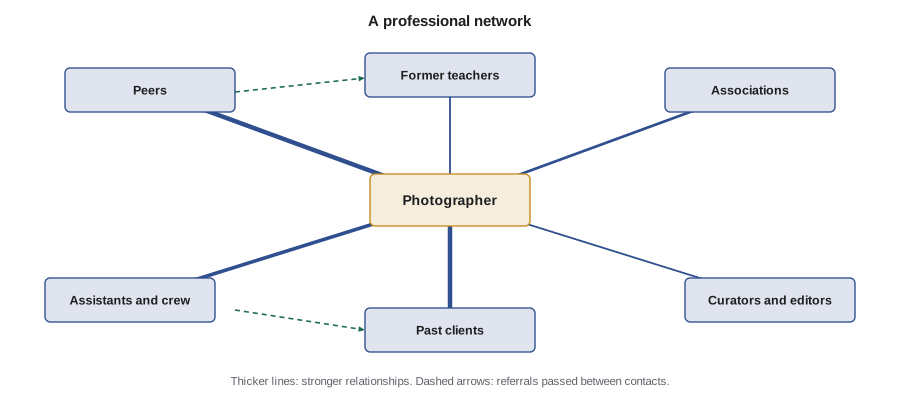
Photography can be a solitary profession, especially for freelancers and artists working on their own. Professional associations, peer networks and communities give you information, advocacy, practical tools, insurance options, referrals and support that are hard to build alone. Many photographers find that a large share of their work eventually comes through relationships: other photographers passing on jobs, former assistants recommending them, curators introducing them to colleagues. This lesson surveys the main associations in Canada and the United States, explains what they offer, and gives practical advice on building a professional network that lasts.
Why networks matter
Relationships matter in creative work for several reasons. Clients and curators prefer to hire people who come recommended, because it reduces the risk of a bad experience. Other photographers refer work they cannot take, especially in specialties next to their own. Peers share pricing information, contract wording and warnings about clients who do not pay. And a community of people who understand the work helps you through slow periods, rejection and difficult decisions.
Networking does not mean collecting business cards or selling yourself at every event. It means being genuinely useful and interested over a long period: sharing knowledge, recommending others, showing up to openings and talks, and following up thoughtfully. The photographers with the strongest networks are often the most generous.
What associations offer
Professional associations vary in focus, but most offer some combination of the following.
- Advocacy on copyright, fees, government policy and industry standards.
- Business resources: contract templates, pricing guides, licensing guidance and legal information.
- Insurance programs for equipment, liability and sometimes health or disability, often at group rates.
- Professional development: workshops, webinars, conferences, mentoring and certification.
- Directories and referrals that help clients find members.
- Community: local chapters, events, online forums and peer support.
Associations in Canada and the United States
In Canada, the main photography associations include CAPIC (the Canadian Association of Professional Image Creators), which represents commercial and editorial photographers and illustrators, advocates on copyright and publishes business resources; and PPOC (Professional Photographers of Canada), which focuses on portrait, wedding and commercial studio photographers and offers accreditation and competitions. Artists working in galleries and public institutions often join CARFAC, the national voice of professional visual artists, which publishes the CARFAC-RAAV fee schedule with RAAV, Quebec's association of visual artists. Photojournalists may connect through journalism organizations and press clubs. Many cities also have artist-run centres, photography collectives and festival communities that act as local networks.
| Specialty | Canada | United States |
|---|---|---|
| Commercial and advertising | CAPIC | ASMP, APA |
| Editorial and documentary | CAPIC, journalism organizations | ASMP, NPPA |
| Portrait, wedding and studio | PPOC | PPA |
| Fine art and exhibitions | CARFAC, RAAV (Quebec), artist-run centres | Regional arts organizations, non-profit photography centres |
| Photojournalism | Journalism organizations, press clubs | NPPA |
Associations change names, programs and fees over time; check their current websites. Many offer discounted student or early-career memberships, which are worth taking advantage of as you graduate.
Is membership worth the cost?
Membership fees vary widely, from modest student rates to several hundred dollars a year for full professional membership. Treat membership as a business decision: estimate the value of the benefits you will actually use and compare it with the cost.
Worked problem
Weighing a membership
A professional membership costs $420 a year. Through it, a photographer saves $180 on equipment insurance, uses contract templates that would otherwise cost about $150 in legal fees, attends two workshops worth $75 each at member rates instead of $150 each, and gets one referral job a year on average worth $600 in profit. Is the membership worth it?
Show solution
- Insurance saving: 180 dollars.
- Contract templates: 150 dollars.
- Workshops: saving \( 2 \times (150 - 75) = 150 \) dollars.
- Referral profit: 600 dollars.
- Total benefits: \( 180 + 150 + 150 + 600 = 1{,}080 \) dollars; net value \( 1{,}080 - 420 = 660 \) dollars.
Answer: About $660 of net value a year, assuming the referral materializes. Without the referral, net value would be \( 480 - 420 = 60 \) dollars, still slightly positive, plus advocacy and community benefits that are hard to price.
Copyright advocacy and small claims
One of the most important roles of associations is advocating for photographers' rights and helping members enforce them. Unauthorized use of photographs online is common, and most individual photographers cannot afford full court cases.
In Canada, photographers can pursue infringement in the courts, and the Copyright Act allows statutory damages: for infringements for commercial purposes, a court may award between $500 and $20,000 for all infringements involved in the proceedings for each work, and for non-commercial infringements between $100 and $5,000 for all works together. Provincial small claims courts handle disputes up to set limits (for example, $50,000 in Ontario), though copyright cases are often brought in the Federal Court. Associations such as CAPIC and CARFAC provide information and have advocated for stronger protection and fair contracts.
In the United States, the Copyright Claims Board, created by the CASE Act of 2020 and operating since 2022, offers a voluntary small-claims process for copyright disputes, with total damages capped at $30,000 per proceeding. A respondent can opt out, in which case the claimant must go to federal court. Statutory damages in federal court range from $750 to $30,000 per work, up to $150,000 for wilful infringement, but are available only for timely registered works (lesson 4). Associations such as ASMP, APA, PPA and NPPA advocated for the CASE Act and provide guidance on using it.
Building your own network
Associations are only part of a network. Your most valuable professional relationships often come from people you already know or meet through work.
- Classmates and teachers: stay in touch after graduation; your classmates will become art directors, editors, curators and photographers who refer work.
- Assisting and second shooting: working for established photographers teaches the business and builds referrals (PHOT-340 and CINE-420 cover crew roles).
- Clients and collaborators: stylists, art directors, retouchers, designers and producers recommend photographers they enjoy working with.
- Local communities: exhibition openings, artist talks, festival events and association chapter meetings.
- Online communities: forums, critique groups and professional networks, used thoughtfully.
Worked problem
A sustainable networking routine
A photographer wants to maintain about 120 professional contacts, keeping in touch with each at least twice a year, and to meet 2 new people a month. If each catch-up message or coffee takes an average of 20 minutes and each new connection takes 45 minutes including follow-up, how much time per week does this require, using 52 weeks?
Show solution
- Catch-ups: \( 120 \times 2 = 240 \) a year, taking \( 240 \times 20 = 4{,}800 \) minutes.
- New connections: \( 2 \times 12 = 24 \) a year, taking \( 24 \times 45 = 1{,}080 \) minutes.
- Total: \( 4{,}800 + 1{,}080 = 5{,}880 \) minutes a year, or \( 5{,}880 / 52 \approx 113 \) minutes a week.
Answer: About 2 hours a week, a manageable investment if planned rather than squeezed in.
Giving back and mentoring
As your career develops, contribute to the networks that helped you: volunteer on association committees, review portfolios for students, refer work to colleagues, share honest pricing information with peers, and hire and train assistants fairly. Mentoring others clarifies your own thinking and strengthens the community you depend on. Many associations run formal mentorship programs where early-career photographers are paired with experienced members.
Professional conduct in networks
Reputations travel quickly in small professional communities. Pay assistants and collaborators promptly, credit people properly, honour referrals by doing excellent work and thanking the person who referred you, and never poach clients from a photographer who brought you onto their job. Keep confidential information confidential. Treat online disagreements with the same courtesy you would use in person.
Making the most of association membership
Joining an association is only the first step. To get real value, attend local chapter events, introduce yourself to organizers and volunteer for small tasks such as helping at an event or reviewing student portfolios. Volunteering puts you in regular contact with experienced members who may later refer work or offer advice. Read the association's newsletters and use its resources: contract templates, pricing surveys, legal guides and recorded webinars. Many associations also run members-only discussion groups where photographers share honest information about rates, difficult clients and changes in the industry.
Peer groups and collectives
Beyond formal associations, many photographers form small peer groups of four to eight people who meet monthly to review work, share leads and hold each other accountable to goals. A good peer group mixes people at similar stages with complementary specialties, so that members can refer work without competing directly. Some photographers go further and form collectives that share studio space, equipment, marketing or exhibitions. Collectives can reduce costs and increase visibility, but they need clear agreements about money, decision making and what happens when members leave.
Networking online and in person
Online communities make it easier to connect with photographers and decision makers in other cities and countries. Use them thoughtfully: comment with substance, share others' work generously and avoid sending sales pitches to strangers. In person, focus on conversations rather than collecting contacts. Ask people about their work, listen and follow up within a few days with something useful, such as an article, an introduction or a short note of thanks. A few genuine relationships are worth more than hundreds of shallow connections.
Working across borders
Photographers near the Canada–US border, and those whose clients are in both countries, often benefit from knowing associations on both sides. Cross-border work raises questions about work permits, taxes, currency and which country's law governs a contract, so seek advice before accepting work in another country. Associations in both countries publish guidance and can point members to professionals who understand cross-border practice.
Keeping your contacts organized
A network is easier to maintain when it is written down. Keep a simple contact list with each person's role, how you met, what you last discussed and when you plan to get in touch again. Note small details, such as a project they mentioned or a show they were preparing, so your next message is personal. Review the list monthly, and use it to send congratulations, share relevant opportunities and introduce people who could help each other. Generous introductions are one of the most valued things you can offer, and they are remembered.
Common mistakes
MistakeTreating networking as selling yourself at every event
InsteadBuild relationships by being useful, interested and generous over time.
MistakeJoining every association without using the benefits
InsteadChoose associations that match your specialty and use the resources you pay for.
MistakeLosing touch with classmates after graduation
InsteadKeep in contact with peers, who will become clients, collaborators and referrers.
MistakeAssuming small infringements cannot be addressed
InsteadLearn your country's options, such as statutory damages, small claims or the Copyright Claims Board.
MistakeTaking a referred client away from the photographer who brought you in
InsteadRespect referrals and keep your reputation for fairness.
Summary and key terms
- Much professional work comes through relationships and referrals.
- Associations offer advocacy, business tools, insurance, education, directories and community.
- Key Canadian associations include CAPIC, PPOC, CARFAC and RAAV; key US associations include ASMP, APA, PPA and NPPA.
- Treat membership as a business decision by comparing benefits you will use with the fee.
- Canada allows statutory damages in court; the US Copyright Claims Board offers small claims up to $30,000.
- About two hours a week of planned contact can maintain a strong network.
- Pay, credit and refer others fairly; reputations travel quickly.
- Professional association
- A membership organization that supports and represents people in a profession
- Advocacy
- Work to influence laws, policies and industry practices on behalf of members
- Referral
- A recommendation that leads a client to hire someone
- Mentorship
- A relationship in which an experienced practitioner guides a less experienced one
- Statutory damages
- Damages set by law within a range, without proving actual losses
- Copyright Claims Board
- A US tribunal for small copyright claims, created by the CASE Act of 2020
- CAPIC
- The Canadian Association of Professional Image Creators
- CARFAC
- Canadian Artists' Representation / Le Front des artistes canadiens, the national association of professional visual artists
- ASMP
- The American Society of Media Photographers
- PPA
- Professional Photographers of America, an association for portrait, wedding and studio photographers
Practice problems
Work each problem on paper first, then reveal the answer to check.
Name four benefits that professional associations commonly offer.
Show answer
Advocacy, business resources, insurance programs and professional development (also directories and community).
Which association serves Canadian portrait and wedding photographers?
Show answer
PPOC, Professional Photographers of Canada.
Which US association focuses on photojournalists?
Show answer
NPPA, the National Press Photographers Association.
A $350 membership gives $120 insurance savings, $200 in legal templates and $100 in workshop savings. What is the net value?
Show answer
\( 420 - 350 = 70 \) dollars.
What is the damages cap per proceeding at the US Copyright Claims Board?
Show answer
$30,000.
What statutory damages range applies in Canada for commercial infringement of one work?
Show answer
Between $500 and $20,000 for all infringements in the proceeding for that work.
80 contacts twice a year at 15 minutes each plus 1 new contact a month at 60 minutes. How many minutes a week?
Show answer
\( 2{,}400 + 720 = 3{,}120 \); \( 3{,}120 / 52 = 60 \) minutes.
Why are classmates valuable professional contacts?
Show answer
They will become clients, collaborators and referrers as careers develop.
How should you treat a client you met as a second shooter on another photographer's job?
Show answer
Respect the relationship and do not try to take the client away.
Name one way to give back to a professional community.
Show answer
Mentor students, volunteer on committees, review portfolios or refer work to colleagues.
Lesson quiz · 5 questions
Score 60% or more to complete this lesson.
Create a free account to save your progress, take quizzes and earn a certificate.