
VIS-410 · Lesson 6 of 12 · 27 min
Finding clients, agents, reps and galleries
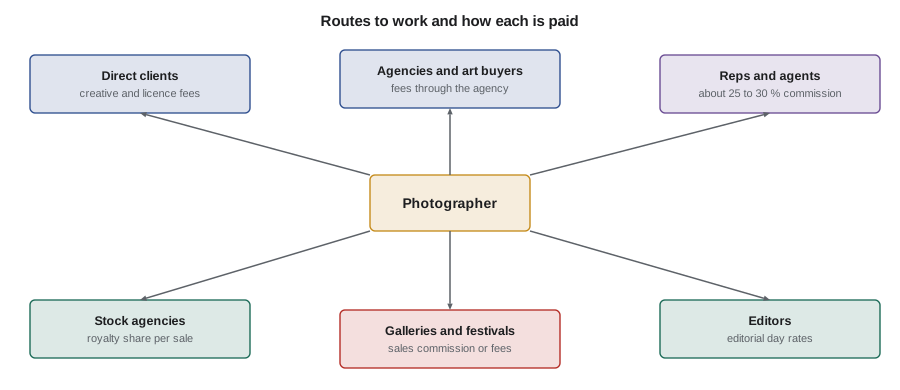
A strong portfolio does nothing until the right people see it. Finding clients and representation is a skill like any other: it rests on research, clear targeting, polite persistence and keeping track of who you have contacted. This lesson covers the main routes to work for photographers, from direct outreach to commercial clients through representation by agents and reps, stock and licensing agencies, and the gallery systems in Canada and the United States. PHOT-302 introduced pricing and client relations; here the focus is finding the people to work with.
Mapping your market
Start by naming the kinds of organizations and people who hire or show the work you make. A food photographer's market might include restaurant groups, food brands, agencies that serve them, cookbook publishers and food magazines. An architectural photographer's market includes architects, interior designers, builders, hotels and building product manufacturers. A documentary photographer's market includes editors, non-profit organizations and foundations. A fine art photographer's market includes artist-run spaces, public galleries, commercial galleries, festivals, collectors and publishers.
Then research specific names: who makes decisions, what work they have commissioned or shown recently and whether your work fits. Credits in magazines, agency websites, gallery exhibition histories and award annuals reveal who commissions what. Quality beats quantity: twenty well-researched contacts who genuinely fit your work are worth more than two hundred random emails.
Direct outreach to clients
Direct outreach means contacting potential clients yourself, usually by a short, personal email followed by a meeting or a portfolio link. A good first email is brief: who you are, why you are contacting this person in particular, two or three relevant images or a link to a tailored gallery, and a simple request, such as a 15-minute call or permission to send a PDF. Do not attach large files to a first contact, and do not send the same generic message to everyone.
- Personalize: mention a recent project of theirs and explain why your work fits it.
- Tailor: link to a gallery or PDF built for their industry, not your whole website.
- Follow up politely: one follow-up after about two weeks and another after a month or two is normal; silence is not rejection, but repeated messages become pestering.
- Record everything: keep a simple spreadsheet or customer relationship management (CRM) tool with names, dates, responses and next steps.
Worked problem
How many contacts lead to a job?
A photographer sends 60 personalized emails over three months. Past experience suggests that about 25 per cent reply, half of those agree to a call or meeting, and about one in five meetings leads to a paid job within six months. How many jobs should he expect?
Show solution
- Replies: \( 60 \times 0.25 = 15 \).
- Meetings: \( 15 \times 0.5 = 7.5 \).
- Jobs: \( 7.5 \times 0.2 = 1.5 \).
Answer: About 1 or 2 jobs from 60 well-targeted contacts, which shows why outreach must be steady and long-term.
These rates are illustrative and depend heavily on your specialty, market and how well you target. The calculation is useful because it turns a vague goal ("get more clients") into a weekly habit ("contact five new people and follow up with five").
Agencies, art buyers and in-house teams
Large advertising campaigns are often commissioned through advertising agencies, where art buyers or producers find photographers, request estimates and negotiate on behalf of the brand. Many brands now also have in-house creative teams that hire photographers directly. Art buyers look at reps' rosters, award annuals, portfolio sites and recommendations, and they need confidence that you can handle the production, budget and paperwork of a larger job. Building relationships with art buyers usually takes years and often goes through a rep.
Reps and agents
A photographer's representative, or rep, promotes a small roster of photographers to agencies and clients, handles estimates and negotiations, and in return takes a commission on the fees they bring in. Commissions in the range of 25 to 30 per cent of creative fees are common in commercial photography, though terms vary, and production costs and expenses are usually excluded from the commission. Reps are selective: they generally take on photographers who already have a distinctive portfolio and some client history, because they need to earn back the effort of promoting you.
- What a rep does: introductions, portfolio showings, estimates, negotiation, contracts, advice on direction and sometimes production support.
- What a rep expects: a strong, consistent portfolio, regular new work, reliability and help with marketing costs such as shared promotions or listings.
- Questions to ask: which clients and photographers they represent, how commission is calculated, which territories and clients are exclusive, who pays for marketing, and how either side can end the agreement and what happens to work in progress.
Read any representation agreement carefully, ideally with legal advice. Watch for long exclusive terms, commissions on clients you brought yourself ("house accounts"), and commissions that continue for long periods after the relationship ends.
Stock and licensing agencies
Stock agencies license existing images to buyers for advertising, editorial or design use. Microstock sites sell large volumes of images at low prices, paying contributors a share that is often small per sale. Rights-managed and premium agencies license fewer images at higher prices with more control over use. Specialist agencies focus on editorial, news, travel, food or particular subjects. Stock can provide passive income from images you have already made, but the market is crowded and prices for generic images have fallen sharply, partly because of competition from generated images.
Worked problem
Is stock worth the time?
A photographer uploads 200 images to a stock agency. Over a year, each image earns an average of $3.50 in royalties after the agency's share. Keywording and uploading took about 10 minutes per image. What is the effective hourly rate for the first year?
Show solution
- Royalties: \( 200 \times 3.50 = 700 \) dollars.
- Time: \( 200 \times 10 = 2{,}000 \) minutes, or about 33.3 hours.
- Effective rate: \( 700 / 33.3 \approx 21 \) dollars an hour, before any model releases or reshoots.
Answer: About $21 an hour in the first year; images may keep earning in later years, but returns per image are often low and uneven, so stock works best as a supplement.
Read stock agency terms carefully, particularly exclusivity, minimum prices, how releases are handled and whether the agency may license images for training generative systems.
Galleries and exhibition spaces
For art photographers, exhibitions and sales usually happen through a mix of public, non-profit and commercial spaces. The systems in Canada and the United States share many features but differ in how they are funded and in artists' rights.
In Canada, the gallery system includes public art galleries and museums, a strong network of artist-run centres, commercial galleries and festivals. Artist-run centres are non-profit spaces run by artists, often supported by the Canada Council for the Arts and provincial or municipal arts councils; they program exhibitions through open calls and juries and generally pay artists exhibition fees, often following the CARFAC-RAAV fee schedule (lesson 7). Public galleries also pay exhibition fees for work shown but not for sale. Commercial galleries sell work and usually take a commission on sales, commonly around 50 per cent. Photography festivals and month-long events in major cities offer further exhibition opportunities.
| Type | How artists are chosen | How artists are paid | What to expect |
|---|---|---|---|
| Public gallery or museum | Curatorial invitation, sometimes open calls | Exhibition or artist fees; acquisitions | Long planning times, high standards |
| Artist-run centre or non-profit space | Open calls and peer juries | Exhibition fees, often modest | Supportive, experimental, good for early careers |
| Commercial gallery | Invitation after a relationship develops | Commission on sales, often around 50 % | Expects a market for the work and loyalty |
| Festival or art fair | Open calls, curators or gallery participation | Varies; some charge participation fees | Visibility, networking, short duration |
Approaching galleries
Galleries rarely take on artists from unsolicited emails. Most relationships develop over time: visit exhibitions, attend openings, learn each gallery's program, and build connections through artist-run centres, festivals, portfolio reviews and other artists. When a gallery accepts submissions, follow its instructions exactly; when it does not, do not send unsolicited packages. Commercial galleries want to know that your work fits their program, that you are committed to developing it and that collectors may respond to it.
- Research the program: look at past exhibitions and the artists represented, and ask honestly whether your work belongs.
- Start with open calls and artist-run centres to build an exhibition history.
- Build relationships: attend events, buy a catalogue, support other artists; curators remember people who engage with the community.
- Prepare a gallery-ready package: a coherent body of work, a clear statement, a CV and installation views if available.
Editors and publications
Editorial work for magazines, newspapers and online publications pays less than advertising but builds credits, visibility and relationships. Photo editors want photographers who understand their publication, can deliver on deadline and can work with journalists. Pitches for story ideas should be concise: a working title, a few sentences on the story and why now, access you have secured and sample images. PHOT-320 covers photojournalism and its ethics.
Keeping track and following up
A simple system prevents good leads from slipping away. For each contact record the date of first contact, what you sent, their response, the next action and its date. Review the list weekly. Send short, relevant updates a few times a year to warm contacts: a new project, an award or a newsletter (lesson 5). Most work comes from relationships built over months and years, not from a single brilliant email.
Preparing for a portfolio meeting
When an outreach email leads to a meeting, prepare as carefully as for a job. Review the client's recent work, choose a tailored selection of about 15 images, and prepare two or three questions about their upcoming projects. Arrive on time, keep the presentation to the time you were offered, let the client lead the conversation and leave something behind, such as a printed card or a short PDF link sent the same day. Ask whether you may keep in touch, and record the date for a polite follow-up. A meeting that does not produce work immediately can still lead to a job months later if you stay in contact with relevant news.
Common mistakes
MistakeSending the same generic email to hundreds of contacts
InsteadResearch a smaller list of well-matched contacts and personalize every message.
MistakeExpecting a rep or gallery to start your career for you
InsteadBuild a distinctive portfolio, client history or exhibition record first.
MistakeSigning a representation agreement without reading the exclusivity and exit terms
InsteadReview commission, territory, house accounts and termination clauses, ideally with legal advice.
MistakeSending unsolicited packages to galleries that do not accept submissions
InsteadFollow each gallery's instructions and build relationships through events, open calls and artist-run centres.
MistakeLosing track of contacts and follow-ups
InsteadKeep a simple CRM or spreadsheet and review it weekly.
Summary and key terms
- Map your market by type of client or space, then research specific decision makers who fit your work.
- Direct outreach works best as a steady habit of personalized contacts and polite follow-ups.
- Reps promote a small roster and commonly take about 25 to 30 per cent of creative fees.
- Stock can supplement income, but returns per image are often low in a crowded market.
- Canada's artist-run centres and public galleries generally pay exhibition fees; US fee practices vary more.
- Commercial galleries commonly take around 50 per cent of sales and choose artists through relationships.
- Track every contact and nurture relationships over months and years.
- Rep
- A representative who promotes photographers to clients in return for a commission
- Roster
- The group of photographers or artists a rep or gallery represents
- House account
- A client the photographer brought in, often excluded from a rep's commission
- Art buyer
- An agency staff member who finds and hires photographers for campaigns
- CRM
- Customer relationship management, a system for tracking contacts and follow-ups
- Microstock
- Stock photography sold in high volume at low prices
- Rights-managed licence
- A licence priced and limited by specific use, duration, territory and exclusivity
- Artist-run centre
- A non-profit exhibition space run by artists, common in Canada
- Commercial gallery
- A gallery that sells artists' work and takes a commission on sales
- Open call
- A public invitation to submit work for an exhibition, festival or publication
Practice problems
Work each problem on paper first, then reveal the answer to check.
Name four types of client for an architectural photographer.
Show answer
Architects, interior designers, builders and hotels (also building product manufacturers).
80 emails, 20 % reply, 40 % of replies meet, 25 % of meetings lead to jobs. How many jobs?
Show answer
\( 80 \times 0.2 \times 0.4 \times 0.25 = 1.6 \).
What are three things to include in a first outreach email?
Show answer
Why you are contacting this person, a tailored link or two images, and a simple request.
What commission range is common for commercial photography reps?
Show answer
About 25 to 30 per cent of creative fees, usually excluding expenses.
What is a house account?
Show answer
A client the photographer brought in themselves, often excluded from or charged a lower rep commission.
150 stock images earn $4 each a year and took 12 minutes each to upload. What is the hourly rate?
Show answer
\( 600 / 30 = 20 \) dollars an hour.
What is an artist-run centre?
Show answer
A non-profit exhibition space run by artists, often funded by arts councils, that programs through open calls.
What share of sales do commercial galleries commonly take?
Show answer
Around 50 per cent.
How should you approach a gallery that does not accept submissions?
Show answer
Build a relationship by attending events and learning its program rather than sending unsolicited work.
What should a contact log record?
Show answer
Date, what you sent, the response, the next action and its date.
Lesson quiz · 5 questions
Score 60% or more to complete this lesson.
Create a free account to save your progress, take quizzes and earn a certificate.